Questions

[5 Marks Each] QUE-ANS

🎯

Test yourself on this topic

8 questions · timed · auto-graded

Question 15 Marks
Describe the following  experiment with Diagram : To check whether the given material I object is a conductor or an insulator of electricity.
Answer
 Given materials : Key, eraser, plastic scale, matchstick, glass bangle, iron nail, coin, rubber, pins, wooden block, pencil lead, thermocol, paper. Apparatus — Materials : Electric cell, torch bulb, three electric wires, insulating tape. Procedure: 
$(1)$ Take an electric cell, a torch bulb and three wires.
$(2)$ Connect all the three as shown in Figure
$(a).$ Leave a small space in between the free ends of the wire.
$(3)$ Place the given objects in between the two free ends of the wire one by one.  
$(4)$ In each case observe that the bulb glows or not? Note down your observations in Table  Conductors and Insulators of electricity
Objects used in place of switch Material it ** made ** of Bulb glows? Yes/No
Key Metal Yes
Eraser Rubber No
Scale Plastic No
Matchstick Wood No
Glass bangle Glass No
**** nail Metal Yes
Conclusion:
$(1)$ Materials which allow electric current to pass through them are conductors of electricity (In the cases in which the bulb glows).
$(2)$ Materials which do not allow electric current to pass through them are called insulators (In the cases in which the bulb does not glow).
View full question & answer
Question 25 Marks
Describe the following  experiment with Diagram : To construct an electric switch in an electric circuit.
Answer
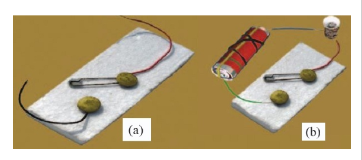
Apparatus - Materials: Two drawing pins, a safety pin, two wires and a small sheet of thermocol. 
 
Procedure: Procedure:
$(1)$ Take a safety pin and a drawing pin.
$(2)$ Insert a drawing pin into the ring at one end of the safety pin and fix it on the thermocol sheet.
$(3)$ Make sure that the safety pin can be rotated freely.
$(4)$ Now, fix the other drawing pin on the thermocol sheet in such a way that the free end of the safety pin can touch it. The safety pin fixed in this way would be your switch.
$(5)$ Now, make a circuit by connecting an electric cell and a bulb with this switch as shown in Figure $(b)$. 
$(6)$ Rotate the safety pin so that its free end touches the other drawing pin. Observe the bulb.
$(7)$ Now, move the safety pin away. Does the bulb continue to glow? Observation and Understanding: When the safety pin touches both the drawing pins, it fills the gaps between them and completes the circuit. This condition is called ‘switch on’. When the free end of the safety pin is removed away from the drawing pm, the circuit becomes discontinuous arid the condition is known as ‘switch off’. Conclusion : A switch is used to turn on or turn off bulb or other electric equipments.
View full question & answer
Question 35 Marks
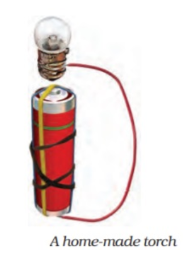
Describe the following  experiment with Diagram : To connect a torch bulb and a cell using a wire. To complete and break the circuit. To understand the function of a switch by these activities.
Answer
Apparatus — Materials : An electric cell, torch bulb, wire, rubber band, electric tape. 

 
Procedure:
$(1)$ Take a torch bulb, a cell and a piece of wire.
$(2)$ Remove the plastic covering at the two ends of the wire by the knife.
$(3)$ Wrap one end of a wire around the base of an electric bulb as shown in the figure.
$(4)$ Fix the other end of the wire to the negative terminal of an electric cell with a rubber band.
$(5)$ Now, bring the tip of the base of the bulb that is, its other terminal, in contact with the positive terminal of the cell. Does the bulb glow?
$(6)$ Now, move the bulb away from the terminal of the electric cell. Does the bulb remain lit? Observation:
$(1)$ As soon as the bulb is touched to the positive terminal of the battery, the circuit gets completed and the bulb glows.
$(2)$ When the bulb is removed from the positive terminal, the circuit breaks and the bulb stops glowing. Conclusion: The function of a switch : To complete the electric circuit and to close the electric circuit when needed.
View full question & answer
Question 45 Marks
Describe the following  experiment with Diagram : To construct a simple circuit by using an electric cell and a torch bulb.
Answer
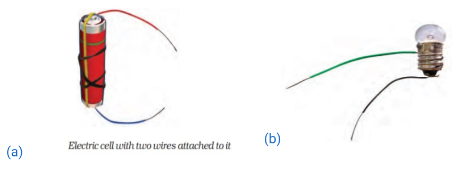
Apparatus — Materials : An electric cell, a torch bulb, knife, electric tape, four electric wires. Procedure:
$(1)$ Take four electric wires with differently coloured plastic coverings.
$(2)$ Remove a little of the plastic covering from each length of the wire at the ends by the knife. This would expose the metal wires at the ends of each length.
$(3)$ Fix the exposed parts of the two wires to the cell. [See figure $(a)$.]
$(4)$ Fix the other exposed parts of the wires to the bulb. [See figure $(b)$.]
$(5)$ Connect the wires fixed to the bulb with those attached to the cell. [See figure $(C)$.]
$(6)$ Thus, the torch bulb glows.
$(7)$ The circuit thus made is a complete circuit.
View full question & answer
Question 55 Marks
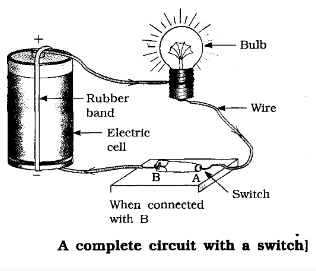
Describe the following experiment with the diagram: To identify whether the given objects are electrical conductors or insulators.
Answer
 
Apparatus — Materials : Torch bulb, electric cell, insulating tape, pieces of conducting wire, rubber band, wood strip, pencil, key, pen refill, matchstick, safety pin, plastic spoon, aluminium wire, ebonite rod. Apparatus — Materials : Torch bulb, electric cell, insulating tape, pieces of conducting wire, rubber band, wood strip, pencil, key, pen refill, matchstick, safety pin, plastic spoon, aluminium wire, ebonite rod. Procedure:
$(1)$ Prepare an electric circuit as shown in the figure.
$(2)$ Keep enough distance between terminals $A$ and $B$ of the wire.
$(3)$ Connect the given materials between terminals $A$ and $B$ one by one.
$(4)$ Observe whether every time the bulb glows or not. Note down your observations in following table.
No. Object Does the **** glow? Yes ** No Electrical Conductor/ Insulator
$1$ Rubber No Insulator
$2$ wooden strip No Insulator
$3$ Pencil No Insulator
$4$ Key Yes Conductor
$5$ Pen refill No Insulator
$6$ Matchstick No Insulator
$7$ Safety pin Yes Conductor
$8$ ******* pin No Insulator
$9$ Aluminium wire Yes Conductor
$10$ Ebonite rod No Insulator
Conclusion:
$(1)$ Key, safety pin and aluminium wire are conductors of electricity.
$(2)$ Rubber band, wood strip, pencil, pen refill, matchstick, plastic spoon and ebonite rod are insulators.
View full question & answer
Question 65 Marks
Describe the following  experiment with Diagram : To construct an electric switch in an electric circuit.
Answer
Apparatus - Materials: Two drawing pins, a safety pin, two wires and a small sheet of thermocol. Procedure:
$(1)$ Take a safety pin and a drawing pin.
$(2)$ Insert a drawing pin into the ring at one end of the safety pin and fix it on the thermocol sheet.
$(3)$ Make sure that the safety pin can be rotated freely.
$(4)$ Now, fix the other drawing pin on the thermocol sheet in such a way that the free end of the safety pin can touch it. The safety pin fixed in this way would be your switch.
$(5)$ Now, make a circuit by connecting an electric cell and a bulb with this switch as shown in Figure $(b)$. 
$(6)$ Rotate the safety pin so that its free end touches the other drawing pin. Observe the bulb.
$(7)$ Now, move the safety pin away. Does the bulb continue to glow? Observation and Understanding: When the safety pin touches both the drawing pins, it fills the gaps between them and completes the circuit. This condition is called ‘switch on’. When the free end of the safety pin is removed away from the drawing pm, the circuit becomes discontinuous arid the condition is known as ‘switch off’. Conclusion : A switch is used to turn on or turn off bulb or other electric equipments.
View full question & answer
Question 75 Marks
Describe the following  experiment with Diagram : To connect a torch bulb and a cell using a wire. To complete and break the circuit. To understand the function of a switch by these activities.
Answer
Apparatus — Materials : An electric cell, torch bulb, wire, rubber band, electric tape.
Procedure:
$(1)$ Take a torch bulb, a cell and a piece of wire.
$(2)$ Remove the plastic covering at the two ends of the wire by the knife.
$(3)$ Wrap one end of a wire around the base of an electric bulb as shown in the figure.
$(4)$ Fix the other end of the wire to the negative terminal of an electric cell with a rubber band.
$(5)$ Now, bring the tip of the base of the bulb that is, its other terminal, in contact with the positive terminal of the cell. Does the bulb glow?
$(6)$ Now, move the bulb away from the terminal of the electric cell. Does the bulb remain lit?
Observation:
$(1)$ As soon as the bulb is touched to the positive terminal of the battery, the circuit gets completed and the bulb glows.
$(2)$ When the bulb is removed from the positive terminal, the circuit breaks and the bulb stops glowing.
Conclusion: The function of a switch : To complete the electric circuit and to close the electric circuit when needed.
View full question & answer
Question 85 Marks
Describe the following  experiment with Diagram : To construct a simple circuit by using an electric cell and a torch bulb.
Answer
Apparatus — Materials : An electric cell, a torch bulb, knife, electric tape, four electric wires. Procedure:
$(1)$ Take four electric wires with differently coloured plastic coverings.
$(2)$ Remove a little of the plastic covering from each length of the wire at the ends by the knife. This would expose the metal wires at the ends of each length.
$(3)$ Fix the exposed parts of the two wires to the cell. [See figure $(a)$.]
$(4)$ Fix the other exposed parts of the wires to the bulb. [See figure$(b)$.]
$(5)$ Connect the wires fixed to the bulb with those attached to the cell. [See figure $(C)$.]
$(6)$ Thus, the torch bulb glows.
$(7)$ The circuit thus made is a complete circuit.
View full question & answer