Questions

[5 Marks Each] QUE-ANS

🎯

Test yourself on this topic

7 questions · timed · auto-graded

Question 15 Marks
Column $I$ shows different positions in which one pole of a magnet is placed near that of the other. Column $II$ indicates the resulting action between them for each situation. Fill in the blanks:
****** $I$ Column$ II$
$N-N$ ...........
$N-......$ Attraction
$S-N$ ............
$......-S$ Repulsion
Answer
Column $I$ Column $II$
$N-N$ Repulsion
$N-S$ Attraction
$S-N$ Attraction
$S-S$ Repulsion
View full question & answer
Question 25 Marks
Write a short note on the discovery of magnet.
Answer
Several centuries ago, in Greece (Asia minor at that time), a special type of stone was found. This stone attracted pieces of iron. It is said that, there was a shepherd named Magnes, who lived in ancient Greece. He used to take his herd of sheep and goats to the nearby mountains for grazing. He would take a stick with him to control his herd. The stick had a small piece of iron attached at one end. One day he was surprised to find that he had to pull hard to free his stick from a rock on the mountainside. It seemed as if the stick was being attracted by the rock. The rock was a natural magnet and it attracted the iron tip of the shepherd’s stick. Such rocks were given the name magnetite. This is how natural magnets were discovered.
View full question & answer
Question 35 Marks
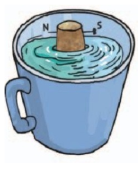
Describe the following  experiment with Diagram: To construct a simple compass.
Answer
Apparatus — Materials: Bar magnet, iron needle, cork, tumbler. Apparatus — Materials: Bar magnet, iron needle, cork, tumbler. Procedure:
$(1)$ Magnetise an iron needle using a bar magnet.
$(2)$ Insert the magnetized needle through a small piece of cork or foam.
$(3)$ Let the cork float in water in a bowl or a tumbler. Make sure that the needle does not touch the water.
$(4)$ Make a note of the direction in which the needle points when the cork is floating. Rotate the cork, with the needle fixed in it in different directions. Note the direction in which the needle points when the cork begins to float again without rotating. Observation : The needle always comes to rest in the North — South direction. Conclusion : The cork floating in water starts acting like a compass and points in the North — South direction.
View full question & answer
Question 45 Marks
Describe the following  experiment with Diagram: To demonstrate that a bar magnet free to rotate in the horizontal plane always comes to rest in North - South direction.
Answer
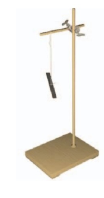
Apparatus — Materials: Bar magnet, wooden stand, thread. Apparatus — Materials: Bar magnet, wooden stand, thread. Procedure $(1)$ Take a bar magnet.
$(2)$ Put a mark on one of its ends for identification.
$(3)$ Tie a thread at the middle of the magnet so that you may suspend it from a wooden stand in such a manner that the magnet can rotate freely in the horizontal plane.
$(4)$ Let it come to rest. Mark two points on the ground to show the position of the ends of the magnet when it comes to rest.
$(5)$ Draw a line joining the two points. This line shows the direction in which the magnet was pointing in its position of rest.
$(6)$ Now, rotate the magnet by gently pushing one end in any direction and let it come to rest. Again, mark the position of the two ends in its position of rest. Note down your observation. Observation: The magnet always comes to rest in the same direction. This is the North — South direction. Conclusion : A bar magnet free to rotate in the horizontal plane always comes to rest in North — South direction.
View full question & answer
Question 55 Marks
Describe the following  experiment with Diagram: To know the position of poles in a magnet.
Answer
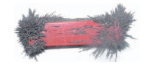
Apparatus - Materials : A bar magnet, iron filings, paper. Apparatus - Materials : A bar magnet, iron filings, paper. Procedure: 
$(1)$ Spread some iron filings on a sheet of paper.
$(2)$ Now, place a bar magnet on this sheet.  
$(3)$ Slowly move the bar magnet on the paper.
$(4)$ Lift the bar magnet gently away from the paper.
$(5)$ Observe the pattern in which the iron filings get attracted by different parts of the magnet.
$(6)$ Remove the iron filings sticking to the magnet and repeat the experiment. Note down your observations. Observation : Maximum iron filings stick to the ends of the magnet. As you move towards the center of the magnet the amount of iron filings stuck to the magnet goes on decreasing. Conclusion: In a magnet, the magnetic strength is more near the ends. These ends are called the poles of the magnet.
View full question & answer
Question 65 Marks
Describe the following  experiment with Diagram:To demonstrate the effect of a magnet on the objects made of iron.
Answer
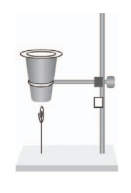
Apparatus — Materials: Paper cup, stand, small magnet, iron clip, thread. Procedure:
$(1)$ Take a paper cup.
$(2)$ Fix it on a stand with the help of a clamp as shown in the figure.
$(3)$ Place a magnet inside the cup and cover it with a paper so that the magnet is not visible.
$(4)$ Attach a thread to a clip made of iron.
$(5)$ Fix the other end of the thread at the base of the stand. (Mind you, the trick involved here, is to keep the length of the thread sufficiently short.)
$(6)$ Now, bring the clip near the base of the cup. Observe what happens next. Observation : The clip with thread is raised in air without any support. Conclusion : Magnet attracts objects made of iron.
View full question & answer
Question 75 Marks
Describe an experiment with the diagram to show that unlike poles of a magnet attract each other and like poles repel each other.
Answer
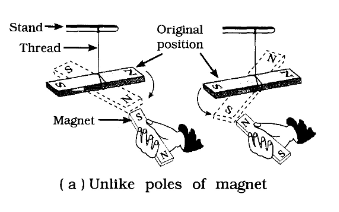
To show that unlike poles of a magnet attract each other and like poles repel each other. Apparatus and materials: Thro bar magnets, wooden stand, thin strong thread. Procedure:
$(1)$ Take a bar magnet.
$(2)$ Tie it with a thread and suspend it from a wooden stand in such a manner that It can rotate freely in the horizontal plane.
$(3)$ Take another bar magnet.
$(4)$ Bring the South pole $(S)$ of the bar magnet held in the hand near the North pole $(N)$ of the suspended magnet.
$(5)$ In the same manner bring the North pole $(N)$ of the bar magnet held in the hand near the South pole $(S)$ of the suspended magnet.
$(6)$ Observe what happens in both the cases.
$(7)$ Now, bring North pole $(N)$ of another magnet near the North pole $(N)$ of the suspended magnet.
$(8)$ In the same manner, bring the South pole $(S)$ of the other magnet near the South pole of the suspended magnet.
$(9)$ Observe what happens and note down your observations in a table.
View full question & answer
[5 Marks Each] QUE-ANS - Science STD 6 Questions - Vidyadip