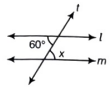
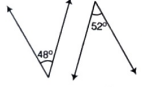
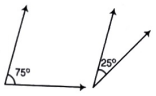
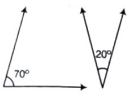
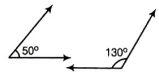
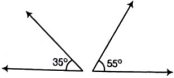
In this pair, measures of the given angles are $50^{\circ}$ and $130^{\circ}$. $\therefore$ Sum of the given angles $=50^{\circ}+130^{\circ}=180^{\circ}$, So, this pair of angles is supplementary.
Yes, two right angles can be supplementary because the measure of each right angle is $90^{\circ}$, therefore the sum of two right angles would be $90^{\circ}+90^{\circ}=180^{\circ}$. So, the two right angles are supplementary.
No, two acute angles cannot be supplementary because the measure of an acute angle is less than $90^{\circ}$. So, the sum of two acute angles would be less than $180^{\circ}$.
No, two obtuse angles cannot be supplementary because the measure of an obtuse angle is more than $90^{\circ}$. So, the sum of two obtuse angles would be more than $180^{\circ}$.
No, two right angles can never be complement to each other because measure of a right angle is $90^{\circ}$ and sum of two right angles is $180^{\circ}$, which is not equal to $90^{\circ}$.
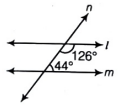
In the figures given below decide whether l is parallel to m.
Answer
Since,$44^{\circ}+126^{\circ}=170^{\circ}$ But $170^{\circ} \neq 180^{\circ}$ i.e. the sum of the interior angles on the same side of the transversal is not $180^{\circ}$. So, $I$ and $m$ are not parallel.
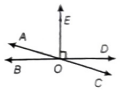
In the given figure, name the following pairs of angles. Adjacent angles that do not form a linear pair.
Answer
Adjacent angles that do not form a linear pair are $\angle A O B$ and $\angle A O E ; \angle A O E$ and $\angle E O D ; \angle E O D$ and $\angle C O D$.
An angle is greater than $45^{\circ}$. Is its complementary angle greater than $45^{\circ}$ or equal to $45^{\circ}$ or less than $45^{\circ} ?$
Answer
We know that the sum of two complementary angles is $90^{\circ}$. So, if an angle is greater than $45^{\circ}$, then its complementary angle would be less than $45^{\circ}$.
Identify which of the following pairs of angles are complementary and which are supplementary? $80^{\circ}, 10^{\circ}$
Answer
Let $\angle x=80^{\circ}$ and $\angle y=10^{\circ}$ Now, $\angle x+\angle y=80^{\circ}+10^{\circ}=90^{\circ}$ Hence, $\angle x$ and $\angle y$ are complementary angles.
Identify which of the following pairs of angles are complementary and which are supplementary? $45^{\circ}, 45^{\circ}$
Answer
Let $\angle x=45^{\circ}$ and $\angle y=45^{\circ}$ Now, $\angle x+\angle y=45^{\circ}+45^{\circ}=90^{\circ}$ Hence, $\angle x$ and $\angle y$ are complementary angles.
Identify which of the following pairs of angles are complementary and which are supplementary? $130^{\circ}, 50^{\circ}$
Answer
Let $\angle x=130^{\circ}$ and $\angle y=50^{\circ}$ Now, $\angle x+\angle y=130^{\circ}+50^{\circ}=180^{\circ}$ Hence, $\angle x$ and $\angle y$ are supplementary angles.
Identify which of the following pairs of angles are complementary and which are supplementary? $112^{\circ}, 68^{\circ}$
Answer
Let $\angle x=112^{\circ}$ and $\angle y=68^{\circ}$ Now, $\angle x+\angle y=112^{\circ}+68^{\circ}=180^{\circ}$ Hence, $\angle x$ and $\angle y$ are supplementary angles.
Identify which of the following pairs of angles are complementary and which are supplementary? $63^{\circ}, 27^{\circ}$
Answer
Let $\angle x=63^{\circ}$ and $\angle y=27^{\circ}$ Now, $\angle x+\angle y=63^{\circ}+27^{\circ}=90^{\circ}$ Hence, $\angle x$ and $\angle y$ are complementary angles.
Identify which of the following pairs of angles are complementary and which are supplementary? $65^{\circ}, 115^{\circ}$
Answer
Let $\angle x=65^{\circ}$ and $\angle y=115^{\circ}$ Now, $\angle x+\angle y=65^{\circ}+115^{\circ}=180^{\circ}$ Hence, $\angle x$ and $\angle y$ are supplementary angles.