Question 14 Marks
Krishna has a farmland in the shape of a rhombus PQRS as shown in the adjoining figure. The length of each side of this land is 450 m. Krishna fixed a wire PM such that $P M \perp Q R$ and another wire along the diagonal PR. He measured PM and PR and found that PM = 75m and PR = 125m He grew potatoes in the triangular region $\triangle P M R$ and sugarcane in the triangular region $\triangle P S R$. The remaining area was left for cattle rearing.
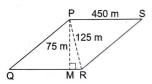
Q.1. The area of the farmland PQRS is
(a) $33,750 m^2$$\quad$(b) $56,250 m^2$
(c) $17,525 m^2$$\quad$(d) $9,375 m^2$
Q.2. The length of the diagonal QS of the rhombus PQRS is
(a) 360 m$\quad$(b) 450 m
(c) 480 m$\quad$(d) 540 m
Q.3. The area of the field used for growing potatoes is
(a) $3,750 m^2$$\quad$(b) $4,225 m^2$
(c) $6,250 m^2$$\quad$(d) $7.500 m^2$
Q.4. The area of the field used for growing sugarcane is
(a) $17,525 m^2$$\quad$(b) $9,375 m^2$
(c) $16,875 m^2$$\quad$(d) $10,250 m^2$
Q.1. The area of the farmland PQRS is
(a) $33,750 m^2$$\quad$(b) $56,250 m^2$
(c) $17,525 m^2$$\quad$(d) $9,375 m^2$
Q.2. The length of the diagonal QS of the rhombus PQRS is
(a) 360 m$\quad$(b) 450 m
(c) 480 m$\quad$(d) 540 m
Q.3. The area of the field used for growing potatoes is
(a) $3,750 m^2$$\quad$(b) $4,225 m^2$
(c) $6,250 m^2$$\quad$(d) $7.500 m^2$
Q.4. The area of the field used for growing sugarcane is
(a) $17,525 m^2$$\quad$(b) $9,375 m^2$
(c) $16,875 m^2$$\quad$(d) $10,250 m^2$
Answer
View full question & answer→1. (a): Area of farmland PQRS (rhombus) = base x height = QR × PM
$=450 m \times 75 m=33.750 m^2$.
2. (d): Area of rhombus
$=\frac{1}{2} \times$ product of diagonals
$\Rightarrow 33,750=\frac{1}{2} \times P R \times Q S$
$\Rightarrow 33,750=\frac{1}{2} \times 125 \times g S $
$\Rightarrow g S=\frac{2 \times 33,750}{125}=540 m$.
3. (a): In right $\triangle P M R$,
$M R=\sqrt{P R^2-P M^2}$
$=\sqrt{(125)^2-(75)^2} m$
$ =\sqrt{15,625-5,625} m$
$=\sqrt{10,000} m=100 m$
Now, Area $\triangle P M R)$
$=\frac{1}{2} \times M R \times P M$
$=\left(\frac{1}{2} \times 100 \times 75\right) m ^2$
$=3.750 m^2$.
$\therefore$ area of field $(\triangle P M R)$ used for growing potatoes
$=3,750 m^2$.
4. (c): Area $(\triangle P Q R)=\frac{1}{2} \times Q R \times P M$
$=\left(\frac{1}{2} \times 450 \times 75\right) m ^2$
$=16.875 m^2$.
$\therefore$ area $(\triangle P S R)$
= area (rhombus $P Q R S)-$ area $(\triangle P Q R)$
$=(33,750-16.875) m ^2=16,875 m^2$.
Thus, the area of the fleld ( $\triangle P S R$ ) used for growing sugarcane $=16,875 m^2$.
$=450 m \times 75 m=33.750 m^2$.
2. (d): Area of rhombus
$=\frac{1}{2} \times$ product of diagonals
$\Rightarrow 33,750=\frac{1}{2} \times P R \times Q S$
$\Rightarrow 33,750=\frac{1}{2} \times 125 \times g S $
$\Rightarrow g S=\frac{2 \times 33,750}{125}=540 m$.
3. (a): In right $\triangle P M R$,
$M R=\sqrt{P R^2-P M^2}$
$=\sqrt{(125)^2-(75)^2} m$
$ =\sqrt{15,625-5,625} m$
$=\sqrt{10,000} m=100 m$
Now, Area $\triangle P M R)$
$=\frac{1}{2} \times M R \times P M$
$=\left(\frac{1}{2} \times 100 \times 75\right) m ^2$
$=3.750 m^2$.
$\therefore$ area of field $(\triangle P M R)$ used for growing potatoes
$=3,750 m^2$.
4. (c): Area $(\triangle P Q R)=\frac{1}{2} \times Q R \times P M$
$=\left(\frac{1}{2} \times 450 \times 75\right) m ^2$
$=16.875 m^2$.
$\therefore$ area $(\triangle P S R)$
= area (rhombus $P Q R S)-$ area $(\triangle P Q R)$
$=(33,750-16.875) m ^2=16,875 m^2$.
Thus, the area of the fleld ( $\triangle P S R$ ) used for growing sugarcane $=16,875 m^2$.