Questions

3 Marks Question

🎯

Test yourself on this topic

14 questions · timed · auto-graded

Question 13 Marks
A teacher placed textbooks that are 2.5 cm thick on a bookshelf. The teacher wanted to place 80 textbooks on the shelf. The bookshelf is 160 cm long. How many books could be placed on the shelf? Was there any space left? If yes, how much?
Answer
Given that, the teacher wanted to place 80 textbooks, each is 2.5 cm thick.
Total thickness required = 80 × 2.5 = 200 cm
The bookshelf is 160 cm long.
The thickness of one book is 2.5 cm.
Number of books that can fit $=\frac{160 cm}{2.5 cm}=64$
64 books could be placed on the shelf.
The total thickness of these books = 64 × 2.5 = 160 cm, which is the full length of the shelf.
The teacher wanted to place 80 textbooks, but only 64 textbooks can fit.
Therefore, there is no space left after placing the maximum number of books.
View full question & answer
Question 23 Marks
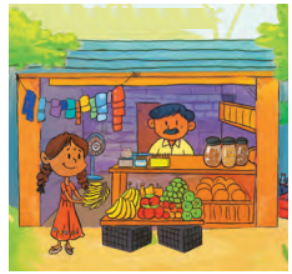
Shyamala bought 3 kg of bananas at ₹ 30/- per kg. She counted 35 bananas in all. She sells each banana for ₹ 5/-. How much profit does she make selling all the bananas?
Image
Answer
Given that Shyamala bought 3 kg of bananas at ₹ 30 per kg.
Total cost = 3 × 30 = ₹ 90
She sold 35 bananas for ₹ 5 each.
Total revenue = 35 × 5 = ₹ 175
Profit = Total revenue – Total cost
= 175 – 90
= ₹ 85
View full question & answer
Question 33 Marks
A 210-gram packet of peanut chikki costs ₹ 70.5, while a 110-gram packet of potato chips costs ₹ 33.25. Which is cheaper?
Answer
Given cost of a peanut is ₹ 70.5 per 210 grams.
∴ Cost per gram $=\frac{70.5}{210}=0.3357$
and cost of potato chips is ₹ 33.25 for 110 grams.
∴ Cost per gram $=\frac{33.25}{110}=0.3023$
∵ 0.3023 < 0.3357.
Hence, potato chips are cheaper.
View full question & answer
Question 43 Marks
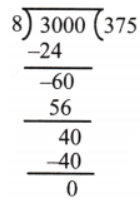
3 litres of watermelon juice is shared among 8 friends equally. How much watermelon juice will each get? Express the quantity of juice in millilitres.
Answer
Here total quantity of juice = 3 litres
No. of friends = 8
∴ Juice per friend $=\frac{3}{8}$ litre
$=\frac{3}{8} \times 1000 ml$
$=\frac{3000}{8}$
= 375 ml
Image
View full question & answer
Question 53 Marks
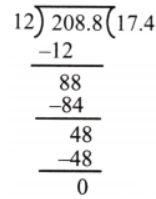
If the perimeter of a regular polygon with 12 sides is 208.8 cm, what is the length of its side?
Answer
Here Perimeter = 208.8 cm
No. of sides = 12
Length 0f a side $=\frac{\text { Perimeter }}{\text { No. of sides }}$
$=\frac{208.8}{12}$
= 17.4 cm
Image
View full question & answer
Question 63 Marks
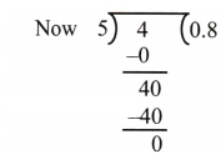
A 4 m long wooden block has to be cut into 5pieces of equal length. What is the length of each piece?
Answer
Here total length = 4 m
No. of pieces = 5
Length of each piece $=\frac{\text { Total length }}{\text { No. of pieces }}$
$=\frac{4}{5}$
= 0.8 m
Image
View full question & answer
Question 73 Marks
Multiplying the following numbers by 10, 100, and 1000 to complete the table.
× 10× 100× 1000
5.7
23.02
0.92
0.306
24.67
Answer
 × 10× 100× 1000
5.7575705700
23.02230.2230223020
0.929.292920
0.3063.0630.6306
24.67246.7246724670
View full question & answer
Question 83 Marks
In which of the following multiplications is the product less than 1? Can you find the answer without actually doing the multiplications?
(a) 7 × 0.6
(b) 0.7 × 0.6
(c) 0.7 × 6
(d) 0.07 × 0.06
Answer
Yes, we can find the answer without actual multiplication, only by using decimal place values.
Multiplying by a number greater than 1: The product is greater than the original number.
Multiplying by a number between 0 and 1: The product is less than the original number.
Multiplying two numbers between 0 and 1: The product will be less than both factors, and therefore definitely less than 1.
(a) Greater than 1.
(b) Less than 1.
(c) Greater than 1.
(d) Less than 1.
View full question & answer
Question 93 Marks
The price of 1 kg of oranges is ₹ 56.50. What is the price of 2.250 kg of oranges? Can we write 56.50 as 56.5 and 2.250 as 2.25 and multiply? Will we get the same product? Why?
Answer
Price of 1 kg of oranges = ₹ 56.50
Price of 2.250 kg of oranges = 56.50 × 2.250
$\begin{array}{l}=\frac{5650 \times 2250}{100 \times 1000} \\ =\frac{12712500}{100000}\end{array}$
= ₹ 127.125
Now 56.5 × 2.25 = 127.125
Hence, we will get the same product.
The zeroes at the end of a decimal do not change its value.
As we saw, 56.50 is the same as 56.5, and 2.250 is the same as 2.25.
Hence, the product of the two numbers will be the same.
View full question & answer
Question 103 Marks
The thickness of a rupee coin is 1.45 mm. What is the total height of the cylinder formed by placing 36 rupee coins one over the other? Write the answer in centimetres.
Answer
Thickness of 1 coin = 1.45 mm
Total thickness of 36 coins = 36 × 1.45
$\begin{array}{l}=\frac{36 \times 145}{100} \\ =\frac{5220}{100}\end{array}$
= 52.2 mm
Now 10 mm = 1 cm
$1 mm=\frac{1}{10} cm$
$\therefore 52.2 mm=\frac{52.2}{10}=5.22 cm$.
View full question & answer
Question 113 Marks
Meenu bought 4 notebooks and 3 erasers. The cost of each book was ₹ 15.50, and each eraser was ₹ 2.75. How much did she spend in all?
Answer
Here cost of 1 notebook = ₹ 15.50
∴ Cost of 4 notebooks = 4 × 15.50
$=\frac{4 \times 1550}{100}$
$=\frac{6200}{100}$
= ₹ 62
and cost of 1 eraser = ₹ 2.75
∴ Cost of 3 erasers = 3 × ₹ 2.75
$=\frac{3 \times 275}{100}$
$=\frac{825}{100}$
= ₹ 8.25
∴ Total amount spent = 62 + 8.25 = ₹ 70.25
View full question & answer
Question 123 Marks
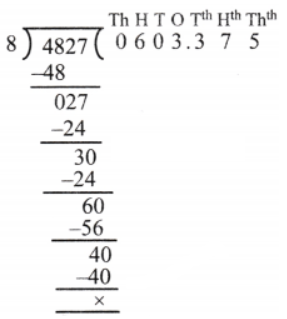
Find the quotient by converting the denominator into 1, 10, 100, or 1000 and verify the solution by the long division method (division by place value):
$\frac{4827}{8}$
Answer
Given $\frac{4827}{8}$
To convert the denominator 8 into 1000, multiply both the Nr and Dr by 125.
$\frac{4827 \times 125}{8 \times 125}=\frac{603375}{1000}=603.375$
Verification
By following the steps:
Image
We get 4827 ÷ 8 = 0603.375
Hence verified.
View full question & answer
Question 133 Marks
Find the quotient by converting the denominator into 1, 10, 100, or 1000 and verify the solution by the long division method (division by place value):
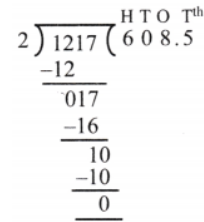
$\frac{1217}{2}$
Answer
Given $\frac{1217}{2}$
To convert the denominator 2 into 10, multiply both the Nr and Dr by 5.
$\frac{1217 \times 5}{2 \times 5}=\frac{6085}{10}=608.5$
Verification
By following the steps:
Image
∴ 1217 ÷ 2 = 608.5
Hence verified.
View full question & answer
Question 143 Marks
Find the quotient by converting the denominator into 1, 10, 100, or 1000 and verify the solution by the long division method (division by place value):
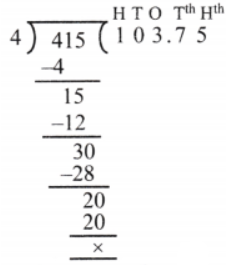
$\frac{415}{4}$
Answer
Given $\frac{415}{4}$
To convert the denominator 4 into 100, multiply both the Nr and Dr by 25.
$\frac{415 \times 25}{4 \times 25}=\frac{10375}{100}=103.75$
Verification
By following the steps
Image
∴ 414 ÷ 4 = 103.75
Hence verified.
View full question & answer
3 Marks Question - MATHS STD 7 Questions - Vidyadip