Questions

2 Marks Questions

🎯

Test yourself on this topic

27 questions · timed · auto-graded

Question 12 Marks
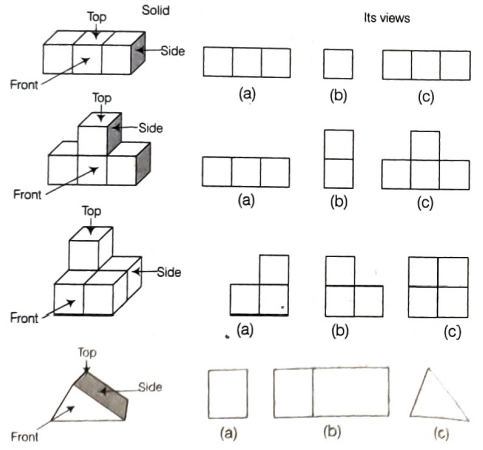
For each solid, the three views (i), (ii) and (iii) are given. Identify for each solid the corresponding top, front and side views.
Image
Answer
(i) (a) $\rightarrow$ Front, (b) $\rightarrow$ Side, (c) $\rightarrow$ Top
(ii) (a) $\rightarrow$ Top, (b) $\rightarrow$ Side, (c) $\rightarrow$ Front
(iii) (a) $\rightarrow$ Side, (b) $\rightarrow$ Front, (c) $\rightarrow$ Top
(iv) (a) $\rightarrow$ Side, (b) $\rightarrow$ Top, (c) $\rightarrow$ Front
View full question & answer
Question 22 Marks
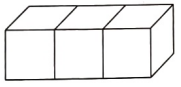
Three cubes each with $2 c m$ edge are placed side by side to form a cuboid. Try to make an oblique sketch and say what could be its length, breadth and height.
Answer
Three cubes each with 2 cm edge are placed side by side to form a cuboid, thus its oblique sketch is given below:
Image
Now, length of cuboid $=2+2+2=6 cm$
Breadth of cuboid $=2 cm$
and height of cuboid $=2 cm$.
View full question & answer
Question 32 Marks
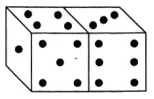
Two dice are placed side by side as shown. Can you say what the total would be on the face opposite to
(i) $5+6$ $\quad$ (ii) $4+3$
Image
Answer
We know that opposite faces of a die always have a total of seven dots on them.
(i) Here, the face opposite to the face having 5 dots is the face having 2 dots and the face opposite to the face having 6 dots is the face having 1 dot.
So, the total on the face opposite to $5+6$ is $2+1$ i.e. 3 .
(ii) The face opposite to the face having 4 dots is the face having 3 dots and the face opposite to the face having 3 dots is the face having 4 dots.
So, the total on the face opposite to $4+3=3+4$ i.e. 7.
View full question & answer
Question 42 Marks
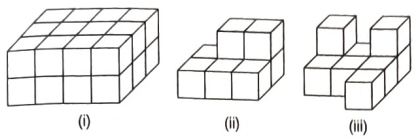
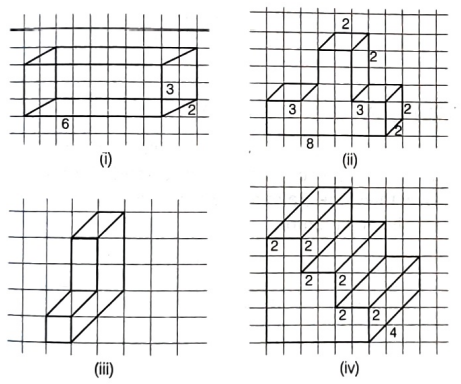
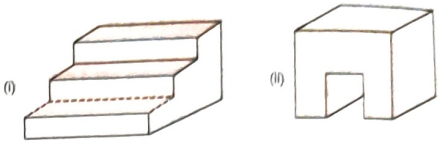
Try to guess the number of cubes in the following arrangements in the figure.
Image
Answer
Number of cubes in the given arrangements are as follow:
(i) 24 cubes $\quad$ (ii) 8 cubes $\quad$ (iii) 9 cubes
View full question & answer
Question 52 Marks
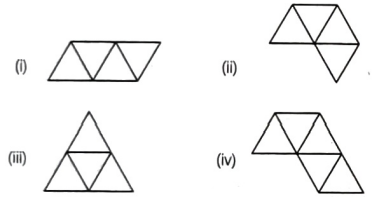
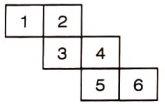
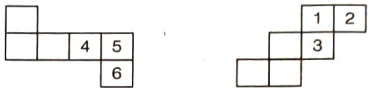
Here, you find four nets. There are two correct nets among them to make a tetrahedron. See If you can work out which nets will make a tetrahedron?
Image
Answer
In the given figures, nets (i) and (iii) are two correct nets to make a tetrahedron.
View full question & answer
Question 62 Marks
Examine, If the following are true statements.
(i) The cube can cast a shadow in the shape of a rectangle.
(ii) The cube can cast a shadow in the shape of a hexagon.
Answer
(i) True, the cube can cast a shadow in the shape of a rectangle.
(ii) False, the cube cannot cast a shadow in the shape of a hexagon.
View full question & answer
Question 72 Marks
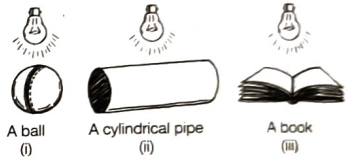
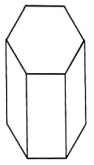
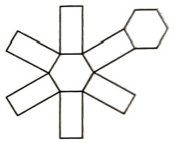
A bulb is kept burning just right above the following solids. Name the shape of the shadows obtained in each case. Attempt to give a rough sketch of the shadow. (You may try to experiment first and then answer these questions.)
Image
Answer
When a bulb is kept burning just right above the given solid, then
(i) the shape of the shadow of a ball looks like a circle.
(ii) the shape of the shadow of a cylindrical pipe looks like a rectangle.
(iii) the shape of the shadow of a book looks like a rectangle.
View full question & answer
Question 82 Marks
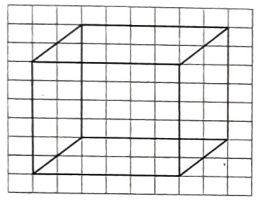
Give (i) an oblique sketch and (ii) an isometric sketch for each of the following.
(i) A cuboid of dimensions $5 cm, 3 cm$ and 2 cm . (Is your sketch unique?)
(ii) A cube with an edge 4 cm long.
Answer
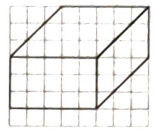
(i) (a) Oblique sketch of a cuboid of dimensions $5 cm, 3 cm$ and 2 cm is as follows.
Image
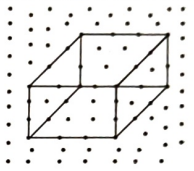
(b) An isometric sketch of this cuboid is as follows
Image
No, these sketches are not unique.
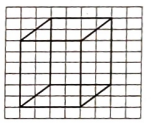
(ii) (a) Oblique sketch of the cube of edge 4 cm is as follows.
Image
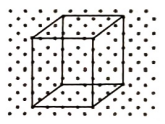
(b) An isometric sketch of this cube is as follows.
Image
View full question & answer
Question 92 Marks
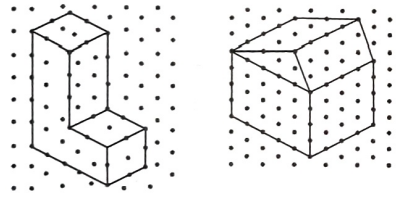
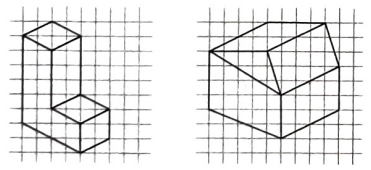
Make an oblique sketch for each one of the given isometric shapes.
Image
Answer
We know that an oblique sketch does not have proportional lengths but it conveys all important aspects of the appearance of the solid. So, oblique sketch for each one of the given isometric sketch are as follow.
Image
View full question & answer
Question 102 Marks
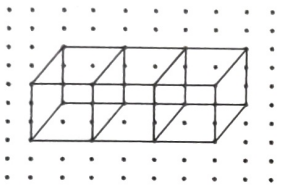
Three cubes each with 2 cm edge are placed side by side to form a cuboid. Sketch an oblique or isometric sketch of this cuboid.
Answer
An isometric sketch of a cuboid formed by placing three cubes with 2 cm edge side by side is given below:
Image
Then, length of cuboid $=2+2+2=6 cm$
Breadth of cuboid $=2 cm$
and height of cuboid $=2 cm$
Also, the oblique sketch of this cuboid is given below.
Image
View full question & answer
Question 112 Marks
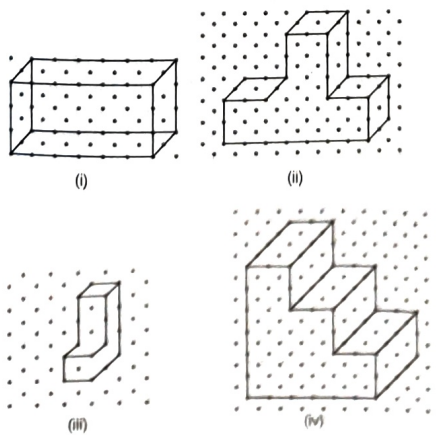
Use isometric dot paper and make an isometric sketch for each one of the given shapes.
Image
Answer
An isometric sketch for each one of the given shapes are as follow:
Image
View full question & answer
Question 132 Marks
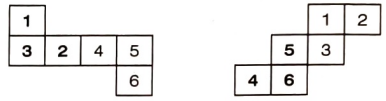
Can this be a net for a die? Explain your answer.
Image
Answer
No, we know that opposite faces of a die always have a total of seven dots on them. In the given net, one pair of opposite faces will have 1 and 4 on them whose total is $5(\neq 7)$ and another pair of opposite faces will have 3 and 6 on them whose total is $9(\neq 7)$. So, given figure cannot be a net for a die.
View full question & answer
Question 142 Marks
Answer
According to the given condition, that opposite faces of a dice always have a total of 7 dots on them, we insert the suitable numbers in the blanks as follows.
Image
View full question & answer
Question 152 Marks
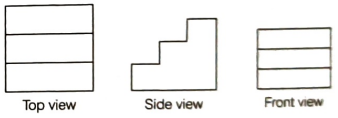
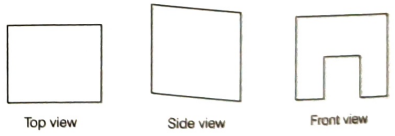
Draw the top, side and front views of the solids given below in figures.
Image
Answer
For given figure (i),
Image
For given figure (ii),
Image
View full question & answer
Question 162 Marks
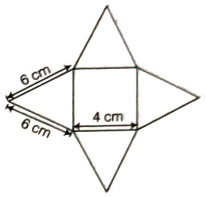
Draw the net of a square pyramid with base as square of side 4 cm and slant edges 6 cm .
Answer
The net of such square pyramid will be
Image
View full question & answer
Question 172 Marks
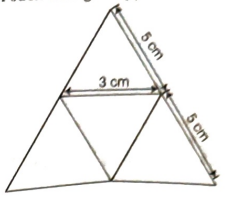
Draw the net of triangular pyramid with base as equilateral triangle of side 3 cm and slant edge 5 cm .
Answer
The net of such triangular pyramid will be
Image
View full question & answer
Question 182 Marks
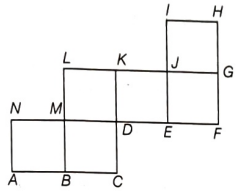
The net given below in figure can be used to make a cube.
(i) Which edge meets AN? (ii) Which edge meets DE?
Image
Answer
(i) The given net of a cube shows edge $G H$ meets edge AN.
(ii) The given net of a cube shows, $D C$ meets $D E$ edge.
View full question & answer
Question 192 Marks
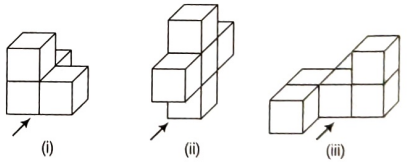
Here are some activities you could try in your free time to help you visualise some solid objects and how they look. Take some cubes and arrange them as shown in figure.
Image
Now, ask your friend to guess how many cubes are there when observed from the view shown by the arrow mark.
Answer
In fig. (i), there are 3 cubes when observed from the view shown by the arrow mark. In fig. (ii), there are 3 cubes when observed from the view shown by the arrow mark. In fig. (iii), there are 4 cubes when observed from the view shown by the arrow mark.
View full question & answer
Question 212 Marks
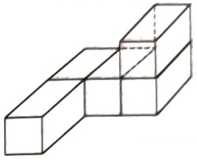
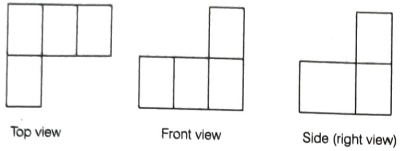
Draw the top, the front and the side views of the following solid figure made up of cubes.
Image
Answer
For the given figure
Image
View full question & answer
Question 232 Marks
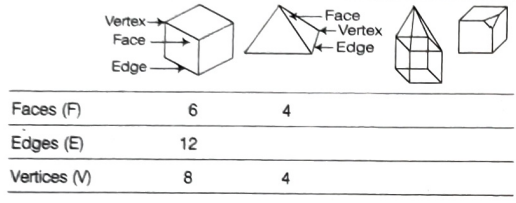
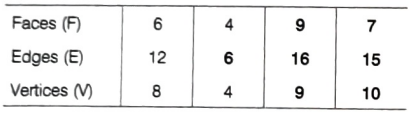
Write the number of faces, edges and vertices in the solids given below:
(i) Cube
(ii) Triangular pyramid
Answer
(i) The number of faces in cube $=6$
The number of edges in cube $=12$
The number of vertices in cube $=8$
(ii) The number of faces in triangular pyramid $=4$
The number of edges in triangular pyramid $=6$
The number of vertices in triangular pyramid $=4$
View full question & answer
Question 242 Marks
If two cuboids of dimensions $3 cm \times 3 cm \times 6 cm$ are placed on each other such that they overlap, what would be the dimensions of the resulting figure?
Answer
Given, dimensions of two cuboid $3 cm \times 3 cm \times 6 cm$.
Dimensions of the resulting figure are
$\begin{array}{l}\text { height }=6+6=12 cm \\ \text { breadth }=3 cm \\ \text { length }=3 cm\end{array}$
View full question & answer
Question 252 Marks
What is an oblique sketch?
Answer
An oblique sketch does not have proportional length but still it conveys all important aspects of the appearance of the solid.
View full question & answer
Question 262 Marks
Can this be a net for a die? Explain your answer.
Image
Answer
No, it is not possible because one pair of opposite faces will have 1 and 4, whose total is not equal to 7 and another pair of opposite faces will have 3 and 6, whose total is not equal to 7.
View full question & answer