Question types

Acids, Bases and Salts question types

104 questions across 9 question groups — pick any mix to generate a Science paper with step-by-step answer keys.

104
Questions
9
Question groups
5
Question types
Sample Questions

Acids, Bases and Salts questions

One sample from each question group in this chapter. Select any group above to see the full set with answer keys.

Q 1MCQ (1 Marks)1 Mark
Phenolphthalein is a synthetic indicator and its colours in acidic and basic solutions respectively are
  • A
    red and blue
  • B
    blue and red
  • C
    pink and colourless
  • colourless and pink

Answer: D.

View full solution
Q 3MCQ (1 Marks)1 Mark
Which of the following sets of substances contains acids only?
  • A
    Grapes, lime water
  • B
    Vinegar, soap
  • C
    Curd, milk of magnesia
  • Curd, vinegar

Answer: D.

View full solution
Q 4MCQ (1 Marks)1 Mark
Anu re-visited a historical monument after 10 years. She noticed that the white monument had turned yellowish.
Which event is most likely to have caused the change in colour of the monument?
  • A
    Flood
  • B
    Drought
  • Acid rain
  • D
    Thunderstorm

Answer: C.

View full solution
Q 5MCQ (1 Marks)1 Mark
A scientist tests a soil sample from a uncultivated field and concludes that the soil is highly basic in nature. She suggests that adding organic matter in the soil could improve the quality of the soil. How does organic matter improve the quality of the soil?
  • It releases acids which neutralises the soil
  • B
    It traps water vapour and increases the moisture content
  • C
    It makes the soil lighter so that it can be easily transported
  • D
    It acts as food for the organisms already present in the soil

Answer: A.

View full solution
The following questions consist of two statements-Assertion (A) and Reason (R). Answer these questions by selecting the appropriate option given below.
Assertion (A) When an acid is mixed with a base in any amount, the reaction is termed as neutralisation reaction.
Reason (R) The salt formed during neutralisation reaction can be acidic, basic or neutral.
  • A
    Both A and R are true and R is the correct explanation of A.
  • B
    Both A and R are true, but R is not the correct explanation of A.
  • C
    A is true, but R is false.
  • A is false, but R is true.

Answer: D.

View full solution
The following questions consist of two statements-Assertion (A) and Reason (R). Answer these questions by selecting the appropriate option given below.
Assertion (A) Turmeric stain on clothes turn red when it is washed with soap.
Reason (R) The soap solution is basic in nature.
  • Both A and R are true and R is the correct explanation of A.
  • B
    Both A and R are true, but R is not the correct explanation of A.
  • C
    A is true, but R is false.
  • D
    A is false, but R is true.

Answer: A.

View full solution
The following questions consist of two statements-Assertion (A) and Reason (R). Answer these questions by selecting the appropriate option given below.
Assertion (A) Sugar solution do not change the colour of blue or red litmus paper.
Reason (R) Neutral solution do not change the colour of either red or blue litmus paper.
  • Both A and R are true and R is the correct explanation of A.
  • B
    Both A and R are true, but R is not the correct explanation of A.
  • C
    A is true, but R is false.
  • D
    A is false, but R is true.

Answer: A.

View full solution
The following questions consist of two statements Assertion (A) and Reason (R). Answer these questions by selecting the appropriate option given below.
Assertion (A) During neutralisation reaction, the reaction mixture becomes hot.
Reason (R) Dilute sulphuric acid when added to lime water (which is a base), releases heat energy.
  • Both A and R are true and R is the correct explanation of A.
  • B
    Both A and R are true but R is not the correct explanation of A.
  • C
    A is true, but R is false.
  • D
    A is false, but R is true.

Answer: A.

View full solution
The following questions consist of two statements Assertion (A) and Reason (R). Answer these questions by selecting the appropriate option given below.
Assertion (A) Plants grow well when the soil is acidic.
Reason (R) Compost is added to the basic soil.
  • A
    Both A and R are true and R is the correct explanation of A.
  • B
    Both A and R are true but R is not the correct explanation of A.
  • C
    A is true, but R is false.
  • A is false, but R is true.

Answer: D.

View full solution
Boojho, Paheli and their friend Golu were provided with a test, each containing China rose solution which was pink in colour. Boojho added 2 drops of solution 'A' in his test tube and got dark pink colour. Paheli added 2 drops of solution 'B' to her test tube and got green colour. Golu added 2 drops of solution 'C, but could not get any change in colour. Suggest the possible cause for the variation in their results.
View full solution
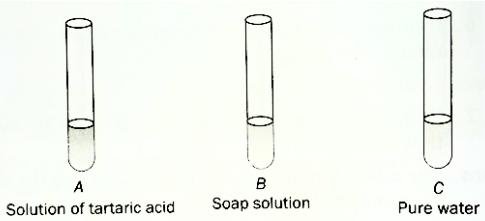
You are provided with three test tubes A, B and C as shown in figure with different liquids.
Image
What will you observe when you put
(i) a piece of blue litmus paper in each test tube?
(ii) a piece of red litmus paper in each test tube?
(iii) a few drops of phenolphthalein solution to each test tube?
View full solution
Look at the given reaction.
Hydrochloric acid + Sodium hydroxide (base) → Sodium chloride (salt) + Water
Sodium chloride formed in this reaction remains in solution form. Can we get solid sodium chloride from this solution? Suggest a method (if any).
View full solution
Paheli observed that most of the fish in the pond of her village were gradually dying. She also observed that the wastes of a factory in their village are flowing into the pond which probably caused the fish to die.
(i) Explain why the fish were dying?
(ii) If the factory waste is acidic in nature, how can it be neutralised?
View full solution
Q 313 Marks Question3 Marks
One day Rahul's mother after taking meal felt pain and irritation in her stomach at that time his father was out of station. Rahul remembered his teacher's statement and gave his mother some baking soda solution which gave her a relief from pain and irritation in stomach.
Read the above passage and answer the following questions
(i) Which information given by Rahul's teacher, that helped him to select the baking soda as remedy?
(ii) Why did he select baking soda as a cure?
(iii) What values are shown by Rahul?
View full solution
Q 333 Marks Question3 Marks
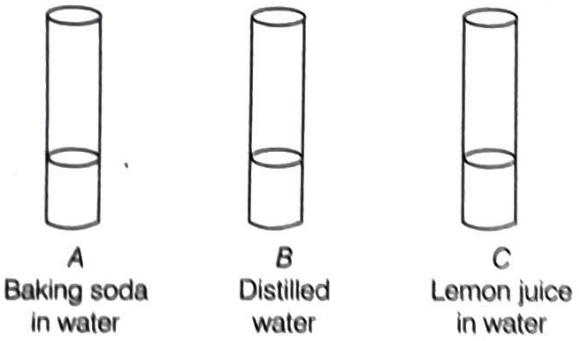
Three test tubes A, B and C are taken as shown in figure below. Red litmus paper was dipped in all three test tubes to test which solution is basic in nature. Identify in which test tube the red litmus paper will change its colour to blue?
Image
View full solution
Q 343 Marks Question3 Marks
A student took some dilute hydrochloric acid in a flask, added a few drops of phenolphthalein and mixed it gently. After that the student added sodium hydroxide drop by drop to this colourless solution and continued until he saw some change in the colour of the solution.
(i) Name the type of reaction that the experiment demonstrates.
(ii) Complete the following word equation for the simple acid-base reaction that took place in the abvoe experiment.
Sodium hydroxide + Hydrochloric acid → _________________
(iii) Describe and explain the colour of the solution when sodium hydroxide was added.
View full solution
Q 353 Marks Question3 Marks
Explain why
(a) an antacid tablet is taken when you suffer from acidity?
(b) calamine solution is applied on the skin, when an ant bites?
(c) factory waste is neutralised before disposing it into the water bodies?
View full solution
Match the Column I with Column II.
Column IColumn II
A. Vinegar1. is used as indicator
B. Sodium chloride2. is sour to taste
C. Milk of magnesia3. major salt of sea
D. Turmeric4. changes red litmus blue
View full solution

Generate a Acids, Bases and Salts paper free

Pick question groups from the list above, set marks and difficulty, and export a branded PDF with step-by-step answer keys. First 3 chapters free — no signup.

Download App