Questions

3 Marks Question

🎯

Test yourself on this topic

15 questions · timed · auto-graded

Question 13 Marks
Read the following story titled ‘Eco-friendly Prithin’, and tick the most appropriate option(s) given in the brackets. Provide a suitable title of your choice for the story.
Prithvi is preparing a meal in the kitchen. He chops vegetables, peels potatoes, and cuts fruits (physical changes/chemical changes). He collects the seeds, fruits, and vegetable peels into a clay pot (physical change/ chemical change). The fruits, vegetable peels, and other materials begin to decompose due to the action of bacteria and fungi, forming compost (physical change/chemical change). He decides to plant seeds in the compost and water them regularly. After a few days, he notices that the seeds begin to germinate and small plants start to grow, eventually blooming into colourful flowers (physical change/chemical change). His efforts are appreciated by all his family members.
Answer
Prithvi’s Green Kitchen
1. Prithvi chops vegetables, peels potatoes, and cuts fruits – S physical changes
2. He collects the seeds, fruits, and vegetable peels into a clay pot – V physical change
3. He collects the seeds, fruits, and vegetable peels into a clay pot — V physical change
4. The fruits, vegetable peels, and other materials decompose into compost — V chemical change
5. Seeds germinate and grow into plants V chemical change
View full question & answer
Question 23 Marks
Table : Can changes be reversed?
ChangeThe original state can be brought back (Yes/ No)
Melting ice cubes
Chopping vegetables
Boiling water
Making popcorn from corn
Cutting a piece of paper
Adding beetroot extract to water
Burning wood
Diying wet clothes
Making small balls of dough
Rolling small balls of dough into chapatis
Cooking of food
Making pot from mud
Answer
ChangeThe original state can be brought back (Yes/ No)
Melting ice cubesYes
Chopping vegetablesNo
Boiling waterYes
Making popcorn from cornNo
Cutting a piece of paperNo
Adding beetroot extract to waterNo
Burning woodNo
Diying wet clothesYes
Making small balls of doughYes
Rolling small balls of dough into chapatisYes
Cooking of foodNo
Making pot from mudNo

Conclusion: Changes around us can be grouped into reversible (original substance can be brought back) and irreversible (original substance cannot be brought back) changes.
View full question & answer
Question 33 Marks
A cleaned magnesium ribbon about 3-4 cm long is burnt using a burner by holding it with a pair of tongs and the ash so formed is collected in a watch-glass. The magnesium ribbon is kept away as far as possible from eyes.
Q.1. What is the colour of the powder collected in a watch glass ?
Q.2. Write the changes that determines the occurrence of chemical reaction.
Q.3. What is the chemical name of the powder collected in a watch glass ?
Answer
1. White
2. Change in state, change in temperature or change in colour determines the occurrence of a chemical reaction.
3. Magnesium oxide (MgO)
View full question & answer
Question 43 Marks
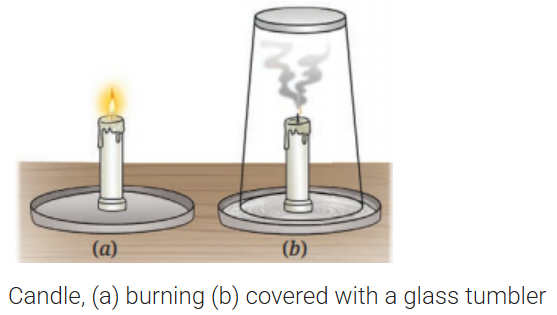
Is air essential for combustion? Explain with the help of an activity.
Answer
Take a candle, light it and fix it on a table. Allow the candle to burn steadily. Now, carefully cover the burning candle with a glass jar. We will observe that after some time, the flame flickers and eventually goes out. This occurs because the oxygen inside the jar is consumed by the burning candle, and without a continuous supply of oxygen from the air, combustion cannot be sustained. This experiment shows that air, specifically oxygen, is essential for combustion.
Image
View full question & answer
Question 53 Marks
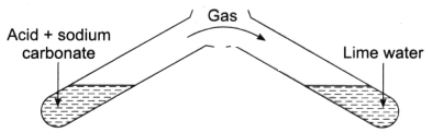
Observe the following figure and answer the following questions:
Image
(i) What does this figure show?
(ii) Name the gas released.
(iii) Write the effect of the gas on lime water.
(iv) Write the chemical equation of the reaction.
Answer
(i) This figure shows the action of an acid over sodium carbonate.
(ii) The gas released is carbon dioxide.
(iii) The lime water becomes milky.
(iv) $\underset{\text { (Lime water) }}{\text { Calcium hydroxide }} + {\text { Carbon dioxide }} \rightarrow  \underset{\text { (Insoluble substance) }}{\text { Carbon carbonate }} + {\text { Water }}$
View full question & answer
Question 63 Marks
Explain weathering of rocks.
Answer
Weathering is the process by which rocks are broken down into smaller pieces, eventually forming soil. It occurs through both physical and chemical changes. Physical weathering occurs when large rocks break into smaller pieces without changing their chemical composition. This can be caused by change in temperature due to climate, the growth of tree roots, or the freezing of water within cracks in the rocks. Chemical weathering happens when water or chemicals in the water react with the minerals in rocks, changing their composition. For example, a black coloured rock called basalt, which contains iron, undergoes a chemical change. When exposed to water or moist air for a long time, the iron reacts with oxygen to form iron oxide, which gives the rock a red colour.
View full question & answer
Question 73 Marks
If you leave a piece of iron in the open for a few days, it acquires a film of brownish substance, called rust.
(a) Do you think rust is different from iron?
(b) Can you change rust back into iron by some simple method?
(c) Do you think formation of rust from iron is a chemical change?
(d) Give two other examples of a similar type of change.
Answer
(a) Yes, it is quite different from iron. Rust is formed due to the oxidation of iron in the presence of moist air.
(b) No, this is an irreversible chemical change.
(c) Yes, it is a chemical change because rust is a new substance formed when iron undergoes chemical reaction with the water particles and oxygen present in air and this change cannot be reversed back.
(d) Cooking of food and curdling of milk are other examples of chemical reaction that cannot be reversed.
View full question & answer
Question 83 Marks
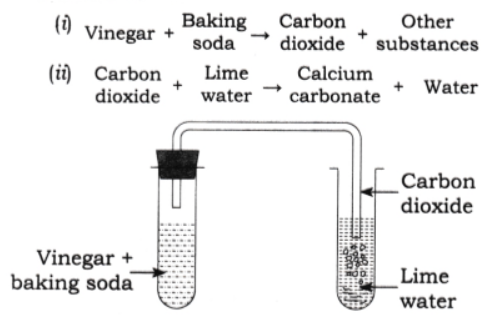
Which gas is released when vinegar and baking soda are mixed? What happens when this gas is passed through lime water?
Answer
When baking soda and vinegar are mixed with each other then carbon dioxide gas is released. When carbon dioxide gas is passed through lime water, then calcium carbonate is formed. Calcium carbonate makes lime water appear milky. The turning of lime water into milky solution is a standard test of carbon dioxide. The following reactions take place:
Image
View full question & answer
Question 93 Marks
Image
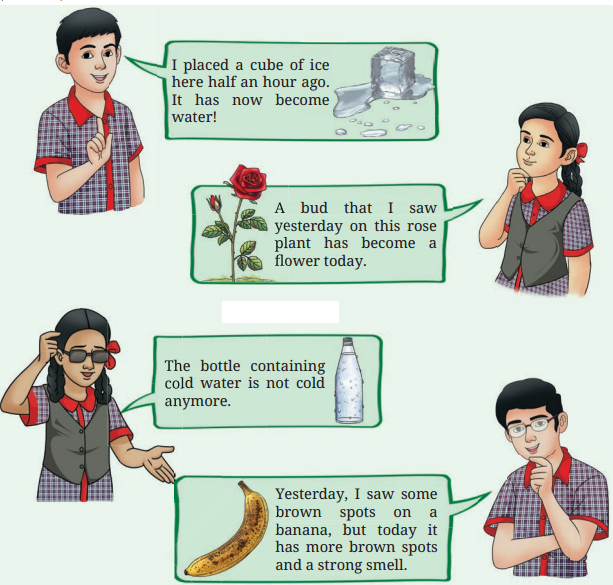
These students are describing some changes. What kinds of changes are they talking about?
Answer
1. Ice melts and becomes water. This is physical change as only state of water from solid to liquid has changed in this process.
2. Bud blossoms to a flower, this is a chemical change as once a bud blooms into a flower, it cannot revert back to its bud form. Also, internal chemical changes takes place.
3. Cold water becomes warm on keeping in open, this is a physical change as water remains the same, only its temperature changes.
4. Rotting of banana is a chemical change as its composition and texture get changed.
View full question & answer
Question 103 Marks
Answer
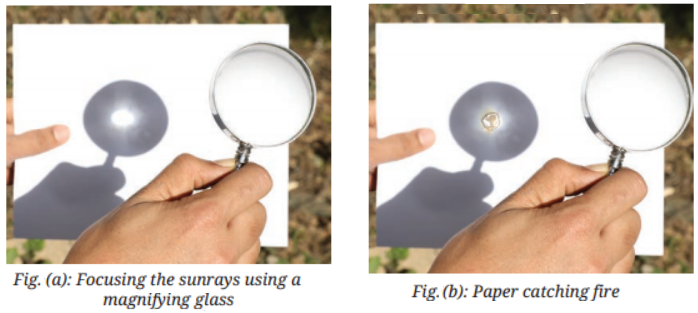
Observation and conclusion: The substance catches fire only when its ignition temperature is reached. Ignition temperature is the minimum temperature at which the substance catches fire. When a lighted matchstick is brought near to the paper it catches fire immediately because the temperature of the matchstick is already higher that the ignition temperature of the paper. In another case, when sunrays are focused using a magnifying glass on a piece of paper, it gets heated up and the temperature of paper increases and it attains its ignition temperature and starts burning and emit smoke.
Requirements for combustion process to occur :
1. A combustible substance (fuel)
2. Oxygen
3. Attainment of ignition temperature.
View full question & answer
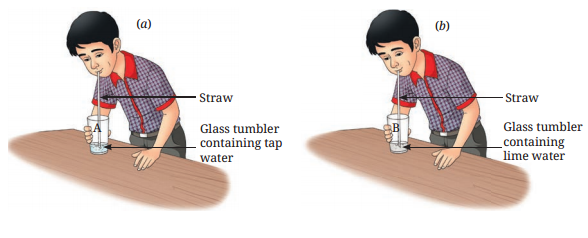
Question 113 Marks
Answer
Observation and conclusion: When we blow air (carbon dioxide) from mouth to tumbler A containing water, we do not observe any change in the colour of water. But when we blow air into tumbler B containing lime water (calcium hydroxide), lime water turns milky and white-coloured insoluble substance (calcium carbonate) gets settle down. Thus, this is classified as chemical change as new substance is being formed.
$\begin{array}{l}\text { Carbon dioxide }\end{array}+\underset{\text { (calcium hydroxide) }}{\text { Lime water }} \rightarrow \underset{\text { carbonate (milky) }}{\text { Calcium }}+ \text { water }$
View full question & answer
Question 123 Marks
Draw a pictorial presentation of the process of rusting and explain the chemical changes involved.
Answer
self
View full question & answer
Question 133 Marks
Research famous scientists (e.g., Marie Curie, Antoine Lavoisier) and their contributions to the understanding of chemical reactions and changes. Create a timeline or a presentation about the history of chemical discoveries.
Answer
self
View full question & answer
Question 143 Marks
Create a collage of natural changes that include both physical and chemical changes, such as the melting of ice, the rusting of metals, the decay of food, and the growing of plants.
Answer
self
View full question & answer
Question 153 Marks
Read the passage and answer the questions :
You are conducting an experiment where you add vinegar to baking soda. As soon as the two substances mix, there is a fizzing sound, and bubbles of gas begin to form, pass this gas through freshly prepared lime water. You observe that the lime water has turned milky due to formation of a precipitate.
Q.1. What type of change has occurred in this experiment?
(a) Physical change
(b) Chemical change
(c) Both physical and chemical change
(d) No change
Q.2. What is the gas that has been produced in this reaction?
(a) Oxygen$\quad$(b) Nitrogen
(c) Carbon dioxide$\quad$(d) Hydrogen
Q.3. What is the name of the white precipitate that forms in the solution?
(a) Calcium hydroxide
(b) Calcium carbonate
(c) Sodium bicarbonate
(d) Magnesium oxide
Answer
(b) Chemical change
(c) Carbon dioxide
(b) Calcium carbonate
View full question & answer
3 Marks Question - Science STD 7 Questions - Vidyadip