Question types

Electricity: Circuits and their Components question types

173 questions across 9 question groups — pick any mix to generate a Science paper with step-by-step answer keys.

173
Questions
9
Question groups
5
Question types
Sample Questions

Electricity: Circuits and their Components questions

One sample from each question group in this chapter. Select any group above to see the full set with answer keys.

Q 1MCQ (1 Marks)1 Mark
Choose the incorrect, statement.
  • A switch is the source of electric current in a circuit.
  • B
    A switch helps to complete or break the circuit.
  • C
    A switch helps us to use electricity as per our requirement.
  • D
    When the switch is in ‘OFF’ position, there is an air gap between its terminals.

Answer: A.

View full solution
Q 2MCQ (1 Marks)1 Mark
When a switch is in the ‘OFF’ position:
(i) Oil from water
(ii) Sand from water
(iii) Cream from milk
(iv) Oxygen from air
Choose the combination of correct answers from the following:
  • A
    All are correct
  • (ii) and (iii) are correct
  • C
    Only (iv) is correct
  • D
    Only (i) and (ii) are correct

Answer: B.

View full solution
Q 3MCQ (1 Marks)1 Mark
In an electric circuit, what happens when the switch is in the ‘OFF’ position?
  • The circuit is open, and no current flows
  • B
    The circuit is closed, and current flows
  • C
    The bulb lights up
  • D
    The battery gets charged

Answer: A.

View full solution
Q 4MCQ (1 Marks)1 Mark
What does the symbol of a resistor look like in an electrical circuit diagram?
  • A zigzag line
  • B
    A circuit with a cross inside
  • C
    A rectangle
  • D
    A straight line

Answer: A.

View full solution
Assertion (A): The switch in a circuit is used to control the flow of electricity.
Reason (R): The switch opens or closes the circuit to either allow or stop the flow of current.
  • Both A and R are true and R is the correct explanation of A.
  • B
    Both A and R are true but R is not the correct explanation of A.
  • C
    A is true, but R is false.
  • D
    A is false but R is true.

Answer: A.

View full solution
Assertion (A): A battery is used to power an electrical circuit.
Reason (R): A battery provides a source of voltage to move electrons through the circuit.
  • Both A and R are true and R is the correct explanation of A.
  • B
    Both A and R are true but R is not the correct explanation of A.
  • C
    A is true, but R is false.
  • D
    A is false but R is true.

Answer: A.

View full solution
Assertion (A): The flow of electric current in a circuit requires a complete path.
Reason (R): If the circuit is incomplete, current will not flow.
  • A
    Both A and R are true and R is the correct explanation of A.
  • B
    Both A and R are true but R is not the correct explanation of A.
  • C
    A is true but R is false.
  • D
    A is false but R is true
View full solution
Assertion (A): LED lamps are more efficient than filament bulbs.
Reason (R): LEDs emit light without generating much heat.
  • Both Assertion (A) and Reason (R) are true, and (R) is the correct explanation of (A).
  • B
    Both Assertion (A) and Reason (R) are true, but (R) is not the correct explanation of (A).
  • C
    (A) is true, but (R) is false.
  • D
    (A) is false, but (R) is true.

Answer: A.

View full solution
Assertion (A): The electric cell has two different terminals to allow current to flow.
Reason (R): Current flows from lower to higher potential in a closed circuit.
  • A
    Both Assertion (A) and Reason (R) are true, and (R) is the correct explanation of (A).
  • B
    Both Assertion (A) and Reason (R) are true, but (R) is not the correct explanation of (A).
  • (A) is true, but (R) is false.
  • D
    (A) is false, but (R) is true.

Answer: C.

View full solution
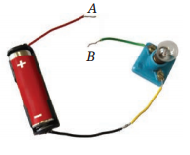
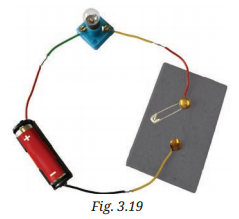
Vidyut has made the circuit as shown in Fig. Even after closing the circuit, the lamp does not glow. What can be the possible reasons? List as many possible reasons as you can for this faulty operation. What will you do to find out why the lamp did not glow?
Image
View full solution
Image
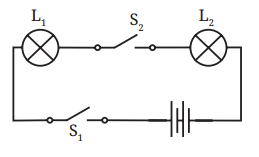
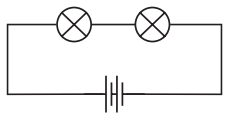
(i) If $S_2$ is in ‘ON’ position, $S_1$ is in ‘OFF’ position, which lamp(s) will glow?
(ii) If $S_2$, is in ‘OFF’ position, $S_1$, is in ‘ON’ position, which lamp(s) will glow?
(iii) If $S_1$, and $S_2$, both are in ‘ON’ position, which lamp(s) will glow?
(iv) If both $S_1$, and $S_2$, are in ‘OFF’ position, which lamp(s) will glow?
View full solution
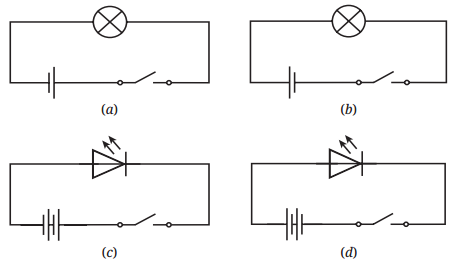
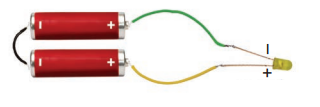
An LED requires two cells in series to glow. Tanya made the circuit as shown in Fig. Will the lamp glow? If not, draw the wires for correct connections.
Image
View full solution
Q 313 Marks Question3 Marks
You are given six cells marked A, B, C, D, E, and F. Some of these are working and some are not. Design an activity to identify which of them are working.
(i) List the items that you require.
(ii) Write the procedure that you will follow.
(iii) With the items, carry out the activity to identify the cells that are working.
View full solution
Q 323 Marks Question3 Marks
An electric cell is a portable source of electrical energy. The positive terminal of the electric cell is marked with a + sign, and the negative terminal is marked with a – sign.
Q.1. What is the terminal marked with a “+” sign called?
Q.2. What happens when an electric cell is connected to a circuit?
Q.3. Which terminal of the cell does the electric current flow from?
View full solution
Q 333 Marks Question3 Marks
A torchlight is a portable light source that runs on batteries. It uses electricity from the batteries to power an LED or an incandescent lamp, providing light in places without electrical outlets.
Q.1. What type of electricity powers a torchlight?
Q.2. What is the function of a torchlight’s LED or incandescent lamp?
Q.3. What is the main component in a torchlight that stores energy?
View full solution
Q 343 Marks Question3 Marks
Draw symbols for various electric circuit components.
1. Electric cell
2. Electric lamp
3. Switch in 'ON' position
4. Switch in 'OFF' position
5. Battery
6. Wire
View full solution
ComponentFunction
Q.1. Battery(a) Conducts electricity between components
Q.2. Switch(b) Lights up when current flows through it
Q.3. Bulb(c) Controls the flow of current in the circuit
Q.4. Wire(d) Provides electrical energy to the circuit
View full solution

Generate a Electricity: Circuits and their Components paper free

Pick question groups from the list above, set marks and difficulty, and export a branded PDF with step-by-step answer keys. First 3 chapters free — no signup.

Download App