Questions

1 Marks Question

🎯

Test yourself on this topic

31 questions · timed · auto-graded

Question 11 Mark
Boojho now understands why clinical thermometer cannot be used to measure high temperatures. But still wonders whether a laboratory thermometer can be used to measure his body temperature.
Answer
Laboratory thermometer can also be used for measuring body temperature because it is inconvenient for this purpose as it lacks the kink which is present in clinical thermometer.
View full question & answer
Question 21 Mark
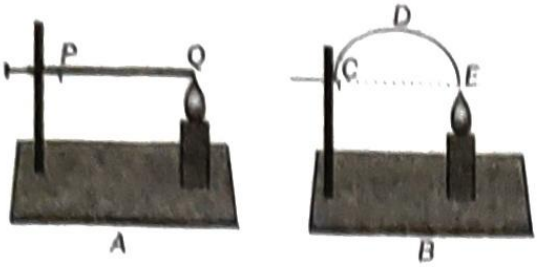
The length of wire PQ In case of A is equal to the diameter of the semi-circle formed by the wire CDE, In case & one pin is attached to each wire with the help of wax as shown in figure. Which pin will fall first? Explain.
Image
Answer
The pin on the wire in case A will fall first as heat will reach to it before it reaches the pin in case B because the diameter is smaller than the circumference of semi-circle.
View full question & answer
Question 31 Mark
Shopkeepers selling ice blocks usually cover them with jute sacks. Explain why?
Answer
As we know that jute sack is thermal insulator, it helps ice not to be melt immediately. So, shopkeepers used to cover ice blocks with jute sacks.
View full question & answer
Question 41 Mark
To keep her soup warm, Paheli wrapped the container in which it was kept with a woollen clothes. Can she apply the same method to keep a glass of cold drink cool? Give reason for your answer.
Answer
Yes, she can apply the same method to keep a glass of cold drink cool because wool is a thermal insulator and it cannot allow to heat pass through it.
View full question & answer
Question 51 Mark
In a mercury thermometer, the level of mercury rises when its bulb comes in contact with a hot object. What is the reason for this rise in the level of mercury?
Answer
As the temperature increases, then expansion in mercury takes place which leads to the rise in the level of mercury in thermometer.
View full question & answer
Question 61 Mark
Why is it advised not to hold the thermometer by its bulb while reading it?
Answer
It is advised not to hold the thermometer bulb while reading it as the level of mercury increases from the actual reading by our body temperature.
View full question & answer
Question 71 Mark
It is preferred to use two thin blankets rather than one thick blanket. Explain the reason.
Answer
In case of two thin blankets, there is an air gap which does not allow heat to pass out from the body and it is not as such in case of one thick blanket.
View full question & answer
Question 81 Mark
Why are you advised to use an umbrella when you go out in the sun?
Answer
An umbrella prevent us from the harmful radiation coming from the sun.
View full question & answer
Question 101 Mark
How does the heat transfer take place in water and air?
Answer
In water, mode of heat transfer is convection and in air, mode of heat transfer is radiation.
View full question & answer
Question 111 Mark
The mercury does not fall or rise in a clinical thermometer when taken out of the mouth. Explain why?
Answer
Because of the kink present in the thermometer, the mercury does not fall or rise.
View full question & answer
Question 121 Mark
What is the use of the kink?
Answer
The clinical thermometer consists of kink which prevents the mercury level from falling on its own.
View full question & answer
Question 131 Mark
Paheli asks, "Does it mean that heat will not be transferred, if the temperature of two objects is the same"?
Answer
The net energy transfer does not take place when the temperature of two objects is same.
View full question & answer
Question 141 Mark
Boojho wonders, why the level of mercury should change at all when the bulb of the thermometer is brought in contact with another object?
Answer
The level of the mercury changes when the bulb of the thermometer is brought in contact with another object because the temperature of other object may not be the same as that of the bulb of the thermometer.
View full question & answer
Question 151 Mark
Boojho got a naughty idea. He wanted to measure the temperature of hot milk using a clinical thermometer. Paheli stopped him from doing so, explain why?
Answer
The clinical thermometer has the range 35°C to 42°C and it is designed to measure the temperature of human body. That's why, paheli stopped him from doing so.
View full question & answer
Question 161 Mark
Paheli measured her body temperature. She got worried as it was not exactly 37°C, explain why?
Answer
The temperature of every person may not be 37°C. It could be slightly higher or lower. So, we consider the average body temperature for human i.e. 37°C.
View full question & answer
Question 171 Mark
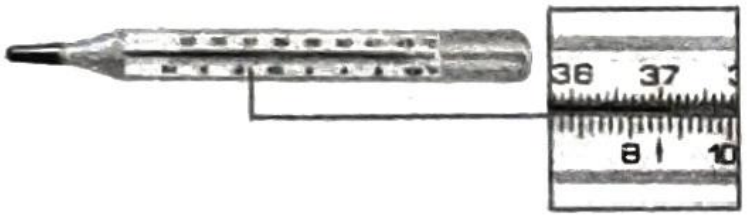
Boojho wondered which of the two scales shown in figure should he read.
Image
Answer
India has adopted the celsius scale, so he should read that scale. The other scale with the range 94-108 degrees is the fahrenheit scale (°F) which was used earlier.
View full question & answer
Question 181 Mark
Boojho says, "My left hand tells me that the water in mug C(in Activity 1) is hot and the right hand tells me that the same water is cold." What should we conclude?
Answer
Both the conclusions are correct relative to each hand but this shows that we cannot arrive at conclusions just based on our sense of touch.
View full question & answer
Question 191 Mark
How do we find out how hot an object really is?
Answer
By using thermometer, we can measure the degree of hotness of a body.
View full question & answer
Question 201 Mark
Why does our hand burn on touching a hot pan, but not on touching its bakelite handle?
Answer
Since, bakelite is an insulator. It does not conduct heat energy. That's why, on touching the bakelite handle of a hot pan, our hand does not burn.
View full question & answer
Question 211 Mark
Explain the reason for serving of tea in China clay cup and plates.
Answer
Tea is generally served in China clay cup and plates because China clay is a bad conductor of heat which does not allow the heat to pass through it and hence keeps the tea hot.
View full question & answer
Question 221 Mark
Name the mode of transfer of heat in which medium is not required.
Answer
Radiation is the mode of transfer of heat in which medium is not required.
View full question & answer
Question 231 Mark
While constructing a house in a coastal area, in which direction should the windows preferably face and why?
Answer
Window should preferably face towards the sea beach, so that the sea breeze coming from sea keeps the house cool during the day time.
View full question & answer
Question 241 Mark
Is the body temperature of every person 37°C?
Answer
No, the body temperature of every person is not 37°C. It is an average temperature. It could be slightly higher or slightly lower.
View full question & answer
Question 251 Mark
How can we measure the temperature of other object rather than human body?
Answer
Temperature of other object is measured with laboratory thermometer because clinical thermometer is not suitable for higher temperature.
View full question & answer
Question 261 Mark
Give two examples each of conductors and insulators of heat.
Answer
Examples of conductors are metal and steel and examples of insulators are wood and plastic.
View full question & answer
Question 271 Mark
Name the process through which the heat of sun reaches us.
Answer
The heat of the Sun reaches us through the process of radiation.
View full question & answer
Question 281 Mark
Describe in brief about the term radiation.
Answer
Radiation is the transfer of heat in the form of electromagnetic waves (infrared rays) without the need for any medium.
It can occur through vacuum, like the heat from the Sun reaching the Earth.
View full question & answer
Question 291 Mark
Why convection not possible in solids? Briefly explain.
Answer
Convection is not possible in solids because the particles in solids are fixed in position and can only vibrate around their mean positions.
Since convection requires the bulk movement of particles to transfer heat (as in liquids and gases), solids cannot support this type of heat transfer. In solids, heat is transferred only by conduction.
View full question & answer
Question 301 Mark
What is the range of laboratory thermometer?
Answer
The range of a laboratory thermometer is usually −10°C to 110°C.
View full question & answer
Question 311 Mark
How do you define heat flow?
Answer
Heat flow is the transfer of heat from a hotter object to a colder object.
View full question & answer
1 Marks Question - Science STD 7 Questions - Vidyadip