Question types

Life Processes in Plants question types

172 questions across 9 question groups — pick any mix to generate a Science paper with step-by-step answer keys.

172
Questions
9
Question groups
5
Question types
Sample Questions

Life Processes in Plants questions

One sample from each question group in this chapter. Select any group above to see the full set with answer keys.

Q 1MCQ (1 Marks)1 Mark
Column IColumn II
1. Oxygen(A) Releases energy from food
2. Glucose(B) By-product of photosynthesis
3. Sunlight(C) Taken in during photosynthesis
4. Carbon dioxide(D) Stored as starch in plants
5. Respiration(E) Source of energy for photosynthesis
  • A
    (1)-(B), (2)-(D), (3)-(E), (4)-(C), (5)-(A)
  • B
    (1)-(D), (2)-(A), (3)-(E), (4)-(C), (5)-(B)
  • C
    (1)-(B), (2)-(A), (3)-(D), (4)-(E), (5)-(C)
  • D
    (1)-(D), (2)-(A), (3)-(B), (4)-(C), (5)-(E)
View full solution
Q 2MCQ (1 Marks)1 Mark
In the absence of which of the following, will photosynthesis not occur in leaves?
  • A
    Guard cells
  • Chlorophyll
  • C
    Vacuole
  • D
    Space between cells

Answer: B.

View full solution
Q 3MCQ (1 Marks)1 Mark
The process by which plants break down glucose and release energy is called
  • respiration
  • B
    photosynthesis
  • C
    transportation
  • D
    food factory

Answer: A.

View full solution
Q 5MCQ (1 Marks)1 Mark
When we observe the lower surface of a leaf through a magnifying lens we see numerous small openings. Which of the following is the term given to such openings?
  • Stomata
  • B
    Lamina
  • C
    Midrib
  • D
    Veins

Answer: A.

View full solution
Assertion (A): The final product of respiration is glucose.
Reason (R): The glucose ultimately gets converted into the starch.
  • A
    Both A and R are true and R is the correct explanation of A.
  • B
    Both A and R are true but R is not the correct explanation of A.
  • C
    A is true but R is false.
  • A is false but R is true.

Answer: D.

View full solution
Assertion (A): The iodine solution indicates the presence of starch in the leaves.
Reason (R): The red-yellow colour confirms the presence of starch in the leaves.
  • A
    Both A and R are true and R is the correct explanation of A.
  • B
    Both A and R are true but R is not the correct explanation of A.
  • A is true but R is false.
  • D
    A is false but R is true.

Answer: C.

View full solution
Assertion (A): Green pigment found in the plant’s leaves is called chlorophyll.
Reason (R): Chlorophyll is responsible for the green colour of the plants.
  • A
    Both A and R are true and R is the correct explanation of A.
  • Both A and R are true but R is not the correct explanation of A.
  • C
    A is true but R is false.
  • D
    A is false but R is true.

Answer: B.

View full solution
Assertion (A): All parts of a plant, green or non-green, carry out respiration.
Reason (R): Water is broken down in the presence of oxygen during respiration.
  • A
    Both A and R are true and R is the correct explanation of A.
  • B
    Both A and R are true but R is not the correct explanation of A.
  • A is true but R is false.
  • D
    A is false but R is true.

Answer: C.

View full solution
Assertion (A): Minerals and water present in the soil are absorbed by the roots and transported to leaves.
Reason (R): Carbon dioxide from air is taken through stomata present on the surface of leaves.
  • A
    Both A and R are true and R is the correct explanation of A.
  • Both A and R are true but R is not the correct explanation of A.
  • C
    A is true but R is false.
  • D
    A is false but R is true.

Answer: B.

View full solution
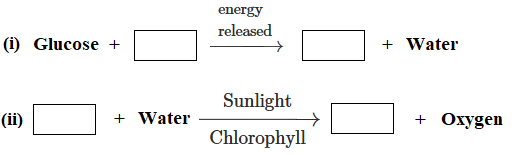
X is broken down using Y to release carbon dioxide, Z, and energy.
$X+Y \rightarrow$ Carbon dioxide + Z + Energy
X, Y, and Z are three different components of the process. What do X, Y, and Z stand for?
View full solution
Vani believes that ‘carbon dioxide is essential for photosynthesis’. She puts an experimental set-up, as shown in Fig, to collect evidence to support or reject her idea.
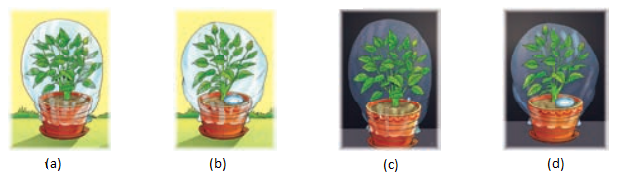
Image
Fig. A potted plant with sufficient water is placed under the prescribed conditions.
(a) Sunlight with carbon dioxide
(b) Sunlight without carbon dioxide
(c) Dark with
(d) Dark without carbon dioxide carbon dioxide
Answer the following questions.
(i) In which plant(s) in the above set-up(s) will starch be formed?
(ii) In which plant(s) in the above set-up(s) will starch not be formed?
(iii) In which plant(s) in the above set-up(s) will oxygen be generated?
(iv) In which plant(s) in the above set-up(s) will oxygen not be generated?
View full solution
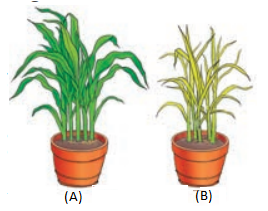
Krishna set-up an experiment with two potted plants of same size and placed one of them in sunlight and the other in a dark room, as shown in Fig.
Image
(i) What idea might she be testing through this experiment?
(ii) What are the visible differences in plants in both the conditions?
(iii) According to you, leaves of which plants confirm the iodine test for the presence of starch?
View full solution
A potato slice shows the presence of starch with iodine solution. Where does the starch in potatoes come from? Where is the food synthesised in the plant, and how does it reach the potato?
View full solution
Q 313 Marks Question3 Marks
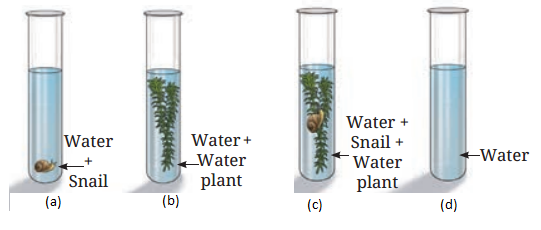
Ananya took four test tubes and filled three- fourth of each test tube with water. She labelled them A, B, C, and D (Fig). In test tube A, she kept a snail; in test tube B, she kept a water plant; in test tube C, she kept both a snail and a plant. In test tube D, she kept only water. Ananya added a carbon dioxide indicator to all the test tubes. She recorded the initial colour of water and observed if there are any colour changes in the test tubes after 2-3 hours. What do you think she wants to find out? How will she know if she is correct?
Image
Fig. Experimental set-up
View full solution
Q 343 Marks Question3 Marks
Oxygen which is essential for the survival of all organisms is produced during photosynthesis. In the absence of photosynthesis, life would be impossible on the earth. During photosynthesis, chlorophyll containing cells of leaves, in the presence of sunlight, use carbon dioxide and water to synthesise carbohydrates. During the process oxygen is released. The presence of starch in leaves indicates the occurrence of photosynthesis. Starch is also a carbohydrate.
Q.1. Which component is essential for the survival of all the living organisms?
(a) Oxygen$\quad$(b) Carbon dioxide$\quad$(c) Carbon Monoxide$\quad$(d) Hydrogen
Q.2. Name the green pigment present in leaves.
Q.3. How we come to know the occurrence of photosynthesis in a plant?
View full solution
FunctionComponent
Q.1. Green pigment in leaves(a) Small openings in leaves
Q.2. Process by which plants make food(b) Gas used in photosynthesis
Q.3. Simple carbohydrate made by plants(c) Simple carbohydrate made by plants
Q.4. Gives energy by breaking down food(d) Process by which plants make food
View full solution
Column AColumn B
Q.1. Xylem(a) Transports food
Q.2. Phloem(b) Gas exchange
Q.3. Stomata(c) Energy release
Q.4. Chlorophyll(d) Transports water
 (e) Green pigment
View full solution

Generate a Life Processes in Plants paper free

Pick question groups from the list above, set marks and difficulty, and export a branded PDF with step-by-step answer keys. First 3 chapters free — no signup.

Download App