Question types

Cubes and Cube Roots question types

97 questions across 11 question groups — pick any mix to generate a MATHS paper with step-by-step answer keys.

97
Questions
11
Question groups
5
Question types
Sample Questions

Cubes and Cube Roots questions

One sample from each question group in this chapter. Select any group above to see the full set with answer keys.

Assertion (A) The ones digit in the cube root of the cube number 100000 is 0.
Reason (R) The cube root of a number is the factor that we multiply by itself three times to get that number.
  • A
    Both A and R are true and R is the correct explanation of A.
  • B
    Both A and R are true but R is not the correct explanation of A.
  • C
    A is true but R is false.
  • A is false but R is true.

Answer: D.

View full solution
Assertion (A) Finding the cube root of a number is the inverse operation of finding the cube of that number.
Reason (R) If you take the cube root of a number and then cube, the result you will get back to the original number.
  • Both A and R are true and R is the correct explanation of A.
  • B
    Both A and R are true but R is not the correct explanation of A.
  • C
    A is true but R is false.
  • D
    A is false but R is true.

Answer: A.

View full solution
Assertion (A) The cube of an even number is always an even number.
Reason (R) When you multiply an even number by itself three times, the result is always even.
  • Both A and R are true and R is the correct explanation of A.
  • B
    Both A and R are true but R is not the correct explanation of A.
  • C
    A is true but R is false.
  • D
    A is false but R is true.

Answer: A.

View full solution
Express the following numbers as the sum of odd numbers using the pattern given below
(i) $6^3$$\quad$(ii) $8^3$$\quad$(iii) $7^3$
$\begin{array}{r}1=1=1^3 \\ 3+5=8=2^3 \\ 7+9+11=27=3^3 \\ 13+15+17+19=64=4^3 \\ 21+23+25+27+29=125=5^3\end{array}$
View full solution
Hardy-Ramanujan number 1729 is the smallest Hardy-Ramanujan number. There are infinitely many such numbers. Few are 4104 (2, 16; 9, 15), 13832 (18, 20 ; 2, 24). Check it with the numbers given in the brackets.
View full solution
Q 193 Marks Question3 Marks
Consider the following pattern
$\begin{array}{l}2^3-1^3=1+2 \times 1 \times 3,3^3-2^3=1+3 \times 2 \times 3 \\4^3-3^3=1+4 \times 3 \times 3\end{array}$
Using the above pattern, find the value of the following:
(i) $7^3-6^3$$\qquad\quad$(ii) $12^3-11^3$
(iii) $20^3-19^3$$\quad~~$(iv) $51^3-50^3$
View full solution
Difference of two numbers which are perfect cubes is 189. If the cube root of the smaller of the two numbers is 3, then find the cube root of the larger number.
View full solution
To collect rain water, Aditya made a cubical tank which can hold $91125\text{ m}^3$ water. He uses this water for watering the plants of his garden.
(i) What is the height of the tank?
(ii) What value is depicted here?
View full solution
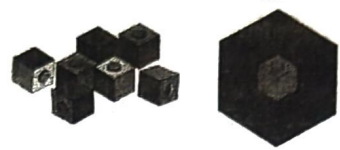
Interlocking cubes come in different colours. Different shapes can be created by joining them.
Image
Sasha is making large cube using small interlocking cubes. She starts with a yellow cube and then fits one layer of red cubes around it to make the large cube.
On the basis of above given information, answer the following questions.

(i) What is the number of red cubes used?
(a) 9 $~~\quad$ (b) 18
(c) 26 $\quad$ (d) 27

(ii) Sasha considers the red layer as the first layer on the yellow cube. Which equation can be used to find the number of red cubes?
(a) $6 x^2$ $~\qquad$ (b) $x^3$
(c) $x^3+1$ $\quad$ (d) $2(x+2)^2+4 x^2$
(iii) The red cube is surrounded by a layer of green cubes. The resulting figure is also a cube. What is the number of green cubes used?
(iv) Shubham puts $\text x$ layers around the yellow cube. How many small cubes did he use on the top-most face of the large cube so formed?
View full solution
Match the Column A to Column B
Column AColumn B
(i) Cube of 26 is(a) 17576
(ii) Cube root of 21952(b) 144
(iii) $\sqrt[3]{125}+(\sqrt[2]{625})^{3}$(c) 28
(iv) $(\sqrt[2]{25})^3+\sqrt[3]{6859}$(d) 15630
View full solution
Q 414 Mark Question4 Marks
Which of the following are perfect cubes?
(i) 400 $\qquad~~$ (ii) 3375 $\quad$ (iii) 8000
(iv) 15625 $\quad$ (v) 9000 $\quad$ (vi) 6859
(vii) 2025 $\quad~$ (viii) 10648
View full solution

Generate a Cubes and Cube Roots paper free

Pick question groups from the list above, set marks and difficulty, and export a branded PDF with step-by-step answer keys. First 3 chapters free — no signup.

Download App