Questions

2 Marks Questions

🎯

Test yourself on this topic

43 questions · timed · auto-graded

Question 12 Marks
$ABC$ is a right-angled triangle and $O$ is the mid point of the side opposite to the right angle. Explain why $O$ is equidistant from $A, B$ and $C. ($The dotted lines are drawn additionally to help you$)$
Answer
Construction : Produce $BO$ to $D$ such that $BO = OD.$ Join $AD$ and $CD.$
Proof : $\overline {AD} \parallel \overline {BC} :\overline {AB} \parallel \overline {DC} $.
So in parallelogram $ABCD,$ the mid point of the diagonal $\overline {AC} $ is $O.$
​​​​​​​Hence, $O$ is equidistant from $A, B$ and $C.$
View full question & answer
Question 22 Marks
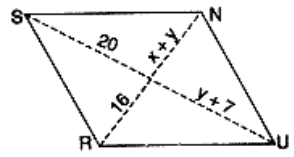
The figure $RUNS$ is a parallelogram. Find $x$ and $y. ($Length is in $cm.)$
Answer
For Figure RUNS
Since the diagonals of a parallelogram bisect each other, therefore
$x + y = 16 ......(1)$
and, $y + 7 = 20 ......(2)$
From $(2),$
$y = 20 - 7 = 13$
Putting $y = 13$ in $(1),$ we get
$x + 13 = 16$
$\Rightarrow x = 16 - 13 = 3.$
View full question & answer
Question 32 Marks
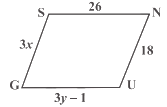
The given figure $GUNS$ is a parallelogram. Find $x$ and $y ($Lengths are in $cm).$
Answer
Since the opposite sides of a parallelogram are of equal length,
Thus, $3x = 18$
$ \Rightarrow x = \frac{{18}}{3} = 6$
and, $3y - 1 = 26$
$\Rightarrow 3y = 26 + 1$
$\Rightarrow 3y = 27$
$ \Rightarrow y = \frac{{27}}{3} = 9$
View full question & answer
Question 42 Marks
Two adjacent angles of a parallelogram have equal measure. Find the measure of each of the angles of the parallelogram.
Answer
Let the two adjacent angles of a parallelogram be $x^\circ $ each.
Then, $x^\circ + x^\circ = 180^\circ (\because $ Sum of the two adjacent angles of a parallelogram is $180^\circ )$
$\Rightarrow 2x^\circ = 180^\circ $
$ \Rightarrow x^\circ = \frac{{180^\circ }}{2}$
$\Rightarrow x^\circ = 90^\circ .$
Since, the opposite angles of a parallelogram are of equal measure, therefore the measure of each of the angles of the parallelogram is $90^\circ .$
View full question & answer
Question 52 Marks
The measure of two adjacent angles of a parallelogram are in the ratio $3 : 2.$ Find the measure of each of the angles of the parallelogram.
Answer
Let the two adjacent angles be $3x^\circ $ and $2x^\circ .$
Then,
$3x^\circ + 2x^\circ = 180^\circ (\because$ Sum of the two adjacent angles of a parallelogram is $180^\circ )$
$\Rightarrow 5x^\circ = 180^\circ $
$ \Rightarrow x^\circ = \frac{{180^\circ }}{5}$
$\Rightarrow x^\circ = 36^\circ $
$\Rightarrow 3x^\circ = 3 \times 36^\circ = 108^\circ $
and $2x^\circ = 2 \times 36^\circ = 72^\circ $
Since, the opposite angles of a parallelogram of equal measure, therefore the measures of the angles of the parallelogram are $72^\circ , 108^\circ , 72^\circ $ and $108^\circ .$
View full question & answer
Question 62 Marks
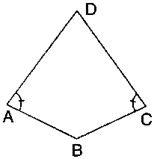
Draw a rough figure of a quadrilateral that is not a parallelogram but has exactly two opposite angles of equal measure.
Answer


A kite for example has two pairs of adjacent sides
So, $AB = BC$ and $AD = DC$
View full question & answer
Question 72 Marks
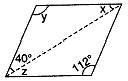
Consider the parallelogram. Find the degree values of the unknowns $x, y, z.$
.
Answer
$y = 112^\circ [ $Opposite angles of a parallelogram are equal$ ]$
$x + y + 40^\circ = 180^\circ [ $Angle sum property$]$
$\Rightarrow x + 112^\circ + 40^\circ = 180^\circ $
$\Rightarrow x + 152^\circ = 180^\circ $
$\Rightarrow x = 180^\circ – 152^\circ $
$\Rightarrow x = 28^\circ $
$z = x = 28^\circ .[$Alternate angles are equal$]$
View full question & answer
Question 82 Marks
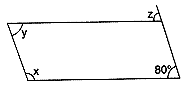
Consider the parallelogram. Find the degree values of the unknowns $x, y,$ and $z.$
Answer
$y = 80^\circ [ $Opposite angles of a parallelogram are equal$ ]$
$x + 80^\circ = 180^\circ [ $Sum of Conjoint angles are equal to $180^\circ]$
$\Rightarrow x = 180^\circ – 80^\circ $
$\Rightarrow x = 100^\circ $
$z = 80^\circ [ $Corresponding angles$]$
View full question & answer
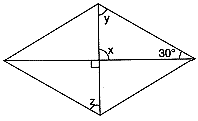
Question 92 Marks
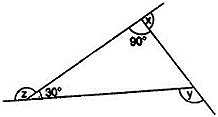
Consider the parallelogram. Find the degree values of the unknowns $x, y, z.$
Answer
$x = 90^\circ [$Vertically opposite angles$]$
$x + y + 30^\circ = 180^\circ [ $Sum of angles of a triangle is equal to $180^\circ]$
$\Rightarrow 90^\circ + y + 30^\circ = 180^\circ $
$\Rightarrow 120^\circ + y = 180^\circ $
$\Rightarrow y = 180^\circ – 120^\circ = 60^\circ $
$y = z = 60^\circ [$Vertically opposite angles$]$
View full question & answer
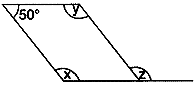
Question 102 Marks
Consider the parallelogram. Find the degree values of the unknowns $x, y,$ and $z.$
.
Answer
$x + 50^\circ = 180^\circ [$Conjoint angles are equal$]$
$\Rightarrow x = 180^\circ – 50^\circ = 130^\circ $
$y = x = 130^\circ [ $Opposite angles of a parallelogram are equal$]$
$180^\circ – z = 50^\circ $
$\Rightarrow z = 180^\circ – 50^\circ = 130^\circ [$Sum of angles on a straight line is equal to two right angles$]$
View full question & answer
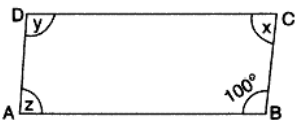
Question 112 Marks
Consider the parallelogram. Find the degree values of the unknowns $x, y, z$
Answer
$y = 100^\circ [$ Opposite angles of a parallelogram are equal$]$
$x + 100^\circ = 180^\circ [$Conjoint angles are equal$]$
$\Rightarrow x = 180^\circ – 100^\circ $
$\Rightarrow x = 80^\circ $
$z = x = 80^\circ [$ Opposite angles of a parallelogram are equal$]$
View full question & answer
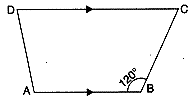
Question 122 Marks
Find $m\angle C$ in the figure. If $\overline {AB} \parallel \overline {DC} $.
Answer
$\because AB\parallel DC$
$\therefore m\angle C + m\angle B = 180^\circ $ [Co-interior angles]
$ \Rightarrow m\angle C + 120^\circ = 180^\circ $
$ \Rightarrow m\angle C + 180^\circ - 120^\circ = 60^\circ $.
View full question & answer
Question 132 Marks
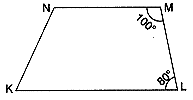
Explain how this figure is a trapezium. Which of its two sides are parallel$?$
Answer
$\because \angle KLM + \angle NML = 80^\circ + 100^\circ = 180^\circ $
[As the angles are collinear, so the sides are parallel]
$\therefore KL\parallel NM$
$\therefore$ Figure $KLMN$ is a trapezium.
View full question & answer
Question 142 Marks
What is the maximum exterior angle possible for a regular polygon$?$
Answer
Consider a regular polygon having the lowest possible number of sides (i.e., an equilateral triangle). The exterior angle of this triangle will be the maximum exterior angle possible for any regular polygon.The greatest exterior angle is $180^\circ – 60^\circ = 120^\circ $
View full question & answer
Question 152 Marks
What is the minimum interior angle possible for a regular polygon$?$ Why$?$
Answer
The equilateral triangle being a regular polygon of $3$ sides has the least measure of an interior angle $= 60^\circ .$
$[ $Sum of all angles of a triangle/ No. of sides $= 180^\circ / 3 = 60^\circ]$
View full question & answer
Question 162 Marks
Can $22^\circ$ be an interior angle of a regular polygon? Why?
Answer
If $22^\circ$ is an interior angle, then $180^\circ-22^\circ$, i.e. $158^\circ$ is exterior angle.
Therefore Number of sides $=\frac{360^{\circ}}{158^{\circ}}=\frac{180^{\circ}}{79}$
Thus, $22^\circ$ cannot be an interior angle of a regular polygon.
View full question & answer
Question 172 Marks
Is it possible to have a regular polygon with measure of each exterior angle as $22^\circ ?$
Answer
No, since $22^\circ $ is not divisible by $360^\circ .$
View full question & answer
Question 182 Marks
How many sides does a regular polygon have if each of its interior angles is $165^\circ ?$
Answer
$\because $ Each interior angle $= 165^\circ $
$\therefore $ Each exterior angle $= 180^\circ – 165^\circ = 15^\circ $
Let the number of sides be $n.$ Then,
$n(15^\circ ) = 360^\circ $
$ \Rightarrow n = \frac{{360^\circ }}{{15^\circ }} = 24^\circ $
Hence, the number of sides is $24.$
View full question & answer
Question 192 Marks
How many sides does a regular polygon have if the measure of an exterior angle is $24^\circ ?$
Answer
Let the number of sides be $n,$ Then, $n(24^\circ ) = 360^\circ .$
$ \Rightarrow n = \frac{{360^\circ }}{{24^\circ }} = 15$
Hence, the number of sides is $15.$
View full question & answer
Question 202 Marks
Find the measure of each exterior angle of a regular polygon of $15$ sides.
Answer
$n = 15$
Size of each exterior angle of a regular polygon $= \frac{360}{n}$
$= \frac{360}{15}$ $= 24^\circ$
View full question & answer
Question 212 Marks
Find the measure of each exterior angle of a regular polygon of $9$ sides.
Answer
$9$ sides
Size of each exterior angle $ = \frac{{360^\circ }}{9} = 40^\circ $
View full question & answer
Question 222 Marks
Find $x$ in figure:
Answer
The sum of the measures of the exterior angles of any polygon is $360^\circ$.
So, $x + 70^\circ+ 60^\circ+ 90^\circ+ 90^\circ= 360^\circ$
$\Rightarrow$ $x + 310^\circ= 360^\circ$
$\Rightarrow$ $x = 360^\circ- 310^\circ$
$\Rightarrow$ $x = 50^\circ$
View full question & answer
Question 232 Marks
Find $x$ in the figures.
Answer
$x + 70^\circ + 60^\circ + (90^\circ + 90^\circ ) = 360^\circ [\because $ The sum of the measures of the exterior angles of any polygon is $360^\circ .]$
$\therefore x + 310^\circ = 360^\circ $
$\therefore x = 360^\circ – 310^\circ $
$\therefore x = 50^\circ $
View full question & answer
Question 242 Marks
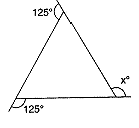
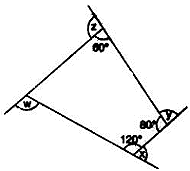
Find $x + y + z + w.$
Answer
By angle sum property of a quadrilateral.
$180^\circ - x + 180^\circ - y + 180^\circ - z + 180^\circ - w = 360^\circ $
$-x -y -z -w =360^\circ -180^\circ -180^\circ -180^\circ -180^\circ $
$-x -y -z -w = - 360^\circ $
Multiplying $-1$ to both sides we get,
$\therefore x + y + z + w = 360^\circ .$
View full question & answer
Question 252 Marks
Find $x + y + z$
Answer
By angle sum property of a triangle.
$180^\circ - x + 180^\circ - z + 180^\circ - y = 180^\circ $
$-x -y -z =180^\circ -180^\circ - 180^\circ - 180^\circ $
$-x -y -z = - 360^\circ $
Multiplying $-1$ to both sides we get,
$\therefore $ $x + y + z = 360^\circ $
View full question & answer
Question 262 Marks
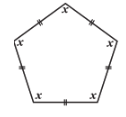
Find the angle measure $x$ in the figure.
Answer
Let each angle of the pentagon be $'x'$
$x + x + x + x + x = (5 - 2) \times 180^\circ $ [ By angle sum property of a pentagon]
$\therefore $ $5x = 540^\circ $
$\therefore $ $x = \frac{{540^\circ }}{5}$
$\therefore $ $x = 108^\circ $
View full question & answer
Question 272 Marks
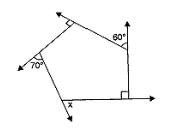
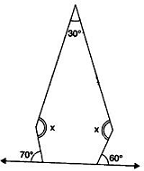
Find the $\angle$ measure $x$ in the below figure.
Answer
$x + 30^\circ + x + (180^\circ – 70^\circ ) + (180^\circ – 60^\circ ) = (5 – 2)$
$\times$ $180^\circ $ [ By angle sum property of a pentagon]
$\therefore$ $2x + 30^\circ + 110^\circ + 120^\circ = 540^\circ $
$\therefore$ $2x + 260^\circ = 540^\circ $
$\therefore$ $2x = 540^\circ – 260^\circ$
$\therefore$ $2x = 280^\circ $
$\therefore$ $x = \frac{{280^\circ }}{2}$
$\therefore$ $x = 140^\circ $
View full question & answer
Question 282 Marks
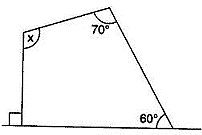
Find the angle measure $x$ in the below figure.
Answer
$x + (180^\circ – 90^\circ ) + 60^\circ + 70^\circ = 360°$ [By angle sum property of a quadrilateral]
$\therefore $ $x + 220^\circ = 360^\circ $
$\therefore $ $x = 360^\circ – 220^\circ $
$\therefore $ $x = 140^\circ $
View full question & answer
Question 292 Marks
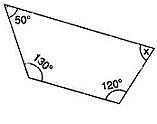
Find the angle measure $x$ in this figure.
Answer
$x + 50^\circ + 130^\circ + 120^\circ = 360^\circ $ [By angle sum property of a quadrilateral]
$\therefore $ $x + 300^\circ = 360^\circ $
$\therefore $ $x = 360^\circ – 300^\circ $
$\therefore $ $x = 60^\circ $
View full question & answer
Question 302 Marks
What is a regular polygon? State the name of a regular polygon of 6 sides.
Answer
A polygon having all sides of equal length and the interior angles of equal size is known as a regular polygon.
The name of the regular polygon is regular hexagon.
View full question & answer
Question 312 Marks
What is a regular polygon? State the name of a regular polygon of $4$ sides.
Answer
A polygon having all sides of equal length and the interior angles of equal size is known as a regular polygon.
The name of the regular polygon of $4$ sides is square.
View full question & answer
Question 322 Marks
What is a regular polygon? State the name of a regular polygon of $3$ sides.
Answer
A polygon having all sides of equal length and the interior angles of equal size is known as a regular polygon.
The name of the regular polygon is equilateral triangle.
View full question & answer
Question 332 Marks
Examine the table. (Each figure is divided into triangles and the sum of the angles deduced from that.)
Figure
Side $3$ $4$ $5$ $6$
Angle sum $180^\circ$ $2 \times 180^{\circ}$
$=(4-2) \times 180^{\circ}$
$3 \times 180^{\circ}$
$=(5-2) \times 180^{\circ}$
$4 \times 180^{\circ} $
$=(6-2) \times 180^{\circ}$
What can you say about the angle sum of a convex polygon with n number of sides?
Answer
From the table, it can be concluded that the angle sum of a convex polygon of n sides is $(n - 2)$ $\times$ $180^\circ$
Hence, the angle sum of the convex polygons having the number of sides as above will be as follows:
Given number of sides $= n$
$\therefore$ Sum of angles $= (n - 2)$ $\times$ $180^\circ$
View full question & answer
Question 342 Marks
Examine the table. (Each figure is divided into triangles and the sum of the angles deduced from that.)
Figure
Side $3$ $4$ $5$ $6$
Angle sum $180^\circ$ $2 \times 180^{\circ}$
$=(4-2) \times 180^{\circ}$
$3 \times 180^{\circ}$
$=(5-2) \times 180^{\circ}$
$4 \times 180^{\circ} $
$=(6-2) \times 180^{\circ}$
What can you say about the angle sum of a convex polygon with $10$ number of sides?
Answer
From the table, it can be concluded that the angle sum of a convex polygon of n sides $= (n - 2)$ $\times$ $180^\circ$
Given that number of sides $= 10$
Therefore, Sum of angles $= (10 - 2)$ $\times$ $180^\circ= 1440^\circ$
View full question & answer
Question 352 Marks
Examine the table. (Each figure is divided into triangles and the sum of the angles deduced from that.)
Figure
Side $3$ $4$ $5$ $6$
Angle sum $180^\circ$ $2 \times 180^{\circ}$
$=(4-2) \times 180^{\circ}$
$3 \times 180^{\circ}$
$=(5-2) \times 180^{\circ}$
$4 \times 180^{\circ} $
$=(6-2) \times 180^{\circ}$
What can you say about the angle sum of a convex polygon with $8$ number of sides?
Answer
From the table, it can be concluded that the angle sum of a convex polygon of n sides is $(n - 2)$ $\times$ $180^\circ$
Given that number of sides $= 8$
Therefore, Sum of angles $= (8 - 2) \times180^\circ= 1080^\circ$
View full question & answer
Question 362 Marks
Examine the table. (Each figure is divided into triangles and the sum of the angles deduced from that.)
Figure
Side $3$ $4$ $5$ $6$
Angle sum $180^\circ$ $2 \times 180^{\circ}$
$=(4-2) \times 180^{\circ}$
$3 \times 180^{\circ}$
$=(5-2) \times 180^{\circ}$
$4 \times 180^{\circ} $
$=(6-2) \times 180^{\circ}$
What can you say about the angle sum of a convex polygon with $7$ number of sides?
Answer
From the table, it can be concluded that the angle sum of a convex polygon of n sides is $(n - 2)$ $\times$ $180^\circ$
Given: number of sides $= 7$
Therefore, Sum of angles $= (7 - 2)$ $\times$ $180^\circ$ $= 900^\circ$
View full question & answer
Question 372 Marks
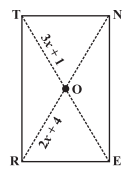
$RENT$ is a rectangle. Its diagonals meet at $O$. Find $x$, if $OR = 2x + 4$ and $OT = 3x + 1$.
.
Answer
$OT$ is half of the diagonal $TE$ and $OR$ is half of the diagonal $RN$.
Now, as the diagonals are equal in rectangle, so, their halves are also equal.
Therefore, $3x + 1 = 2x + 4$
or $3x - 2x = 4 - 1$
or $x = 3$
View full question & answer
Question 382 Marks
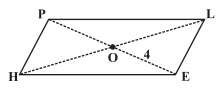
$HELP$ is a parallelogram (Lengths are in cms). Given that $OE = 4$ and $HL$ is $5$ more than $PE$. Find $OH$.
Answer
As we know the diagonals of a parallelogram bisect each other,
So if $OE = 4$ then $OP$ also is $4$.
So $PE = OE + OP = 8$
Therefore $HL = PE + 5 = 8 + 5 = 13$
Hence, $OH =$ $\frac{1}{2}\times13$ $= 6.5\ cm$
View full question & answer
Question 392 Marks
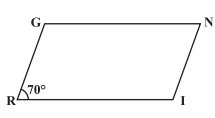
In a parallelogram $RING$ (figure), if m$∠R = 70^\circ $, find all the other angles.
Answer


Given: $m∠R = 70^\circ $
Then $m∠N = 70^\circ $because $∠R$ and $∠N$ are opposite angles of a parallelogram.
Since $∠R $ and $∠I$ are supplementary,
$m∠I = 180^\circ – 70^\circ = 110^\circ $
Also, $m∠G = 110^\circ $ since $∠G$ is opposite to $∠I $
Thus, $m∠R = m\angle N = 70^\circ $ and $m∠I = m∠G = 110^\circ $
View full question & answer
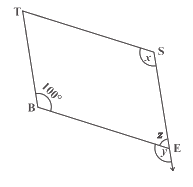
Question 402 Marks
$BEST$ is a parallelogram. Find the values $x, y$ and $z$.
Answer


$S$ is opposite to $B$.
So, $x = 100^\circ$ (opposite angles property)
$y = 100^\circ $ (measure of angle corresponding to $∠x)$
$z = 80^\circ $ (since $∠y, ∠z$ is a linear pair)
View full question & answer
Question 412 Marks
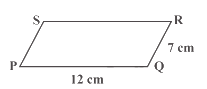
Find the perimeter of the parallelogram $PQRS$.
Answer

In a parallelogram, the opposite sides have same length.
Therefore, $PQ = SR = 12\ cm$ and $QR = PS = 7\ cm$
So, Perimeter $= PQ + QR + RS + SP$
$= 12 cm + 7 cm + 12 cm + 7 cm = 38\ cm$
View full question & answer
Question 422 Marks
Find the number of sides in a regular polygon when the measure of each exterior angle is $45^\circ$.
Answer
If the polygon has $n$ sides,
Then, we know that; $n = 360^\circ$ /measure of each exterior angle$\frac{360^\circ}{measure\;of\;each\;exterior\;angle}$
= $\frac{360^\circ}{45^\circ}$
$= 8$
Therefore, the regular polygon has $8$ sides.
View full question & answer
Question 432 Marks
Find the measure of angle $x$ in figure.
Answer
The sum of exterior angles of quadrilateral is $360^\circ$
So, $x + 90^\circ+ 50^\circ+ 110^\circ= 360^\circ$
$x + 250^\circ = 360^\circ$
$x = 110^\circ$
View full question & answer
2 Marks Questions - MATHS STD 8 Questions - Vidyadip