Question types

Particulate Nature of Matter question types

99 questions across 8 question groups — pick any mix to generate a Science paper with step-by-step answer keys.

99
Questions
8
Question groups
5
Question types
Sample Questions

Particulate Nature of Matter questions

One sample from each question group in this chapter. Select any group above to see the full set with answer keys.

The primary difference between solids and liquids is that the constituent particles are:
  • A
    closely packed in solids, while they are stationary in liquids.
  • B
    far apart in solids and have fixed positions in liquids.
  • C
    always moving in solids and have a fixed position in liquids.
  • closely packed in solids and move past each other in liquids.

Answer: D.

View full solution
Assertion (A): Gases can be compressed easily as compared to solids and liquids.
Reason (R): The particles in gases are closely packed with very little inter-particle space.
  • A
    Both (A) and (R) are true, and (R) is the correct explanation of (A).
  • B
    Both (A) and (R) are true, but (R) is not the correct explanation of (A).
  • (A) is true, but (R) is false.
  • D
    (A) is false, but (R) is true.

Answer: C.

View full solution
Assertion (A): The physical state of a substance depends on the arrangement and movement of its particles.
Reason (R): Solids have the least interparticle spacing and particles vibrate in fixed positions, while gases have maximum spacing and move freely in all directions.
  • Both (A) and (R) are true, and (R) is the correct explanation of (A).
  • B
    Both (A) and (R) are true, but (R) is not the correct explanation of (A).
  • C
    (A) is true, but (R) is false.
  • D
    (A) is false, but (R) is true.

Answer: A.

View full solution
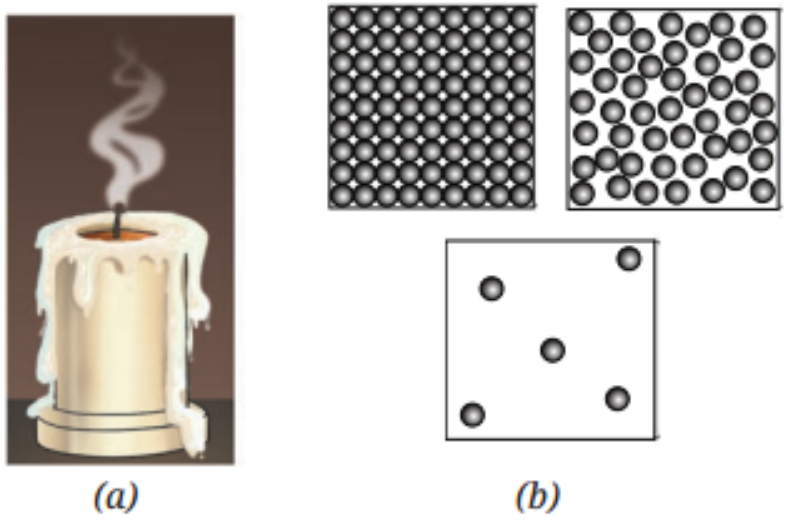
Observe figure (A), which shows the image of a candle that was just extinguished after burning for some time. Identify the different states of wax in the figure and match them with figure B, showing the arrangement of particles.
Image
View full solution
Column AColumn B
Q.1. Particulate matter(a) Very large
Q.2. Matter is composed of(b) Tiny particles suspended in the air
Q.3. The state of matter depends on(c) Atoms 86 molecules
Q.4. Interparticle spacing in gases(d) Temperature and Pressure
View full solution

Generate a Particulate Nature of Matter paper free

Pick question groups from the list above, set marks and difficulty, and export a branded PDF with step-by-step answer keys. First 3 chapters free — no signup.

Download App