Question 11 Mark
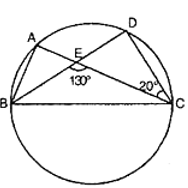
In figure, A, B, C, D are four points on the circle. AC and BD intersect at a point E such that $\angle$BEC = 130° and $\angle$ECD = 20° Find $\angle$BAC.
Answer
View full question & answer→Given: $\angle$BEC = 130° and $\angle$ECD = 20°
$\angle$DEC = 180° - $\angle$BEC = 180° - 130° = 50° [Linear pair]
Now in $\triangle$DEC,
$\angle$DEC + $\angle$DCE + $\angle$EDC = 180° [Angle sum property]
$\Rightarrow$ 50° + 20° + $\angle$EDC = 180° $\Rightarrow$ $\angle$EDC = 110°
$\Rightarrow$ $\angle$BAC = $\angle$EDC = 110° [Angles in same segment]
$\angle$DEC = 180° - $\angle$BEC = 180° - 130° = 50° [Linear pair]
Now in $\triangle$DEC,
$\angle$DEC + $\angle$DCE + $\angle$EDC = 180° [Angle sum property]
$\Rightarrow$ 50° + 20° + $\angle$EDC = 180° $\Rightarrow$ $\angle$EDC = 110°
$\Rightarrow$ $\angle$BAC = $\angle$EDC = 110° [Angles in same segment]