Questions · Page 1 of 5

M.C.Q

🎯

Test yourself on this topic

50 questions · timed · auto-graded

MCQ 11 Mark
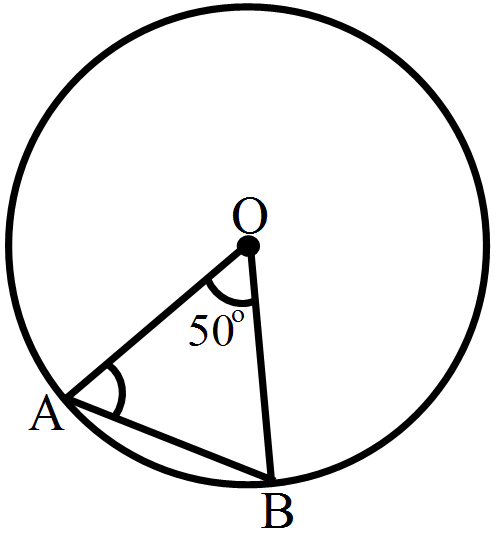
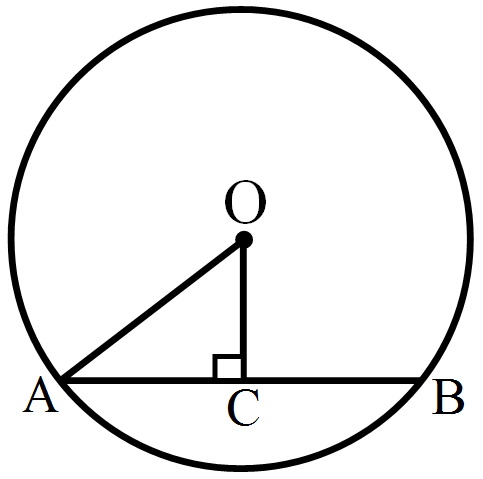
In the given figure, O is the centre of a circle. Then, $\angle\text{OAB}=?$
  • A
    50°
  • B
    60°
  • C
    55°
  • D
    65°

Answer
  1. 65°
    Solution:
    OA = OB [Radii of the same circle]
    $\Rightarrow\ \angle\text{OAB}=\angle\text{OBA}$
    In $\triangle\text{OAB},$
    $\angle\text{BOA}+\angle\text{OAB}+\angle\text{OBA}=180^\circ$ [Angle sum property]
    $\Rightarrow\ 50^\circ+\angle\text{OAB}+\angle\text{OAB}=180^\circ$
    $\Rightarrow\ 2\angle\text{OAB}=130^\circ$
    $\Rightarrow\ \angle\text{OAB}=65^\circ$
View full question & answer
MCQ 21 Mark
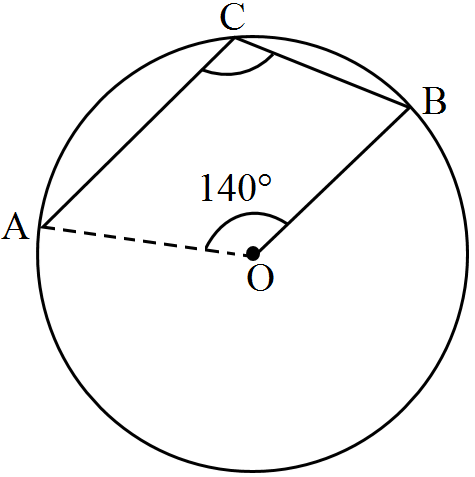
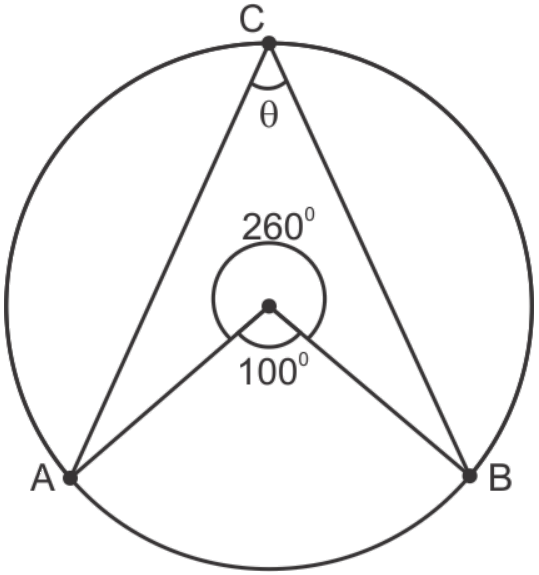
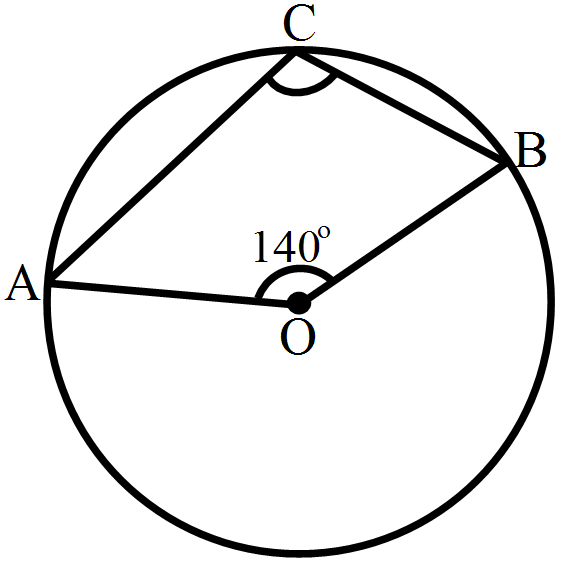
In the given figure, O is the centre of a circle and $\angle\text{AOB}=140^\circ.$ Then, $\angle\text{ACB}=?$
  • A
    70°
  • B
    80°
  • C
    110°
  • D
    40°

Answer
  1. 110°
    Solution:
    Minor $\angle\text{AOB}=140^\circ$
    Major $\angle\text{AOB}=360^\circ-140^\circ$
    ⇒ Major $\angle\text{AOB}=220^\circ$
    Since $\angle\text{ACB}=\frac{1}{2}\text{major}\angle\text{AOB}$
    $\Rightarrow\ \angle\text{ACB}=\frac{1}{2}(220^\circ)$
    $\Rightarrow\ \angle\text{ACB}=110^\circ$
View full question & answer
MCQ 41 Mark
The greatest chord of a circle is called its:
  • A
    Radius.
  • B
    Secant.
  • C
    Diameter.
  • D
    None of these.
Answer
  1. Diameter.
    Solution:
    The greatest chord of the circle is diameter of the circle.
View full question & answer
MCQ 61 Mark
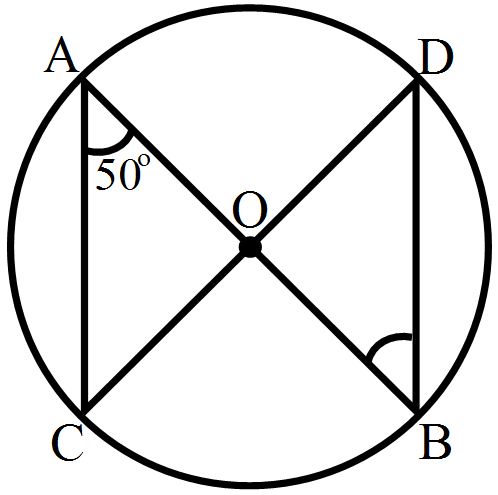
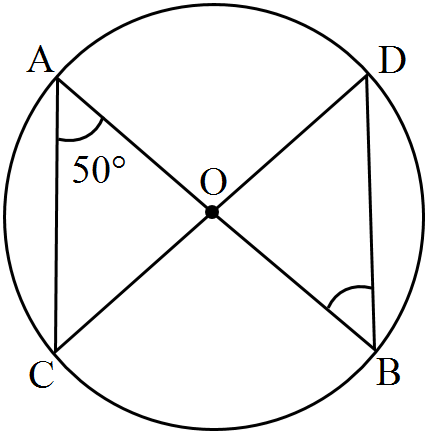
In the given figure, O is the centre of a circle. If $\angle\text{OAC}=50^\circ$ then $\angle\text{ODB}=?$
  • A
    40°
  • B
    50°
  • C
    60°
  • D
    75°

Answer
  1. 50°
    Solution:
    Since angles in the same segment of a circle are equal.
    $\angle\text{CDB}=\angle\text{BAC}$
    That is , $\angle\text{ODB}=\angle\text{OAC}=50^\circ.$
View full question & answer
MCQ 71 Mark
Greatest chord of a circle is called its:
  • A
    Chord
  • B
    Diameter
  • C
    Secant
  • D
    Radius
Answer
  1. Diameter
    Solution:
    Since diameter is the longest segment that can be drawn in a circle(touching the circle at both ends), therefore it is the longest possible chord also.
View full question & answer
MCQ 81 Mark
One half of the whole arc of a circle.
  • A
    Semi-circle
  • B
    Sector
  • C
    Circumference
  • D
    Segment
Answer
  1. Semi-circle
    Solution:
    A semi-circle is half the circle. In other words, half of the total length of the circle makes the semicircle.
View full question & answer
MCQ 91 Mark
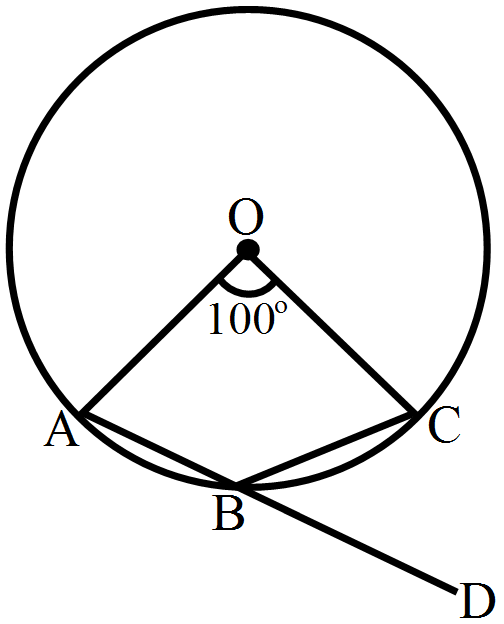
In the given figure, O is the centre of a circle in which $\angle\text{AOC}=100^\circ.$ Side AB of quadrilateral OABC has been produced to D. Then, $\angle\text{CBD}=?$
  • A
    50°
  • B
    40°
  • C
    25°
  • D
    80°

View full question & answer
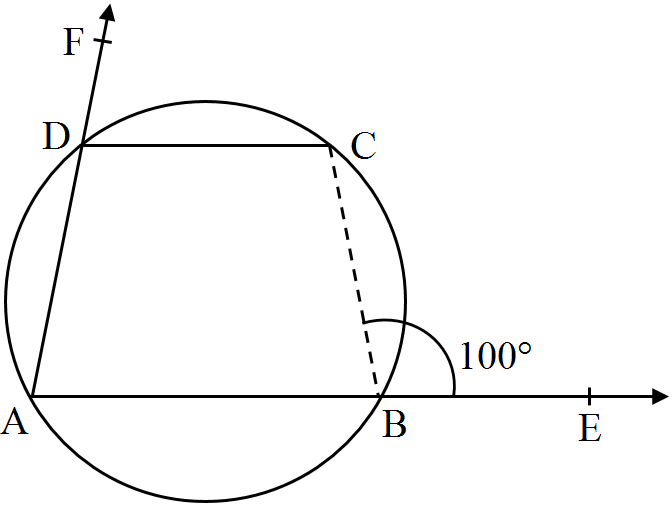
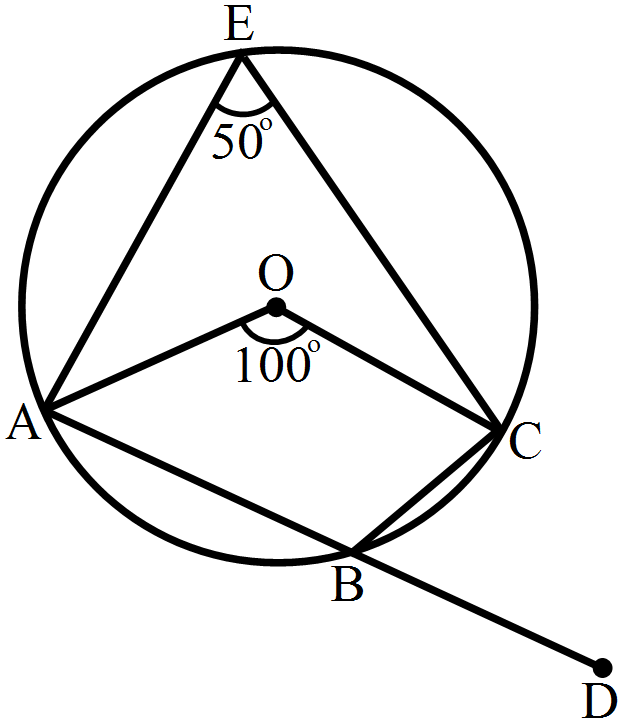
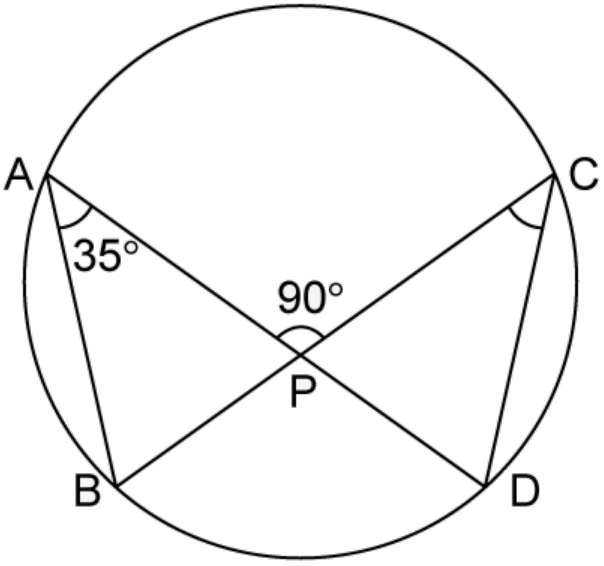
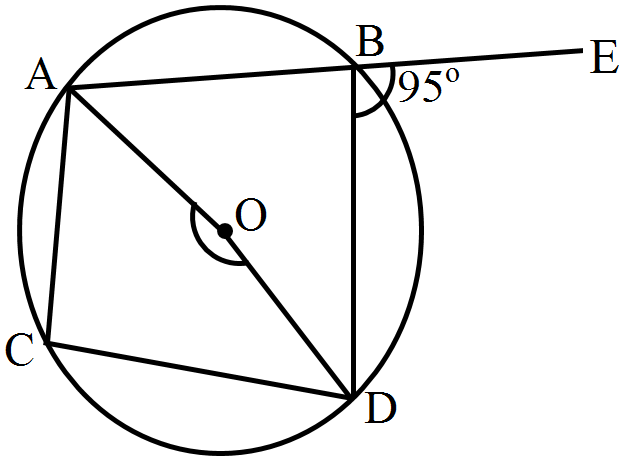
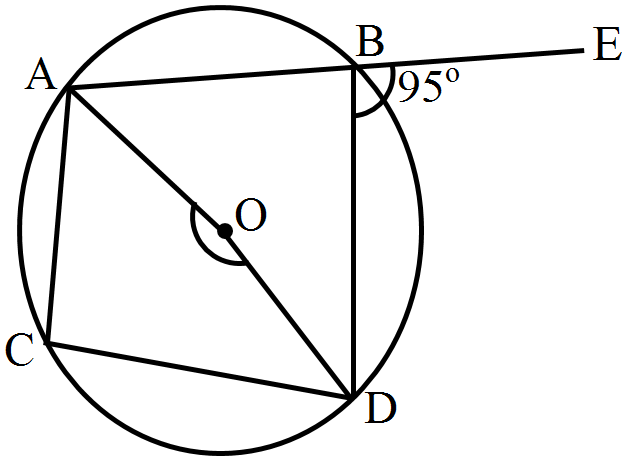
MCQ 101 Mark
  • A
    25º
  • B
    50º
  • C
    45º
  • D
    40º
View full question & answer
MCQ 111 Mark
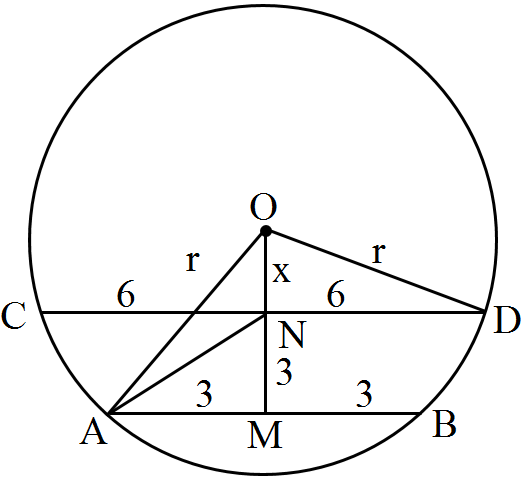
AB and CD are two parallel chords of a circle with centre O such that AB = 6cm and CD = 12cm. The chords are on the same side of the centre and the distance between them is 3cm. The radius of the circle, is:
  • A
    $7\text{cm}$
  • B
    $6\text{cm}$
  • C
    $3\sqrt{5}\text{cm}$
  • D
    $5\sqrt{2}\text{cm}$
View full question & answer
MCQ 121 Mark
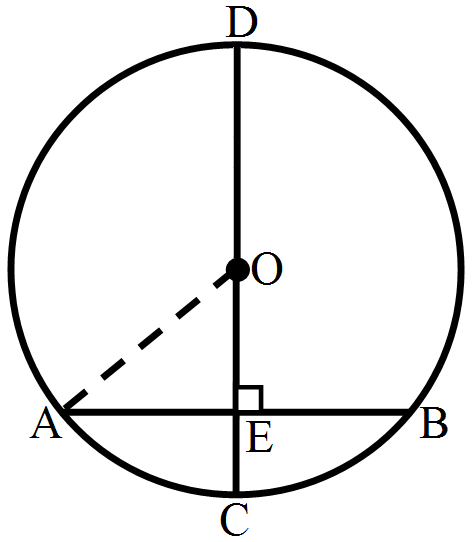
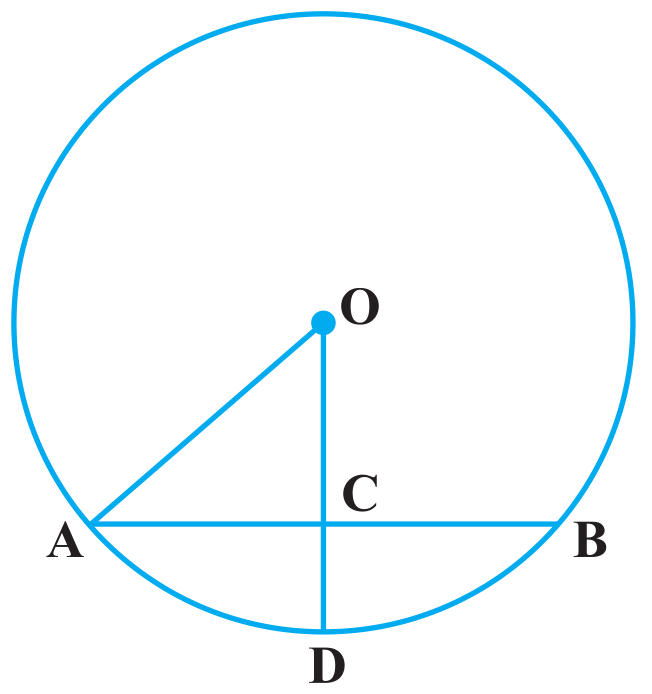
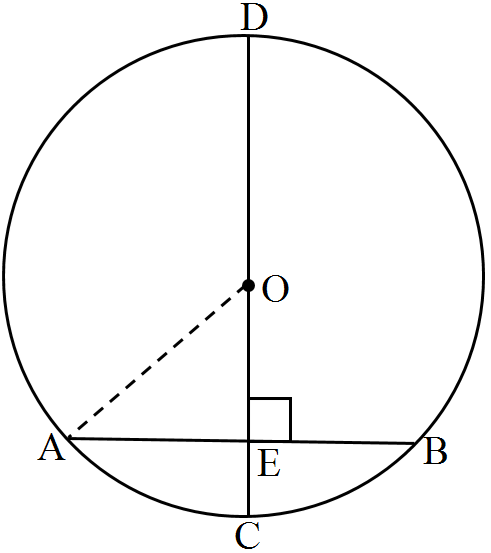
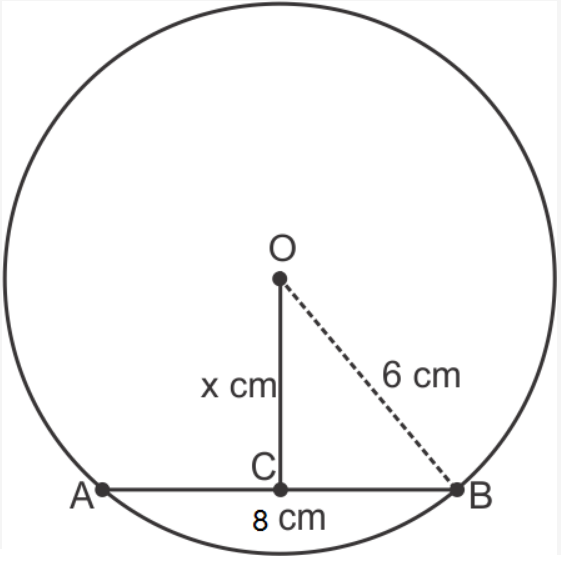
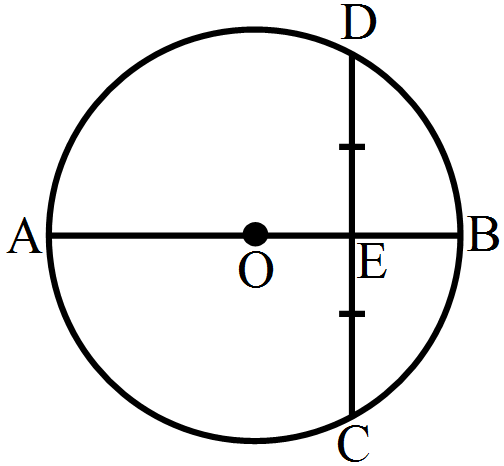
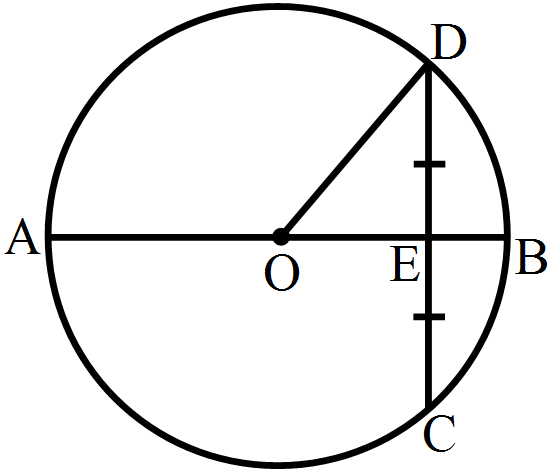
In the given figure, CD is the diameter of a circle with centre O and CD is perpendicular to chord AB. If AB = 12cm and CE = 3cm, then radius of the circles is:
  • A
    6cm
  • B
    9cm
  • C
    7.5cm
  • D
    8cm

Answer
  1. 7.5cm
    Solution:
    OA = OC
    ⇒ OA = OE + CE
    ⇒ OA = OE + 3
    ⇒ OE = OA - 3 ...(i)
    $\text{AE}=\frac{1}{2}\text{AB}$ [Perpendicular drawn from the centre of a circle to the chord bisect the chord]
    $=\frac{1}{2}(12)=6\text{cm}$
    In right $\triangle\text{OEA},$
    OA2 = OE2 + AE2
    ⇒ OA2 = (OA - 3)2 + AE2 [From (i)]
    ⇒ OA2 = OA2 - 6OA + 9 + AE2
    ⇒ 6OA = 9 + 62
    ⇒ 6OA = 9 + 36
    $\Rightarrow\ \text{OA}=\frac{45}{6}=7.5\text{cm}$
    So, the radius of the circle is 7.5cm.
View full question & answer
MCQ 141 Mark
A chord is at a distance of 8cm from the centre of a circle of radius 17cm. The length of the chord is:
  • A
    25cm
  • B
    12.5cm
  • C
    30cm
  • D
    9cm
View full question & answer
MCQ 151 Mark
Circle having same centre are said to be:
  • A
    Secant
  • B
    Concentric
  • C
    Chord
  • D
    Circle
Answer
  1. Concentric
    Solution:
    Concentric circles are those circle that is drawn with the same point as a centre but different radii.
View full question & answer
MCQ 171 Mark
  • A
    7.5cm
  • B
    9.5cm
  • C
    10.5cm
  • D
    8.5cm
Answer
  1. 8.5cm
    Solution:
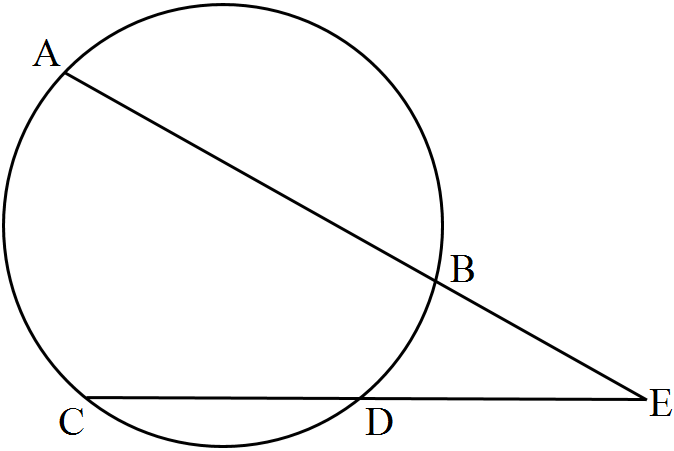
    Join AC.
    Then AE : CE = DE : BE (Intersecting secant theorem)
    $\therefore$ AE × BE = DE × CE ....(i)
    Let CD = x cm
    Then AE = (AB + BE) = (11 + 3)cm = 14cm;
    BE = 3cm; CE = (x + 3.5)cm; DE = 3.5cm
    $\therefore$ 14 × 3 = (x + 3.5) × 3.5 [FROM (1)]
    $\Rightarrow\text{x}+3.5=\frac{14\times3}{3.5}=\frac{42}{3.5}=12$
    ⇒ x = (12 - 3.5)cm = 8.5cm
    Hence, CD = 8.5cm
View full question & answer
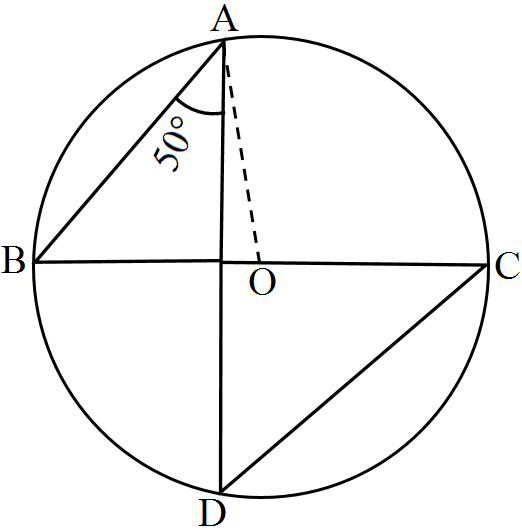
MCQ 191 Mark
  • A
    9cm
  • B
    6cm
  • C
    8cm
  • D
    7.5cm
Answer
  1. 7.5cm
    Solution:
    Let OA = OC = r cm.
    Then OE = (r - 3)cm and $\text{AE}=\frac{1}{2}\text{AB}=6\text{cm}$
    Now, in right $\triangle\text{OAE},$ we have:
    OA2 = OE2 + AE2 [Using paythagoras theorem]
    ⇒ (r)2 = (r - 3)2 + 62
    ⇒ r2 = r2 + 9 - 6r + 36
    ⇒ 6r = 45
    $\Rightarrow\text{r}=\frac{45}{6}=7.5\text{cm}$
    Hence, the required radius of the circle is 7.5cm.
View full question & answer
MCQ 201 Mark
  • A
    110º
  • B
    70º
  • C
    80º
  • D
    40º
Answer
  1. 110º
    Solution:
    Let, D on any point on circumference and join AD and BD,
    Now, $\angle\text{ADB}=\frac{\angle\text{AOB}}{2}$
    $\angle\text{ADB}=\frac{140}{2}=70^\circ$
    Now, in cyclic quadrilateral ADBC
    $\Rightarrow\angle\text{ADB}+\angle\text{ACB}=180^\circ$
    $\Rightarrow\angle\text{ACB}=180^\circ-\angle\text{ADB}$
    $\Rightarrow\angle\text{ACB}=180^\circ-70^\circ$
    $\Rightarrow\angle\text{ACB}=110^\circ$
View full question & answer
MCQ 211 Mark
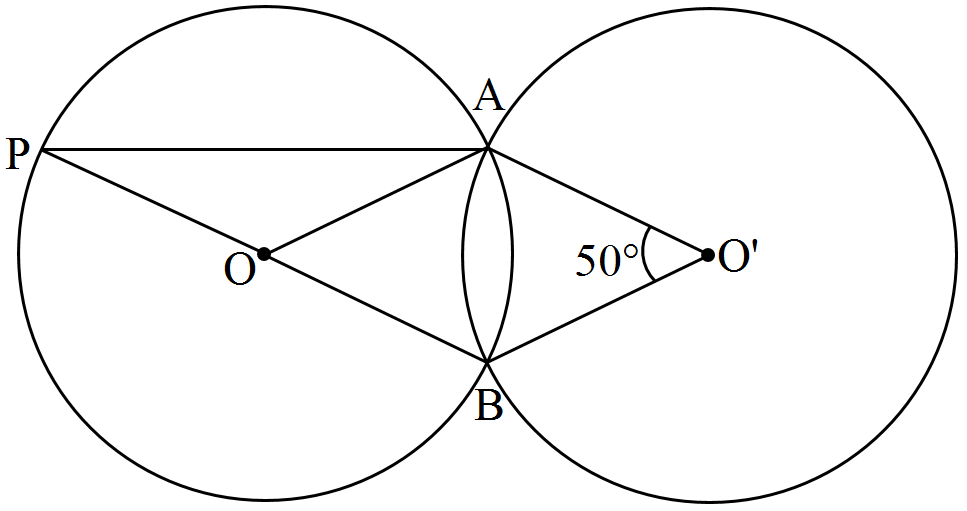
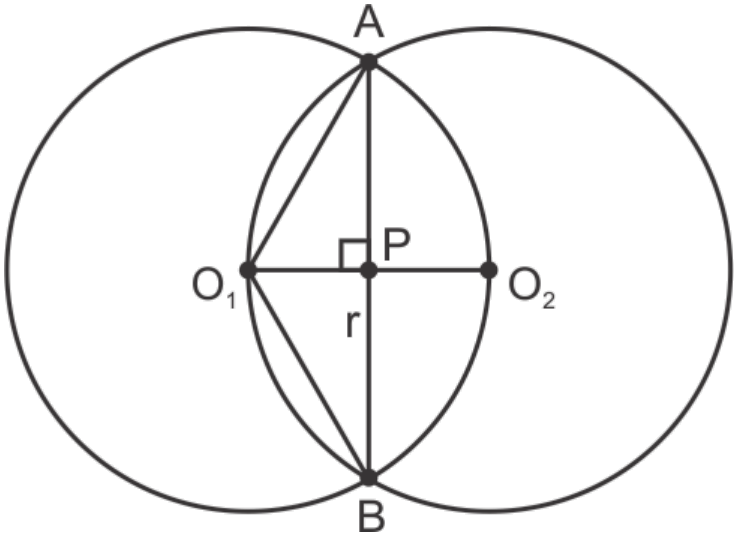
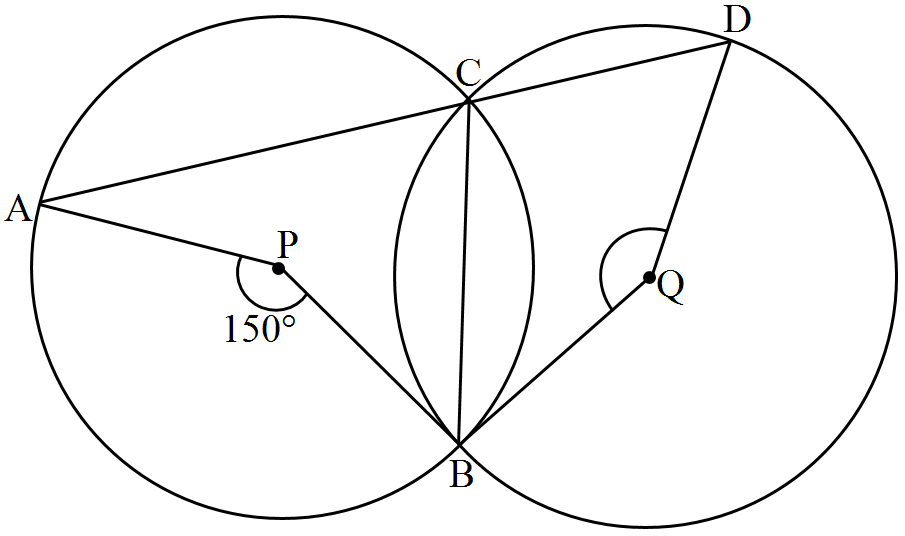
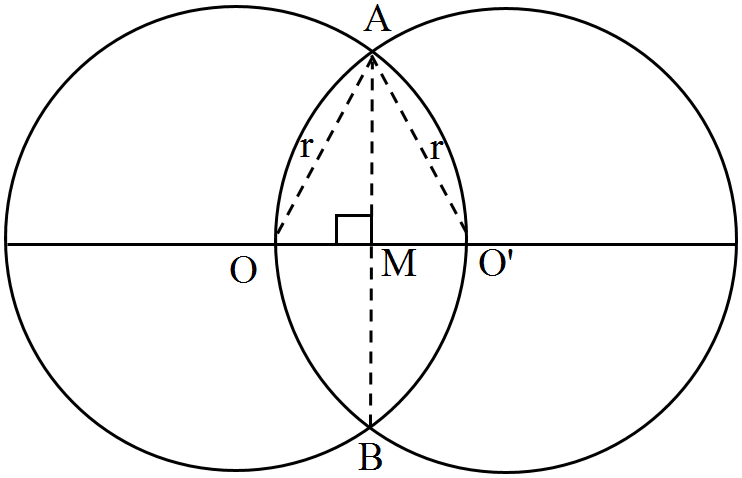
Two equal circles of radius r intersect such that each passes through the centre of the other. The length of the common chord of the circle is:
  • A
    $\sqrt{\text{r}}$
  • B
    $\sqrt{2}\text{r}\text{AB}$
  • C
    $\sqrt{3}\text{r}$
  • D
    $\frac{\sqrt3}{2}$
View full question & answer
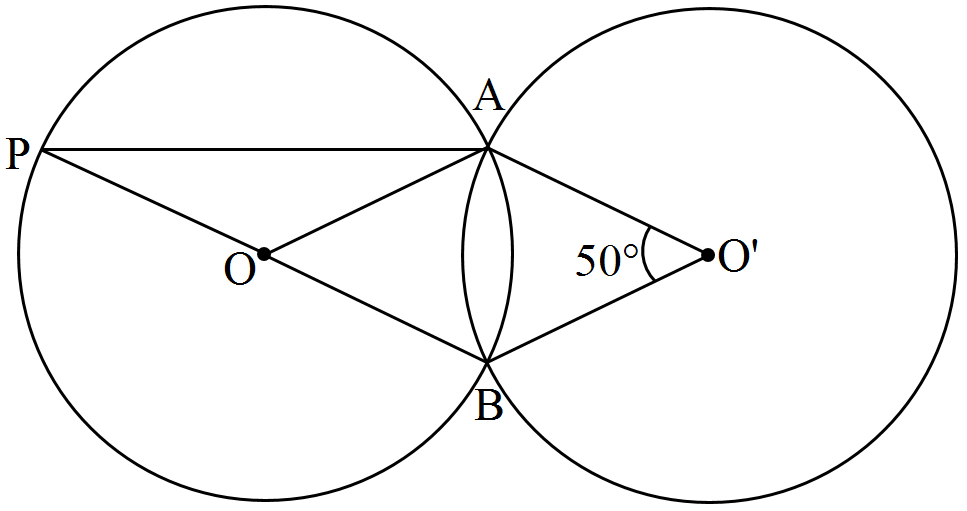
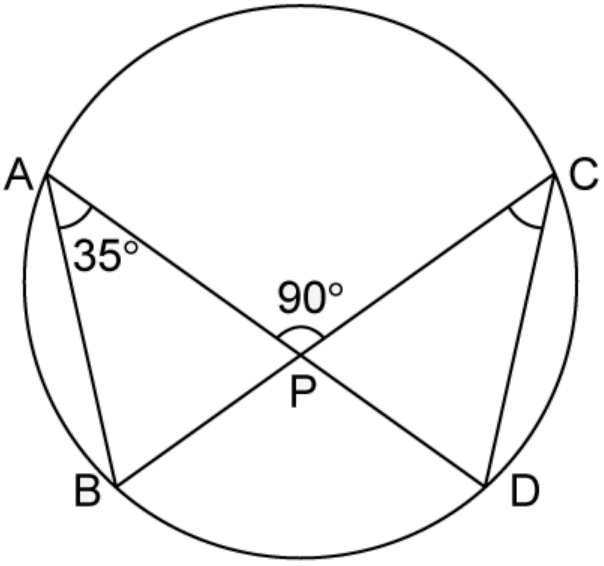
MCQ 221 Mark
  • A
    115º
  • B
    150º
  • C
    105º
  • D
    130º
View full question & answer
MCQ 231 Mark
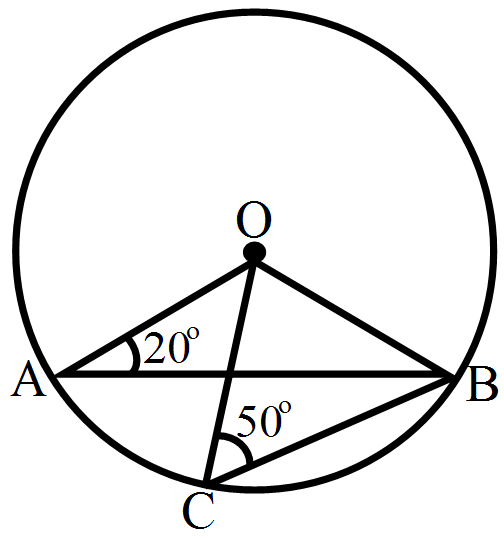
In the given figure, O is the centre of a circle in which $\angle\text{OAB}=20^\circ$ and $\angle\text{OCB}=50^\circ.$ Then, $\angle\text{AOC}=?$
  • A
    50°
  • B
    70°
  • C
    20°
  • D
    60°

Answer
  1. 60°
    Solution:
    OA = OC [Radii of the same circle]
    $\Rightarrow\ \angle\text{OBA}=\angle\text{OAB}=20^\circ$
    In $\triangle\text{OAB,}$
    $\angle\text{OBA}+\angle\text{OAB}+\angle\text{AOB}=180^\circ$ [Angle sum property]
    $\Rightarrow\ 20^\circ+20^\circ+\angle\text{AOB}=180^\circ$
    $\Rightarrow\ \angle\text{AOB}=140^\circ$
    Now,
    OB = OC [Radii of the same circle]
    $\Rightarrow\ \angle\text{OBC}=\angle\text{OCB}=50^\circ$
    In $\triangle\text{OCB},$
    $\angle\text{OBC}+\angle\text{OCB}+\angle\text{COB}=180^\circ$ [Angle sum property]
    $\Rightarrow\ 50^\circ+50^\circ+\angle\text{COB}=180^\circ$
    $\Rightarrow\ \angle\text{COB}=80^\circ$
    So,
    $\angle\text{AOB}=\angle\text{AOC}+\angle\text{COB}$
    $\Rightarrow\ \angle\text{AOC}=\angle\text{AOB}-\angle\text{COB}$
    $\Rightarrow\ \angle\text{AOC}=140^\circ-80^\circ$
    $\Rightarrow\ \angle\text{AOC}=60^\circ$
View full question & answer
MCQ 251 Mark
  • A
    80º
  • B
    70º
  • C
    60º
  • D
    50º
Answer
  1. 60º
    Solution:
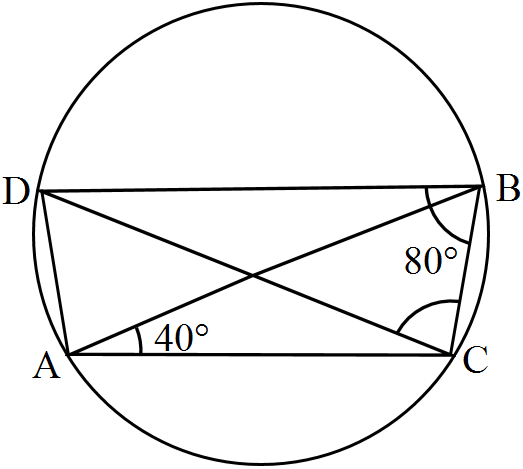
    We have:
    $\angle\text{CDB}=\angle\text{CAB}=40^\circ$ (Angles in the same segment of a circle)
    In $\triangle\text{CBD},$ we have:
    $\angle\text{CDB}+\angle\text{BCD}+\angle\text{CBD}=180^\circ$ (Angle sum property of a triangle)
    $\Rightarrow40^\circ+80^\circ+\angle\text{CBD}=180^\circ$
    $\Rightarrow\angle\text{CBD}=(180^\circ-120^\circ)=60^\circ$
    $\Rightarrow\angle\text{CBD}=60^\circ$
View full question & answer
MCQ 271 Mark
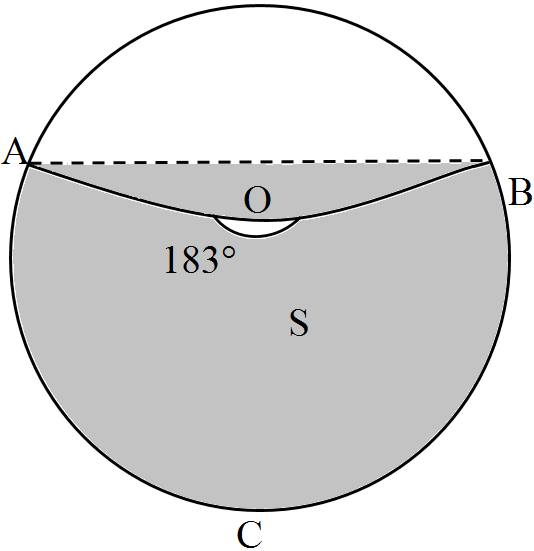
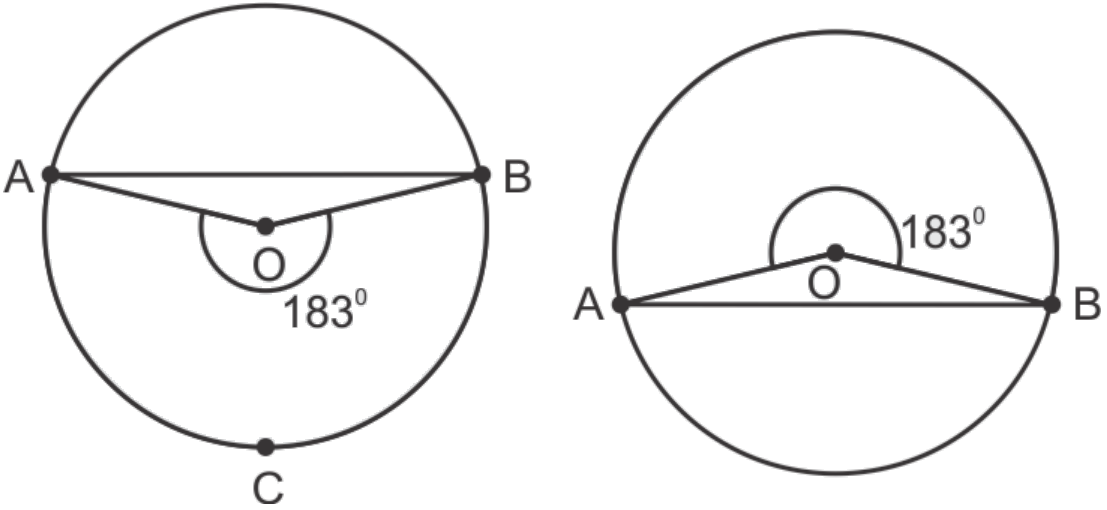
Let C be the mid-point of an arc AB of a circle such that m AB^ = 183º. If the region bounded by the arc ACB and line segment AB is denoted by S, then the centre O of the circle lies.
  • A
    In the interior of S.
  • B
    On the segment AB.
  • C
    On AB and bisect AB.
  • D
    In the exterior of S.
View full question & answer
MCQ 301 Mark
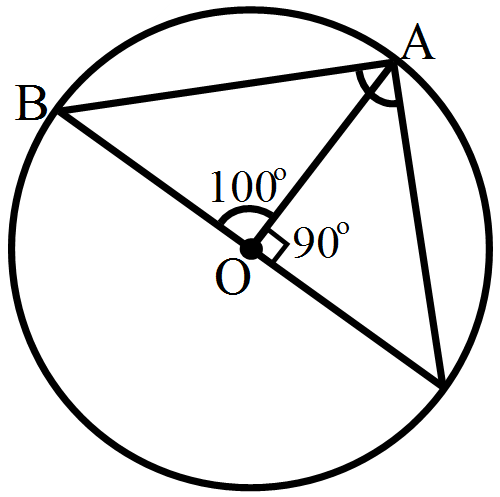
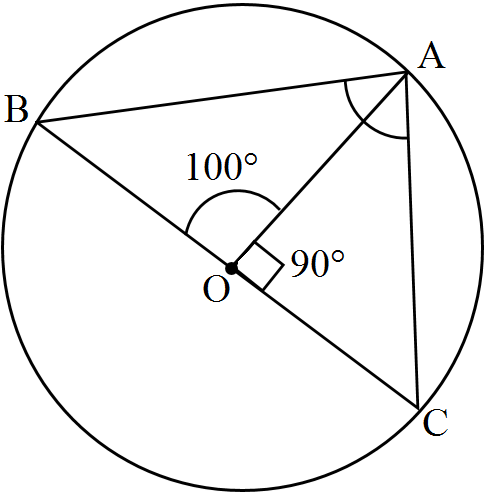
In the given figure, O is the centre of a circle. If $\angle\text{AOB}=100^\circ$ and $\angle\text{AOC}=90^\circ$ then $\angle\text{BAC}=?$
  • A
    85°
  • B
    80°
  • C
    95°
  • D
    75°

Answer
  1. 85°
    Solution:
    $\angle\text{BOA}+\angle\text{AOC}+\angle\text{BOC}=360^\circ$ [Angles around a point are 360°]
    $\Rightarrow\ 100^\circ+90^\circ+\angle\text{BOC}=360^\circ$
    $\Rightarrow\ \angle\text{BOC}=170^\circ$
    Now,
    $\angle\text{BAC}=\frac{1}{2}(\angle\text{BOC})=\frac{1}{2}(170^\circ)=85^\circ$
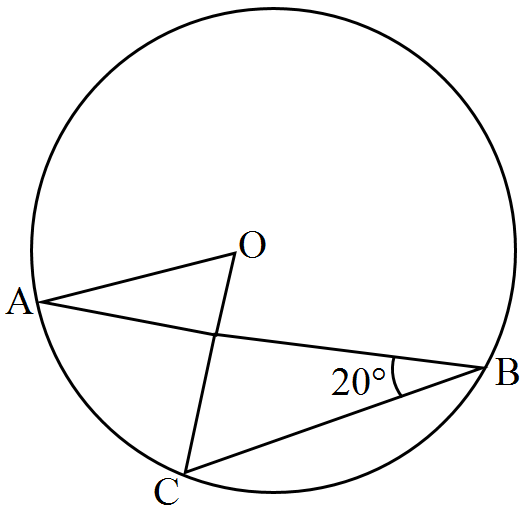
View full question & answer
MCQ 311 Mark
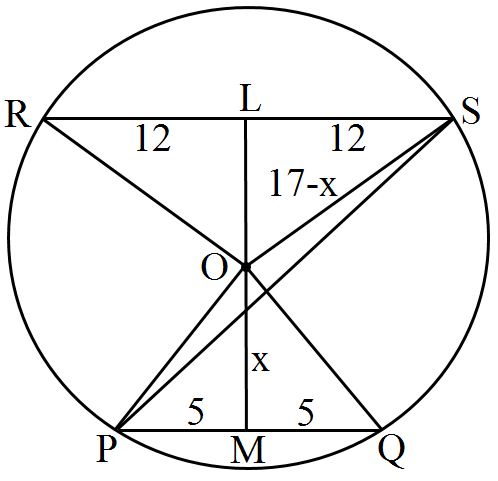
PS and RS are two chord's of a circle such that PQ = 10cm and RS = 24cm and PQ || RS. The distance between PQ and RS is 17cm. Find the radius of circle.
  • A
    13cm
  • B
    15cm
  • C
    None of these.
  • D
    10cm
View full question & answer
MCQ 331 Mark
Two equal circles of radius r intersect such that each passes through the centre of the other. The length of the common chord of the circles, is:
  • A
    $\sqrt{3}\text{r}$
  • B
    $\sqrt{2}\text{rAB}$
  • C
    $\frac{\sqrt{3}}{2}\text{r}$
  • D
    $\sqrt{\text{r}}$
View full question & answer
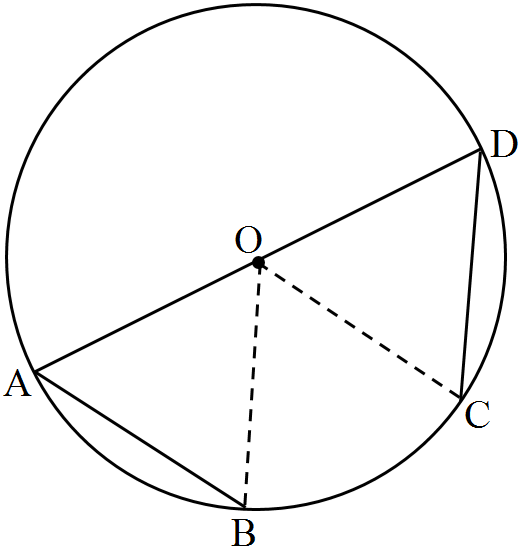
MCQ 341 Mark
  • A
    90º, 45º
  • B
    60º, 30º
  • C
    120º, 60º
  • D
    None of these.
Answer
  1. 90º, 45º
    Solution:
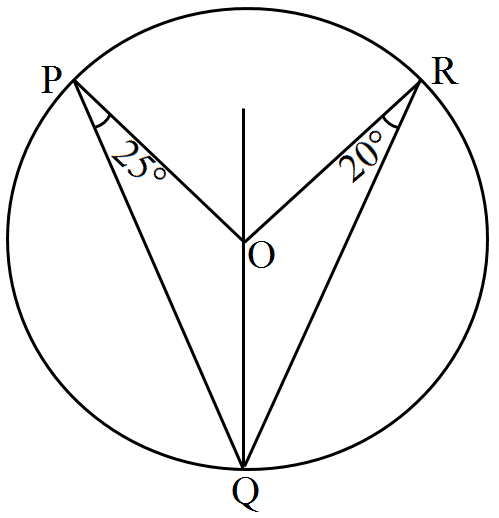
    Here, given
    OP = OQ and OR = OQ (Radius of circle)
    So, {angles opposite to equal sides are also equal}
    Hence,
    PQR = 25º + 20º = 45º
    and PQR = 2 PQR = 2 45º = 90º
    {Angle subtended by same sides on centre is double the angle at opposite vertex}
View full question & answer
MCQ 351 Mark
Let C be the mid-point of an arc AB of a circle such that $\text{m}\widehat{\text{AB}}=183^\circ.$ If the region bounded by the arc ACB and the line segment AB is denoted by S, then the centre O of the circle lies:
  • A
    In the interior of S.
  • B
    In the exertior of S.
  • C
    On the segment AB.
  • D
    On AB and bisects AB.
View full question & answer
MCQ 371 Mark
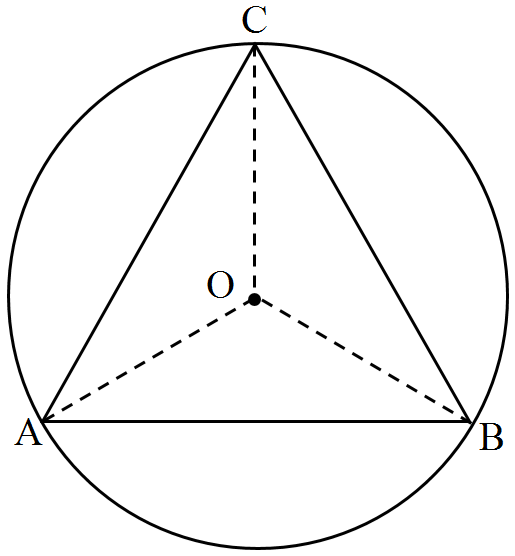
An equilateral triangle ABC is inscribed in a circle with centre O. The measures of $\angle\text{BOC}$ is:
  • A
    60º
  • B
    90º
  • C
    30º
  • D
    120º
View full question & answer
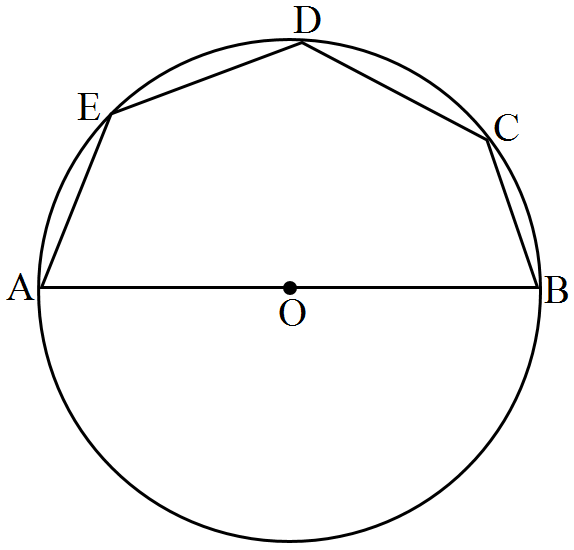
MCQ 381 Mark
  • A
    260º
  • B
    280º
  • C
    250º
  • D
    270º
View full question & answer
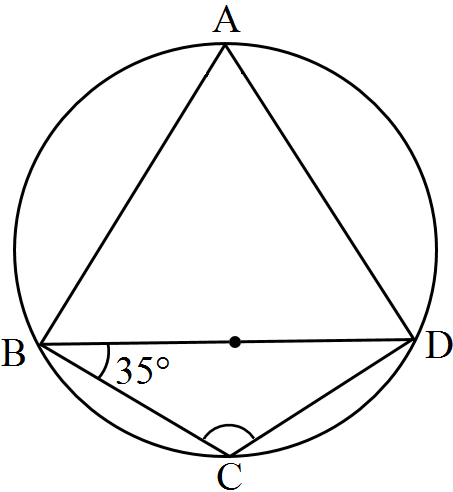
MCQ 391 Mark
  • A
    35°
  • B
    45°
  • C
    55°
  • D
    65°
View full question & answer
MCQ 411 Mark
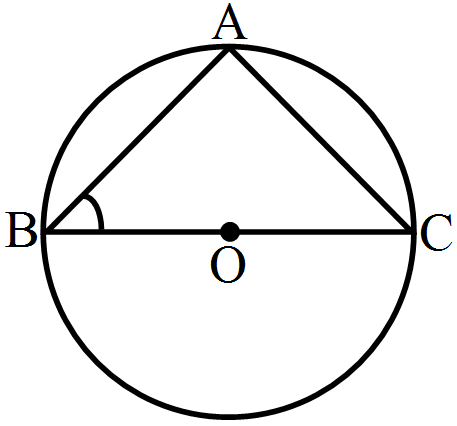
In the given figure, BOC is a diameter of a circle and AB = AC. Then, $\angle\text{ABC}=?$
  • A
    30°
  • B
    45°
  • C
    60°
  • D
    90°

Answer
  1. 45°
    Solution:
    Since BOC is a diameter of a circle, $\angle\text{BAC}$ is 90°.
    Given that AB = AC.
    $\Rightarrow\ \angle\text{ABC}=\angle\text{ACB}$
    In $\triangle\text{BAC},$
    $\angle\text{ABC}+\angle\text{ACB}+\angle\text{BAC}=180^\circ$ [Angle sum property]
    $\Rightarrow\ \angle\text{ABC}+\angle\text{ABC}+90^\circ=180^\circ$
    $\Rightarrow\ 2\angle\text{ABC}=90^\circ$
    $\Rightarrow\ \angle\text{ABC}=45^\circ$
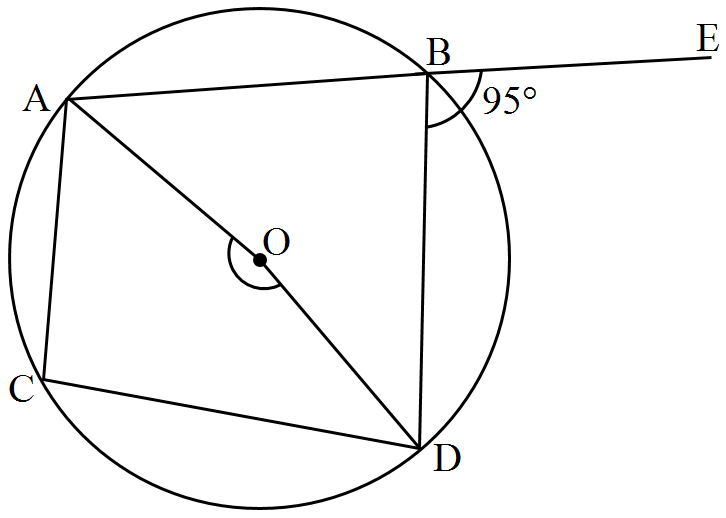
View full question & answer
MCQ 431 Mark
If A and B are two points on a circle such that $\text{m}\big(\widehat{\text{AB}}\big)=260^\circ.$ A possible value for the angle subtended by arc BA at a point on the circle is:
  • A
    100°
  • B
    75°
  • C
    50°
  • D
    25°
View full question & answer
MCQ 451 Mark
In the given figure, O is the centre of a circle and diameter AB bisects the chord CD at a point E such that CE = ED = 8cm and EB = 4cm. The radius of the circle is:
  • A
    10cm
  • B
    12cm
  • C
    6cm
  • D
    8cm

View full question & answer
MCQ 471 Mark
If AB is a chord of a circle, P and Q are the two points on the circle different from A and B, then:
  • A
    $\angle\text{APB}=\angle\text{AQB}$
  • B
    $\angle\text{APB}+\angle\text{AQB}=180^\circ\ \text{or }\angle\text{APB}=\angle\text{AQB}$
  • C
    $\angle\text{APB}+\angle\text{AQB}=90^\circ$
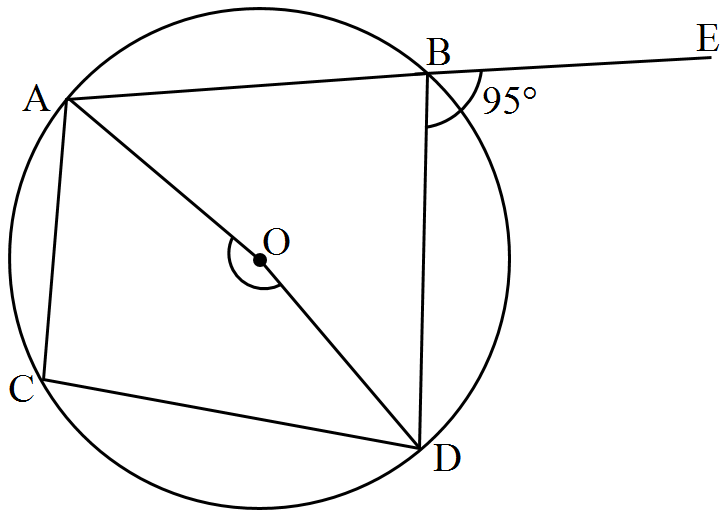
  • D
    $\angle\text{APB}+\angle\text{AQB}=180^\circ$
View full question & answer
MCQ 481 Mark
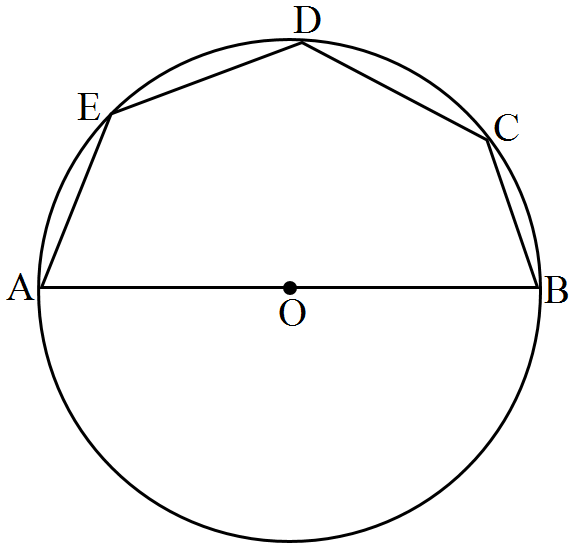
If ABC is an arc of a circle and $\angle\text{ABC}=135^\circ,$ then the ratio of arc ABC^ to the circumference, is:
  • A
    1 : 4
  • B
    1 : 2
  • C
    3 : 8
  • D
    3 : 4
Answer
  1. 3 : 8
    Solution:
    The length of an arc subtending an angle $\theta$ in a circle of radius r is given by the formula,
    Length of the arc $=\frac{\theta}{360^\circ}2\pi\text{r}$
    Here, it is given that the are subtends an angle of 135º with its centre. So the length of the given arc in a circle with radius r is given as
    Length of the arc $=\frac{135^\circ}{360^\circ}2\pi\text{r}\ ....(\text{i})$
    The circumference of the same circle with radius $\text{r}=2\pi\text{r}.\ ....(\text{ii})$
    The ratio between the lengths of the arc and the circumference of the circle will be
    $\frac{\text{Length of the arc}}{\text{Cirrumference of the circle}}=\frac{135^\circ(2\pi\text{r})}{360^\circ(2\pi\text{r})}=\frac{135^\circ}{360^\circ}=\frac{3}{8}$ [FROM (i) and (ii)]
    RATIO = 3 : 8
View full question & answer
MCQ 491 Mark
  • A
    95º
  • B
    85º
  • C
    75º
  • D
    80º
Answer
  1. 85º
    Solution:
    We have:
    $\angle\text{BOC}+\angle\text{BOA}+\angle\text{AOC}=360^\circ$
    $\Rightarrow\angle\text{BOC}+100^\circ+90^\circ=360^\circ$
    $\Rightarrow\angle\text{BOC}=(360^\circ-190^\circ)=170^\circ$
    $\therefore\angle\text{BAC}=(\frac{1}{2}\times\angle\text{BOC})=(\frac{1}{2}\times170^\circ)=85^\circ$
    $\Rightarrow\angle\text{BAC}=85^\circ$
View full question & answer
MCQ 501 Mark
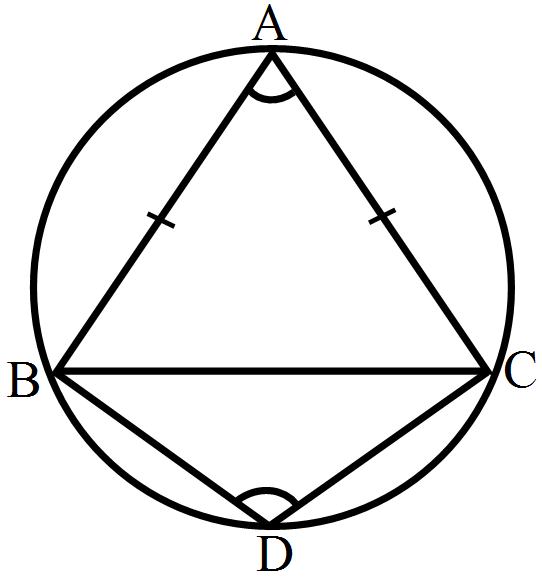
In the given figure, equilateral $\triangle\text{ABC}$ is inscribed in a circle and ABCD is a quadrilateral, as shown. Then, $\angle\text{BDC}=?$
  • A
    90°
  • B
    60°
  • C
    120°
  • D
    150°

Answer
  1. 120°
    Solution:
    Since $\triangle\text{BDC}$ is an equilateral traingle, $\angle\text{BAC}=60^\circ.$
    Since ABCD is a cyclic equilateral,
    $\angle\text{BAC}+\angle\text{BDC}=180^\circ$
    $\Rightarrow\ 60^\circ+\angle\text{BDC}=180^\circ$
    $\Rightarrow\ \angle\text{BDC}=120^\circ$
View full question & answer
M.C.Q - Maths STD 9 Questions - Vidyadip