The degree measure of an arc is the complement of the central angle containing the arc.
Answer
False. Explanation: Given that the degree measure of an arc is the complement of the central angle containing the arc. As we know that the degree measure of a minor arc is the measure of the central angle containing the arc and that of a major arc is 360° minus the degree measure of the corresponding minor arc. Let degree measure of an arc $\widehat{\text{PQ}}$ is $\theta$ of a given circle C(O, r) is denoted by $\text{m}\big(\widehat{\text{PQ}}\big)=\theta.$
A chord of a circle, which is twice as long is its radius is a diameter of the circle.
Answer
True. Explanation: Given that a chord of the circle, which is twice as long as its radius is diameter of the circle. As we know that a chord of a circle which is largest to others and passing through the centre of the circle and twice as long as its radius is called diameter of the circle.
If a circle is divided into three equal arcs each is a major arc.
Answer
True. Explanation: Given that if a circle is divided into three equal arcs each is a major arc. As we know that if points P, Q and R lies on the given circle C(O, r) in such a way that: $1\big(\widehat{\text{PQ}}\big)=1\big(\widehat{\text{QR}}\big)=1\big(\widehat{\text{RP}}\big)$ Then each arc is called major arc.
False. Explanation: It is given that a circle has only finite number of equal chords. As we know that a circle having infinite number of unequal chords.
Line segment joining the center to any point on the circle is a radius of the circle,
Answer
True. Explanation: Given that line segment joining the centre to any point on the circle is a radius of the circle. As we know that line segment joining the centre to any point on the circle is a radius of the circle.
True. Explanation: Given that the degree measure of a semi-circle is 180°. As we know that the diameter ofa circle divides into two equal parts and each of these two arcs are known as semi-circle. $\widehat{\text{PQ}}$ and $\widehat{\text{QP}}$ are semi circle. Hence, $\text{m}\big(\widehat{\text{PQ}}\big)=\text{m}\big(\widehat{\text{QP}}\big)=180^\circ$
True. Explanation: Given that a circle is a plane figure. As we know that a circle is a collection of those points in a plane that are at a given constant distance from a fixed point in the plane.
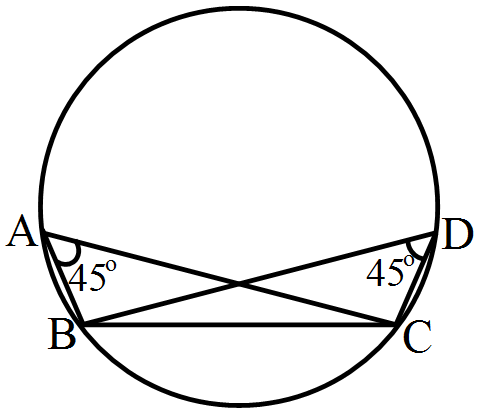
If A, B, C, D are four points such that $\angle\text{BAC}=30^\circ$ and $\angle\text{BDC}=60^\circ$ then D is the centre of the circle through A, B and C.
Answer
False. Solution: Because, there can be many points D, such that $\angle\text{BDC}=60^\circ$ and each such point cannot be the centre of the circle through A, B and C.
Sector is the region between the chord and its corresponding arc.
Answer
True. Explanation: It is given that sector is the region between the chord and its corresponding arc. As we know that the region between the chord and its corresponding arc is called sector.
A circle of radius 3cm can be drawn through two points A, B such that AB = 6cm.
Answer
True. Solution: Suppose, we consider diameter of a circle is AB = 66m. Then, radius of a circle $=\frac{\text{AB}}{2}=\frac{6}{2}=3\text{cm},$ which is true.
ABCD is a cyclic quadrilateral such that $\angle\text{A}=90^\circ,\angle\text{B}=70^\circ,\angle\text{C}=95^\circ$ and $\angle\text{D}=105^\circ.$
Answer
False. Solution: In a cyclic quadrilateral, the sum of opposite angles is 180°. Now, $\angle\text{A}+\angle\text{C}=90^\circ+95^\circ=185^\circ\neq180^\circ$ and $\angle\text{B}+\angle\text{D}=70^\circ+105^\circ=175^\circ\neq180^\circ$ Here, we see that, the sum of opposite angles is not equal to 180°. So, it is not a cyclic quadrilateral.