Questions

M.C.Q

🎯

Test yourself on this topic

10 questions · timed · auto-graded

Question 11 Mark
Write the correct answer in the following:
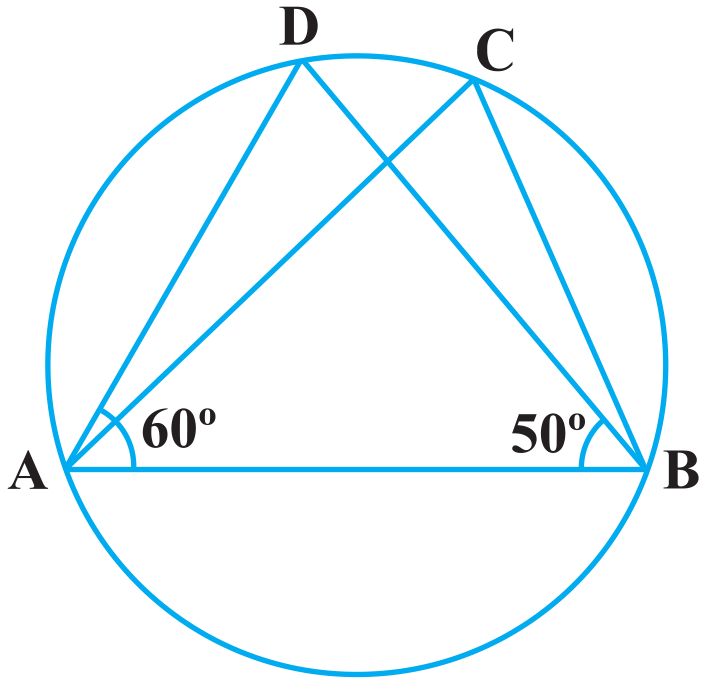
In Fig. if $\angle\text{DAB} = 60^\circ, \angle\text{ABD} = 50^\circ,$ then $\angle\text{ACB}$ is equal to:
  1. 60°.
  2. 50°.
  3. 70°.
  4. 80°.
Answer
  1. 70°.

Solution:

In $\triangle\text{ADB},$ we have

$\angle\text{A}+\angle\text{B}+\angle\text{D}=180^\circ$ [Angle sum property of a triangle]

$\Rightarrow60^\circ+50^\circ+\angle\text{D}=180^\circ$

$\Rightarrow\angle\text{D}=180^\circ-110^\circ=70^\circ$

i.e., $\angle\text{ABD}=70^\circ$

Now, $\angle\text{ACB}=\angle\text{ADB}=70^\circ$

[$\because$ Angles in the same segment of a circle are equal]

Hence, (c) is the correct answer.
View full question & answer
Question 21 Mark
Write the correct answer in the following:
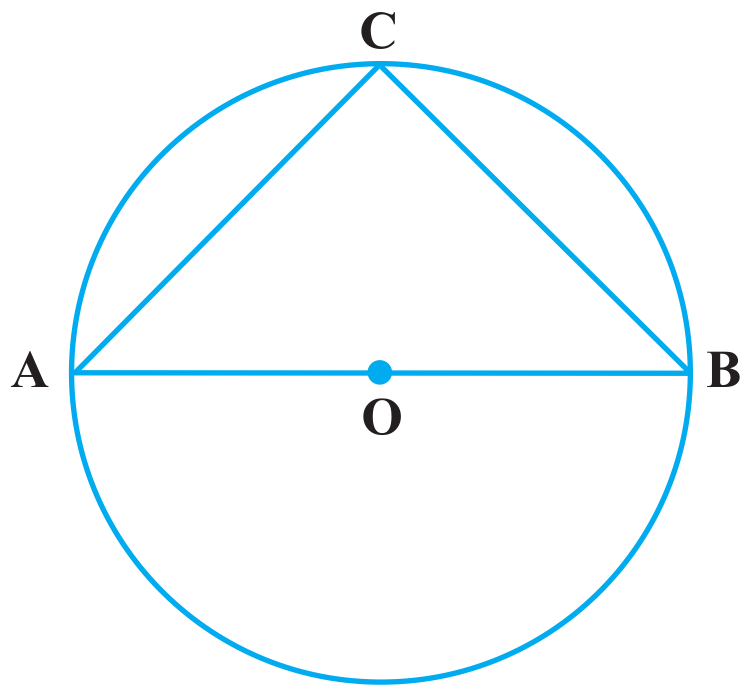
In Fig. if AOB is a diameter of the circle and AC = BC, then $\angle\text{CAB}$ is equal to:

  1. 30°.
  2. 60°.
  3. 90°.
  4. 45°.
Answer
  1. 45°.

Solution:

As AOB is a diameter of the circle,

$\angle\text{C}=90^\circ$

[$\because$ Angles in a semi-circle is 90°]

Now, AC = BC

$\angle\text{A}=\angle\text{B}$

[$\because$ Angles opposite to equal sides of triangle are equal]

Using angle sum property of a triangle, we have

$\angle\text{A}+\angle\text{B}+\angle\text{C}=180^\circ\Rightarrow2\angle\text{A}+90^\circ=180^\circ$

$\Rightarrow2\angle\text{A}=90^\circ\Rightarrow\angle\text{A}=90^\circ\div2=45^\circ$

Hence, (d) is the correct answer.

View full question & answer
Question 31 Mark
Write the correct answer in the following:

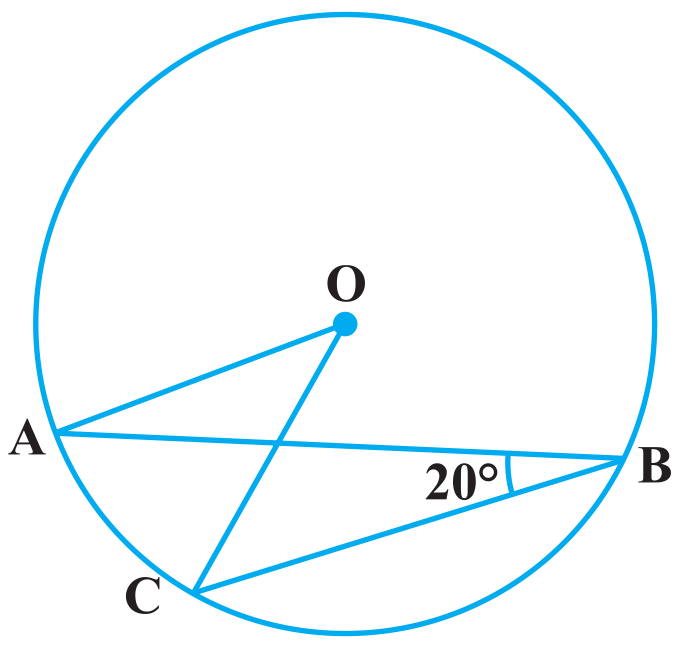
In Fig. if $\angle\text{ABC}=20^\circ,$ then $\angle\text{AOC}$ is equal to:

  1. 20°
  2. 40°
  3. 60°
  4. 10°
Answer
  1. 40°.

Solution:

Given, $\angle\text{ABC} = 20^\circ$

We know that, angle subtended at the centre by an arc is twice the angle subtended by it at the remaining part of circle.

$\angle\text{AOC} = 2\angle\text{ABC} = 2 \times 20^\circ = 40^\circ$

View full question & answer
Question 41 Mark
Write the correct answer in the following:
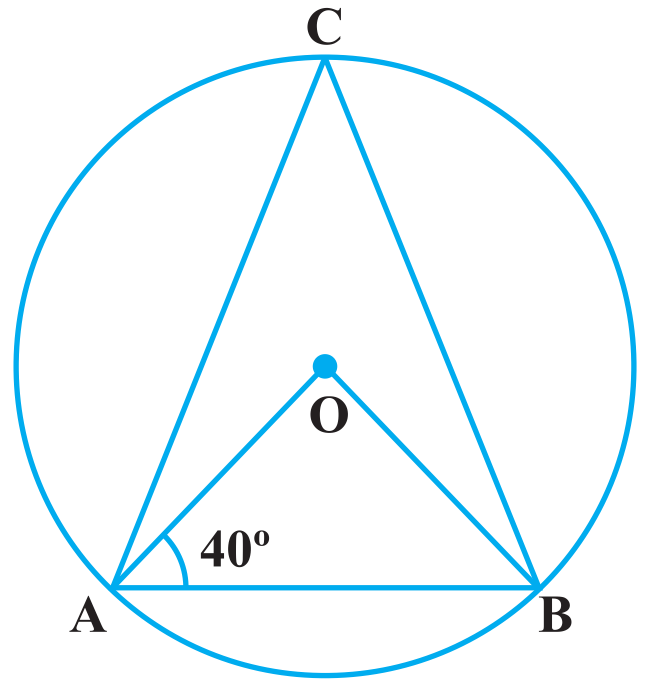
In Fig. if $\angle\text{OAB}=40^\circ,$ then $\angle\text{ACB}$ is equal to:

  1. 50°.
  2. 40°.
  3. 60°.
  4. 70°.
Answer
  1. 50°.

Solution:

In $\triangle\text{QAB, OA} = \text{OB}$ [both are the radius of a circle]

$\angle\text{OAB} = \angle\text{OBA}\Rightarrow \angle\text{OBA} = 40^\circ$

[angles opposite to equal sides are equal]

Also, $\angle\text{AOB} = \angle\text{OBA}\Rightarrow \angle\text{BAO} = 180^\circ$

[by angle sum property of a triangle]

$\angle\text{AOB} + 40^\circ + 40^\circ = 180^\circ$

$\Rightarrow\ \angle\text{AOB} = 180^\circ – 80^\circ = 100^\circ$

We know that, in a circle, the angle subtended by an arc at the centre is twice the angle subtended by it at the remaining part of the circle.

$\angle\text{AOB} = 2 \angle\text{ACB} \Rightarrow 100^\circ =2 \angle\text{ACB}$

$\angle\text{ACB} = \frac{100}{2} = 50^\circ$

View full question & answer
Question 51 Mark
Write the correct answer in the following:
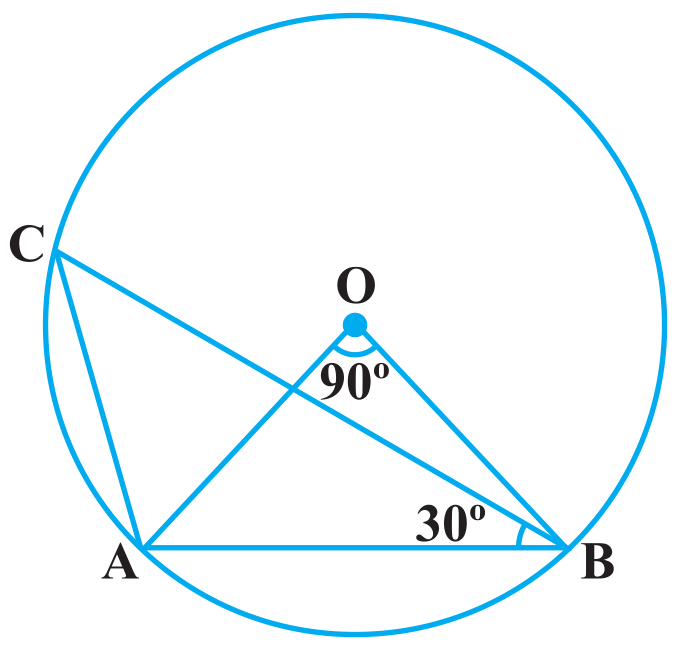
In Fig. $\angle\text{AOB}=90^\circ$ and $\angle\text{ABC}=30^\circ,$ then $\angle\text{CAO}$ is equal to:

  1. 30°.
  2. 45°.
  3. 90°.
  4. 60°.
Answer
  1. 60°.

Solution:

In $\triangle\text{OAB},$ we have

$\text{OA}=\text{OB}$

[Radii of the same circle]

$\therefore\angle\text{OAB}=\angle\text{OBA}$

In triangle OAB, we have

$\angle\text{OAB}+\angle\text{OBA}+\angle\text{AOB}=180^\circ$

$\therefore2\angle\text{OAB}=(180^\circ-\angle\text{AOB})$

$=(180^\circ-90^\circ)=90^\circ$ [$\because$ sum of angles of $\triangle$ is 180°]

$\Rightarrow\angle\text{OAB}=\frac{1}{2}\times90^\circ=45^\circ$

Also, $\angle\text{ACB}=\frac{1}{2}\angle\text{AOB}=\frac{1}{2}\times90^\circ=45^\circ$

Now, in $\triangle\text{CAB},$ we have

$\angle\text{CAB}=180^\circ-(\angle\text{ABC}+\angle\text{ACB})$

$=180^\circ-(30^\circ+45^\circ)=105^\circ$

Now, $\angle\text{CAO}=\angle\text{CAB}-\angle\text{OAB}$

$\Rightarrow\angle\text{CAO}=105^\circ-45^\circ=60^\circ$

Hence, (d) is the correct answer.

View full question & answer
Question 61 Mark
Write the correct answer in the following:
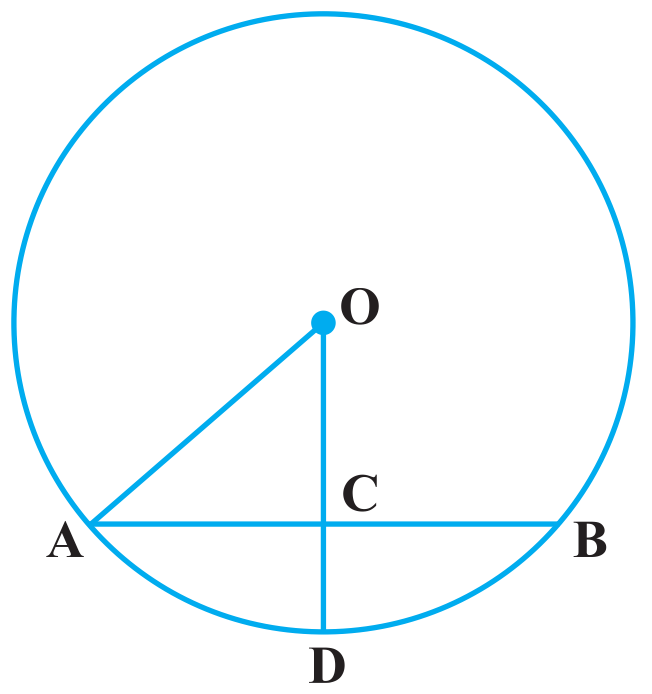
In Fig. if OA = 5cm, AB = 8cm and OD is perpendicular to AB, then CD is equal to:

  1. 2cm.
  2. 3cm.
  3. 4cm.
  4. 5cm.
Answer
  1. 4cm.

Solution:

As perpendicular from the centre to a chord the chord,

$\text{AC}=\frac{1}{2}\times\text{AB}=\frac{1}{2}\times8=4\text{cm}$

$\text{OC}=\sqrt{(\text{OA})^2-(\text{AC})^2}=\sqrt{(5)^2-(4)^2}=\sqrt{25-16}=\sqrt{9}$

OC = 3cm

Now, CD = OD - OC

= 5cm - 3cm = 2cm

Hence, (c) is the correct answer.
View full question & answer
Question 71 Mark
Write the correct answer in the following:
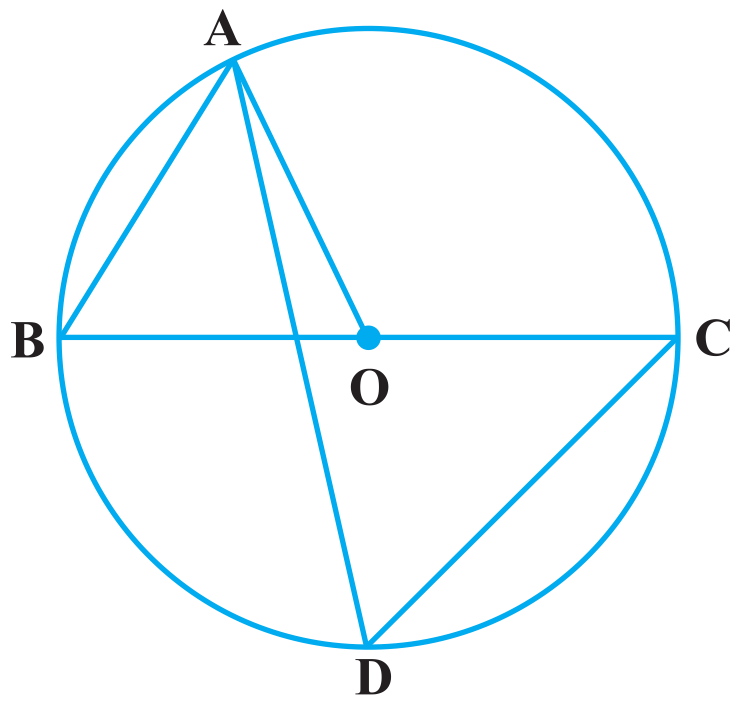
In Fig. BC is a diameter of the circle and $\angle\text{BAO}=60^\circ.$ Then $\angle\text{ADC}$ is equal to:

  1. 30°.
  2. 45°.
  3. 60°.
  4. 120°.
Answer
  1. 60°.

Solution:

In $\triangle\text{OAB},$ we have

OA = OB [Radii of the same circle]

$\therefore\angle\text{ABO}=\angle\text{BAO}$ [Angles opp. To equal sides are equal]

$\therefore\angle\text{ABO}=\angle\text{BAO}=60^\circ$ [Given]

Now, $\angle\text{ADC}=\angle\text{ABC}=60^\circ$

[$\because\angle\text{ABC}$ and $\angle\text{ADC}$ are angles in the same segment of circle, are equal]

Hence, $\angle\text{ADC}=60^\circ$

So, (c) is the correct answer.

View full question & answer
Question 81 Mark
Write the correct answer in the following:
AD is a diameter of a circle and AB is a chord. If AD = 34cm, AB = 30cm, the distance of AB from the centre of the circle is:
  1. 17cm.
  2. 15cm.
  3. 4cm.
  4. 8cm.
Answer
  1. 8cm.

Solution:

Draw $\text{OP}\bot\text{AB}.$

As perpendicular from the centre to a chord bisect the chord,

So, $\text{AP}=\frac{1}{2}\times\text{AB}=\frac{1}{2}\times30=15\text{cm}$

Radius $=\text{OA}=\frac{1}{2}\times34=17\text{cm}$

In right $\triangle\text{OPA},$ we have

$\text{OP}=\sqrt{\text{OA}^2-\text{AP}^2}=\sqrt{(17)^2-(15)^2}$

$=\sqrt{289-225}=\sqrt{64}=8\text{cm}$

Hence, (d) is the correct answer.

View full question & answer
Question 91 Mark
Write the correct answer in the following:
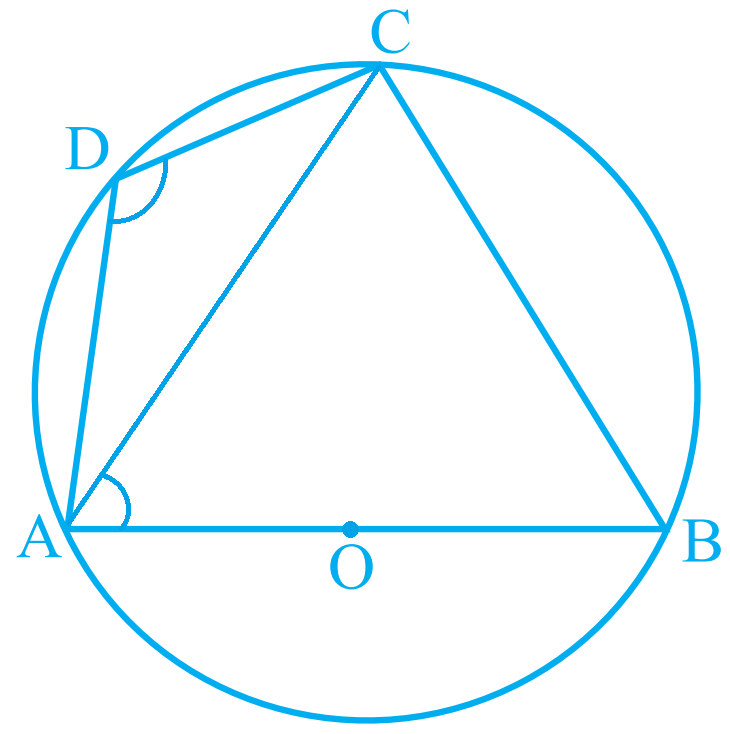
ABCD is a cyclic quadrilateral such that AB is a diameter of the circle circumscribing it and $\angle\text{ADC}=140^\circ,$ then $\angle\text{BAC}$ is equal to:
  1. 80°.
  2. 50°.
  3. 40°.
  4. 30°.
Answer
  1. 50°.

Solution:

Given, ABCD is a cyclic quadrilateral and $\angle\text{ADC}=140^\circ.$

We know that, sum of the opposite angles in a cyclic quadrilateral is 180°.

$\angle\text{ADC}+\angle\text{ABC}=180^\circ$

$\Rightarrow\ 140^\circ+\angle\text{ABC}=180^\circ$

$\Rightarrow\ \angle\text{ABC}=180^\circ-140^\circ$

$\therefore\angle\text{ABC}=40^\circ$

Since, $\angle\text{ACB}$ is an angle in a semi-circle.

$\therefore\angle\text{ACB}=90^\circ$

In $\triangle\text{ABC},\ \ \angle\text{BAC}+\angle\text{ACB}+\angle\text{ABC}=180^\circ$ [by angle sum property of a triangle]

$\Rightarrow\angle\text{BAC}+90^\circ+40^\circ=180^\circ$

$\Rightarrow\angle\text{BAC}=180^\circ-130^\circ=50^\circ$

View full question & answer
Question 101 Mark
Write the correct answer in the following:
If AB = 12cm, BC = 16cm and AB is perpendicular to BC, then the radius of the circle passing through the points A, B and C is:
  1. 6cm.
  2. 8cm.
  3. 10cm.
  4. 12cm.
Answer
  1. 10cm.

Solution:

AB is perpendicular to BC, therefore ABC is a right triangle.

In right $\triangle\text{ABC},$ we have

$\text{AC}=\sqrt{\text{AB}^2+\text{BC}^2}$

$=\sqrt{(12)^2+(16)^2}$

$\sqrt{144+256}$

$\text{AC}=20\text{cm}$

$\therefore\text{Radius}=\frac{1}{2}\times\text{diameter}=\frac{1}{2}\times20\text{cm}=10\text{cm}$

Hence, (c) is the correct answer.
View full question & answer
M.C.Q - Maths STD 9 Questions - Vidyadip