- A12cm
- B5cm
- C10cm
- D8cm
- 12cm
Solution:
Area of rhombus $=\frac{1}{2}\text{d}_1\text{d}_2$
$96=\frac{1}{2}\times16\times\text{d}_2$
$\text{d}_2=\frac{96\times2}{16}$
$\text{d}_2=6\times2=12\text{cm}$
50 questions · timed · auto-graded
Solution:
Here, $\text{s}=\frac{4+4+2}{2}=5\text{cm}$
Area of $\triangle=\sqrt{5(5-2)(5-4)(5-4)}$
$=\sqrt{5\times3\times1\times1}=\sqrt{15}\text{cm}^2$
Solution:
Area of triangle $=\frac{1}{2}\times\text{Base}\times\text{Height}$
$=\frac{1}{2}\times30\times30=450\text{ sq.cm}$
Solution:
Let each of the equal sides of given triangle be x cm. Then the third side is (32 - 2x)cm,
According to quesiton, $\frac{\text{x}}{32-2\text{x}}=\frac{3}{2}$
According to quesiton, x 32 - 2x = 32
⇒ 2x = 96 - 6x
⇒ 8x = 96
⇒ x = 12cm
Therefore, the sides are 12cm, 12cm and 8cm
Area $=\sqrt{\text{s}(\text{s}-\text{a})(\text{s}-\text{b})(\text{s}-\text{c})}$
$=\sqrt{16(16-12)(16-12)(16-3)}$
$=\sqrt{16\times4\times4\times8}$
$=32\sqrt{2}\text{sq}.\text{cm.}$
Solution:
Area of regular hexagon $=\frac{3\sqrt{3}}{2}(\text{Side})^2$
$=\frac{3\sqrt{3}}{2}\times4\times4$
$=24\sqrt{3}\text{cm}^2$
Solution:
$\text{S}=\frac{(24+20+20)}{2}=32\text{cm}$
$\text{Area}=\sqrt{\text{s}(\text{s}-\text{a})(\text{s}-\text{b})(\text{s}-\text{c})}$
$=\sqrt{32(32-24)(32-20)(32-20)}$
$=192\text{sq}.\text{cm}.$
Solution:
Perpendicular $=\sqrt{10^2-8^2}=\sqrt{100-64}=6\text{cm}$
Area of triangle $=\frac{1}{2}\times\text{Base}\times\text{Height}$
$=\frac{1}{2}\times8\times6=24\text{ sq.cm}$
Solution:
According to the question,
Area of the field $=\frac{1}{2}\times128\times17.3+\frac{1}{2}\times128\times22.7$
$=\frac{1}{2}\times128(17.3+22.7)$
$=2560\text{ sq.m}$
Solution:
Let:
a = 40m, b = 24m and c = 32m
$\text{s}=\frac{\text{a}+\text{b}+\text{c}}{2}=\frac{40+24+32}{2}=48\text{m}$
Byu Heron's formula, we have:
Area of triangle $=\sqrt{\text{s}(\text{s}-\text{a})(\text{s}-\text{b})(\text{s}-\text{c})}$
$=\sqrt{48(48-40)(48-24)(48-32)}$
$=\sqrt{48\times8\times24\times16}$
$=\sqrt{24\times2\times8\times24\times8\times2}$
$=24\times8\times2$
$=384\text{m}^2$
$\frac{\sqrt{15}}{4}\text{m}^2$
Solution:
$\text{s}=\frac{1+2+2}{2}=\frac{5}{2}\text{m}$
Area of triangle $=\sqrt{\text{s}(\text{s}-\text{a})(\text{s}-\text{b})(\text{s}-\text{c})}$
$=\sqrt{\frac{5}{2}(\frac{5}{2}-1)(\frac{5}{2}-2)(\frac{5}{2}-2)}$
$=\sqrt{\frac{5}{2}\times\frac{3}{2}\times\frac{1}{2}\times\frac{1}{2}}$
$=\frac{\sqrt{15}}{4}\text{ sq.m}$
Solution:
Let the two adjacent sides of the parallelogram be a = 74cm, b = 40cm
Let the length of diagonal be c = 102cm
These two sides and the diagonal forms a triangle
semi perimeter, $\text{s}= \frac{(\text{a} + \text{b} + \text{c})}{2}$
$\text{s}=\frac{(74+40+102)}{2}$
$=\frac{216}{2}$
$=108\text{cm}$
By Heron's formula, we have area of triangle $=\sqrt{\text{s}(\text{s}-\text{a})(\text{s}-\text{b})(\text{s}-\text{c})}$
Area of triangle $=\sqrt{108(108-74)(108-40)(108-102)}$
$=1224\text{cm}^2$
therefore, area of parallelogram = 1224 × 2
= 2448 sq. cm
Solution:
Area of quadrilateral triangle $=\frac{\sqrt{3}}{4}\times(\text{side})^2$
$=\frac{\sqrt{3}}{4}\times(8)^2$
$=\frac{\sqrt{3}}{4}\times64$
$=16\sqrt{3}\text{cm}^2$
Solution:
Let a = 7cm, b = 9cm, c = 14cm
Semi-perimeter = $\text{s}=\frac{\text{a}+\text{b}+\text{c}}{2}=\frac{7+9+14}{2}=15\text{cm}$
s - a = 15 -7 = 8cm, s - b = 15 - 9 = 6cm and s - c = 15 - 14 = 1cm
Area of a triangle $=\sqrt{\text{s}(\text{s}-\text{a})(\text{s}-\text{b})(\text{s}-\text{c})}$
$=\sqrt{15\times8\times6\times1}$
$=\sqrt{5\times3\times4\times2\times3\times2}$
$=2\sqrt{5}\text{cm}^2$
Hence, correct option is (a).
Solution:
Height of equilateral triangle
$=\frac{\sqrt{3}}{2}\times\text{Side}$$=\frac{\sqrt{3}}{2}\times10$
$=5\sqrt{3}\text{cm}$
Solution:
Area of rhombus $=\frac{1}{2}\times$ Product of diagonal
$\Rightarrow96=\frac{1}{2}(16\times\text{d}_2)$
$\Rightarrow\text{d}_2=\frac{96\times2}{16}=12\text{cm}$
Since diagonals of a rhombus bisect each other at a right angle.
Therefore, the side of the rhombus is the hypotenuse of a triangle.
Side $=\sqrt{8^2+6^2}=10\text{cm}.$
Solution:
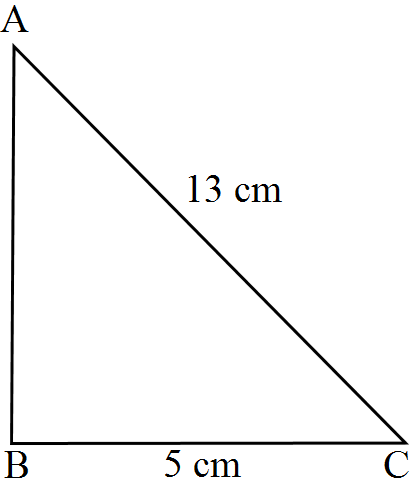
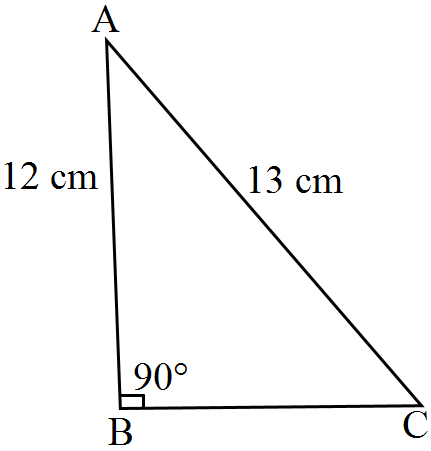
In the given triangle,
$\text{Base}(\text{BC})=\sqrt{13^2-12^2}=\sqrt{169-144}=5\text{cm}$
Area of triangle ABC $=\frac{1}{2}\times\text{BC}\times\text{AB}$
$=\frac{1}{2}\times5\times12$
$=30\text{ sq.cm}$
$40\text{cm}$
Solution:
$\text{d}_2=\frac{\text{Area}\times2}{\text{d}_1}$
$=\frac{96\times2}{12}$
$=16\text{cm}$
length of side of rhombus $=\sqrt{6^2+8^2}=10\text{cm}$
peimeter of rhombus = 4 × side
=4 × 10 = 40cm
Solution:
Perimeter of triangle = 3a
Now, $3\text{a}=60$
$\Rightarrow\text{ a}=60\div3=20\text{m}$
Area of equilateral $\triangle=\frac{\sqrt{3}}{4}(\text{side})^2$
$=\frac{\sqrt{3}}{4}\times(20)^2=100\sqrt{3}\text{m}^2$
Solution:
Let the two adjacent sides of the parallelogram be a = 74cm, b = 40cm
Let the length of diagonal be c = 102cm
These two sides and the diagonal forms a triangle
semi perimeter, $\text{s}=\frac{\text{a}+\text{b}+\text{c}}{2}$
$\text{s}=\frac{74+40+102}{2}$
$=\frac{216}{2}$
= 108cm
By Heron's formula, we have area of triangle $=\sqrt{\text{s}(\text{s}-\text{a})(\text{s}-\text{b})(\text{s}-\text{c})}$
Area of triangle $=\sqrt{108(108-74)(108-40)(108-102)}$
= 1224cm2
therefore, area of parallelogram = 1224 × 2
= 2448 sq.cm
Solution:
$\text{Side}=\frac{24}{3}=8\text{m}$
$\text{Area}=\frac{\sqrt{3}}{4}\times8\times8$
$=16\sqrt{3}\text{m}^2.$