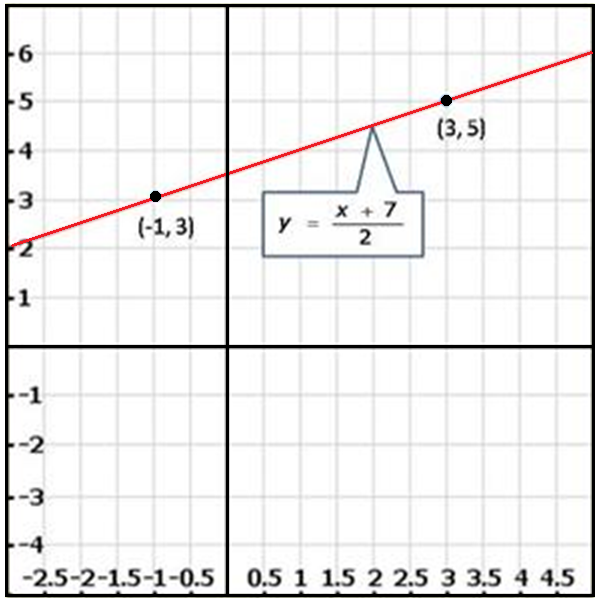
We are given the co-ordinates of the Cartesian plane at (3, 5).
For the equation of the line parallel to x axis, we assume the equation as a one variable equation independent of x containing y equal to 5.
We get the equation as y = 5

19 questions · timed · auto-graded
We are given the co-ordinates of the Cartesian plane at (3, 5).
For the equation of the line parallel to x axis, we assume the equation as a one variable equation independent of x containing y equal to 5.
We get the equation as y = 5
We are given the co-ordinates of the Cartesian plane at (0, 4).
For the equation of the line parallel to x axis, we assume the equation as a one variable equation independent of x containing y equal to 4.
We get the equation as y = 4
We are given the co-ordinates of the Cartesian plane at (-3, -7).
For the equation of the line parallel to y axis, we assume the equation as a one variable equation independent of y containing x equal to -3.
We get the equation as x = -3

3x + 2 = x - 8
⇒ 3x - x = -8 - 2
⇒ 2x = -10
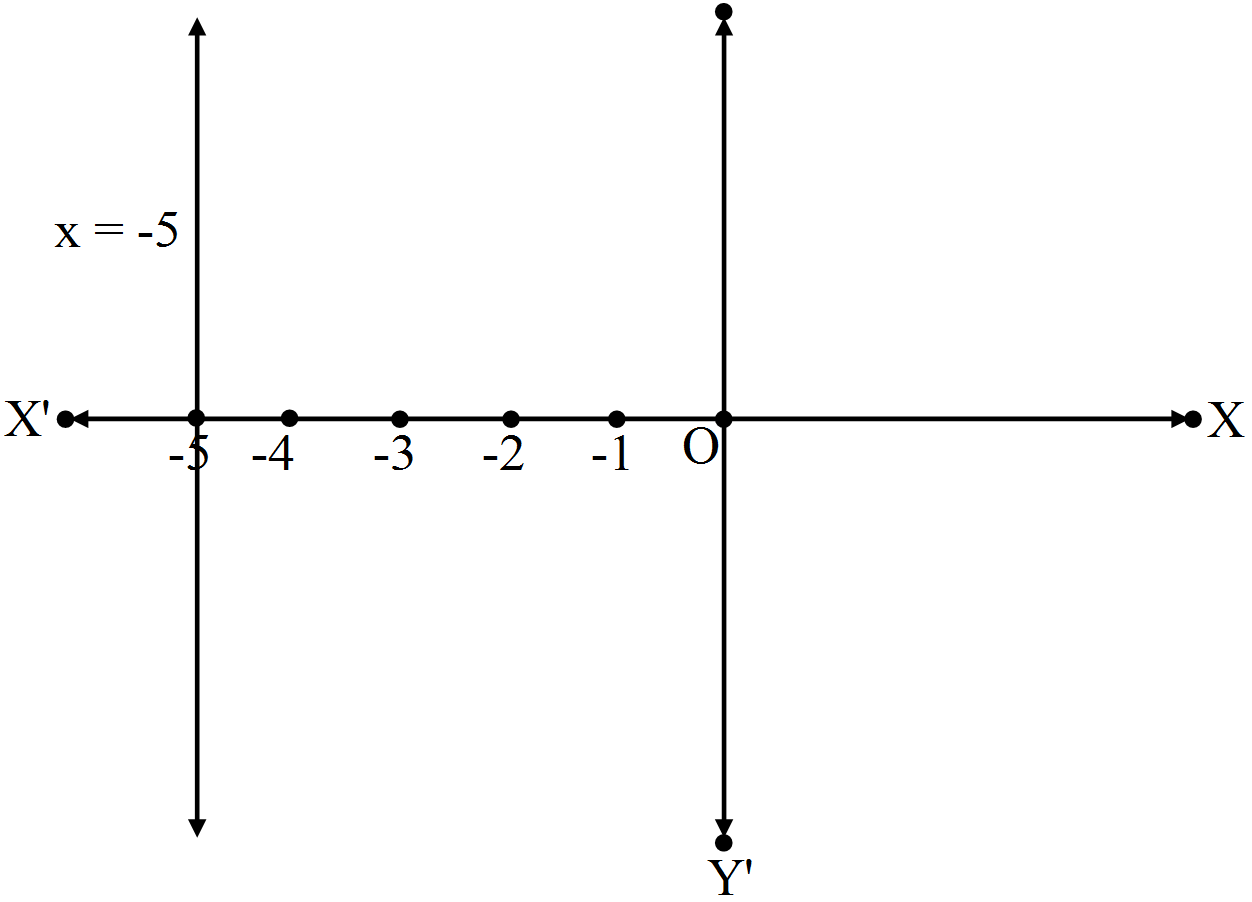
⇒ x = -5
Points A represents -5 on number line.

On Cartesian plane, equation represents all points on y axis for which x = -5
We are given,
3x - 2 = 2x + 3
we get,
3x - 2x = 3 + 2
x = 5
The representation of the solution on the number line, when given equation is treated as an equation in one variable.


In the equation 2x - y = 6,
We have L.H.S = 2x - y and R.H.S = 6 Substituting x = 2 and y = -2 in 2x - y, We get L.H.S = 2 × 2 - (-2) = 6 ⇒ L.H.S = R.H.S ⇒ (2, -2) is a solution of 2x - y = 6.We are given the co-ordinates of the Cartesian plane at (-4, 6).
For the equation of the line parallel to x axis, we assume the equation as a one variable equation independent of x containing y equal to 6.
We get the equation as y = 6