Questions · Page 1 of 2

M.C.Q

🎯

Test yourself on this topic

50 questions · timed · auto-graded

MCQ 11 Mark
x = 2 y = - 1 is a solution of the linear equation
  • x + 2y = 0
  • B
    x + 2y = 4
  • C
    2x + y = 0
  • D
    2x + y = 5
Answer
Correct option: A.
x + 2y = 0
a
View full question & answer
MCQ 21 Mark
The work done by a body on application of a constant force is the product of the constant force and the distance travelled by the body in the direction of the force. If the constant force is 3 units, y is the work done and x is the distance travelled, then the linear equation in two variables to express the above statement is
  • A
    x = 3y
  • B
    y = 3x
  • C
    y = x + 3
  • D
    x = y + 3
Answer
B. y = 3x
$\begin{array}{l}\text { It is given that: Work done }=\text { Constant force } \times \text { Distance } \\ \therefore \quad y=3 x \text {, which is the required linear equation. }\end{array}$
View full question & answer
MCQ 31 Mark
The solution of the linear equation x + 2y = 8 which represents a point on y-axis, is
  • A
    (0,4)
  • B
    (8,0)
  • C
    (4,2)
  • D
    (2, 3)
Answer
A. (0, 4)
Let $(0, a)$ be a point on $y$-axis representing a solution of the equation. Then, $x=0$ and $y=a$ is a solution of equation $x+2 y=8$.
$\therefore$ $0+2 a=8 \Rightarrow a=4
$
Hence, $(0,4)$ is the required point.
View full question & answer
MCQ 41 Mark
The solution of the linear equation x + 2y = 8 which represents a point on x-axis, is
  • A
    (4,0)
  • B
    (0,4)
  • C
    (8,0)
  • D
    (4,2)
Answer
C. (8, 0)
Let $(a, 0)$ be a point on $x$-axis representing a solution of the equation $x+2 y=8$. Then, $x=a$ and $y=0$ is a solution of $x+2 y=8$.
$
\therefore \quad a+2 \times 0=8 \Rightarrow a=8
$
Hence, $(8,0)$ is the point representing a solution of the given equation.
View full question & answer
MCQ 51 Mark
The positive solutums of the equation $a x+b y+c=0$ always lie in the
  • A
    $l^2$ quadrant
  • B
    $2^{\text {nt }}$ quadrant
  • C
    $3^{\text {te }}$ quadrant
  • D
    $4^{\text {te }}$ quadrant
Answer
A. $l^2$ quadrant
The points representing positive solutions of $a x+b y+c=0$ have both the coordinates poritive So, they lie in the $1^{st}$ quadrant.
View full question & answer
MCQ 61 Mark
The point on the graph of the linear equation $2 x+5 y=19$, whose ordinate is $1 \frac{1}{2}$ times its abscissa, is
  • A
    $(2,3)$
  • B
    $(3,2)$
  • C
    $(-2,-3)$
  • D
    $(-3,-2)$
Answer
A. $(2,3)$
Let $P(x, y)$ be the required point. It is given that the ordinate is $1 \frac{1}{2}$ times the abscissa.
$
\therefore \quad y=\frac{3}{2} x
$
Putting $y=\frac{3}{2} x$ in $2 x+5 y=19$, we obtain
$
2 x+\frac{15}{2} x=19 \Rightarrow \frac{19}{2} x=19 \Rightarrow x=2
$
Putting $x=2$ in (i), we obtain $y=3$. Hence the required point is $(2,3)$.
View full question & answer
MCQ 71 Mark
The point on the graph of the equation $3 x-2 y-12=0$ whose $y$-coordinate is $3 / 4$ times the $x$-coordinate, is
  • A
    $(8,6)$
  • B
    $(8,-6)$
  • C
    $(-8,-6)$
  • D
    $(-6,-8)$
Answer
C. $(-8,-6)$
Let the required point be $(x, y)$. It is given that the $y$-coordinate is $3 / 4$ times the $x$-coordinate. Therefore, $y=\frac{3}{4} x$.
Putting $y=\frac{3}{4} x$ in $3 x-2 y+12=0$, we obtain$
3 x-2\left(\frac{3}{4} x\right)+12=0=3 x-\frac{3}{2} x+12=0=\frac{3}{2} x=-12 \Rightarrow x=-8
$
'utting $x=-8$ in $y=\frac{3}{4} x$, we get $y=-6$. Hence, the required point is $(-8,-6)$.
View full question & answer
MCQ 81 Mark
The point of the form (a, a) always lies on
  • A
    x-axis
  • B
    y-axis
  • on the line y = x
  • D
    on the line x + y = 0
Answer
Correct option: C.
on the line y = x
c
View full question & answer
MCQ 91 Mark
The linear equation 2x - 5y = 7 has
  • A
    a unique solution
  • B
    two solutions
  • infinitely many solutions
  • D
    no solutions
Answer
Correct option: C.
infinitely many solutions
c
View full question & answer
MCQ 101 Mark
The graph of y = 6 is a line
  • parallel to x-axis at a distance 6 units from the origin.
  • B
    parallel to y-axis at a distance 6 units from the origin.
  • C
    making an intercept 6 on the x-axis.
  • D
    making an intercept 6 on both the axes.
Answer
Correct option: A.
parallel to x-axis at a distance 6 units from the origin.
a
View full question & answer
MCQ 111 Mark
The graph of the linear equation y = x passes through the point
  • A
    $\left(\frac{3}{2},-\frac{3}{2}\right)$
  • B
    $\left(0, \frac{3}{2}\right)$
  • (1,1)
  • D
    $\left(-\frac{1}{2}, \frac{1}{2}\right)$
Answer
Correct option: C.
(1,1)
c
View full question & answer
MCQ 121 Mark
The graph of the linear equation 4x - 3y - 12 = 0 cuts x-axis at point
  • A
    (3,0)
  • B
    (-3,0)
  • C
    (4,0)
  • D
    (-4, 0)
Answer
A. (3, 0)
Let the graph of the equation $4 x-3 y-12=0$ meet $x$-axis at $(a, 0)$. Then, $x=a$ and $y=0$, is a solution of the equation.
 $\therefore$ $4 \times a-3 \times 0-12=0$ $\Rightarrow a=3$
Hence, the required point is $(3,0)$.
View full question & answer
MCQ 131 Mark
The graph of the linear equation 2x - y = 4 cuts x-axis at
  • (2,0)
  • B
    (-2,0)
  • C
    (0,-4)
  • D
    (0,4)
Answer
Correct option: A.
(2,0)
a
View full question & answer
MCQ 141 Mark
The graph of the linear equation 2x + 3y = 6 cuts the y-axis at the point
  • A
    (2,0)
  • B
    (0,3)
  • C
    (3,0)
  • (0,2)
Answer
Correct option: D.
(0,2)
d
View full question & answer
MCQ 151 Mark
The graph of the equation 2x + 3y = 6 is a line which meets the x and y axes respectively at the points
  • (3,0) and (0, 2)
  • B
    (2,0) and (0,3)
  • C
    (0, 3) and (2,0)
  • D
    (3, 2) and (2, 3)
Answer
Correct option: A.
(3,0) and (0, 2)
a
View full question & answer
MCQ 161 Mark
The equation y = - 4 in two variables x and y, can be written as
  • A
    $1 \cdot x+1 \cdot y=-4$
  • B
    $1 \cdot x+0 y=-4$
  • C
    $0 x+1 \cdot y+4=0$
  • D
    $0 x+1 \cdot y=4$
Answer
C. $0 x+1 \cdot y+4=0$
Equation $y=-4$ can also be written as $0 \cdot x+1 \cdot y=-4$ or, $0 \cdot x+1 \cdot y+4=0$.
View full question & answer
MCQ 171 Mark
The equation x = 7 in two variables x and y, can be written as
  • A
    $1 \cdot x+1 \cdot y=7$
  • B
    $1 \cdot x+0 y=7$
  • C
    $0 x+1 \cdot y=7$
  • D
    $0 x+0 y=7$
Answer
B. $1 \cdot x+0 y=7$
Equation $x=7$ can be written as $1 \cdot x+0 y=7$.
View full question & answer
MCQ 181 Mark
The equation x - 2 = 0 on number line is represented by
  • A
    a line
  • a point
  • C
    infinitely many lines
  • D
    two lines
Answer
Correct option: B.
a point
b
View full question & answer
MCQ 201 Mark
The equation 2x + 5y = 7 has a unique solution, if x y are
  • natural numbers
  • B
    positive real numbers
  • C
    real numbers
  • D
    rational numbers
Answer
Correct option: A.
natural numbers
a
View full question & answer
MCQ 231 Mark
The Autorikshaw fare in a city is charged @ ₹ 10 for the first kilometer and @ ₹4 per kilometer for subsequent distance covered. The linear equation to express the statement is
  • A
    y = 4x + 10
  • B
    y = 4x + 6
  • C
    y + 4x = 10
  • D
    y + 4x = 6
Answer
B. y = 4x + 6
Let the total distance covered be x km and the fare charged be ₹y. Then, for the first km, fare charged is ₹10 and for the remaining (x - 1) km fare charged is ₹ 4(x - 1) .
$
\therefore \quad y=4(x-1)+10 \Rightarrow y=4 x+6
$
The required equation is $y=4 x+6$.
View full question & answer
Question 241 Mark

x = 2, y = -1 is a solution of the linear equation:

  1. x + 2y = 0
  2. x + 2y = 4
  3. 2x + y = 0
  4. 2x + y = 5
Answer
  1. x + 2y = 0

Solution:

Substituting x = 2 and y = -1 in the following equations:

L.H.S. = x + 2y = 2 + 2(-1) = 2 - 2 = 0 = R.H.S.

L.H.S. = x + 2y = 2 + 2(-1) = 2 - 2 = 0 ≠ 4 ≠ R.H.S.

L.H.S. = 2x + y = 2(2) + (-1) = 4 - 1 = 3 ≠ 0 ≠ R.H.S.

L.H.S. = 2x + y = 2(2) + (-1) = 4 - 1 = 3 ≠ 5 ≠ R.H.S.

Hence, correct option is (a).

View full question & answer
Question 251 Mark

The graph of the linear equation 2x - y = 4 cuts x-axis at:

  1. (2, 0)
  2. (-2, 0)
  3. (0, -4)
  4. (0, 4)
Answer
  1. (2, 0)

Solution:

On x-axis, the y-co-ordinate is always 0.

So, 2x - y = 4 will cut the x-axis where y = 0

i.e. 2x = 4

i.e. x = 2

Thus, 2x - y = 4 will cut the x-axis at (2, 0).

Hence, correct option is (a).

View full question & answer
Question 261 Mark

The equation x - 2 = 0 on number line is represented by:

  1. A line.
  2. A point.
  3. Infinitely many lines.
  4. Two lines.
Answer
  1. A point.

Solution:

The equation x - 2 = 0 is represented by a point on the number line.

Therefore, the correct answer is (b).

View full question & answer
Question 271 Mark

The distance between the graphs of the equations y = -1 and y = 3 is:

  1. 2
  2. 4
  3. 3
  4. 1
Answer
  1. 4

Solution:

The distance between given two graphs

= 3 - (-1)

= 3 + 1

= 4

Hence, correct option is (b).

View full question & answer
Question 281 Mark

The distance between the graph of the equations x = -3 and x = 2 is:

  1. 1
  2. 2
  3. 3
  4. 5
Answer
  1. 5

Solution:

The distance between the graph of the equations x = -3 and x = 2

= 2 - (-3)

= 2 + 3

= 5

Hence, correct option is (d).

View full question & answer
Question 291 Mark

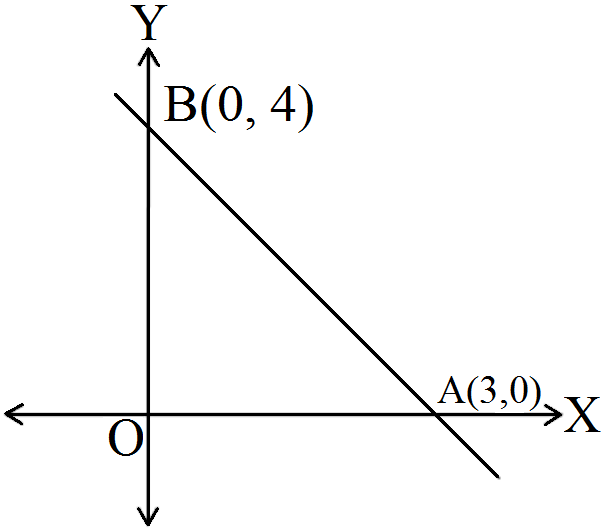
lf the graph of the equation 4x + 3y = 12 cuts the coordinate axes at A and B, then hypotenuse of right triangle AOB is of length:

  1. 4 units.
  2. 3 units.
  3. 5 units.
  4. None of these.
Answer
  1. 5 units.

Solution:

4x + 3y = 12

At x = 0, 3y = 12 ⇒ y = 4 units

At y = 0, 4x = 12 ⇒ x = 3 units

The triangle formed is $\triangle\text{AOB},$ where

OB = 4 units

OA = 3 units

Hypotenuse $=\text{AB}=\sqrt{\text{OB}^2+\text{OA}^2}=\sqrt{16+9}=5\text{ units}$

Hence, correct option is (c).

View full question & answer
Question 301 Mark

If (a, 4) lies on the graph of 3x + y = 10, then the value of a is:

  1. 3
  2. 1
  3. 2
  4. 4
Answer
  1. 2

Solution:

3x + y = 10

If (a, 4) lies on its graph, then it must satisfy the equation.

Thus, we have

3(a) + 4 = 10

i.e. 3a = 6

i.e. a = 2

Hence, correct option is (c).

View full question & answer
Question 311 Mark

If (4, 19) is a solution of the equation y = ax + 3, then a =

  1. 3
  2. 4
  3. 5
  4. 6
Answer
  1. 4

Solution:

y = ax + 3

If (4, 19) is its solution, then it must satisfy the equation.

Thus, we have

19 = a × 4 + 3

i.e. 4a = 16

i.e. a = 4

Hence, correct option is (b).

View full question & answer
Question 321 Mark

If (2k - 1, k) is a solution of the equation 10x - 9y = 12, then k =

  1. 1
  2. 2
  3. 3
  4. 4
Answer
  1. 2

Solution:

If (2k - 1, k) is solution of equation 10x - 9y = 12, then it must satisfy this equation.

Thus, we have

10(2k - 1) - 9k = 12

20k - 10 - 9k = 12

11k = 22

k = 2

Hence, correct option is (b).

View full question & answer
Question 331 Mark

How many linear equations are satisfied by x = 2 and y = -3?

  1. Only one.
  2. Two.
  3. Three.
  4. Infinitely many.
Answer
  1. Infinitely many.

Solution:

From Point (2, -3) there are infinitely many lines passing in every-direction.

So (2, -3) is satisfied with infinite linear equations.

Hence, correct option is (d).

View full question & answer
MCQ 341 Mark
If x = k + 1 y = 2k - 1 is a solution of the equation 3x - 2y + 7 = 0 then k =
  • A
    10
  • B
    6
  • C
    4
  • D
    12
Answer
D. 12
Given that $x=k+1, y=2 k-1$ is a solution of $3 x-2 y+7=0$.$
\therefore \quad 3(k+1)-2(2 k-1)+7=0 \Rightarrow-k+12=0 \Rightarrow k=12 .
$
View full question & answer
MCQ 351 Mark
If $x=1$ and $y=6$ is a solution of the equation $8 x-a y+a^2=0$, then $a=$
  • A
    $-2-4$
  • B
    2,4
  • C
    $-2,4$
  • D
    $2,-4$
Answer
B. 2, 4
Given that $x=1$ and $y=6$ is a solution of the equation $8 x-a y+a^2=0$.$
8 \times 1-6 \times a+a^2=0 \Rightarrow a^2-6 a+8=0 \Rightarrow(a-2)(a-4)=0 \Rightarrow a=2, 4$
View full question & answer
MCQ 361 Mark
If $x=1$ and $y=1$ is a solution of both the equations $2 x-3 a y+a^2=0$ and $4 x-5 a y+a^2=0$, then $a=$
  • A
    1
  • B
    4
  • C
    2
  • D
    -1
Answer
A. 1
Given that $x=1$ and $y=1$ is a solution of both the equations$
\begin{array}{ll}
\therefore & 2-3 a+a^2=0 \text { and } 4-5 a+a^2=0 \\
\Rightarrow & a^2-3 a+2=0 \text { and } a^2-5 a+4=0 \\
\Rightarrow & (a-1)(a-2) \text { and }(a-1)(a-4)=0 \Rightarrow a=1,2 \text { and } a=1,4 \Rightarrow a=1
\end{array}
$
View full question & answer
MCQ 371 Mark
If we multiply or divide both sides of a linear equation with non-zero number, then the solution of the linear equation
  • A
    changes
  • remains some
  • C
    changes in case of division only
  • D
    changes in case of multiplication only.
Answer
Correct option: B.
remains some
b
View full question & answer
MCQ 381 Mark
If the graph of the equation 4x + 3y = 12 cuts the coordinate axes at A and B, then hypotenuse of right triangle AOB is of length
  • A
    4 units
  • B
    3 units
  • 5 units
  • D
    none of these
Answer
Correct option: C.
5 units
c
View full question & answer
MCQ 391 Mark
If a linear equation has solutions (-2, 2) (0, 0) and (2,2), then it is of the form
  • y = - x
  • B
    y = x
  • C
    y = 2x
  • D
    x = 2y
Answer
Correct option: A.
y = - x
a
View full question & answer
MCQ 431 Mark
If (2, 0) is a solution of the linear equation 2x + 3y = k then the value of k is
  • 4
  • B
    6
  • C
    5
  • D
    2
Answer
Correct option: A.
4
a
View full question & answer
MCQ 441 Mark
How many linear equations in x and y can be satisfied by x = 1 and y = 2?
  • A
    only one
  • B
    two
  • C
    three
  • infinitely many
Answer
Correct option: D.
infinitely many
d
View full question & answer
MCQ 451 Mark
How many linear equations are satisfied by x = 2 and y = - 3 ?
  • A
    only one
  • B
    two
  • C
    three
  • infinitely many
Answer
Correct option: D.
infinitely many
d
View full question & answer
MCQ 461 Mark
Any solution of the linear equation 2x + 0y + 9 = 0 in two variables is of the form
  • $\left(-\frac{9}{2}, a\right)$
  • B
    $\left(b,-\frac{9}{2}\right)$
  • C
    $\left(0,-\frac{9}{2}\right)$
  • D
    $(-9,0)$
Answer
Correct option: A.
$\left(-\frac{9}{2}, a\right)$
a
View full question & answer
MCQ 471 Mark
Any solution of linear equation 0x - 2y + 11 = 0 in two variables is of the form
  • A
    $(m, 11 / 2)$
  • B
    $(m,-11 / 2)$
  • C
    $(m, 11)$
  • D
    $(m,-11)$
Answer
A. $(m, 11 / 2)$
 We find that $x=m$ and $y=\frac{11}{2}$ satisfies the equation $0 x-2 y+11=0$.
Hence, ( $m, 11 / 2$ ) represents a solution.
View full question & answer
MCQ 501 Mark
Any point on the line y = - x is of the form
  • (a, - a)
  • B
    (- a, - a)
  • C
    (a, a)
  • D
    (a, 0)
Answer
Correct option: A.
(a, - a)
a
View full question & answer
M.C.Q - Maths STD 9 Questions - Vidyadip