Questions · Page 2 of 4

M.C.Q

MCQ 511 Mark
The equation of a line parallel to x-axis and 3 units above the origin is:
  • A
    x = 3
  • B
    y = 3
  • C
    x = -3
  • D
    y = -3
Answer
  1. y = 3
    Solution:
    The equation of a line parallel to x-axis and 3 units above the origin is y = 3.
    Because when a line parallel to x axis in that case equation of line is y = a where a is the co-ordinate of y-axis and 3 units above the origin value x-coordinate is 3 so required equation is y = 3.
View full question & answer
MCQ 521 Mark
3x + 10 = 0 will have:
  • A
    Unique solution
  • B
    Two solutions
  • C
    Infinitely many solutions
  • D
    No solutions
Answer
  1. Unique solution
    Solution:
    $3\text{x}+10 = 0$
    $\text{x}=\frac{-10}{3}.$
    Hence, only one solution is possible.
View full question & answer
MCQ 531 Mark
If a linear equation has solutions (-2, 2), (0, 0) and (2, -2), then it is of the form:
  • A
    -x + 2y = 0
  • B
    x + y = 0
  • C
    x - y = 0
  • D
    -2x + y = 0
Answer
  1. x + y = 0
    Solution:
    Linear equation has solutions (-2, 2), (0, 0) and (2, -2), then the equation will be x + y = 0.
    As all the given three points satisfy the given equation.
View full question & answer
MCQ 541 Mark
The area of the triangle formed by the line 2x + 5y = 10 and the co-ordinate axis is:
  • A
    4 sq. units.
  • B
    10 sq. units.
  • C
    3 sq. units.
  • D
    5 sq. units.
Answer
  1. 5 sq. units.
    Solution:
    To find the area of the triangle formed by the line 2x + 5y = 10 and co-ordinate axis. We put x = 0 in given equation at x = 0, we get y = 2 at y = 0 we get x = 5. So the line cut y-axis at 2 and x-axis at 5.
    So the height of the triangle is 2 units and the base is 5 units.
    Area of triangle $=\frac{1}{2}$ base × heigh,
    $=\frac{1}{2}\times2\times5$
    = 5 sq. units.
View full question & answer
MCQ 551 Mark
The equation of a line parallel to x - axis and 3 units above the origin is:
  • A
    x = -3
  • B
    x = 3
  • C
    y = -3
  • D
    y = 3
Answer
  1. y = 3
View full question & answer
MCQ 561 Mark
If x and y are both positive solutions of equation ax + by + c = 0, always lie in the:
  • A
    First quadrant
  • B
    Second quadrant
  • C
    Third quadrant
  • D
    Fourth quadrant
Answer
  1. First quadrant
View full question & answer
MCQ 571 Mark
Any point of the form (a, -a) always lie on the graph of the equation.
  • A
    x = -a
  • B
    y = a
  • C
    y = x
  • D
    x + y = 0
Answer
  1. x + y = 0
View full question & answer
MCQ 581 Mark
If (2, 0) is a solution of the linear equation 2x + 3y = k, then the value of k is:
  • A
    2
  • B
    4
  • C
    5
  • D
    6
Answer
  1. 4
    Solution:
    Substitute x = 2 and y = 0 in the given equation, we get
    2 (2) + 3 (0) = k
    k = 4 + 0
    k = 4.
    Hence, the value of k is 4.
    Stay tuned with BYJU’S – The Learning App and download the app today to get more class - wise concepts.
View full question & answer
MCQ 591 Mark
The point of the form (a, a), where a lies on:
  • A
    The line y = x.
  • B
    The line x + y = 0.
  • C
    The x-axis.
  • D
    The y-axis.
Answer
  1. The line y = x.
    Solution:
    The point (a, a) lies on line x = y or x - y = 0
    Here, is the verification
    Put x = a in equation
    x - y = 0
    a - y = 0
    -y = -a
    y = a
    Hence, it is prove that (a, a) is a solution of x - y = 0 or x = y.
View full question & answer
MCQ 601 Mark
A linear equation in two variables x and y is of the form ax + by + c = 0, where:
  • A
    $\text{a}\neq0,\ \text{b}\neq0$
  • B
    $\text{a}\neq0,\ \text{b}=0$
  • C
    $\text{a}=0,\ \text{b}\neq0$
  • D
    $\text{a}=0,\ \text{c}=0$
Answer
  1. $\text{a}\neq0,\ \text{b}\neq0$
    Solution:
    A linear equation in tow variables x and y is of the form ax + by + c = 0, where $\text{a}\neq0$ and $\text{b}\neq0,$ since if either a or be is 0, the degree of the equation would be but it would not be a linear equation in tow variables.
    If both a and b are 0, then the equation is not linear.
View full question & answer
MCQ 611 Mark
The linear equation 2x + 3y = 6 has:
  • A
    Infinitely many solutions.
  • B
    Two solutions.
  • C
    A unique solution.
  • D
    Three solutions.
Answer
  1. Infinitely many solutions.
    Solution:
    2x + 3y = 6
    2x = 6 - 3y
    $\text{x}=\frac{6-3\text{y}}{2}$
x032323
y210
This table continues for infinite terms for different values of x and y. So for infinite value of y we have infinite value of x.
Therefore, this equation has Infinitely many solutions.
View full question & answer
MCQ 621 Mark
Which of the following pair is a solution of the equation 3x - 2y = 7?
  • A
    (-2, 1)
  • B
    (5, 1)
  • C
    (1, -2)
  • D
    (1, 5)
Answer
  1. (1, -2)
    Solution:
    Solution of the equation 3x - 2y = 7 is (1, -2) as it satisfy the given equation,
    3x - 2y = 7
    ⇒ 3(1) - 2(-2) = 7
    ⇒ 3 + 4 = 7
    LHS = RHS.
View full question & answer
MCQ 631 Mark
Which of the following is not a solution of 2x - 3y = 12?
  • A
    (6, 0)
  • B
    (3, -2)
  • C
    (0, -4)
  • D
    (2, 3)
Answer
  1. (2, 3)
    Solution:
    We have to check (2, 3) is a solution of 2x - 3y = 12 if (2, 3) satisfy the equation then (2, 3) solution of 2x - 3y = 12.
    LHS = 2x - 3y
    2 × 2 - 3 × 3
    4 - 9 = -5
    RHS = -5
    LHS ≠ RHS
    So (2, 3) is not a solution of 2x - 3y = 12.
View full question & answer
MCQ 641 Mark
If (4, 19) is a solution of the equation y = ax + 3, then a =
  • A
    3
  • B
    4
  • C
    5
  • D
    6
Answer
  1. 4
    Solution:
    y = ax + 3
    If (4, 19) is its solution, then it must satisfy the equation.
    Thus, we have
    19 = a × 4 + 3
    i.e. 4a = 16
    i.e. a = 4
    Hence, correct option is (b).
View full question & answer
MCQ 651 Mark
x = 2, y = -1 is a solution of the linear equation:
  • A
    x + 2y = 0
  • B
    x + 2y = 4
  • C
    2x + y = 0
  • D
    2x + y = 5
Answer
  1. x + 2y = 0
    Solution:
    Substituting x = 2 and y = -1 in the following equations:
    L.H.S. = x + 2y = 2 + 2(-1) = 2 - 2 = 0 = R.H.S.
    L.H.S. = x + 2y = 2 + 2(-1) = 2 - 2 = 0 ≠ 4 ≠ R.H.S.
    L.H.S. = 2x + y = 2(2) + (-1) = 4 - 1 = 3 ≠ 0 ≠ R.H.S.
    L.H.S. = 2x + y = 2(2) + (-1) = 4 - 1 = 3 ≠ 5 ≠ R.H.S.
    Hence, correct option is (a).
View full question & answer
MCQ 661 Mark
The equation of a line parallel to y-axis and 4 units to the right of origin is:
  • A
    x = 4
  • B
    x = -4
  • C
    y = -4
  • D
    y = 4
Answer
  1. x = 4
    Solution:
    The equation of a line parallel to y-axis at a distance of 4 units from it, to its right from the origin.
    x = 4
    Because when a line parallel toy axis in that case equation of line is x = 4
    So required equation is x = 4
View full question & answer
MCQ 671 Mark
For what value of ‘k’, x = 2 and y = -1 is a solution of x + 3y - k = 0?
  • A
    2
  • B
    -2
  • C
    -1
  • D
    1
Answer
  1. -1
    Solution:
    For finding value of ‘k’, we put x = 2 and y = -1 in a equation x + 3y - k = 0.
    x + 3y - k = 0
    2 + 3(-1) = k
    2 - 3 = k
    k = -1.
View full question & answer
MCQ 681 Mark
The maximum number of points that lie on the graph of a linear equation in two variables is:
  • A
     One
  • B
     Two
  • C
     Three
  • D
     Infinitely many
Answer
  1. Infinitely many
View full question & answer
MCQ 691 Mark
The graph of the equation 2x + 3y = 6 cuts the x - axis at the point.
  • A
    (0, 3)
  • B
    (3, 0)
  • C
    (2, 0)
  • D
    (0, 2)
Answer
  1. (3, 0)
View full question & answer
MCQ 701 Mark
If (a, 4) lies on the graph of 3x + y = 10, then the value of a is:
  • A
    3
  • B
    1
  • C
    2
  • D
    4
Answer
  1. 2
    Solution:
    3x + y = 10
    If (a, 4) lies on its graph, then it must satisfy the equation.
    Thus, we have
    3(a) + 4 = 10
    i.e. 3a = 6
    i.e. a = 2
    Hence, correct option is (c).
View full question & answer
MCQ 711 Mark
Write the correct answer in the following:
The equation of X-axis is of the form,
  • A
    x = 0
  • B
    y = 0
  • C
    x + y = 0
  • D
    x = y
Answer
  1. y = 0
    Solution:
    y = 0 is the equation of x-axis.
View full question & answer
MCQ 721 Mark
The graph of x = 4 is a line.
  • A
    Making an intercept 4 on the y-axis.
  • B
    Parallel to the y-axis at a distance of 5 units from the origin.
  • C
    Making an intercept 4 on the x-axis.
  • D
    Parallel to the x-axis at a distance of 4 units from the origin.
Answer
  1. Making an intercept 4 on the x-axis.
    Solution:
    As, the graph of x = 4 is a line parallel to y-axis i.e. x = 0.
    ⇒ The line represented by the equation x = 4 is parallel to y-axis and intersects x-axis at x = 4.
    So, the graph of x = 4 is parallel to y-axis at a distance of 4 units from the origin making an intercept 4 on the x-axis.
View full question & answer
MCQ 731 Mark
Which of the following ordered pairs is a solution of the equation x - 2y - 6?
  • A
    (2, 4)
  • B
    (0, 3)
  • C
    (-4, 1)
  • D
    (4, -1)
Answer
  1. (4, -1)
View full question & answer
MCQ 741 Mark
If x = 3 and y = -2 satisfies 5x - y = k, then the value of k is:
  • A
    3
  • B
    -2
  • C
    17
  • D
    12
Answer
  1. 17
    Solution:
    If x = 3 and y = -2 satisfies 5x - y = k
    Then
    5x - y = k
    5 × 3 - (-2) = k
    15 + 2 = k
    k = 17.
View full question & answer
MCQ 751 Mark
If (-2, 5) is a solution of 2x + my = 11, then the value of ‘m’ is:
  • A
    -3
  • B
    2
  • C
    3
  • D
    -2
Answer
  1. 3
    Solution:
    If (-2, 5) is a solution of 2x + my = 11 then it will satisfy the given equation,
    2.(-2) + 5m = 11
    -4 + 5m = 11
    5m = 11 + 4
    5m = 15
    $\text{m}=\frac{15}{5}=3$
    m = 3.
View full question & answer
MCQ 761 Mark
If the line represented by the equation 3x + ky = 9 passes through the points (2, 3), then the value of 'k' is:
  • A
    2
  • B
    1
  • C
    3
  • D
    4
Answer
  1. 1
    Solution:
    If the line represented by the equation 3x + ky = 9 passes through the points (2, 3) then (2, 3) will satisy the equation 3x + ky = 9
    3(2) + 3k = 9
    ⇒ 6 + 3k = 9
    ⇒ 3k - 9 - 6
    ⇒ 3k = 3
    ⇒ k = 1
View full question & answer
MCQ 771 Mark
The condition that the equation ax + by + c = 0 represents a linear equation in two variables is:
  • A
    a ≠ 0, b = 0
  • B
    b ≠ 0, a = 0
  • C
    a = 0, b = 0
  • D
    a ≠ 0, b ≠ 0
Answer
  1. a ≠ 0, b ≠ 0
View full question & answer
MCQ 801 Mark
If the line represented by the equation 3x + ky = 9 passes through the points (2, 3), then the value of k is:
  • A
    2
  • B
    4
  • C
    3
  • D
    1
Answer
  1. 1
    Solution:
    If the line represented by the equation 3x + ky = 9 passes through the points (2, 3) then (2, 3) will satisy the equation 3x + ky = 9
    3(2) + 3k = 9
    ⇒ 6 + 3k = 9
    ⇒ 3k = 9 - 6
    ⇒ 3k = 3
    ⇒ k = 1
View full question & answer
MCQ 821 Mark
The point of the form (a, a) always lies on:
  • A
    On the line x + y = 0
  • B
    On the line y = x
  • C
    x - axis
  • D
    y - axis
Answer
  1. On the line y = x
    Solution:
    The point of the form (a, a) always lies on the line y = x.
    If the point has the same x and y values, it should lie on the same line.
View full question & answer
MCQ 831 Mark
The graph of x = 3 is a line:
  • A
    Parallel to x - axis at a distance of 3 units from the origin.
  • B
    Parallel to y - axis at a distance of 3 units from the origin.
  • C
    Makes an intercept 3 on x - axis.
  • D
    Makes an intercept 3 on y - axis.
Answer
  1. Parallel to y - axis at a distance of 3 units from the origin.
View full question & answer
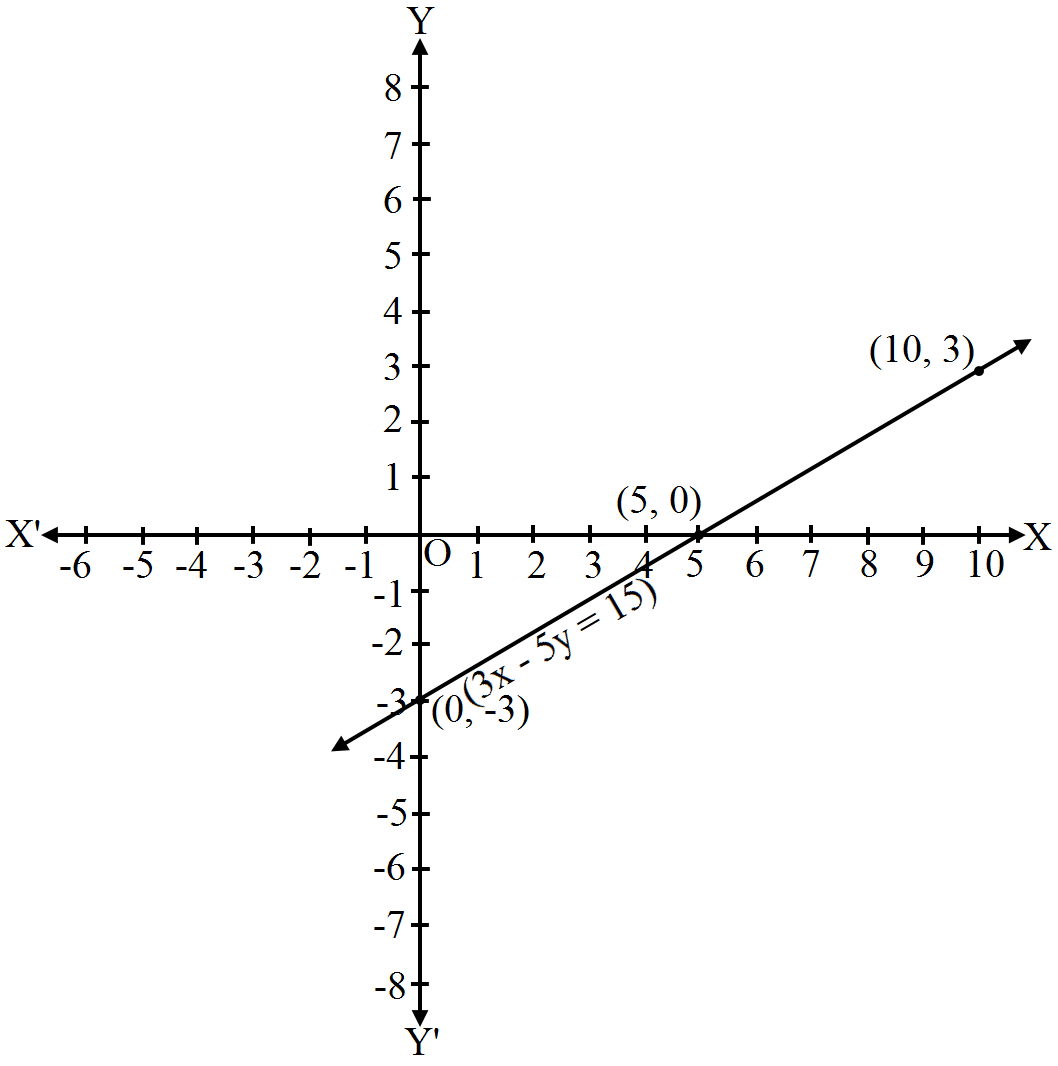
MCQ 841 Mark
The linear equation 3x - 5y = 15 has:
  • A
    Two solutions.
  • B
    A unique solution.
  • C
    No solution.
  • D
    Infinitely many solutions.
View full question & answer
MCQ 851 Mark
The equation 2x + 5y = 7 has a unique solution, if x, y are:
  • A
    Rational numbers
  • B
    Real numbers
  • C
    Natural numbers
  • D
    Positive real numbers
Answer
  1. Natural numbers
    Solution:
    The equation 2x + 5y = 7 has a unique solution, if x, y are natural numbers.
    In natural numbers, there exists only one pair (1, 1) which satisfies the given equation.
    But for rational numbers, real numbers, positive real numbers, there exist many solution pairs to satisfy the equation.
View full question & answer
MCQ 861 Mark
The graph of linear equation x + 2y = 2, cuts the y - axis at:
  • A
    (2, 0)
  • B
    (0, 2)
  • C
    (0, 1)
  • D
    (1, 1)
Answer
  1. (0, 1)
    Solution:
    x + 2y = 2
    $\text{y}=\frac{(2-\text{x})}{2}$
    If x = 0, then;
    $\text{y}=\frac{(2-0)}{2}=\frac{2}{2}=1$
    Hence, x + 2y = 2 cuts the y - axis at (0, 1).
View full question & answer
MCQ 871 Mark
The graph of y + 2 = 0 is a line.
  • A
    Parallel to the y-axis at a distance of 2 units to the left of y-axis.
  • B
    Parallel to the x-axis at a distance of 2 units below the x-axis.
  • C
    Making an intercept of -2 on the x-axis.
  • D
    Making an intercept of -2 on the y-axis.
Answer
  1. Making an intercept of -2 on the y-axis.
    Solution:
    As, the graph of y + 2 = 0 or y = -2 is a line parallel to x-axis i.e. y = 0.
    ⇒ The line represented by the equation y = -2 is parallel to x-axis and intersects y-axis at y = -2.
    So, the graph of y + 2 = 0 is a line parallel to the x-axis at a distance of 2 units below the x-axis making an intercept -2 on the y-axis.
View full question & answer
MCQ 881 Mark
The cost of a notebook is twice the cost of a pen. The equation to represent this statement is:
  • A
    x = 3y
  • B
    x - 2y = 0
  • C
    2x = 3y
  • D
    None of these
Answer
  1. x - 2y = 0
    Solution:
    Let the cost of the notebook is ₹ x and pen is ₹ y and we have given that the cost of a notebook is twice the cost of a pen.
    So we have
    x = 2y
    Or x - 2y = 0.
View full question & answer
MCQ 891 Mark
The graph of the linear equation 2x + 5y = 10 meets the x-axis at the point.
  • A
    (0, 5)
  • B
    (5, 0)
  • C
    (0, 2)
  • D
    (2, 0)
Answer
  1. (5, 0)
    Solution:
    If the graph of the linear equation 2x + 5y = 10 meets the x-axis, then y = 0.
    Substituting the value of y = 0 in equation 2x + 5y = 10, we get
    2x + 5(0) = 10
    ⇒ 2x = 10
    $\Rightarrow\text{x}=\frac{10}{2}$
    ⇒ x = 5
    So, the point of meeting is (5, 0).
View full question & answer
MCQ 901 Mark
The graph of the linear equation 2x + 3y = 6 is a line which meets the x-axis at the point.
  • A
    (0, 2)
  • B
    (0, 3)
  • C
    (3, 0)
  • D
    (2, 0)
Answer
  1. (3, 0)
    Solution:
    2x + 3y = 6 meets the x-axis.
    Put y = 0,
    2x + 3(0) = 6
    x = 3
    Therefore, graph of the given line meets x-axis at (3, 0).
View full question & answer
MCQ 911 Mark
The equation 2x + 5y = 7 has a unique solution, if x and y are:
  • A
    Natural numbers.
  • B
    Rational numbers.
  • C
    Positive real numbers.
  • D
    Real numbers.
Answer
  1. Natural numbers.
    Solution:
    The equation 2x + 5y = 7 has a unique solution, if x and y are natural numbers.
    If we take x = 1 and y = 1, the given equation is satisfied.
View full question & answer
MCQ 921 Mark
Any point on the x-axis is of the form:
  • A
    (x, y)
  • B
    (0, y)
  • C
    (x, 0)
  • D
    (x, x)
Answer
  1. (x, 0)
    Solution:
    Any point on x-axis is of the form (x, 0), where $\text{x}\neq0,$
    Since its y-coordinate will be 0 always.
View full question & answer
MCQ 931 Mark
The point which lies on y-axis at a distance of 6 units in the positive direction of y-axis is:
  • A
    (0, 6)
  • B
    (-6, 0)
  • C
    (6, 0)
  • D
    (0, -6)
Answer
  1. (0, 6)
    Solution:
    At y-axis the value of x co-ordinate is 0 and y-axis at a distance of 6 units in the positive direction so the co-ordinate of the y-axis is 6. So the co-ordinate of point is (0, 6).
View full question & answer
MCQ 941 Mark
Write the correct answer in the following:
The graph of y = 6 is a Line,
  • A
    Parallel to X-axis at a distance 6 units from the origin.
  • B
    Parallel to Y-axis at a distance 6 units from the origin.
  • C
    Making an intercept 6 on the X-axis.
  • D
    Making an intercept 6 on both axes.
Answer
  1. Parallel to X-axis at a distance 6 units from the origin.
    Solution:
    The given equation y = 6 does not contain x. Its graph is a line parallel to x-axis.
    So, the graph of y = 6 is a line parallel to x-axis at a distance 6 units from the origin.
View full question & answer
MCQ 951 Mark
Write the correct answer in the following: The graph of the linear equation 2x + 3y = 6 cuts the Y-axis at the point,
  • A
    (2, 0)
  • B
    (0, 3)
  • C
    (3, 0)
  • D
    (0, 2)
Answer
  1. (0, 2)
    Solution:
    The graph of the linear equation 2x + 3y = 6 cuts the y-axis at the point where x coordinate is zero.
    Putting x = 0 in 2x + 3y = 6, we get
    2(0) + 3y = 6 ⇒ 3y = 6 ⇒ y = 6 ÷ 3 = 2
View full question & answer
MCQ 961 Mark
x - 4 is the equation of:
  • A
    x-axis.
  • B
    A line parallel to x-axis.
  • C
    y-axis.
  • D
    A line parallel to y-axis.
Answer
  1. A line parallel to y-axis.
    Solution:
    We know that the line parallel to y-axis is given by x = a
    x - 4 = 0
    x = 4
    So it is a line parallel to y-axis, at a distance of 4 units from it, to the right.
View full question & answer
MCQ 971 Mark
Express ‘x’ in terms of ‘y’ in the equation 2x - 3y - 5 = 0.
  • A
    $\text{x}=\frac{5-3\text{y}}{2}$
  • B
    $\text{x}=\frac{5+3\text{y}}{2}$
  • C
    $\text{x}=\frac{3\text{y}+5}{2}$
  • D
    $\text{x}=\frac{3\text{y}-5}{2}$
Answer
  1. $\text{x}=\frac{3\text{y}+5}{2}$
    Solution:
    2x - 3y -5 = 0
    2x = 3y + 5
    $\text{x}=\frac{3\text{y}+5}{2}.$
View full question & answer
MCQ 981 Mark
The point of the form $(\text{a},-\text{a}),\ \text{a}\neq0$ lies on:
  • A
    The x-axis
  • B
    The y-axis
  • C
    The line y = x
  • D
    The line x + y = 0
Answer
  1. The line x + y = 0
    Solution:
    A point which lies on the x-axis has its y-coordinate = 0
    While a point which lies on the y-axis has its x-coordinate = 0.
    So, the points of the form (a, -a) will not lie on either axes.
    Also, it does not satisfy the equation on of the line y = x.
    The point of the form (a, -a) lies on the line x + y = 0 since it satisifes the equation of the given line.
View full question & answer
MCQ 991 Mark
The graph of x + 3 = 0 is a line.
  • A
    Making an intercept -3 on the y-axis.
  • B
    Parallel to the x-axis at a distance of 3 units below the x-axis.
  • C
    Making an intercept -3 on the x-axis.
  • D
    Parallel to the y-axis at a distance of 3 units to the left of y-axis.
Answer
  1. Making an intercept -3 on the x-axis.
    Solution:
    As, the graph of x + 3 = 0 or x = -3 is a line parallel to y-axis i.e. x = 0.
    ⇒ The line represented by the equation x = -3 is parallel to y-axis and intersects x-axis at x = -3.
    So, the graph of x + 3 = 0 is a line parallel to the y-axis at a distance of 3 units to the left of y-axis making an intercept -3 on the x-axis.
View full question & answer
MCQ 1001 Mark
The graph of x = 4 is a line:
  • A
    Making an intercept 4 on the x-axis.
  • B
    Making an intercept 4 on the y-axis.
  • C
    Parallel to the x-axis at a distance of 4 units from the origin.
  • D
    Parallel to the y-axis at a distance of 4 units from the origin.
Answer
  1. Parallel to the y-axis at a distance of 4 units from the origin.
    Solution:
    The graph of x = 4 is a line parallel to the y-axis at a distance of 4 units from the origin.
View full question & answer
M.C.Q - Page 2 - Maths STD 9 Questions - Vidyadip