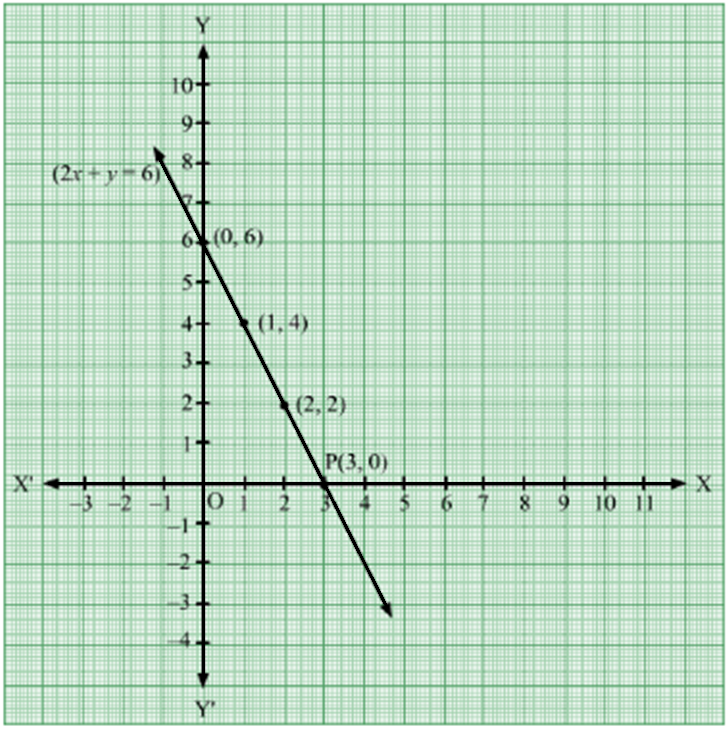
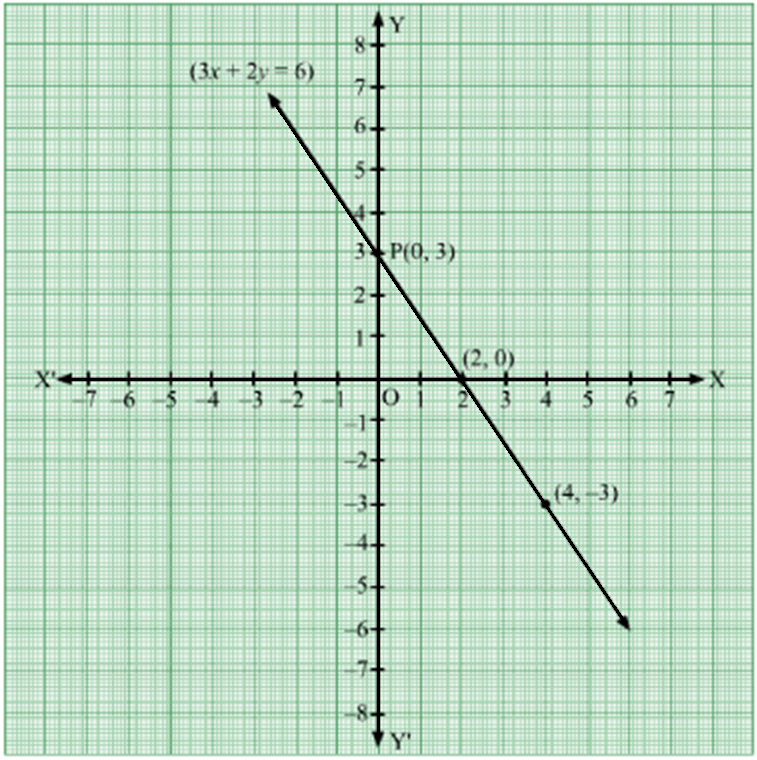
Find the coordinates of the point where the graph cuts the x-axis.
| x | 0 | 1 | 2 |
| Y | 6 | 4 | 2 |
9 questions · timed · auto-graded
| x | 0 | 1 | 2 |
| Y | 6 | 4 | 2 |
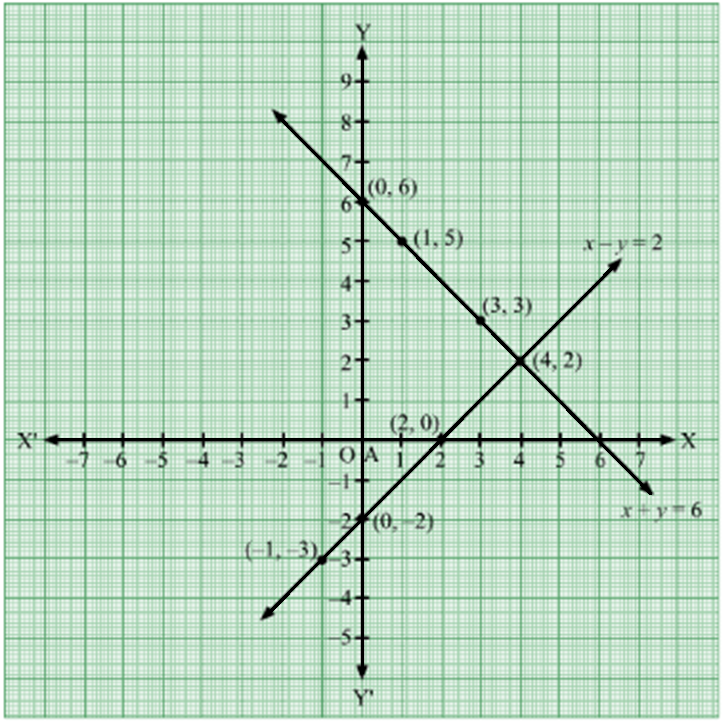
| x | 0 | 1 | 3 |
| y | 6 | 5 | 3 |
| x | 0 | 2 | -1 |
| y | -2 | 0 | -3 |

⇒ y = x - 1
When x = 0, y = 0 - 1 = -1
When, x = 1, y = 1 - 1 = 0
When x = 2, y = 2 - 1 = 1
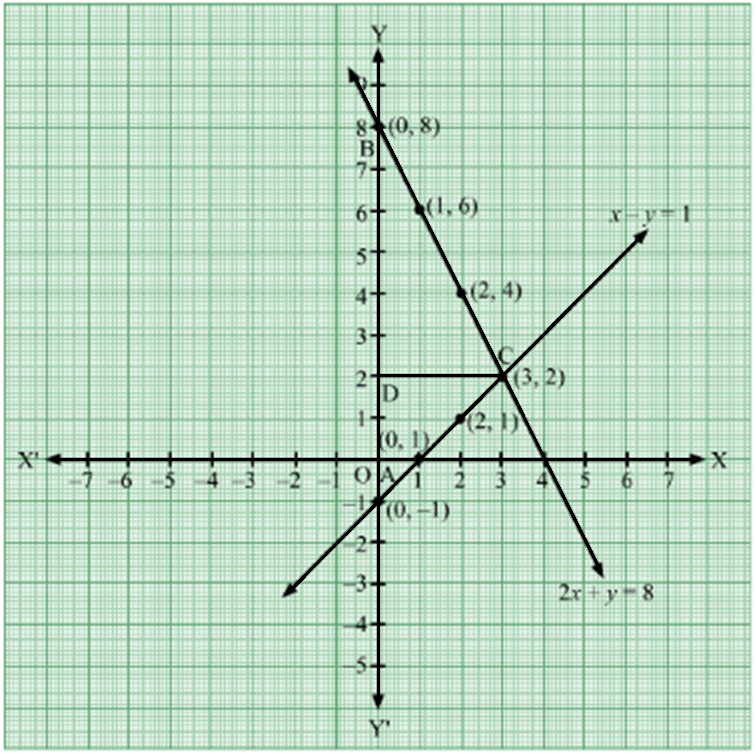
Thus, the points on the line x - y = 1 are as given in the following table:
| x | 0 | 1 | 2 |
| y | -1 | 0 | 1 |
Plotting the points (0, 1), (1, 0) and (2, 1) and drawing a line passing through these points, we obtain the graph of the line x - y = 1.
2x + y = 8
⇒ y = -2x + 8
When, x = 1, y = -2 × 1 + 8 = -2 + 8 = 6
When, x = 2, y = -2 × 2 + 8 = -4 + 8 = 4
When, x = 3, y = -2 × 3 + 8 = -6 + 8 = 2
Thus, the points on the line 2x + y = 8 are as given in the following tabel:
| x | 1 | 2 | 3 |
| y | 6 | 4 | 2 |
Plotting the points (1, 6), (2, 4) and (3, 2) and drawing a line passing through these points, we obtain the graph of the line 2x + y = 8.

The shaded region represents the area bounded by the lines x - y = 1, 2x + y = 8 and the y-axis. This represents a triangle.
It can be seen that the lines intersect at the point C(3, 2). Draw CD perpendicular from C on the y-axis.
Height = CD = 3 units
Base = AB = 9 units
$\therefore\ $Area of the shaded region = Area of $\triangle\text{ABC}=\frac{1}{2}\times\text{AB}\times\text{CD}=\frac{1}{2}\times9\times3=\frac{27}{2}$ square units.
$\Rightarrow3\text{y}=-4\text{x}+24$
$\Rightarrow\text{y}=\frac{-4\text{x}+24}{3}$
When, $\text{x}=0,\ \text{y}=\frac{-4\times0+24}{3}=\frac{0+24}{3}=\frac{24}{3}=8$
When, $\text{x}=3,\ \text{y}=\frac{-4\times3+24}{3}=\frac{-12+24}{3}=\frac{12}{3}=4$
When, $\text{x}=6,\ \text{y}=\frac{-4\times6+24}{3}=\frac{-24+24}{3}=\frac{0}{3}=0$
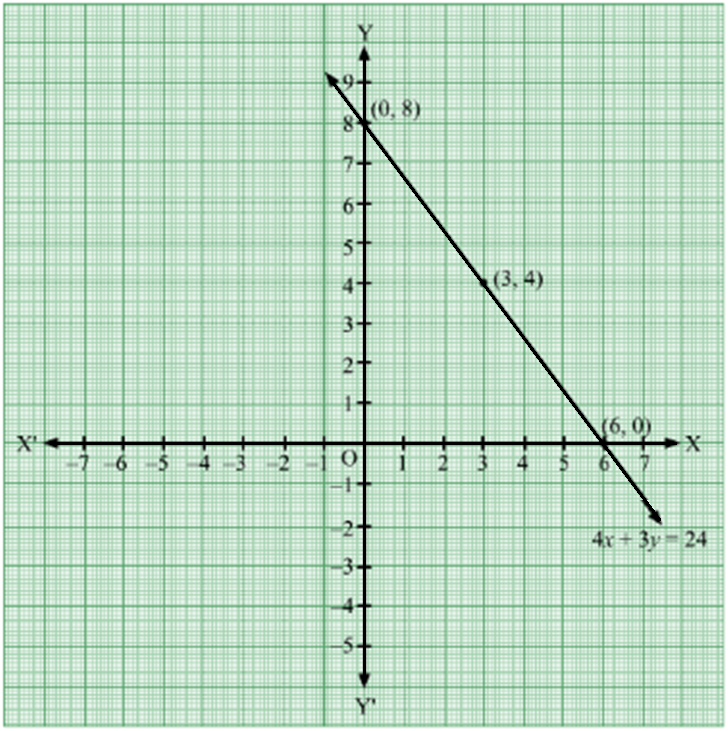
Thus, the points on the line 4x + 3y = 24 are as given in the following table:
| x | 0 | 3 | 6 |
| y | 8 | 4 | 0 |
Plotting the points (0, 8), (3, 4) and (6, 0) and drawing a line passing through these points, we obtain the graph of line 4x + 3y = 24.

$\therefore\ $Area of the triangle $=\frac{1}{2}\times6\times8=24$ square units.
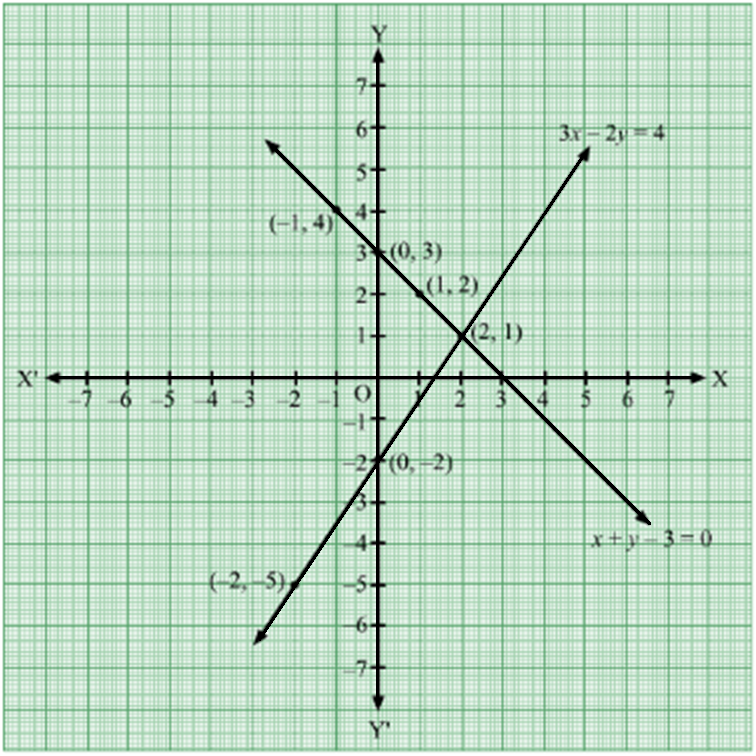
$\Rightarrow2\text{y}=3\text{x}-4$
$\Rightarrow\text{y}=\frac{3\text{x}-4}{2}$
When,
$\text{x}=0,\ \text{y}=\frac{3\times0-4}{2}=\frac{0-4}{2}=\frac{-4}{2}=-2$When,
$\text{x}=2,\ \text{y}=\frac{3\times2-4}{2}=\frac{6-4}{2}=\frac{2}{2}=1$When,
$\text{x}=-2,\ \text{y}=\frac{3\times(-2)-4}{2}=\frac{-6-4}{2}=\frac{-10}{2}=-5$Thus, the points on the line 3x - 2y = 4 are as given in the following table:
| x | 0 | 2 | -2 |
| y | -2 | 1 | -5 |
Plotting the points (2, -2), (-2, -5) and drawing a line passing through these points, we obtain the graph of the line 3x - 2y = 4.
x + y - 3 = 0
⇒ y = -x + 3
When, x = 0, y = -0 + 3 = 3
When, x = 1, y = -1 + 3 = 2
When, x = -1, y = -(-1) + 3 = 1 + 3 = 4
Thus, the points on the line x + y - 3 = 0 are as given in the following tabel
| x | 0 | 1 | -1 |
| y | 3 | 2 | 4 |
Plotting the points (0, 3), (1, 2) and (-1, 4) and drawing a line passing through these points, we obtain the graph of the line x + y = 0.

It can be seen that the linces 3x - 2y = 4 and x + y - 3 = 0 interesect at the point (2, 1).
From your graph, Find:
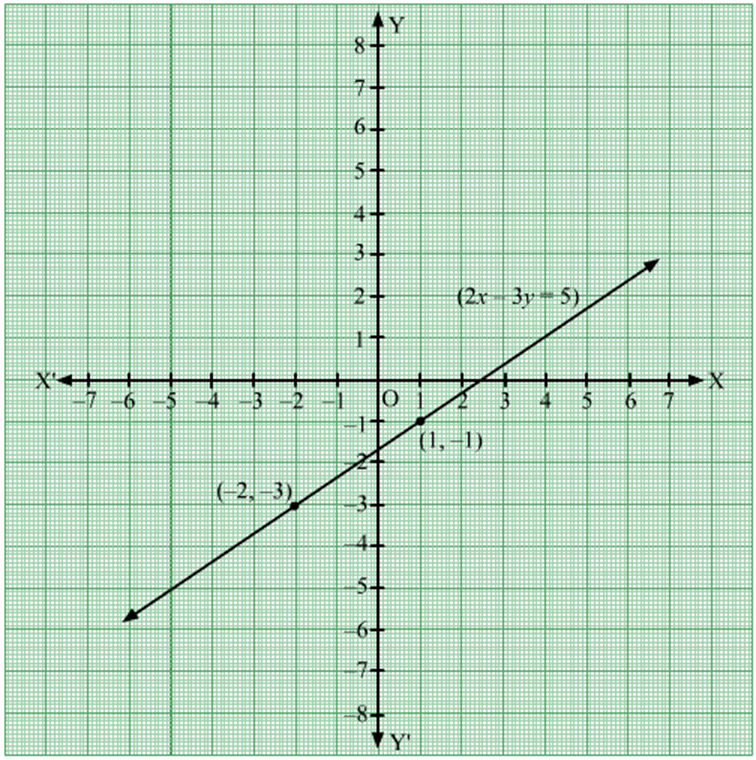
$2\text{x}-3\text{y}-3=5$
$\Rightarrow2\text{x}=3\text{y}+5$
$\Rightarrow\text{x}=\frac{3\text{y}+5}{2}$
When, $\text{y}=-1,$$\text{x}=\frac{-3+5}{2}$
$\Rightarrow\frac{2}{2}=1$
When, $\text{y}=-3$$\text{x}=\frac{-9+5}{2}$
$\Rightarrow\frac{-4}{2}=-2$
Thus, we have the following table:| x | 1 | -2 |
| y | -1 | -3 |
$4=\frac{3\text{y}+5}{2}$
$\Rightarrow8=3\text{y}+5$
$\Rightarrow3\text{y}=8-5=3$
$\Rightarrow3\text{y}=3$
$\Rightarrow\text{y}=1$
$\text{x}=\frac{3\text{y}+5}{2}$
$\Rightarrow\frac{14}{2}=7$

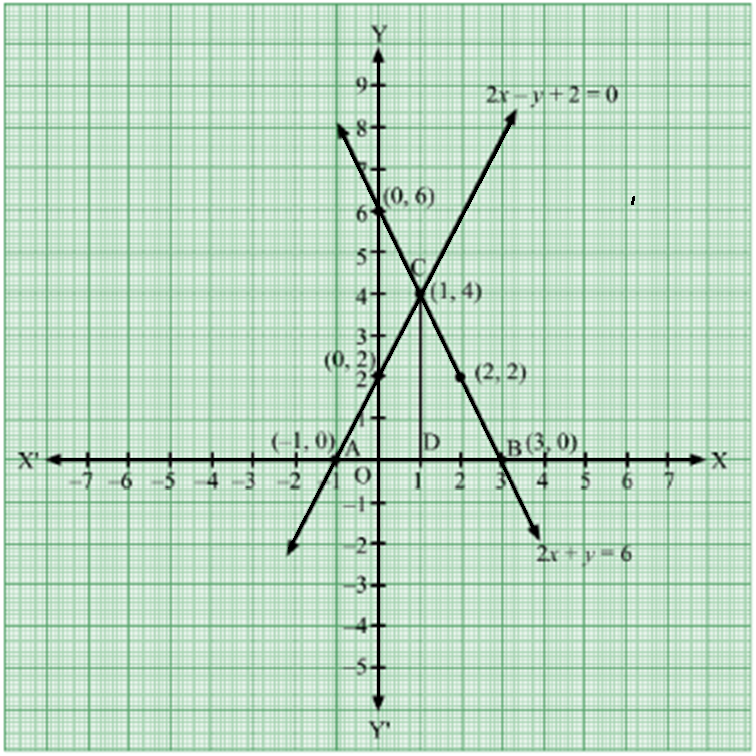
| x | 0 | 1 | 2 |
| y | 6 | 4 | 2 |
| x | 0 | 1 | -1 |
| y | 2 | 4 | 0 |
The shaded region represents the area bounded by the linces 2x + y = 6, 2x - y + 2 = 0 and the x-axis. This represents a triangle. It can be seen that the lines intersect at the point c(1, 4). Draw CD perpendicular from C on the x-axis. Height = CD = 4 units Base = AB = 4 units $\therefore\ $Area of the shaded region = Area of $\triangle\text{ABC}=\frac{1}{2}\times\text{AB}\times\text{CD}=\frac{1}{2}\times4\times4=8$ square units.
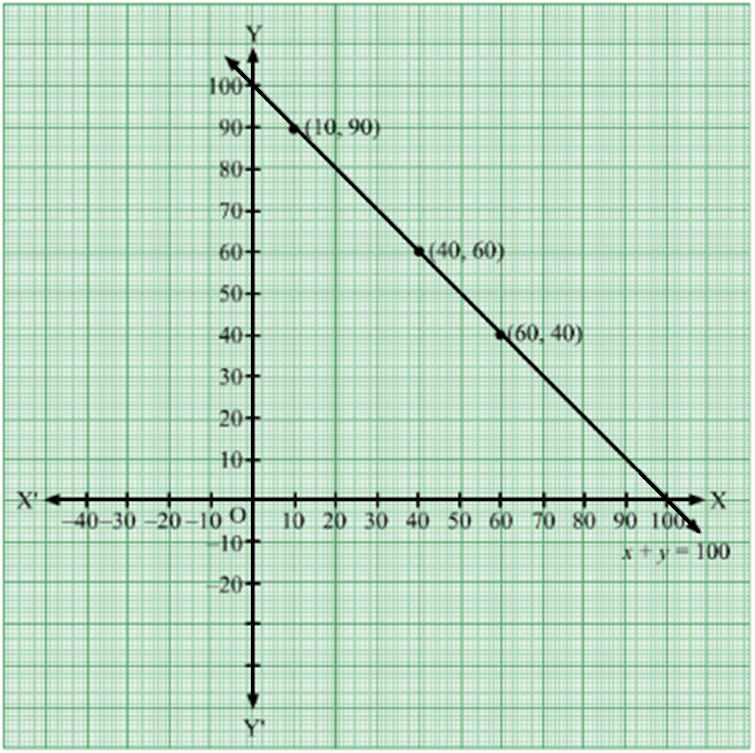
$\therefore\ $x + y = 100
This is the linear equation satisfying the given data. x + y = 100 ⇒ y = 100 - x When, x = 10, y = 100 - 10 = 90 When, x = 40, y = 100 - 40 = 60 When, x = 60, y = 100 - 60 = 40 Thus, the points on the line x + y = 100 are as given in the following tabel:| x | 10 | 40 | 60 |
| y | 90 | 60 | 40 |

$3\text{x}+2\text{y}=6.$
Then,$2\text{y}=6-3\text{x}$
$\Rightarrow\text{y}=\frac{6-3\text{x}}{2}$
When, $\text{x}=2,\ \text{y}=\frac{6-6}{2}=0$ When, $\text{x}=4,\ \text{y}=\frac{6-12}{2}=-3$ Thus, we get the following table:| x | 2 | 4 |
| y | 0 | -3 |
Clearly, the graph cuts the y-axis at p(0, 3).