Question 13 Marks
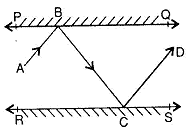
In figure, PQ and RS are two mirrors placed parallel to each other. An incident ray AB strikes the mirror PQ at B. The reflected ray moves along the path BC and strikes the mirror RS at C and again reflects back along CD. Prove that AB || CD.
Answer
View full question & answer→Draw ray BL $\perp$ PQ and ray CM $\perp$ RS.
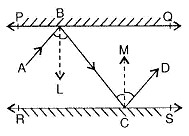
BL $\perp$ PQ, CM $\perp$ RS and PQ $\parallel$ RS
BL || CM
$\angle$LBC = $\angle$MCB . . . (1)
$\angle$ABL = $\angle$LBC . . . [Angle of incident = Angle of reflection] . . . .(2)
$\angle$MCB = $\angle$MCD . . . [Angle of incident = Angle of reflection] . . . . (3)
$\angle$ABL = $\angle$MCD . . . [From (1), (2) and (3)]
$\angle$LBC + $\angle$ABL = $\angle$MCB + $\angle$MCD . . . [Adding (1) and (4)]
$\angle$ABC = $\angle$BCD are alternate interior angles and are equal.
$\therefore$ AB || CD
BL $\perp$ PQ, CM $\perp$ RS and PQ $\parallel$ RS
BL || CM
$\angle$LBC = $\angle$MCB . . . (1)
$\angle$ABL = $\angle$LBC . . . [Angle of incident = Angle of reflection] . . . .(2)
$\angle$MCB = $\angle$MCD . . . [Angle of incident = Angle of reflection] . . . . (3)
$\angle$ABL = $\angle$MCD . . . [From (1), (2) and (3)]
$\angle$LBC + $\angle$ABL = $\angle$MCB + $\angle$MCD . . . [Adding (1) and (4)]
$\angle$ABC = $\angle$BCD are alternate interior angles and are equal.
$\therefore$ AB || CD