Questions

M.C.Q

🎯

Test yourself on this topic

8 questions · timed · auto-graded

Question 11 Mark
Write the correct answer in the following:
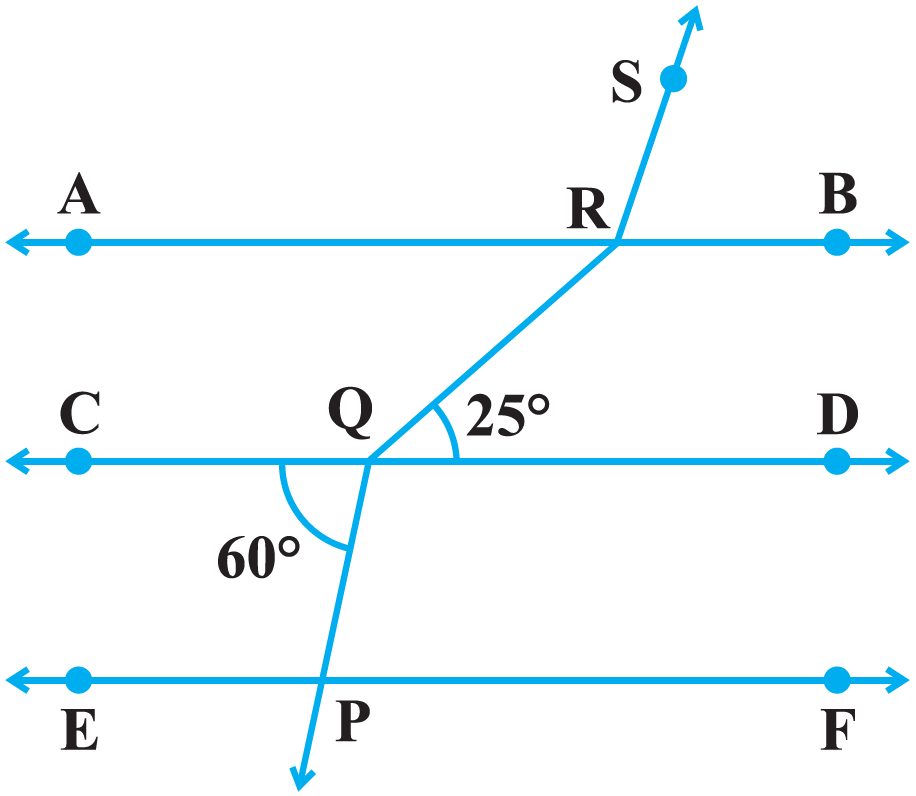
In Fig. if $\text{AB}||\text{CD}||\text{EF},\text{PQ}||\text{RS},$ $\angle\text{RQD}=25^\circ$ and $\angle\text{CQP}=60^\circ,$ then $\angle\text{QRS}$ is equal to.
  1. 85°
  2. 135°
  3. 145°
  4. 110°
Answer
  1. 145°

Solution:

Given, $\text{PQ}||\text{RS}$

$\angle\text{PQC}=\angle\text{BRC}=60^\circ$$\big[$alternate exterior angles and $\angle\text{PQC}=60^\circ$ (given)$\big]$ and $\angle\text{DQR}$

$=\angle\text{QRA}=25^\circ$ [alternate interior angles]

$$$\big[\angle\text{DQR}=25^\circ,\text{(given)}\big]$

$\angle\text{QRS}=\angle\text{QRA}+\angle\text{ARS}$

$=\angle\text{QRA}+\big(180^\circ-\angle\text{BRS}\big)$ [linear pair axiom]

$=25^\circ+180^\circ-60^\circ=205^\circ-60^\circ=145^\circ$
View full question & answer
Question 21 Mark
Write the correct answer in the following:
The angles of a triangle are in the ratio 5 : 3 : 7 The triangle is.
  1. An acute angled triangle.
  2. An obtuse angled triangle.
  3. A right triangle.
  4. An isosceles triangle.
Answer
  1. An acute angled triangle.

Solution:

Let the angles of the triangle be 5x, 3x and 7x.

As the sum of the angles of a triangle is 180° then

5x + 3x + 7x = 180° 

⇒ 15x = 180° ⇒ x = 180° ÷ 15 = 12°

Therefore, the angle of the triangle are:

5 × 12°, 3 × 12° and 7 × 12°, i.e., 60°, 36° and 84°

As the measure of each angle of the triangle is less than 90°, so the angles of triangle are acute angles.

Therefore, the triangle is an acute angled triangle.

Hence, (a) is the correct answer.

View full question & answer
Question 31 Mark
Write the correct answer in the following:

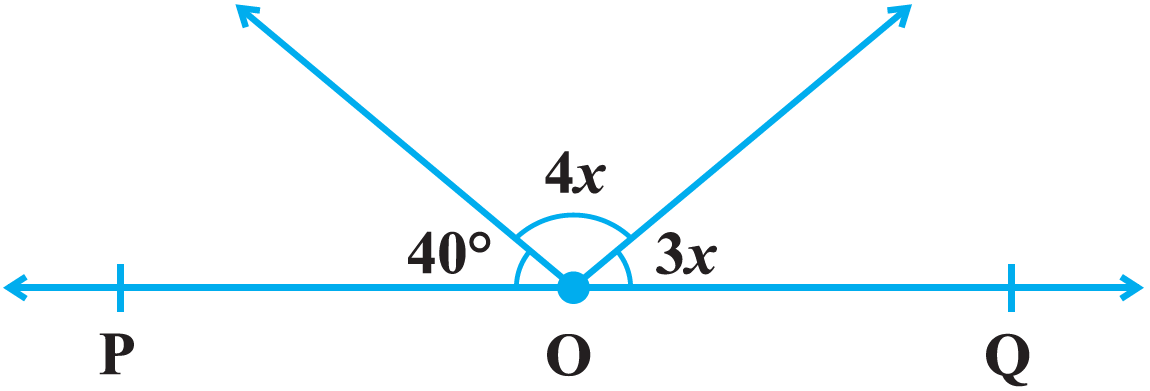
In Fig. POQ is a line.The value of x is.

  1. 20°
  2. 25°
  3. 30°
  4. 35°

Answer
  1. 20°

Solution:

We have 3x + 4x + 40° = 180° (Angles on the straight line)

⇒ 7x + 40° = 180° ⇒ 7x = 180° - 40° = 140°

⇒ x = 140° ÷ 7 = 20°

Hence, (a) is the correct answer.

View full question & answer
Question 41 Mark
Write the correct answer in the following:
An exterior angle of a triangle is 105° and its two interior opposite angles are equal. Each of these equal angles is,
  1. $37\frac{1}{2}^\circ$
  2. $52\frac{1}{2}^\circ$
  3. $72\frac{1}{2}^\circ$
  4. $75^\circ$
Answer
  1. $52\frac{1}{2}^\circ$

Solution:

An exterior angle of triangle is 150°

Let each of to two interior opposites angles be x.

We know that exterior angle of a equal to the sum of two interior opposite angles.

$105^\circ=\text{x}+\text{x}\Rightarrow2\text{x}=105^\circ$

$\Rightarrow\text{x}=\frac{1}{2}\times105^\circ=52\frac{1}{2}^\circ$

So, each of equal angle angle is $52\frac{1}{2}^\circ$

Hence, (b) is the correct answer.

View full question & answer
Question 51 Mark
Write the correct answer in the following:
If one angle of a triangle is equal to the sum of the other two angles, then the triangle is.
  1. An isosceles triangle.
  2. An obtuse triangle.
  3. An equilateral triangle.
  4. An equilateral triangle.
Answer
  1. An equilateral triangle.

Solution:

Let the angles of $\Delta\text{ABC}\ \text{be}\ \angle\text{A},\angle\text{B}\ \text{and}\ \angle\text{C}$

Given that $\angle\text{A}=\angle\text{B}+\angle\text{C}.....(1)$ 

But, in any $\Delta\text{ABC},\angle\text{A}+\angle\text{B}+\angle\text{C}=180^\circ....(2)$[Angles sum property of triangle]

From equation (1) and (2), we get

$\angle\text{A}+\angle\text{A}=180^\circ\Rightarrow2\angle\text{A}=180^\circ\Rightarrow\angle\text{A}\frac{180^\circ}{2}=90^\circ$

$\Rightarrow\angle\text{A}=90^\circ$

Hence, the triangle is a right triangle and option (d) is correct.

View full question & answer
Question 61 Mark
Write the correct answer in the following:

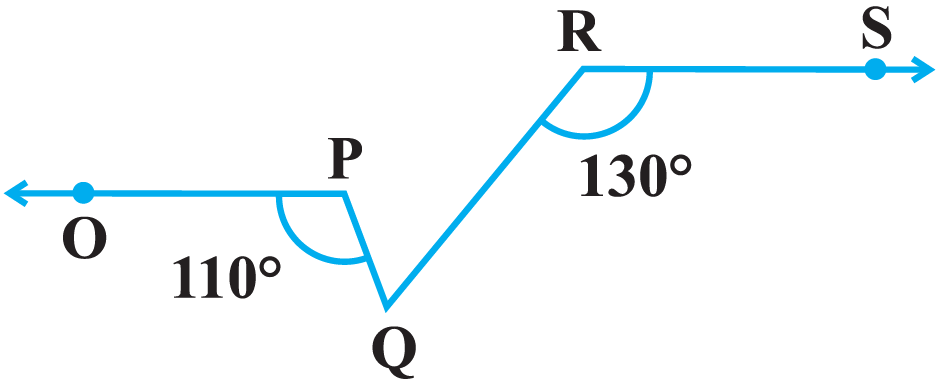
In Fig. if $\text{OP}||\text{RS},$ $\angle\text{OPQ}=110^\circ$ and $\angle\text{QRS}=130^\circ,$ then $\angle\text{PQR}$ is equal to,

  1. 40°
  2. 50°
  3. 60°
  4. 70°

Answer
  1. 60°

Solution:

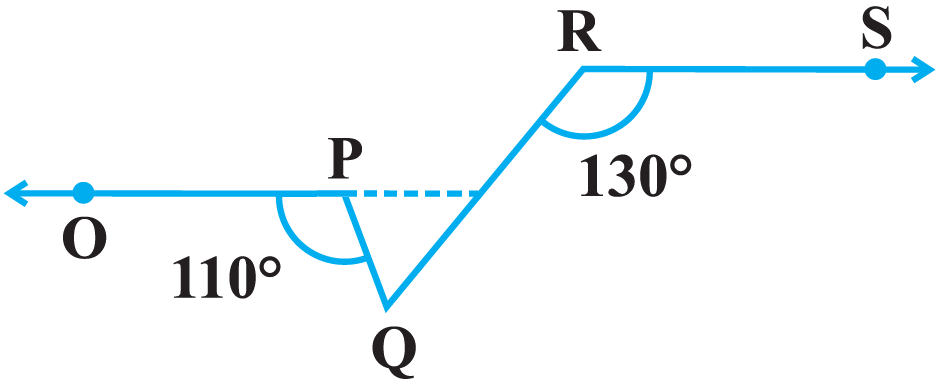
In the given figure, producing OP, to interscet RQ at X.

Since, $\text{OP}||\text{RS}$ and RX is a transversal.

So, $\angle\text{RXP}=\angle\text{XRS}$

$\Rightarrow\angle\text{RXP}=130^\circ$$\big[\because\angle\text{QRS}=130^\circ(\text{given})\big]....(\text{i})$

Now, RQ is a line segment.

So,$\angle\text{PXQ}+\angle\text{RXP}=180^\circ$ [linear pair axiom]

$\Rightarrow\angle\text{PXQ}=180^\circ-\angle\text{RXP}=180^\circ-130^\circ$ [from eq. (i)]

$\Rightarrow\angle\text{PXQ}=50^\circ$

In $\Delta\text{PQX},$ $\angle\text{OPQ}$ is an exterior angle,

$\therefore\angle\text{OPQ}=\angle\text{PXQ}+\angle\text{PQX}$

[$\because\ $exterior asngle = sum of two opposite interior angles]

$110^\circ=50^\circ+\angle\text{PQX}$

$\angle\text{PQX}=110^\circ-50^\circ$

$\angle\text{PQR}=60^\circ$ $[\because\ \angle\text{PQX}=\angle\text{PQR}]$

View full question & answer
Question 71 Mark
Write the correct answer in the following:
Angles of a triangle are in the ratio 2 : 4 : 3. The smallest angle of the triangle is,
  1. 60°
  2. 40°
  3. 80°
  4. 20°
Answer
  1. 40°

Solution:

Given that: The Ratio of angles of a triangle is 2 : 4 : 3

Let the angles of the triangle be $\angle\text{A},\angle\text{B},$ and $\angle\text{C},$

$\therefore\ \angle\text{A}=2\text{x},\angle\text{B}=4\text{x}$ and $\angle\text{C}=3\text{x}$

In $\angle\text{ABC},$ $\angle\text{A}+\angle\text{B}+\angle\text{C}=180^\circ$

[$\because\ $Sum of angles of a triangle is 180°]

$\Rightarrow2\text{x}+4\text{x}+3\text{x}=180^\circ\Rightarrow9\text{x}=180^\circ\Rightarrow\text{x}=\frac{180^\circ}{9}=20^\circ$

$\therefore\ \angle\text{A}=2\text{x}=2\times20^\circ=40^\circ$

$\angle\text{B}=4\text{x}=4\times20^\circ=80^\circ$

And $\angle\text{C}=3\text{x}=3\times20^\circ=60^\circ$

Hence, the smallest angles of a triangle is 40° and option (b) is correct answer.

View full question & answer
Question 81 Mark
Write the correct answer in the following:
If one of the angles of a triangle is 130°, then the angle between the bisectors of the other two angles can be.
  1. 50°
  2. 65°
  3. 145°
  4. 155°
Answer
  1. 155°

Solution:

$$In $\Delta\text{ABC},$ we have $\angle\text{A}=130^\circ$

OB and OC are the bisectors of the angles B and C.

Let $\angle\text{OBC}=\angle\text{OBA}=\text{x}\ \text{and}\angle\text{OCB}=\angle\text{OCA}=\text{y}$

In $\Delta\text{ABC},$

$\angle\text{A}+\angle\text{B}+\angle\text{C}=180^\circ$

$\Rightarrow130^\circ+2\text{x}+2\text{y}=180^\circ$

$\Rightarrow\text{x}+\text{y}=25^\circ$

$\text{i.e}\angle\text{OBC}+\angle\text{OCB}=25^\circ$

Now, In $\Delta\text{BOC}$

$\angle\text{BOC}=180^\circ-\big(\angle\text{OBC}+\angle\text{OCB}\big)$ (Angle sum Property)

$=180^\circ-25^\circ=155^\circ$

Hence, (d) is the correct answer.

View full question & answer
M.C.Q - Maths STD 9 Questions - Vidyadip