Question 14 Marks
Read the following text carefully and answer the questions that follow:
There is a Diwali celebration in the $\text{DPS}$ school Janakpuri New Delhi. Girls are asked to prepare Rangoli in a triangular shape. They made a rangoli in the shape of triangle $\text{ABC}$ . Dimensions of $\triangle \text{ABC}$ are $26 \ cm, 28 \ cm, 25 \ cm$ .
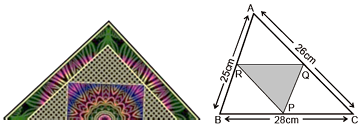
$i.$ In fig $R$ and $Q$ are mid$-$points of $\text{AB}$ and $\text{AC}$ respectively. Find the length of $\text{RQ}$.
$ii.$ Find the length of Garland which is to be placed along the side of $\triangle \text{QPR}$.
$iii.$ R, $P$ and $Q$ are the mid$-$points of $\text{AB, BC}$, and $\text{AC}$ respectively. Then find the relation between area of $\triangle P Q R$ and area of $\triangle \text{ABC}$.
OR
$\text{R, P, Q}$ are the mid$-$points of corresponding sides $\text{AB, BC, CA}$ in $\triangle \text{ABC}$, then name the figure so obtained $\text{BPQR.}$
There is a Diwali celebration in the $\text{DPS}$ school Janakpuri New Delhi. Girls are asked to prepare Rangoli in a triangular shape. They made a rangoli in the shape of triangle $\text{ABC}$ . Dimensions of $\triangle \text{ABC}$ are $26 \ cm, 28 \ cm, 25 \ cm$ .
$i.$ In fig $R$ and $Q$ are mid$-$points of $\text{AB}$ and $\text{AC}$ respectively. Find the length of $\text{RQ}$.
$ii.$ Find the length of Garland which is to be placed along the side of $\triangle \text{QPR}$.
$iii.$ R, $P$ and $Q$ are the mid$-$points of $\text{AB, BC}$, and $\text{AC}$ respectively. Then find the relation between area of $\triangle P Q R$ and area of $\triangle \text{ABC}$.
OR
$\text{R, P, Q}$ are the mid$-$points of corresponding sides $\text{AB, BC, CA}$ in $\triangle \text{ABC}$, then name the figure so obtained $\text{BPQR.}$
Answer
View full question & answer→$i.$ We know that line joining mid points of two sides of triangle is half and parallel to third side.
Hence $\text{RQ}$ is parallel to $\text{BC}$ and half of $\text{BC}$.
$\text{RQ}=\frac{28}{2}=14 \ cm$
Length of $\text{RQ} =14 \ cm$
$ii.$ By mid$-$point theorem we know that line joining mid points of two sides of triangle is half and parallel to third side.
$\text{PQ} =\frac{A B}{2}=\frac{25}{2}=12.5 \ cm$
$\text{QR} =\frac{B C}{2}=\frac{28}{2}=14 \ cm$
$\text{RP} =\frac{A C}{2}=\frac{26}{2}=13 \ cm$
Length of garland $= \text{PQ + QR + RP} =12.5+14+13=39.5 \ cm$
Length of garland $=39.5 \ cm$.
$iii.$ As $R$ and $P$ are mid$-$points of sides $\text{AB}$ and $\text{BC}$ of the triangle $\text{ABC}$ , by mid point theorem, $\ce{RP \| AC}$ Similarly, $\ce{RQ \| BC}$ and $\ce{PQ \| AB}$.
Therefore $\text{ARPQ, BRQP}$ and $\text{RQCP}$ are all parallelograms.
Now $\text{RQ}$ is a diagonal of the parallelogram $\text{ARPQ}$,
therefore, $\triangle \text{ARQ} \cong \triangle \text{PQR}$ Similarly $\triangle \text{CPQ} \cong \triangle \text{RQP}$ and $\triangle \text{BPR} \cong \triangle \text{QRP}$
so, all the four triangles are congruent.
Therefore Area of $\triangle \text{ARQ} =$ Area of $\triangle \text{CPQ} =$ Area of $\triangle \text{BPR} =$ Area of $\triangle \text{PQR}$
Area $\triangle \text{ABC} =$ Area of $\triangle \text{ARQ} +$ Area of $\triangle \text{CPQ} +$ Area of $\triangle \text{BPR} +$ Area of $\triangle \text{PQR}$
Area of $\triangle \text{ABC} =4$ Area of $\triangle \text{PQR}$
$\triangle \text{PQR} =\frac{1}{4} \operatorname{ar}( \text{ABC} )$
OR
As $R$ and $Q$ are mid$-$points of sides $\text{AB}$ and $\text{AC}$ of the triangle $\text{ABC}$. Similarly, $P$ and $Q$ are mid points of sides $\text{BC}$ and $\text{AC}$ by mid$-$point theorem, $\ce{RQ \| BC}$ and $\ce{PQ \| AB}$. Therefore $\text{BRQP}$ is parallelogram.
Hence $\text{RQ}$ is parallel to $\text{BC}$ and half of $\text{BC}$.
$\text{RQ}=\frac{28}{2}=14 \ cm$
Length of $\text{RQ} =14 \ cm$
$ii.$ By mid$-$point theorem we know that line joining mid points of two sides of triangle is half and parallel to third side.
$\text{PQ} =\frac{A B}{2}=\frac{25}{2}=12.5 \ cm$
$\text{QR} =\frac{B C}{2}=\frac{28}{2}=14 \ cm$
$\text{RP} =\frac{A C}{2}=\frac{26}{2}=13 \ cm$
Length of garland $= \text{PQ + QR + RP} =12.5+14+13=39.5 \ cm$
Length of garland $=39.5 \ cm$.
$iii.$ As $R$ and $P$ are mid$-$points of sides $\text{AB}$ and $\text{BC}$ of the triangle $\text{ABC}$ , by mid point theorem, $\ce{RP \| AC}$ Similarly, $\ce{RQ \| BC}$ and $\ce{PQ \| AB}$.
Therefore $\text{ARPQ, BRQP}$ and $\text{RQCP}$ are all parallelograms.
Now $\text{RQ}$ is a diagonal of the parallelogram $\text{ARPQ}$,
therefore, $\triangle \text{ARQ} \cong \triangle \text{PQR}$ Similarly $\triangle \text{CPQ} \cong \triangle \text{RQP}$ and $\triangle \text{BPR} \cong \triangle \text{QRP}$
so, all the four triangles are congruent.
Therefore Area of $\triangle \text{ARQ} =$ Area of $\triangle \text{CPQ} =$ Area of $\triangle \text{BPR} =$ Area of $\triangle \text{PQR}$
Area $\triangle \text{ABC} =$ Area of $\triangle \text{ARQ} +$ Area of $\triangle \text{CPQ} +$ Area of $\triangle \text{BPR} +$ Area of $\triangle \text{PQR}$
Area of $\triangle \text{ABC} =4$ Area of $\triangle \text{PQR}$
$\triangle \text{PQR} =\frac{1}{4} \operatorname{ar}( \text{ABC} )$
OR
As $R$ and $Q$ are mid$-$points of sides $\text{AB}$ and $\text{AC}$ of the triangle $\text{ABC}$. Similarly, $P$ and $Q$ are mid points of sides $\text{BC}$ and $\text{AC}$ by mid$-$point theorem, $\ce{RQ \| BC}$ and $\ce{PQ \| AB}$. Therefore $\text{BRQP}$ is parallelogram.