Question 13 Marks
If $\sqrt{2}=1.414,\ \sqrt{3}=1.732$ then find the value of $\frac{4}{3\sqrt{3}-2\sqrt{2}}+\frac{3}{3\sqrt{3}+2\sqrt{2}}.$
AnswerWe have, $\frac{4}{3\sqrt{3}-2\sqrt{2}}+\frac{3}{3\sqrt{3}+2\sqrt{2}}$ $=\frac{4(3\sqrt{3}+2\sqrt{2})+3(3\sqrt{3}-2\sqrt{2})}{(3\sqrt{3}-2\sqrt{2})(3\sqrt{3}+2\sqrt{2})}$
$=\frac{12\sqrt{3}+8\sqrt{2}+9\sqrt{3}-6\sqrt{2}}{(3\sqrt{3})^2-(2\sqrt{2})^2}$ $[\text{Using identity, (a+b) (a}-\text{b)}=\text{a}^2-\text{b}^2]$
$=\frac{21\sqrt{3}+2\sqrt{2}}{27-8}=\frac{21\sqrt{3}+2\sqrt{2}}{19}$
$=\frac{21\times1.732+2\times1.414}{19}$ $[\text{put}\sqrt{2}=1.414\text{ and } \sqrt{3}=1.732]$
$=\frac{36.372+2.828}{19}=\frac{39.2}{19}$
$=2.06316\approx2.063$
View full question & answer→Question 23 Marks
If $\text{a}=\frac{3+\sqrt{5}}{2}$ then find the value of $\text{a}^2+\frac{1}{\text{a}^2}.$
AnswerGiven, $\text{a}=\frac{3+\sqrt{5}}{2}\ ...\text{(i)}$
Now, $\frac{1}{\text{a}}=\frac{2}{3+\sqrt{5}}=\frac{2}{3+\sqrt{5}}\times\frac{3-\sqrt{5}}{3-\sqrt{5}}$ $[$multiplying numerator and denominator by${ 3}-\sqrt{5}]$
$=\frac{6-2\sqrt{5}}{3^2-(\sqrt{5})^2}$ $[\text{using identity, (a}-\text{b) (a+b)}=\text{a}^2-\text{b}^2]$
$=\frac{6-2\sqrt{5}}{9-5}=\frac{6-2\sqrt{5}}{4}$
$\Rightarrow\ \frac{1}{\text{a}}=\frac{2(3-\sqrt{5})}{4}=\frac{3-\sqrt{5}}{2}\ ...(\text{ii})$
$\therefore\ \text{a}^2+\frac{1}{\text{a}^2}=\text{a}^2+\frac{1}{\text{a}^2}+2-2=\Big(\text{a}+\frac{1}{\text{a}}\Big)^2-2$ [adding and subtracting 2]
$=\Big(\frac{3+\sqrt{5}}{2}+\frac{3-\sqrt{5}}{2}\Big)^2-2$ [from Eqs. (i) and (ii)]
$=\Big(\frac{6}{2}\Big)^2-2=(3)^2-2=9-2=7$
View full question & answer→Question 33 Marks
Rationalise the denominator of the following:
$\frac{\sqrt{3}+\sqrt{2}}{\sqrt{3}-\sqrt{2}}$
AnswerLet $\text{E}=\frac{\sqrt{3}+\sqrt{2}}{\sqrt{3}-\sqrt{2}}$
For rationalising the denominator, multiplying numerator and denominator by $\sqrt{3}+\sqrt{2}$
$\text{E}=\frac{\sqrt{3}+\sqrt{2}}{\sqrt{3}-\sqrt{2}}\times\frac{\sqrt{3}+\sqrt{2}}{\sqrt{3}+\sqrt{2}}=\frac{(\sqrt{3}+\sqrt{2})^2}{(\sqrt{3})^2+(\sqrt{2})^2}$$[\text{Using identity, (a}-\text{b) (a+b)}=\text{a}^2-\text{b}^2]$
$\frac{(\sqrt{3})^2+(\sqrt{2})^2+2\sqrt{3}\sqrt{2}}{3-2}$ $[\text{Using identity, }\text{(a+b)}^2=\text{a}^2+\text{b}^2+2\text{ab}]$
$3+2+2\sqrt{6}=5+2\sqrt{6}$
View full question & answer→Question 43 Marks
Locate $\sqrt{10}$ on the number line.
AnswerHere, 10 = 32 + 1 So, draw a right angled $\triangle\text{OAB}$ in which OA = 3 units and AB = 1 unit and $\angle\text{OAB}=90^\circ$ By using Pythagoras theorem. we get $\text{OB}=\sqrt{\text{OA}^2+\text{AB}^2}$ $=\sqrt{3^2+1^2}=\sqrt{9+1}=\sqrt{10}$ 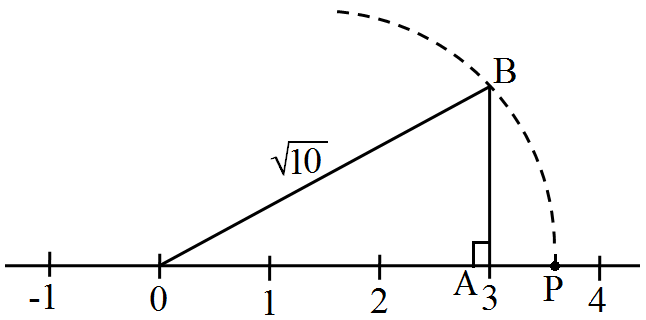
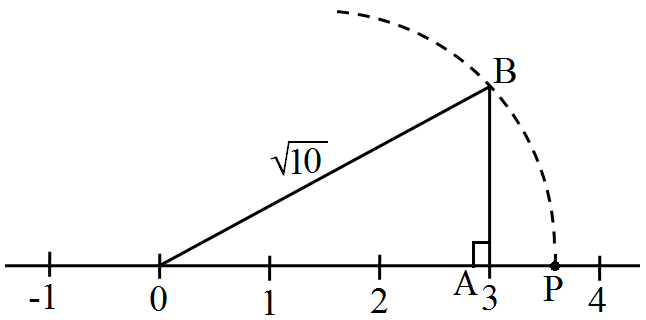
Taking $\text{OB}=\sqrt{10}$ as radius and point O as centre, draw an arc which meets the number line at point P on the positive side of it. The point P represents $\sqrt{10}$ on the number line. View full question & answer→Question 53 Marks
Represent geometrically the following numbers on the number line:
$\sqrt{2.3}$
AnswerFirstly, we draw a line segment AS = 2.3 units and extend it to C such that SC = 1 unit. Let O be the mid-point of AC. Now, draw a semi-circle with centre 0 and radius OA. Let us draw BD perpendicular to AC passing through point 6 and intersecting the semi-circle at point D. Hence, the distance BD is $\sqrt{2.3}\text{ units.}$ Draw an arc with centre 6 and radius BD, meeting AC produced at E, then BE = BD $=\sqrt{2.3}\text{ units.}$ 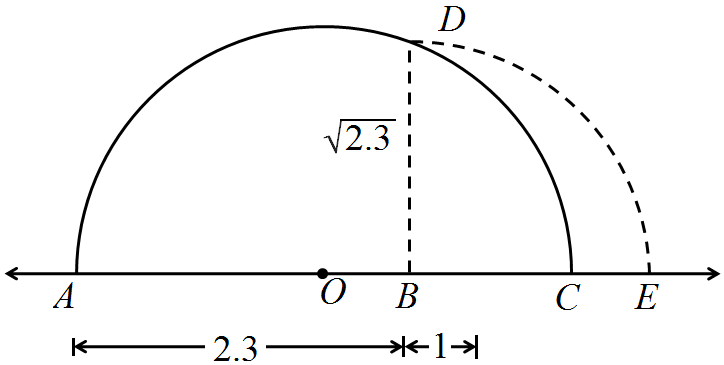
View full question & answer→Question 63 Marks
Locate $\sqrt{5}$ on the number line.
AnswerHere, 5 = 22 + 12 So, draw a right angled $\triangle\text{OAB}$ in which OA = 2 units and AB = 1 unit and $\angle\text{OAB}=90^\circ$ By using Pythagoras theorem, we get $\text{OB}=\sqrt{\text{OA}^2+\text{AB}^2}$ $=\sqrt{2^2+1^2}=\sqrt{4+1}=\sqrt{5}$ 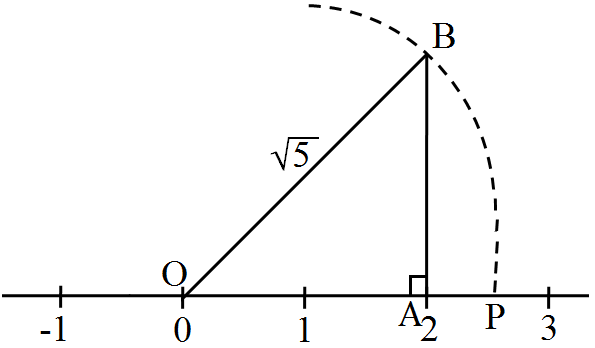
Taking $\text{OB}=\sqrt{5}$ as radius and point O as centre, draw an arc which meets the number line at point P on the positive side of it. Hence, it is clear that point P represents $\sqrt{5}$ on the number line. View full question & answer→Question 73 Marks
Find the values of a and b in the following:
$\frac{\sqrt{2}+\sqrt{3}}{3\sqrt{2}-2\sqrt{3}}=2-\text{b}\sqrt{6}$
Answer$\text{LHS}=\frac{\sqrt{2}+\sqrt{3}}{3\sqrt{2}-2\sqrt{3}}=\frac{\sqrt{2}+\sqrt{3}}{3\sqrt{2}-2\sqrt{3}}=\frac{3\sqrt{2}+2\sqrt{3}}{3\sqrt{2}+2\sqrt{3}}$
$=\frac{(\sqrt{2}+\sqrt{3})(3\sqrt{2}+2\sqrt{3})}{(3\sqrt{2})^2-(2\sqrt{3})^2}$
$=\frac{6+2\sqrt{6}+3\sqrt{6}+6}{18-12}$
$=\frac{12+5\sqrt{6}}{6}=2\frac{5\sqrt{6}}{6}$
Now, $2-\text{b}\sqrt{6}=2+\frac{5}{6}\sqrt{6}\Rightarrow\text{b}=-\frac{5}{6}$
View full question & answer→Question 83 Marks
Rationalise the denominator of the following:
$\frac{\sqrt{6}}{\sqrt{2}+\sqrt{3}}$
AnswerLet $\text{E}=\frac{\sqrt{6}}{\sqrt{2}+\sqrt{3}}$
For rationalising the denominator, multiplying numerator and denominator by $\sqrt{2}-\sqrt{3}$
$\text{E}=\frac{\sqrt{6}}{\sqrt{2}+\sqrt{3}}\times\frac{\sqrt{2}-\sqrt{3}}{\sqrt{2}-\sqrt{3}}=\frac{\sqrt{6}(\sqrt{2}-\sqrt{3})}{(\sqrt{2})^2-(\sqrt{3})^2}$$[\text{Using identity, (a}-\text{b) (a+b)}=\text{a}^2-\text{b}^2]$
$=\frac{\sqrt{6}(\sqrt{2}-\sqrt{3})}{2-3}=\frac{\sqrt{6}(\sqrt{2}-\sqrt{3})}{-1}=\sqrt{6}(\sqrt{3}-\sqrt{2})$
$=\sqrt{18}-\sqrt{12}=\sqrt{9\times2}-\sqrt{4\times3}=3\sqrt{2}-2\sqrt{3}.$
View full question & answer→Question 93 Marks
Represent geometrically the following numbers on the number line:
$\sqrt{8.1}$
AnswerFirstly, we draw a line segment AB = 8.1 units and extend it toC such that SC = 1 unit. Let O be the mid-point of AC.
Now, draw a semi-circle with centre 0 and radius OA.
Let us draw BD perpendicular to AC passing through point 6 intersecting the semi-circle at point D.
Hence, the distance BD is $\sqrt{8.1}\text{ units}.$
Draw an arc with centre Sand radius BD, meeting AC produced at E, then BE = BD = $\sqrt{8.1}\text{ units}.$
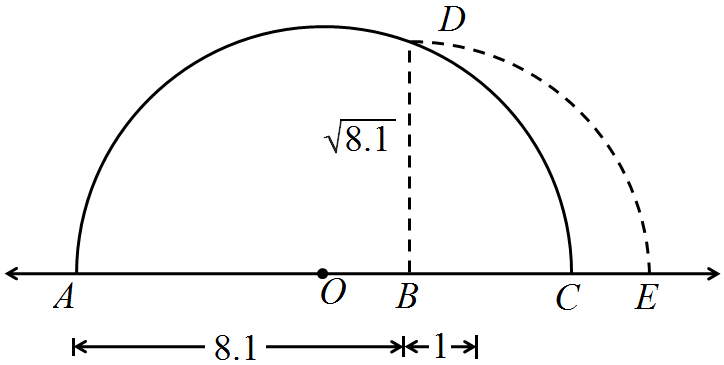
View full question & answer→Question 103 Marks
Represent geometrically the following numbers on the number line:
$\sqrt{4.5}$
AnswerFirstly, we draw a line segment AB = 4.5 units and extend it to C such that BC = 1 unit. Let O be the mid-point of AC. Now, draw a semi-circle with centre O and radius OA Let us draw BD perpendicular to AC passing through point B and intersecting the semi-circle at point D. Hence, the distance BD is $\sqrt{4.5}\text{ units.}$ Draw an arc with centre B and radius BD, meeting AC produced at E, then BE = BD = $\sqrt{4.5}\text{ units.}$ 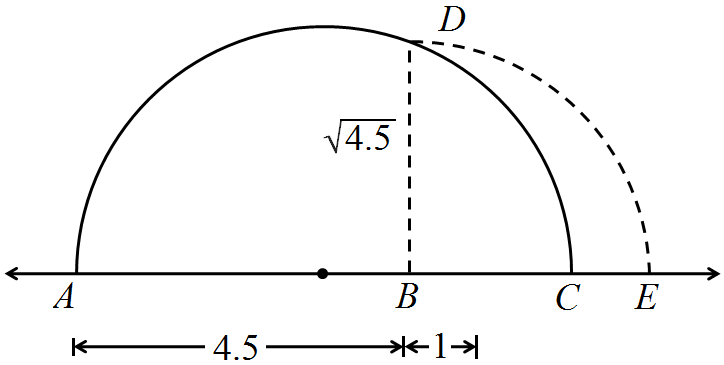
View full question & answer→Question 113 Marks
Show that 0.142857142857... $=\frac{1}{7}$
AnswerLet x = 0.142857142857... (i)
$\therefore1000000\text{x}=142857.\overline{142857}\ (\text{ii})$
Subtracting (i) from (ii), we get
999999x = 142857 (iii)
$\Rightarrow\text{x}=\frac{142857}{999999}=\frac{1}{7}$
Hence, 0.142857142857... $=\frac{1}{7}$
View full question & answer→Question 123 Marks
Express the following in the form $\frac{\text{p}}{\text{q}},$ where p and q are integers and $\text{q}\neq0$:
$0.\overline{134}$
AnswerLet $\text{x}=0.\overline{134}$
$\Rightarrow\text{x}=0\cdot\overline{134}=0.13434...$ (i)
on multiplying both sides of Eq. (i) by 10, we get
10x = 1.3434... (ii)
on multiplying both sides of Eq. (ii) by 100, we get
1000x = 134.3434... (iii)
on subtraking Eq. (ii) from Eq. (iii), we get
1000x - 10x = 134.34... - (1.3434...)
⇒ 990x = 133
$\therefore\text{x}=\frac{133}{990}$
View full question & answer→Question 133 Marks
Simplify the following:
$(\sqrt{3}-\sqrt{2})^2$
Answer$(\sqrt{3}-\sqrt{2})^2$
$=(\sqrt{3})^2+(\sqrt{2})^2-2(\sqrt{3})(\sqrt{2})$
$=3+2-2\sqrt{3\times2}=5-2\sqrt{6}$
$=(3+6+\frac{7}{3})\sqrt{3}$
$=\frac{34}{3}\sqrt{3}$
View full question & answer→Question 143 Marks
Find the values of a and b in the following:
$\frac{3-\sqrt{5}}{3+2\sqrt{5}}=\text{a}\sqrt{5}-\frac{19}{11}$
Answer$\text{LHS}=\frac{3-\sqrt{5}}{3+2\sqrt{5}}=\frac{3-\sqrt{5}}{3+2\sqrt{5}}\times\frac{3-2\sqrt{5}}{3-2\sqrt{5}}$
$=\frac{(3-\sqrt{5})(3-2\sqrt{5})}{(3)^2(2\sqrt{5})^2}$
$=\frac{9-6\sqrt{5}-3\sqrt{5}+10}{9-20}=\frac{19-9\sqrt{5}}{-11}$
Now, $\frac{19-9\sqrt{5}}{-11}=\text{a}\sqrt{5}-\frac{19}{11}$
$\Rightarrow\ \frac{-19}{11}+\frac{9}{11}\sqrt{5}=\text{a}\sqrt{5}-\frac{19}{11}$
$\Rightarrow\ \frac{9}{11}\sqrt{5}-\frac{-19}{11}=\text{a}\sqrt{5}-\frac{19}{11}$
$\text{Hence, a}=\frac{9}{11}$
View full question & answer→Question 153 Marks
Express the following in the form $\frac{\text{p}}{\text{q}},$ where p and q are integers and $\text{q}\neq0$:
0.2555...
AnswerLet x = 0.2555... (i)
on multiplying both sides of Eq. (i) by 10, we get
10x = 2.555... (ii)
on multiplying both sides of Eq. (ii) by 10, we get
100x = 25.55... (iii)
on subtraking Eq. (ii) from Eq. (iii), we get
100x - 10x = 25.55... - (2.555...)
⇒ 90x = 23
$\therefore\text{x}=\frac{23}{90}$
View full question & answer→Question 163 Marks
Rationalise the denominator of the following:
$\frac{4\sqrt{3}+5\sqrt{2}}{\sqrt{48}+\sqrt{18}}$
AnswerLet $\text{E}=\frac{4\sqrt{3}+5\sqrt{2}}{\sqrt{48}+\sqrt{18}}=\frac{4\sqrt{3}+5\sqrt{2}}{\sqrt{16\times3}+\sqrt{9\times2}}=\frac{4\sqrt{3}+5\sqrt{2}}{4\sqrt{3}+3\sqrt{2}}$ For rationalising the denominator, multiplying numerator and denominator by $4\sqrt{3}-3\sqrt{2}$ $=\frac{4\sqrt{3}+5\sqrt{2}}{4\sqrt{3}+3\sqrt{2}}\times\frac{4\sqrt{3}-3\sqrt{2}}{4\sqrt{3}-3\sqrt{2}}$ $=\frac{4\sqrt{3}(4\sqrt{3}-3\sqrt{2})+5\sqrt{2}(4\sqrt{3}-3\sqrt{2})}{(4\sqrt{3})^2-(3\sqrt{2})^2}$ $[\text{Using identity, (a}+\text{b) (a}-\text{b})=\text{a}^2-\text{b}^2]$ $=\frac{48-12\sqrt{6}+20\sqrt{6}-30}{30}$ $=\frac{18+8\sqrt{6}}{30}=\frac{9+4\sqrt{6}}{15}$
View full question & answer→Question 173 Marks
Rationalise the denominator of the following:
$\frac{16}{\sqrt{41}-5}$
AnswerLet $\text{E}=\frac{16}{\sqrt{41}-5}$
For rationalising the denominator, multiplying numerator and denominator by $\sqrt{41}+5$
$\text{E}=\frac{16}{\sqrt{41}-5}\times\frac{\sqrt{41}+5}{\sqrt{41}+5}$
$=\frac{16(\sqrt{41}+5)}{(\sqrt{41})^2-(\sqrt{5})^2}$ $[\text{Using identity, (a}-\text{b) (a+b)}=\text{a}^2-\text{b}^2]$
$=\frac{16(\sqrt{41}+5)}{41-25}$
$=\frac{16(\sqrt{41}+5)}{16}=\sqrt{41}+5$
View full question & answer→Question 183 Marks
Represent geometrically the following numbers on the number line:
$\sqrt{5.6}$
AnswerFirstly, we draw a line segment AB = 5.6 units and extend it to C such that BC = 1 unit. Let O be the mid-point of AC.
Now, draw a semi-circte with centre O and radius OA. Let us draw BD perpendicular to AC passing through point B and intersecting the semi-circle at point D.
Hence, the distance BD is $\sqrt{5.6}\text{ units}.$ units.
Draw an arc with centre B and radius BD, meeting AC produced at E, then BE = BD = $\sqrt{5.6}\text{ units}.$
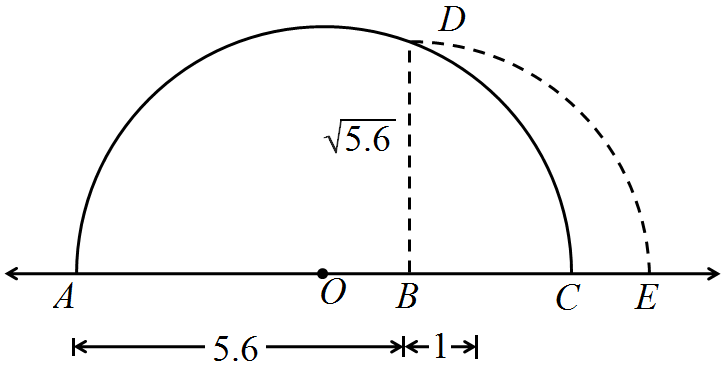
View full question & answer→Question 193 Marks
Express the following in the form $\frac{\text{p}}{\text{q}},$ where p and q are integers and $\text{q}\neq0$:
.404040...
AnswerLet x = .404040... (i)
on multiplying both sides of Eq. (i) by 100, we get
100x = 40.4040... (ii)
on subtraking Eq. (ii) from Eq. (iii), we get
100x - x = 40.4040... - (0.404040...)
⇒ 99x = 40
$\therefore\text{x}=\frac{40}{99}$
View full question & answer→Question 203 Marks
Rationalise the denominator of the following:
$\frac{3\sqrt{5}+\sqrt{3}}{\sqrt{5}-\sqrt{3}}$
AnswerLet $\text{E}=\frac{3\sqrt{5}+\sqrt{3}}{\sqrt{5}-\sqrt{3}}$
For rationalising the denominator, multiplying numerator and denominator by $\sqrt{5}+\sqrt{3}$
$\text{E}=\frac{3\sqrt{5}+\sqrt{3}}{\sqrt{5}-\sqrt{3}}\times\frac{\sqrt{5}+\sqrt{3}}{\sqrt{5}+\sqrt{3}}=\frac{3\sqrt{5}(\sqrt{5}+\sqrt{3})+\sqrt{3}(\sqrt{5}+\sqrt{3})}{(\sqrt{5})^2-(\sqrt{3})^2}$$[\text{Using identity, (a}-\text{b) (a+b)}=\text{a}^2-\text{b}^2]$
$=\frac{15+3\sqrt{15}+\sqrt{15}+3}{5-3}=9+2\sqrt{15}$
View full question & answer→Question 213 Marks
Express the following in the form $\frac{\text{p}}{\text{q}},$ where p and q are integers and $\text{q}\neq0$:
.00323232...
AnswerLet x = .00323232... (i)
on multiplying both sides of Eq. (i) by 100, we get
100x = 0.3232... (ii)
on multiplying both sides of Eq. (ii) by 100, we get
10000x = 32.3232... (iii)
on subtraking Eq. (ii) from Eq. (iii), we get
10000x - 100x = 32.32... - (0.3232...)
⇒ 9900x = 32
$\therefore\text{x}=\frac{32}{9900}=\frac{8}{2475}$ [dividing numerator and denominator by 4]
View full question & answer→Question 223 Marks
Simplify:
$\frac{7\sqrt{3}}{\sqrt{10}+\sqrt{3}}-\frac{2\sqrt{5}}{\sqrt{6}+\sqrt{5}}-\frac{3\sqrt{2}}{\sqrt{15}+3\sqrt{2}}.$
Answer$\frac{7\sqrt{3}}{\sqrt{10}+\sqrt{3}}-\frac{2\sqrt{5}}{\sqrt{6}+\sqrt{5}}-\frac{3\sqrt{2}}{\sqrt{15}+3\sqrt{2}}$
$=\frac{7\sqrt{3}}{\sqrt{10}+\sqrt{3}}\times\frac{\sqrt{10}-\sqrt{3}}{\sqrt{10}-\sqrt{3}}-\frac{2\sqrt{5}}{\sqrt{6}+\sqrt{5}}\times\frac{\sqrt{6}-\sqrt{5}}{\sqrt{6}-\sqrt{5}}-\frac{3\sqrt{2}}{\sqrt{15}+3\sqrt{2}}\times\frac{\sqrt{15}-3\sqrt{2}}{\sqrt{15}-3\sqrt{2}}$
$=\frac{7\sqrt{3}(\sqrt{10}-\sqrt{3})}{10-3}-\frac{2\sqrt{5}(\sqrt{6}-\sqrt{5})}{6-5}=\frac{3\sqrt{2}(\sqrt{15}-3\sqrt{2})}{15-18}$
$=\sqrt{3}(\sqrt{10}-\sqrt{3})-2\sqrt{5}(\sqrt{6}-\sqrt{5})+\sqrt{2}(\sqrt{15}-3\sqrt{2})$
$=\sqrt{30}-3-2\sqrt{30}+10+\sqrt{30}-6$
$=2\sqrt{30}-9-2\sqrt{30}+10=1$
View full question & answer→Question 233 Marks
Rationalise the denominator of the following:
$\frac{2+\sqrt{3}}{2-\sqrt{3}}$
AnswerLet $\text{E}=\frac{2+\sqrt{3}}{2-\sqrt{3}}$
For rationalising the denominator, multiplying numerator and denominator by $2+\sqrt{3}$
$\text{E}=\frac{2+\sqrt{3}}{2-\sqrt{3}}\times\frac{2+\sqrt{3}}{2+\sqrt{3}}=\frac{(2+\sqrt{3})^2}{(2)^2-(\sqrt{3})^2}$$[\text{Using identity, (a}-\text{b) (a+b)}=\text{a}^2-\text{b}^2]$
$=\frac{2^2+(\sqrt{3})^2+2\times2\times\sqrt{3}}{4-3}$ $[\text{Using identity, }-\text{(a+b)}^2=\text{a}^2+2\text{ab+}\text{b}^2]$
$=4+3+4\sqrt{3}=7+4\sqrt{3}$
View full question & answer→Question 243 Marks
Locate $\sqrt{17}$ on the number line.
AnswerHere, 17 = 42 + 1 So, draw a right angled $\triangle\text{OAB}$ in which OA = 4 units and AB = 1 unit and $\angle\text{OAB}=90^\circ$ By using Pythagoras theorem, we get $\text{OB}=\sqrt{\text{OA}^2+\text{AB}^2}$ $=\sqrt{4^2+1^2}=\sqrt{16+1}=\sqrt{17}$ 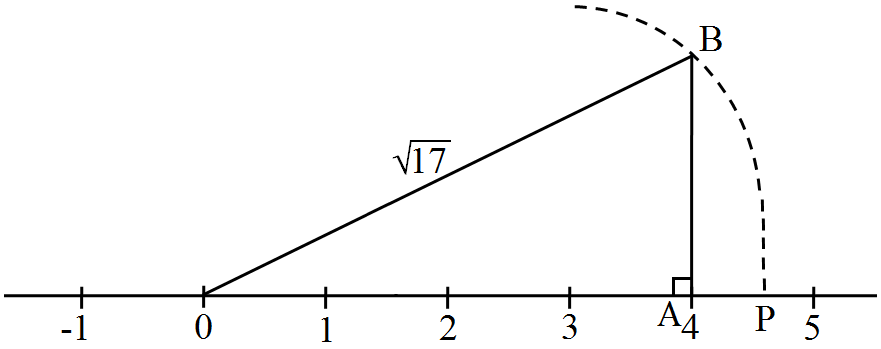
Taking $\text{OB}=\sqrt{17}$ as radius and point as centre, draw an arc which meets the number line at point on the positive side of it. The point Prepresents $\sqrt{17}$ on the number line. View full question & answer→Question 253 Marks
Find the value of $\frac{4}{(216)^{-\frac{2}{3}}}+\frac{1}{(256)^{-\frac{3}{4}}}+\frac{2}{(243)^{-\frac{1}{5}}}$
AnswerWe have,
$\frac{4}{(216)^{-\frac{2}{3}}}+\frac{1}{(256)^{-\frac{3}{4}}}+\frac{2}{(243)^{-\frac{1}{5}}}={4}{(216)^{\frac{2}{3}}}+{(256)^{\frac{3}{4}}}+{2}{(243)^{\frac{1}{5}}}$
$={4}{(6^3)^{\frac{2}{3}}}+{(4^4)^{\frac{3}{4}}}+{2}{(3^5)^{\frac{1}{5}}}$
$={4}\times{6^{3\times\frac{2}{3}}}+4^{4\times{\frac{3}{4}}}+{2}\times{3^{5\times\frac{1}{5}}}$
$={4}\times{6^2}+4^{{3}}+{2}\times{3}$
$=144+64+6=214$
View full question & answer→Question 263 Marks
Find the values of a and b in the following:
$\frac{5+2\sqrt{3}}{7+4\sqrt{3}}=\text{a}-6\sqrt{3}$
Answer$\text{LHS}=\frac{5+2\sqrt{3}}{7+4\sqrt{3}}=\frac{5+2\sqrt{3}}{7+4\sqrt{3}}\times\frac{7-4\sqrt{3}}{7-4\sqrt{3}}$
$=\frac{(5+2\sqrt{3})(7-4\sqrt{3})}{(7)^2(4\sqrt{3})^2}$
$=\frac{35+20\sqrt{3}+14\sqrt{3}-24}{49-48}$
$=\frac{11-6\sqrt{3}}{1}=11-6\sqrt{3}$
Now, $11-6\sqrt{3}=\text{a}-6\sqrt{3}$
$\Rightarrow\ \text{a}=11$
View full question & answer→