Questions

Assertion (A) & Reason (B) MCQ

🎯

Test yourself on this topic

10 questions · timed · auto-graded

MCQ 11 Mark
Statement-1 (A): The diagonals of a parallelogram bisect each other.
Statement-2 (R): If the diagonals of a parallelogram are equal and intersect at right angle, then it is a square.
  • Statement-1 is true, Statement-2 is true; Statement-2 is a correct explanation for Statement-1.
  • B
    Statement-1 is true, Statement-2 is true; Statement-2 is not a correct explanation for Statement-1.
  • C
    Statement-1 is true, Statement-2 is false.
  • D
    Statement-1 is false, Statement-2 is true.
Answer
Correct option: A.
Statement-1 is true, Statement-2 is true; Statement-2 is a correct explanation for Statement-1.
a
View full question & answer
MCQ 21 Mark
Statement-1 (A): The bisectors of the angles of a parallelogram enclose a rectangle.
Statement-2 (R): In a parallelogram, the bisectors of any two consecutive angles intersect at right angle.
  • Statement-1 is true, Statement-2 is true; Statement-2 is a correct explanation for Statement-1.
  • B
    Statement-1 is true, Statement-2 is true; Statement-2 is not a correct explanation for Statement-1.
  • C
    Statement-1 is true, Statement-2 is false.
  • D
    Statement-1 is false, Statement-2 is true.
Answer
Correct option: A.
Statement-1 is true, Statement-2 is true; Statement-2 is a correct explanation for Statement-1.
a
View full question & answer
MCQ 31 Mark
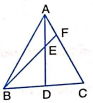
Statement-1 (A): In Fig. if AD is the median of Delta $\triangle A B C$ and E is the mid-point of AD. BE produced meets AC in F, then $A F=\frac{1}{3} A C$.
Statement-2 (R): The line through the mid-point of one side of a triangle, parallel to another side, intersects the third side at its mid-point.
Image
  • Statement-1 is true, Statement-2 is true; Statement-2 is a correct explanation for Statement-1.
  • B
    Statement-1 is true, Statement-2 is true; Statement-2 is not a correct explanation for Statement-1.
  • C
    Statement-1 is true, Statement-2 is false.
  • D
    Statement-1 is false, Statement-2 is true.
Answer
Correct option: A.
Statement-1 is true, Statement-2 is true; Statement-2 is a correct explanation for Statement-1.
a
View full question & answer
MCQ 41 Mark
Statement-1 (A): In a rhombus ABCD, diagonals, AC bisects the angles $\angle A$ as well as $\angle C$.
Statement-2 (R): The diagonals of a rhombus bisect each other at right angle.
  • A
    Statement-1 is true, Statement-2 is true; Statement-2 is a correct explanation for Statement-1.
  • Statement-1 is true, Statement-2 is true; Statement-2 is not a correct explanation for Statement-1.
  • C
    Statement-1 is true, Statement-2 is false.
  • D
    Statement-1 is false, Statement-2 is true.
Answer
Correct option: B.
Statement-1 is true, Statement-2 is true; Statement-2 is not a correct explanation for Statement-1.
b
View full question & answer
MCQ 51 Mark
Statement-1 (A): If the measures of three angles of a quadrilateral are 130°, 70° and 60°, then the measure of fourth angle is 100°.
Statement-2 (R): The sum of all the angles of a quadrilateral is 360°.
  • Statement-1 is true, Statement-2 is true; Statement-2 is a correct explanation for Statement-1.
  • B
    Statement-1 is true, Statement-2 is true; Statement-2 is not a correct explanation for Statement-1.
  • C
    Statement-1 is true, Statement-2 is false.
  • D
    Statement-1 is false, Statement-2 is true.
Answer
Correct option: A.
Statement-1 is true, Statement-2 is true; Statement-2 is a correct explanation for Statement-1.
a
View full question & answer
MCQ 61 Mark
Statement-1 (A): If the diagonals of a parallelogram are equal, then it is a rectangle.
Statement-2 (R): Diagonals of a parallelogram bisect each other.
  • A
    Statement-1 is true, Statement-2 is true; Statement-2 is a correct explanation for Statement-1.
  • Statement-1 is true, Statement-2 is true; Statement-2 is not a correct explanation for Statement-1.
  • C
    Statement-1 is true, Statement-2 is false.
  • D
    Statement-1 is false, Statement-2 is true.
Answer
Correct option: B.
Statement-1 is true, Statement-2 is true; Statement-2 is not a correct explanation for Statement-1.
b
View full question & answer
MCQ 71 Mark
Statement-1 (A): Every parallelogram is a rectangle.
Statement-2 (R): The angle bisectors of a parallelogram form a rectangle.
  • A
    Statement-1 is true, Statement-2 is true; Statement-2 is a correct explanation for Statement-1.
  • B
    Statement-1 is true, Statement-2 is true; Statement-2 is not a correct explanation for Statement-1.
  • C
    Statement-1 is true, Statement-2 is false.
  • Statement-1 is false, Statement-2 is true.
Answer
Correct option: D.
Statement-1 is false, Statement-2 is true.
d
View full question & answer
MCQ 81 Mark
Statement-1 (A): Diagonals of a rectangle are equal.
Statement-2 (R): Diagonals of a parallelogram bisect each other.
  • A
    Statement-1 is true, Statement-2 is true; Statement-2 is a correct explanation for Statement-1.
  • Statement-1 is true, Statement-2 is true; Statement-2 is not a correct explanation for Statement-1.
  • C
    Statement-1 is true, Statement-2 is false.
  • D
    Statement-1 is false, Statement-2 is true.
Answer
Correct option: B.
Statement-1 is true, Statement-2 is true; Statement-2 is not a correct explanation for Statement-1.
b
View full question & answer
MCQ 91 Mark
Statement-1 (A): Diagonals of a rectangle are equal and perpendicular to each other.
Statement-2 (R): Diagonals of a rhombus are perpendicular to each other.
  • A
    Statement-1 is true, Statement-2 is true; Statement-2 is a correct explanation for Statement-1.
  • B
    Statement-1 is true, Statement-2 is true; Statement-2 is not a correct explanation for Statement-1.
  • C
    Statement-1 is true, Statement-2 is false.
  • Statement-1 is false, Statement-2 is true.
Answer
Correct option: D.
Statement-1 is false, Statement-2 is true.
d
View full question & answer
MCQ 101 Mark
Statement-1 (A): All angles of a quadrilateral can be obtuse angle.
Statement-2 (R): Sum of the angles of a quadrilateral is 360°.
  • A
    Statement-1 is true, Statement-2 is true; Statement-2 is a correct explanation for Statement-1.
  • B
    Statement-1 is true, Statement-2 is true; Statement-2 is not a correct explanation for Statement-1.
  • C
    Statement-1 is true, Statement-2 is false.
  • Statement-1 is false, Statement-2 is true.
Answer
Correct option: D.
Statement-1 is false, Statement-2 is true.
d
View full question & answer