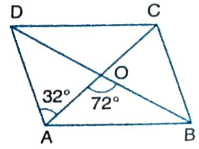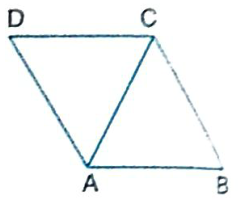
- Aopposite sides are equal
- Bopposite angles are equal
- ✓opposite angles are bisected by the diagonals
- Ddiagonal bisects each other
50 questions · timed · auto-graded


Solution:
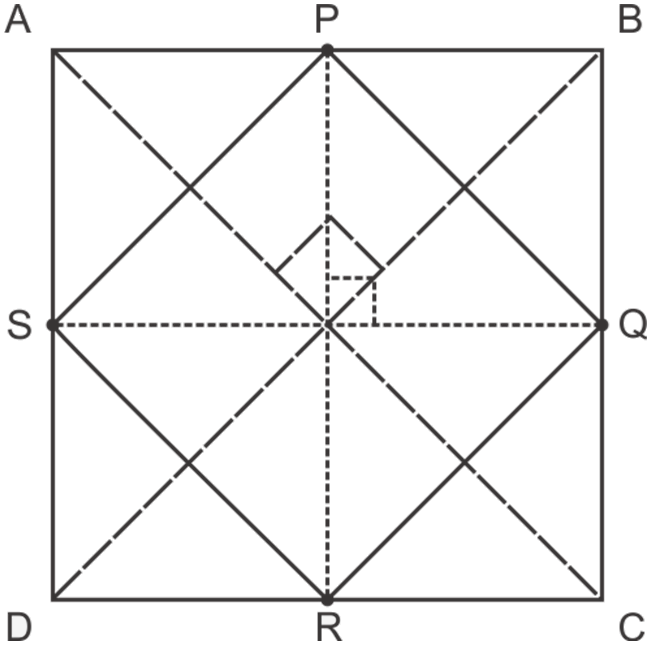
For a rhombus, the angle between the diagonals is 90° and not 60°.
Solution:

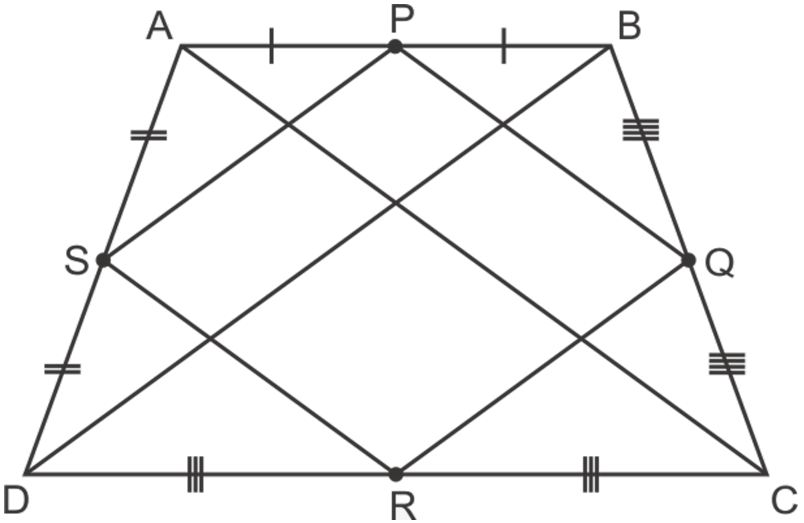
$\text{PR}||\text{AD}\Rightarrow\text{AB}\not\bot\text{AD}$
$\text{QS}||\text{AB}\Rightarrow\text{PR}\not\bot\text{QS}$
Since diagonals of PQRS are not making 90° between them,
PQRS is not a Rhombus.

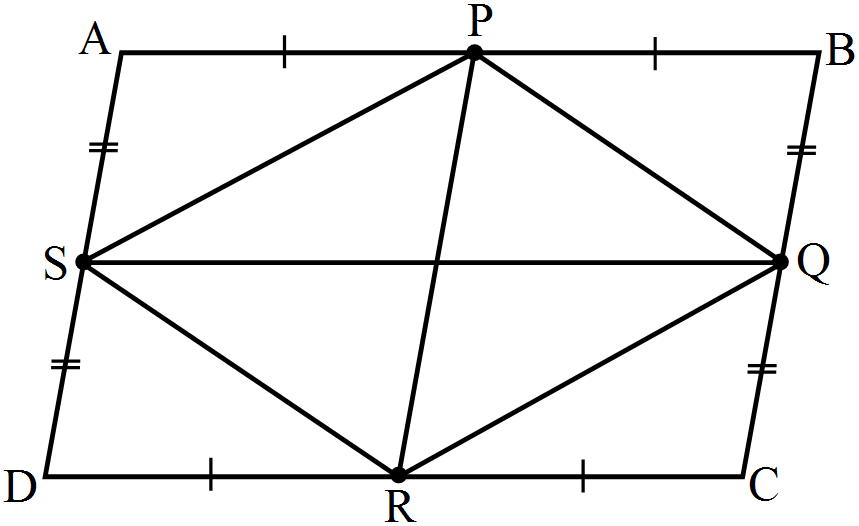
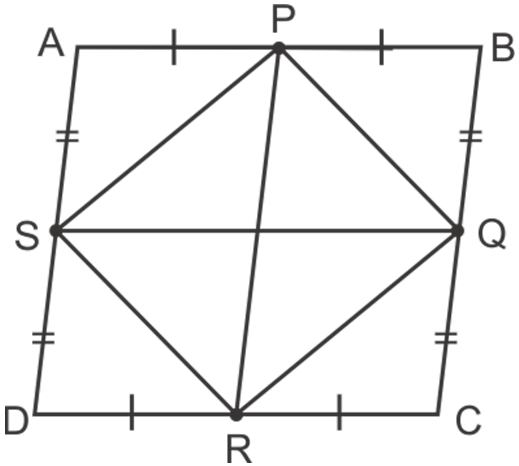
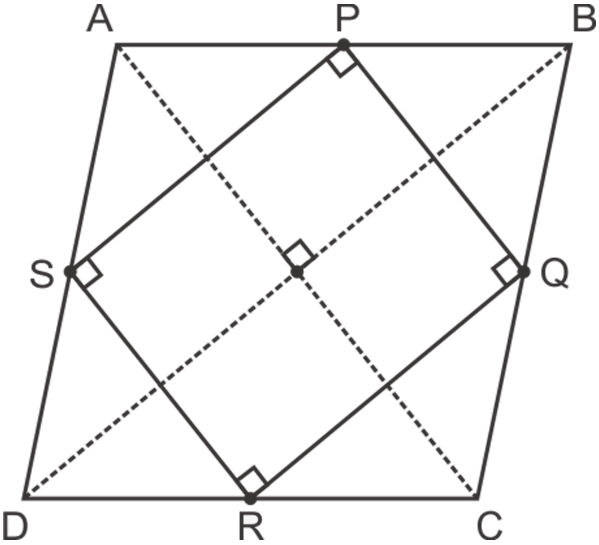
P, Q, R and S are the mid-points,
PR and QS are diagonals of quadrilateral PQRS.
PR || AD, QS || AB
Because they are Formed by joning of mid-points of sides of Rhombus ABCD.
AD is not $\bot$ to AB
⇒ PR will not be $\bot$ to QS
i.e angle between diagonals PR & QS is not 90°.
So, PQRS is not a Rhombus.

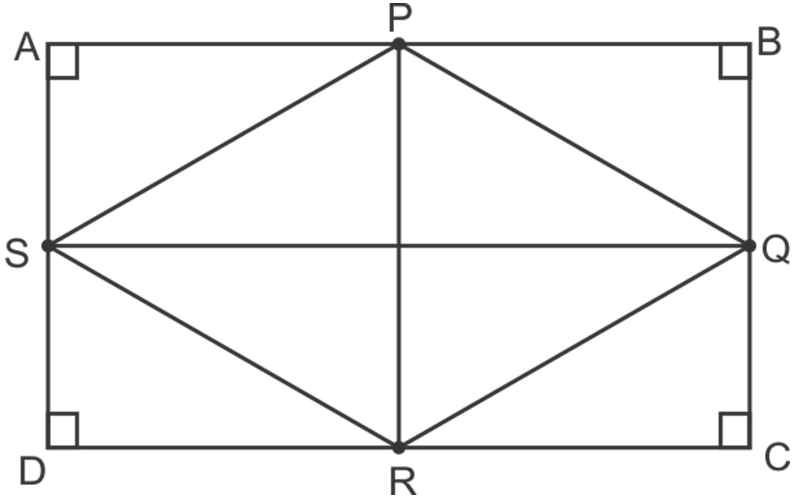
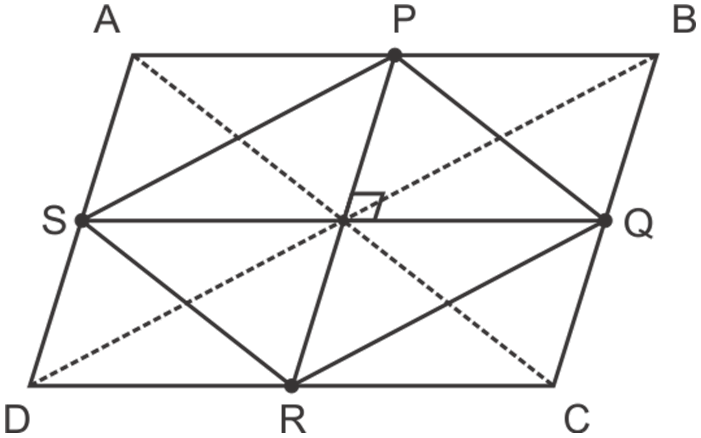
PR and QS are making 90° with each - other.
Because PR || AD, QS || AB and $\text{AD}\perp\text{AB}$
So PR and QS are diagonals of PQRS and are $\perp$ to each other.
Hence , PQRS is a Rhombus.

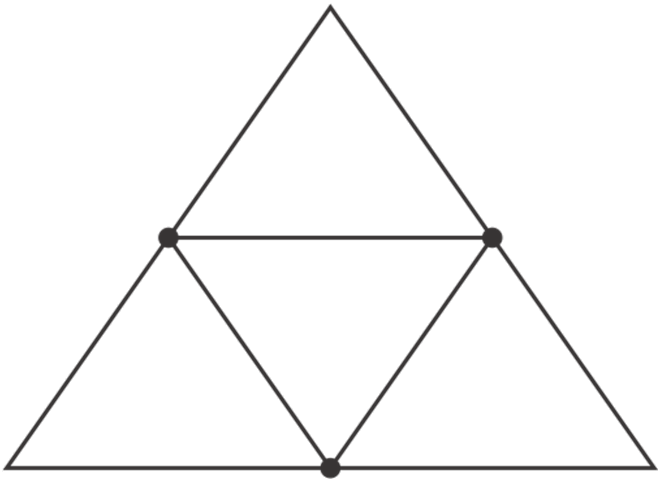
By joining the mid-points of sides of a triangle, no quadrilateral is formed.
Solution:
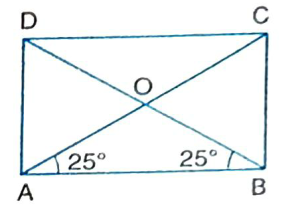
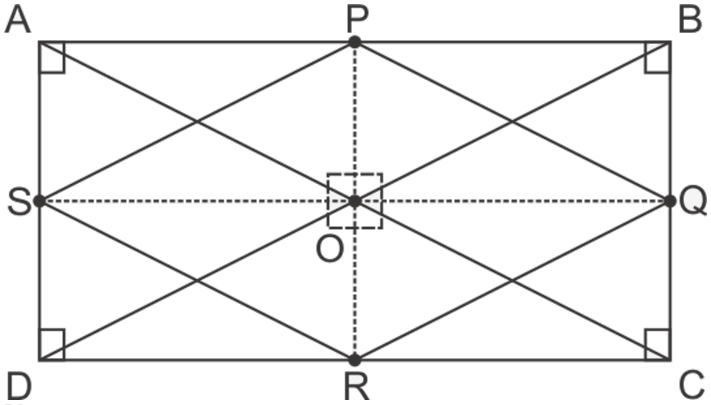
The two diagonals are equal in a rectangle (property).
Solution:

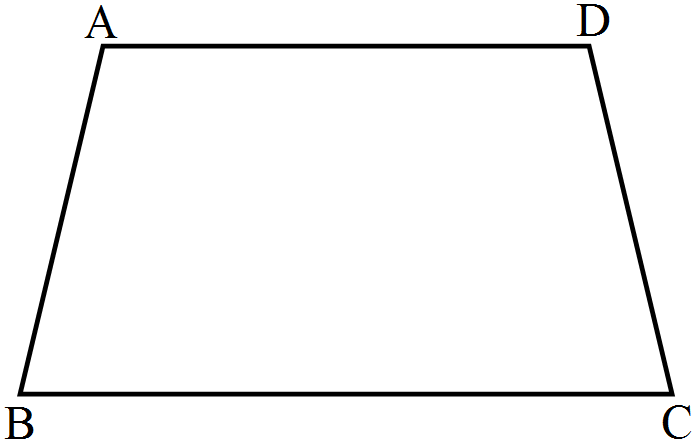
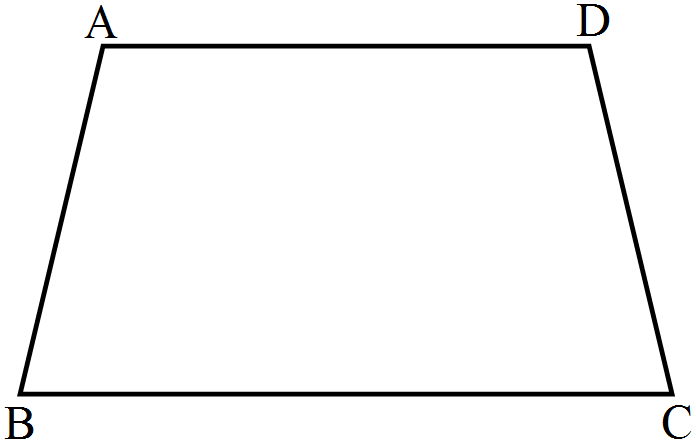
ABCD is a Quadrilateral.
The opposite sides AB and DC, AD and BC have no common point.
Solution:

PS || QR, PQ || SR ...(1)
{Because lines joining the mid-points of any two sides of a triangle are parallel to the third side}
$\text{AC } \bot \text{ BD}$ & $\text{BR } \bot \text{ QS}$ (From Figure)
SR || AC and QR || BD
$\text{AC } \bot \text{ BD}$
$\Rightarrow \text{SR }\bot \text{ QR}$
Hence $\angle\text{SRQ}=90^\circ\ ...(2)$
Also $\triangle\text{APS}\cong\triangle\text{DSR}$
$\Rightarrow\text{PS} = \text{SR}\dots(3)$
From equations (1), (2), (3)
PQRS is a square.
Solution:

In $\triangle\text{ABD}$ and $\triangle\text{CBD}$
PS || BD and QR || BD
{A line joining mid-points of two sides of triangle is parallel to third side}
⇒ PS || QR
Similiarly PQ || SR
Because SR || AC and QR || BD,
And angle between the diagonals of a Rhombus AC and BD =90°,
Angle between SR and QR = 90°
⇒ PQRS is a rectangle.
Solution:

PQ || AC (since in $\triangle\text{ABC}$ mid-points of AB & BC are meeting by PQ)
Similarly, SR || AC
⇒ PQ || SR
Now in $\triangle\text{ABD}$ and $\triangle\text{CBD},$
PS || BD and QR || BD
⇒ PS || QR
Hence, PQRS is a parallelogram.
But $\text{PR }\bot \text{ QS}$
⇒ Diagonals cut at 90°
⇒ PQRS is a Rhomus.
Solution:

P, Q, R & S are the mid-points of AB, BC, CD & AD respectively.
Consider $\triangle\text{ADB},$
If in a triangle, the mid-points of two sides are joint by a line then the line is parallel to the third side.
$\Rightarrow\text{PS}||\text{DB}$ in $\triangle\text{ADB}$
Similarly in $\triangle\text{CDB},$
RQ || DB
Hence PS || RQ ...(1)
Similarly in $\triangle\text{ABC}$ and $\triangle\text{ADC}$
SR || AC, PQ || AC
⇒ SR || PQ ...(2)
From eq. (1) and (2), PQRS is a parallelogram.
Solution:

PQ || SR || AC
QR || PS || BD
{Because line joining the mid-points of two sides of triangle is || to third side}
Now because AC is not prependicular to BD in parallelogram,
⇒ SR is not perpendicular to QR
Also $\triangle\text{ASP}\not\cong\triangle\text{DRS}$
$⇒ \text{PS} \neq \text{SR}$
⇒ PQRS is just a parallelogram.
Solution:

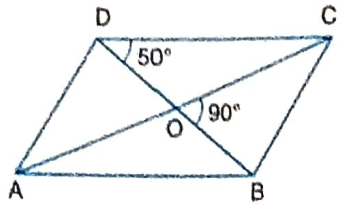
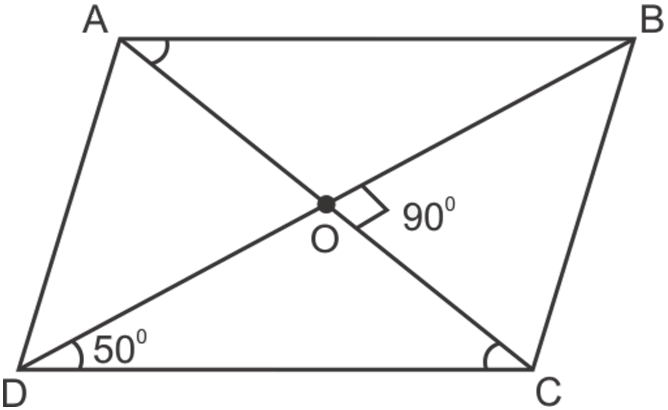
In a parallelogram ABCD,
$\angle\text{OAB}=\angle\text{OCB}$
In $\triangle\text{OCB}$
$\angle\text{OCD}+\angle\text{COD}+\angle\text{ODC}=180^\circ$
$\angle\text{COD}=90^\circ$
$\angle\text{ODC}=50^\circ$ (given)
$\angle\text{OCD}=180^\circ-90^\circ-50^\circ=40^\circ$
$\Rightarrow\angle\text{OAB}=\angle\text{OCD}=40^\circ$
Solution:

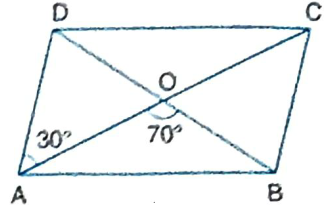
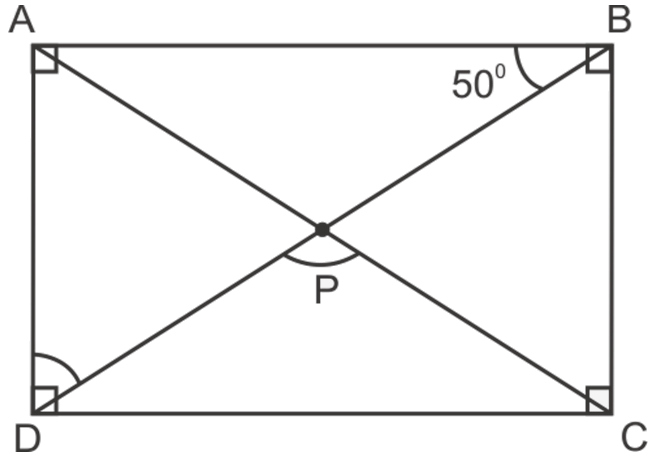
In $\triangle\text{ABD},$
$\angle\text{BDA}+\angle\text{ABD}+\angle\text{DAB}=180^\circ$
$\angle\text{ABD}=50^\circ$ and $\angle\text{DAB}=90^\circ$
$\Rightarrow\angle\text{BDA}=180^\circ-90^\circ-50^\circ=40^\circ$
Consider $\triangle\text{ABD}\ \&\ \triangle\text{BAC}$
$\text{AD}=\text{BC},\ \angle\text{DAB}=\angle\text{ABC}=90^\circ,\text{BD}=\text{AC}$
Hence, by RHS property $\triangle\text{ABD}\cong\triangle\text{BAC}$
$\Rightarrow\angle\text{ABD}=\angle\text{BAC}=50^\circ$
Now, consider $\triangle\text{ABP}$
$\angle\text{PAB}+\angle\text{PBA}+\angle\text{APB}=180^\circ$
$\angle\text{PAB}=\angle\text{BAC}=50^\circ$
$\angle\text{PAB}=\angle\text{ABD}=50^\circ$
$\Rightarrow\angle\text{APB}=180^\circ-50^\circ-50^\circ=80^\circ$
Now, $\angle\text{APB}=\angle\text{DPC}$ (Opposite angles)
$\Rightarrow\angle\text{DPC}=80^\circ$
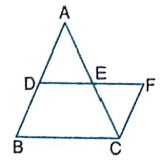
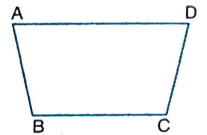
Solution:

Consecutive sides of a Quadrilateral ABCD are
AB and BC,
BC and CD,
CD and AD,
AD and AB,
Which have only one point in common
i.e the joint point of their ends.
Solution:

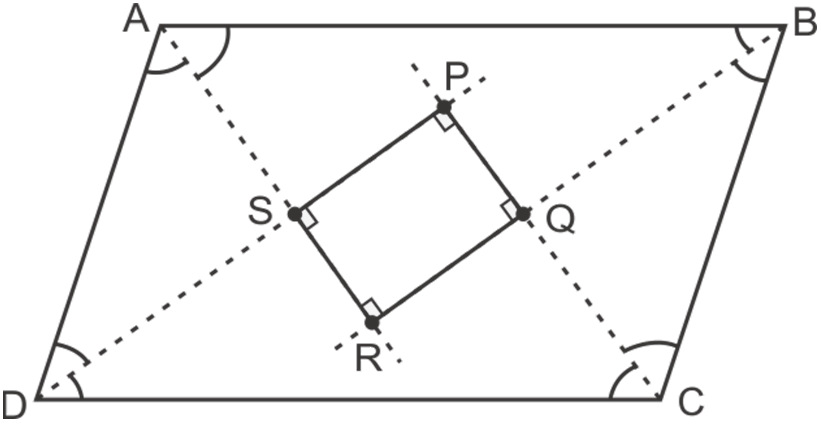
AR, BR, CP, DP are the bisectors of angles of parallelogram.
Because two bisectors of adjacent angles make 90° between them So PQRS is a Rectangle
Because DP and BR are acute angle bisectors so the distance between them PQ < PS (The distance between other two bisectors) So $\text{PQ}\neq\text{PS}$ (So PQRS is not a square, but only a rectangle)

Solution:

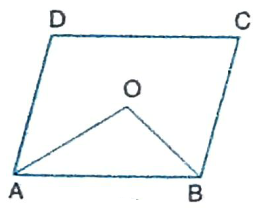
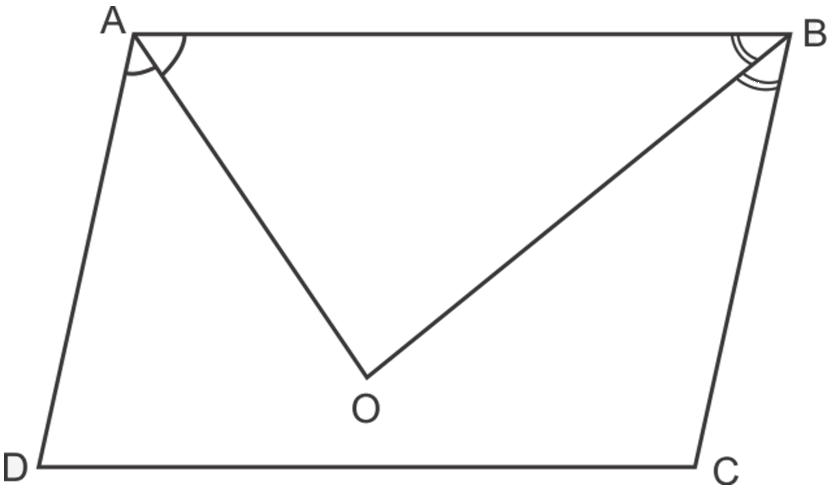
In a parallelogram, sum of adjacent angles = 180°
$\Rightarrow \angle \text{A}+\angle\text{B}=180^\circ$
$\Rightarrow\frac{\angle\text{A}}{2}+\frac{\angle\text{B}}{2}=90^\circ\ ...(1)$
$\Rightarrow\angle\text{OAB}=\frac{\angle\text{A}}{2}$ and $\angle\text{OBA}=\frac{\angle\text{B}}{2}$
Thus, $\angle\text{OAB}+\angle\text{OBA}=90^\circ$ [From eq (1)]
$\Rightarrow\angle\text{AOB}=180^\circ-(\angle\text{OAB}+\angle\text{OBA})=180^\circ-90^\circ$
$\Rightarrow\angle\text{AOB}=90^\circ$
Solution:
In a parallelogram, opposite corner angles are equal and sum of adjacent angles = 108°
Hence, in quadrrilateral PQRS,
$\Rightarrow\angle\text{P}=\angle\text{R}$ and $\angle\text{Q}=\angle\text{S}$
Also, $\angle\text{P}+\angle\text{Q}=\angle\text{Q}+\text{R}=180^\circ$
Hence, if $\angle\text{P}=100^\circ$ and $\angle\text{Q}=80^\circ,$ then
$\angle\text{P}+\angle\text{Q}=100^\circ+80^\circ=180^\circ$
Also, if $\angle\text{Q}+=80^\circ$ and $\angle\text{R}=100^\circ$ then
$\angle\text{Q}+\angle\text{R}=80^\circ+100^\circ=180^\circ$
Solution:

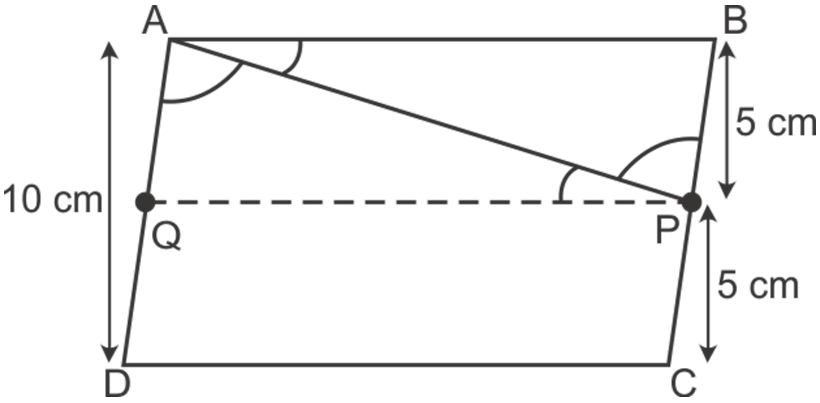
Let a line parallel to AB is drawn from P to meet AD at Q.
PQ || AB || DC
Q is also mid-point of AD.
Now, consider parallelogram ABPQ.
$\angle\text{PAQ}=\angle\text{APB}$ (Alternate angles)
Also $\angle\text{PAQ}=\angle\text{BAP}$ (Given)
$\Rightarrow\angle\text{APB}=\angle\text{BAP}$
So $\triangle\text{ABP}$ is isoseceles triangle.
$\Rightarrow\text{BP}=\text{AB}$
i.e. $\text{AB}=\frac{10}{2}=5\text{cm}$