Questions

2 Marks Questions

🎯

Test yourself on this topic

6 questions · timed · auto-graded

Question 12 Marks
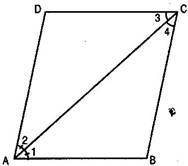
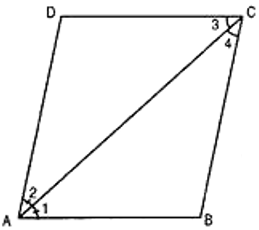
Diagonal AC of a parallelogram ABCD bisects $\angle$A (See figure). Show that:
  1. It bisects $\angle$C also.
  2. ABCD is a rhombus.
View full question & answer
Question 22 Marks
Answer
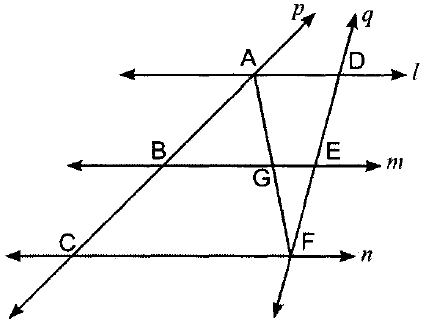
It is given that AB = BC and we need to prove that DE = EF.
Construction: Join A to F which intersects m at G as shown below.


The trapezium ACFD is divided into two triangles; namely $\triangle$ACF and $\triangle$AFD.
In $\triangle$ACF, it is given that B is the mid-point of AC (AB = BC)
and BG $\parallel$ CF (Since m$\parallel$n)
So, By the converse of Mid-point Theorem, G is the mid-point of AF.
Now, in $\triangle$AFD, by applying the same argument as G is the mid-point of AF, we have GE $\parallel$ AD so E is the mid-point of DF,
i.e., DE = EF
In other words /, m and n cut-off equal intercepts on q also.
View full question & answer
Question 32 Marks
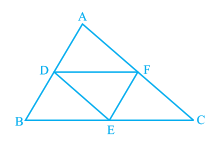
In $\triangle ABC$, D, E and F are respectively the mid-points of sides AB, BC and CA. Show that $\triangle ABC$ is divided into four congruent triangles by joining D, E and F.>
Answer
 As D and E are mid-points of sides AB and BC of the triangle ABC (Mid-points of two sides of a triangle is parallel to the third side),
DE || AC
Similarly, DF || BC and EF || AB
Therefore ADEF, BDFE and DFCE are all parallelograms.
Now DE is a diagonal of the parallelogram BDFE,
therefore, $\triangle BDE$ $\cong$ $\triangle FED$
Similarly $\triangle DAF$ $\cong$ $\triangle FED$
and $\triangle EFC$ $\cong$ $\triangle FED$
So, all the four triangles are congruent.
View full question & answer
Question 42 Marks
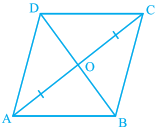
Show that the diagonals of a rhombus are perpendicular to each other.
Answer


Consider the rhombus ABCD.
You know that AB = BC = CD = DA
Now, in $\triangle AOD$ and $\triangle COD$, OA = OC (Diagonals of a parallelogram bisect each other)
OD = OD (Common)
AD = CD
Therefore, $\triangle AOD$ ≅ $\triangle COD$ (SSS congruence rule)
This gives, $\angle AOD$ = $\angle COD$ (CPCT)
But, $\angle AOD$ + $\angle COD$ = 180° (Linear pair)
So, $2\angle AOD$ = 180°
or, $\angle AOD$ = 90°
So, the diagonals of a rhombus are perpendicular to each other.
View full question & answer
Question 52 Marks
Show that each angle of a rectangle is a right angle.
Answer
We know that rectangle is a parallelogram whose one angle is right angle.

Let ABCD be a rectangle. $\angle A = {90^0}$
To prove $\angle B = \angle C = \angle D = {90^0}$
Proof: $\because AD\parallel BC$ and AB is transversal
$\therefore \angle A + \angle B = {180^0}$
${90^0} + \angle B = {180^0}$
$\angle B = {180^0} - {90^0} = {90^0}$
$\angle C = \angle A$
$\therefore {\text{ }}\angle C = {90^0}$
$\angle D = \angle B$
$\therefore {\text{ }}\angle D = {90^0}$ 
Hence, all the angles of the rectangles is a right angle.
View full question & answer
Question 62 Marks
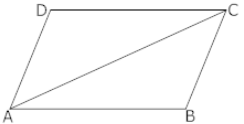
ABCD is a rhombus show that diagonal AC bisects $\angle $A as well as $\angle $C and diagonal BD bisects $\angle $B as well as $\angle $D
Answer
Given: ABCD is a rhombus

In $\triangle$ABC and $\triangle$ADC,
AB = CD [Sides of a rhombus]
BC = DA [Sides of a rhombus]
AC = AC [Common]
$\therefore$ $\triangle$ABC $\cong$ $\triangle$ADC [By SSS Congruency]
$\therefore$ $\angle $CAB = $\angle $CAD And $\angle $ACB = $\angle $ACD
Hence AC bisects $\angle $A as well as $\angle $C
Similarly, by joining B to D, we can prove that $\triangle$ABD $\cong$ $\triangle$CBD
Hence BD bisects $\angle $B as well as $\angle $D
View full question & answer
2 Marks Questions - Maths STD 9 Questions - Vidyadip