Questions

3 Marks Question

🎯

Test yourself on this topic

11 questions · timed · auto-graded

Question 13 Marks
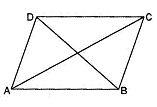
If the diagonals of a quadrilateral bisect each other, then it is a parallelogram.
Answer
Image
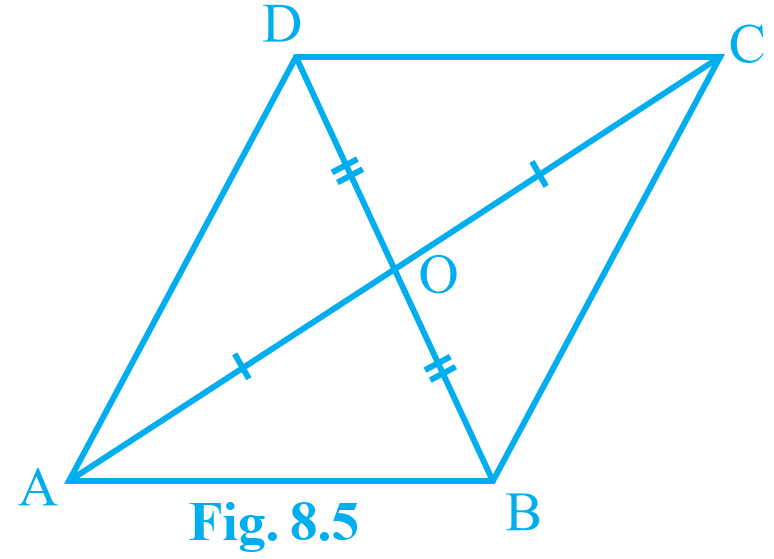
Note that in Fig. 8.5, it is given that $\mathrm{OA}=\mathrm{OC}$ and $\mathrm{OB}=\mathrm{OD}$.
So,
$\triangle \mathrm{AOB} \cong \triangle \mathrm{COD} \text { (Why?) }$
Therefore, $\angle \mathrm{ABO}=\angle \mathrm{CDO}$ (Why?)
From this, we get $A B \| C D$
Similarly, $\quad B C \| A D$
Therefore ABCD is a parallelogram.
Let us now take some examples.
View full question & answer
Question 23 Marks
If in a quadrilateral, each pair of opposite angles is equal, then it is a parallelogram.
Answer
Image
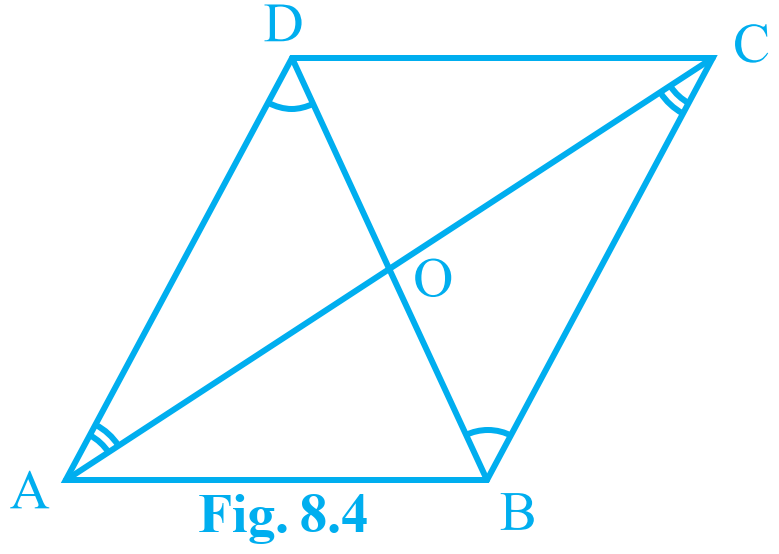
There is yet another property of a parallelogram. Let us study the same. Draw a parallelogram $A B C D$ and draw both its diagonals intersecting at the point $O$ (see Fig. 8.4).
Measure the lengths of $\mathrm{OA}, \mathrm{OB}, \mathrm{OC}$ and $\mathrm{OD}$.
What do you observe? You will observe that
$\mathrm{OA}=\mathrm{OC} \text { and } \mathrm{OB}=\mathrm{OD} \text {. }$
or, $\mathrm{O}$ is the mid-point of both the diagonals.
Repeat this activity with some more parallelograms.
Each time you will find that $\mathrm{O}$ is the mid-point of both the diagonals.
So, we have the following theorem :
View full question & answer
Question 33 Marks
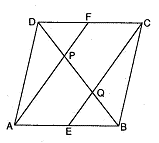
In a parallelogram ABCD, E and F are the mid-points of sides AB and CD respectively. Show that the line segments AF and EC trisect the diagonal BD.

Answer
Given: In a parallelogram ABCD, E and F are the mid-points of sides AB and CD respectively.
To Prove: Line segments AF and EC intersect the diagonal BD.

Proof: AB || CD . . .[Opp. sides of || gm ABCD]
$\therefore$ AE || FC . . . (1)
As AB = DC . . .[Opp. sides of || gm ABCD]
$\therefore$ $\frac{1}{2}AB = \frac{1}{2}DC$ . . .[Halves of equals are equal]
$\therefore$ AE = CF . . . (2)
According to (1) and (2)
AECF is a parallelogram . . [A quadrilateral is a parallelogram if a pair of opp. sides is parallel and of equal length]
$\therefore$ EC || AF . . . [Opp. sides of || gm AECF] . . .(3)
In $\triangle $DBC,
As F is the mid-point of DC and FP || CQ . . .[As EC || AF]
P is the mid-point of DQ . . . [By converse of mid-point theorem]
$\therefore$ DP = PQ . . . . (4)
Similarly, In $\triangle $BAP,
BQ = PQ . . . .(5)
DP = PQ = BQ . . . From (4) and (5)
$\therefore$ Line segments AF and EC trisect the diagonal BD.
View full question & answer
Question 43 Marks
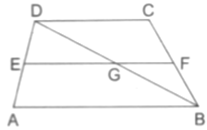
ABCD is a trapezium in which AB || DC, BD is a diagonal and E is the mid-point of AD. A line is drawn through E parallel to AB intersecting BC at F. Show that F is the mid-point of BC.
View full question & answer
Question 53 Marks
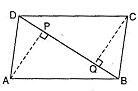
ABCD is a parallelogram and AP and CQ are perpendiculars from vertices A and C on diagonal BD respectively.

Show that :
  1. $\triangle$APB  $\cong$ $\triangle$CQD
  2. AP = CQ.
Answer
Given: ABCD is a parallelogram and AP and CQ are perpendicular from vertices A and C on diagonal BD respectively.
To Prove :

  1. $\triangle$APB $\cong$  $\triangle$CQD
  2. AP = CQ.

Proof :

  1. In $\triangle$APB and $\triangle$CQD
    AB = CD . . . [Opp. sides of || gm ABCD]
    $\angle$ABP = $\angle$CDQ . . .[Alternate interior angles for AB||CD]
    $\therefore$ $\angle$APB = $\angle$CQD . . .[Each 90o]
    $\triangle$APB $\cong$ $\triangle$CQD . . . [By AAS rule]
  2. As $\triangle$APB $\cong$ $\triangle$CQD . . .[As proved above]
    $\therefore$ AP = CQ . . .[c.p.c.t.]
View full question & answer
Question 63 Marks
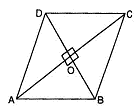
Show that if the diagonals of a quadrilateral bisect each other at right angles, then it is a rhombus.
Answer
Given: Diagonals of quadrilateral intersect each other at right angles.

To Prove: Quadrilateral is a rhombus.
Proof : In $\triangle$AOB and $\triangle$AOD,
AO = AO . . . [Common]
OB = OD . . . [Given]
$\angle$AOB = $\angle$AOD . . .[Each 90o]
$\therefore$ $\angle$AOB $\cong$ $\triangle$AOD . . . [By SAS property]
$\therefore$ AB = AD . . . [c.p.c.t.] . . . . (1)
Similarly, we can prove that
AB = BC . . . . (2)
BC = CD . . . . (3)
CD = AD . . . . (4)
From (1), (2), (3) and (4)
AB = BC = CD = DA
Since opposite sides of quadrilateral ABCD are equal, it can be said that ABCD is a parallelogram. Since all sides of a parallelogram ABCD are equal, it can be said that ABCD is a rhombus.
View full question & answer
Question 73 Marks
If the diagonals of a parallelogram are equal, then show that it is a rectangle.
Answer
Given: The diagonals of a parallelogram are equal.

To prove: Parallelogram is a rectangle.
Proof : In $\triangle$ACB and $\triangle$BDA,
AC = BD . . . [Given]
AB = BA . . . [Common]
BC = AD . . . [Opposite sides of parallelogram]
$\therefore$ $\triangle$ACB $\cong$$\triangle$BDA . . .[By SSS property]
$\therefore$ $\angle$ABC = $\angle$BAD . . . [c.p.c.t.] . . . .(1)
As AD || BC . . . [Opposite sides of parallelogram]
transversal AB intersects them.
$\therefore$ $\angle$BAD + $\angle$ABC = 180o . . . [Sum of interior angle on the same side of a transversal] . . . .(2)
$\angle$BAD = $\angle$ABC = 90o . . . [From (1) and (2)]
$\therefore$ $\angle$A = 90o
$\therefore$ Parallelogram ABCD is a rectangle.
View full question & answer
Question 83 Marks
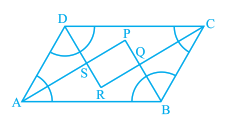
Show that the bisectors of angles of a parallelogram form a rectangle.
Answer

Let P, Q, R and S be the points of intersection of the bisectors of $\angle A$ and $\angle B$, $\angle B$ and $\angle C$, $\angle C$ and $\angle D$, and $\angle D$ and $\angle A$ respectively of parallelogram ABCD.
In $\triangle ASD$,
Since DS bisects $\angle D$ and AS bisects $\angle A$,
therefore,
$\angle DAS$ + $\angle ADS$ = $\frac 12$$\angle A$ + $\frac 12$$\angle D$
= $\frac 12$ ($\angle A$ + $\angle D$)
= $\frac 12 \times 180^o$ ($\angle A$ and $\angle D$ are interior angles on the same side of the transversal)
= 90o
Also, $\angle DAS$ + $\angle ADS$ + $\angle DSA$ = 180o (Angle sum property of a triangle)
or, 90o + $\angle DSA$ = 180o
or, $\angle DSA$ = 90o
So, $\angle PSR$ = 90o (Being vertically opposite to $\angle DSA$)
Similarly, it can be shown that $\angle APB$ = 90o or $\angle SPQ$ = 90o (as it was shown for $\angle DSA$).
Similarly, $\angle PQR$ = 90o and $\angle SRQ$ = 90o.
So, PQRS is a quadrilateral in which all angles are right angles.
We have shown that $\angle PSR$ = $\angle PQR$ = 90o and $\angle SPQ$ = $\angle SRQ$ = 90o.
So both pairs of opposite angles are equal.
Therefore, PQRS is a parallelogram in which one angle (in fact all angles) is 90o and so, PQRS is a rectangle.
View full question & answer
Question 93 Marks
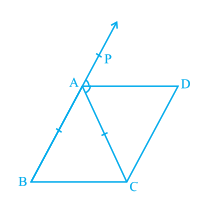
In Figure ABC is an isosceles triangle in which AB = AC. AD bisects exterior angle PAC and CD || AB. Show that 

  1. $\angle DAC = \angle BCA$
  2. ABCD is a parallelogram

Answer
  1. $\triangle ABC$ is isosceles in which AB = AC (Given)
    So, $\angle ABC$= $\angle ACB$ (Angles opposite to equal sides)
    Also, $\angle PAC$ = $\angle ABC$ + $\angle ACB$ (Exterior angle of a triangle)
    or, $\angle PAC$ = 2$\angle ACB$   ...(1)
    Now, AD bisects $\angle PAC$.
    So, $\angle PAC$ = 2 $\angle DAC$    ...(2)
    Therefore, 2$\angle DAC$ = 2$\angle ACB$ [From (1) and (2)]
    or, $\angle DAC$ = $\angle ACB$
  2. Now, these equal angles $\angle DAC = \angle ACB$ form a pair of alternate angles when line segments BC and AD are intersected by a transversal AC.
    So, BC || AD
    Also, BA || CD (Given)
    Now, both pairs of opposite sides of quadrilateral ABCD are parallel.
    So, ABCD is a parallelogram.
View full question & answer
Question 103 Marks
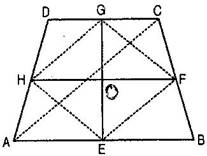
Show that the line segments joining the mid-points of opposite sides of a quadrilateral bisect each other.
Answer
Given: A quadrilateral ABCD in which EG and FH are the line-segments joining the mid-points of opposite sides of a quadrilateral.

To prove: EG and FH bisect each other.
Construction: Join AC, EF, FG, GH and HE.
Proof: In ABC, E and F are the mid-points of respective sides AB and BC.
$\therefore$ EF || AC and EF = $\frac{1}{2}$ AC ……….(i)
Similarly, in ADC,
G and H are the mid-points of respective sides CD and AD.
$\therefore$HG || AC and HG = $\frac{1}{2}$ AC ……….(ii)
From eq. (i) and (ii), we get,
EF || HG and EF = HG
$\therefore$ EFGH is a parallelogram.
Since the diagonals of a parallelogram bisect each other, therefore line segments (i.e. diagonals) EG and FH (of parallelogram EFGH) bisect each other.
Hence Proved.
View full question & answer
Question 113 Marks
The angles of a quadrilateral are in the ratio 3 : 5 : 9 : 13. Find all angles of the quadrilateral.
Answer
Let the quadrilateral ABCD, $\angle $A=3x,$\angle $B= 5x, $\angle $ C = 9x and $\angle $ D = 13x.
Since, sum of all the angles of a quadrilateral = $360^\circ $
$\therefore $ $\angle $A + $\angle $ B +$\angle $C + $\angle $ D = $360^\circ $$\Rightarrow $
$3x + 5x + 9x + 13x = 360^\circ $
$\Rightarrow $$ 30x = 360^\circ $$\Rightarrow $ $x = 12^\circ $
Now $\angle $ A = $3x = 3 \times 12 = 36^\circ $
$\angle $ B =$ 5x = 5 \times 12 = 60^\circ $
$\angle $ C =$ 9x = 9 \times 12 = 108^\circ $
And$\angle $ D = $13x = 13 \times 12 = 156^\circ $
Hence angles of given quadrilateral are$ 36^\circ ,60^\circ ,108^\circ and 156^\circ .$
View full question & answer
3 Marks Question - Maths STD 9 Questions - Vidyadip