Questions · Page 1 of 5

M.C.Q

🎯

Test yourself on this topic

50 questions · timed · auto-graded

MCQ 11 Mark
Two parallelograms stand on same base and between the same parallels. The ratio of their areas is:
  • A
    3 : 1
  • B
    2 : 1
  • C
    1 : 1
  • D
    1 : 2
Answer
  1. 1 : 1
    Solution:
    Parallelograms on the same base and between the same parallels are equal in area. Hence the ration of two parallelograms will be 1 : 1.
View full question & answer
MCQ 21 Mark
If the degree measures of the angles of quadrilateral are 4x, 7x, 9x and 10, what is the sum of the measures of the smallest angle and largest angle?
  • A
    140°
  • B
    150°
  • C
    168°
  • D
    180°
Answer
  1. 168°
    Solution:
    Sum of all angles of a Quadrilateral = 360°
    4x + 7x + 9x + 10x = 360°
    30x = 360°
    x = 12°
    So, sum of smallest and largest angle,
    i.e. 4x + 10x = 14x = 14 × 12 = 168°
View full question & answer
MCQ 31 Mark
Write the correct answer in the following:
The figure obtained by joining the mid-points of the sides of a rhombus, taken in order, is:
  • A
    A rhombus.
  • B
    A rectangle.
  • C
    A square.
  • D
    Any parallelogram.
Answer
  1. A rectangle.
    Solution:
    The figure will be a rectangle.
    Hence, (b) is the correct answer.
View full question & answer
MCQ 41 Mark
The length of each side of a rhombus is 10cm and one of its diagonal is of length 16cm. The Length of the other Diagonal is:
  • A
    12cm
  • B
    13cm
  • C
    5cm
  • D
    6cm
Answer
  1. 12cm
    Solution:
    Use pythagoras theorem in right triangle,
    $102 -\Big[\frac{16}{2}\Big]^2 = 100 - 64 = 36 = [6]^2$
    Hence, the other diagonal = 6 × 2 = 12cm
View full question & answer
MCQ 51 Mark
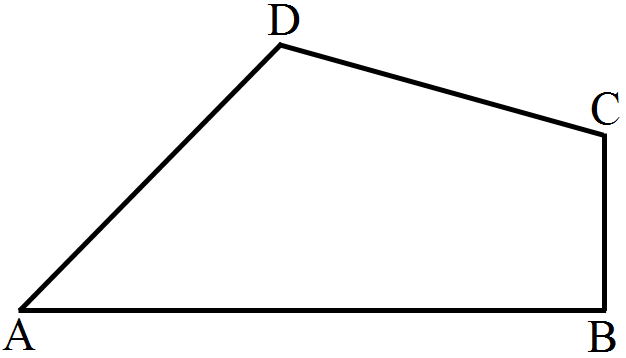
One Angle of a quadrilateral is of 108º and the remaining three angles are equal. Find each of the three equal angles.
  • A
    84º, 84º, 84º
  • B
    90º, 84º, 90º
  • C
    90º, 90º, 84º
  • D
    84º, 90º, 90º
Answer
  1. 84º, 84º, 84º
    Solution:
    Let ABCD be a quadrilateral with $\angle\text{A} = 108^\circ$ and $\angle\text{B} = \angle\text{C} = \angle\text{D} = \text{x}$
    $\angle\text{A} + \angle\text{B} + \angle\text{C} + \angle\text{D} = 360^\circ$ (angle sum property)
    108º + x + x + x = 360º
    3x = 360º - 108º
    3x = 252º
    x = 84º
View full question & answer
MCQ 61 Mark
Three angles of a quadrilateral are in the ratio 3 : 4 : 5 : 6. The smallest of these angles is:
  • A
    60º
  • B
    80º
  • C
    45º
  • D
    48º
Answer
  1. 60º
    Solution:
    Let the angles be 3x, 4x, 5x and 6x
    3x + 4x + 5x + 6x = 360º (Sum of angles of a quadrilateral)
    18x = 360º
    $\text{x}=\frac{360}{18}$
    x = 20º
    $∴$ Angles of the quadrilateral are: 3x = 3 × 20º = 60º
    4x = 4 × 20º = 80º
    5x = 5 × 20º = 100º
    6x = 6 × 20º = 120º
    Hence, the smallest angle is 60º.
View full question & answer
MCQ 71 Mark
If the diagonals of a quadrilateral bisect each other, and opposite sides are parallel and equal, then the quadrilateral must be.
  • A
    Rectangle
  • B
    Rhombus
  • C
    Square
  • D
    Parallelogram
Answer
  1. Parallelogram
    Solution:
    By theorm diagonals of quadrilateral bisect each other if and only if it is a parallelogram.For a quadrilateral to be parallelogram some other properties are required: Opposite sides are equal and parallel. Opposite angles are equal. Sum of any adjacent angles is 180.
View full question & answer
MCQ 81 Mark
Write the correct answer in the following:
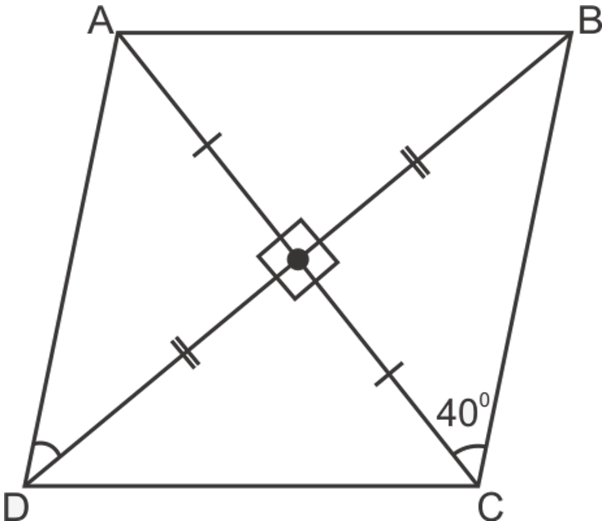
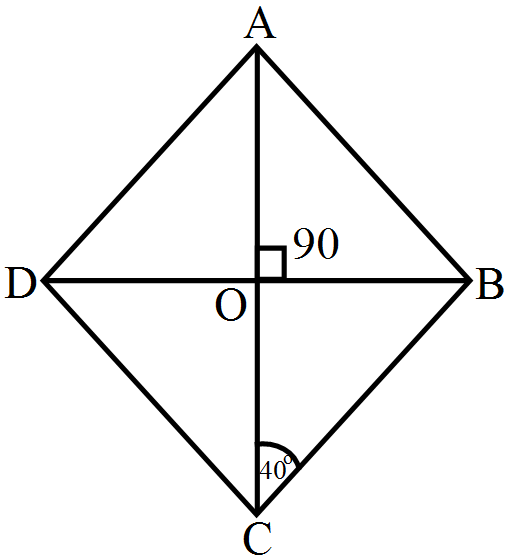
ABCD is a rhombus such that $\angle\text{ACB}=40^\circ.$ then $\angle\text{ADB}$ is:
  • A
    40º
  • B
    45º
  • C
    50º
  • D
    60º
View full question & answer
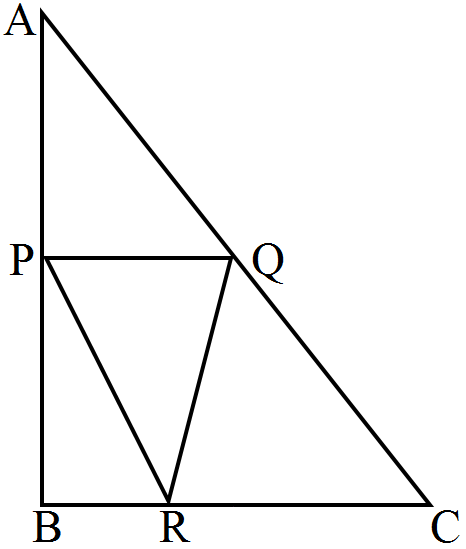
MCQ 91 Mark
  • A
    15.5cm
  • B
    14cm
  • C
    15cm
  • D
    13cm
Answer
  1. 15cm
    Solution:
    In triangle ABC, P, Q and R are the midpoints.
    By midpoint theorem, PQ is parallel to BC and $\text{PQ} = \frac{1}{2}$ of BC
    QR is parallel to AB and $\text{QR} = \frac{1}{2}$ of AB
    PR is parallel to AC and $\text{PR} = \frac{1}{2}$ of AC.
    So, perimeter of triangle $\text{PQR} = \text{PQ} + \text{QR} + \text{PR} = \frac{1}{2}$ of $\text{(AB + BC + AC)}$
    $= \frac{1}{2}$ of $(10 + 8 + 12) =\frac{1}{2} $ of $30=15.$
View full question & answer
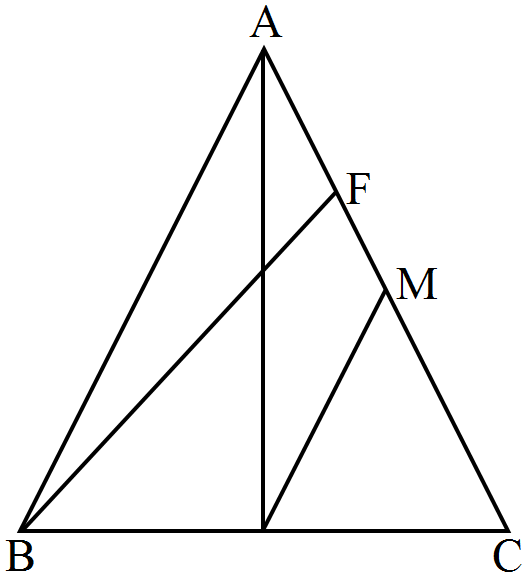
MCQ 101 Mark
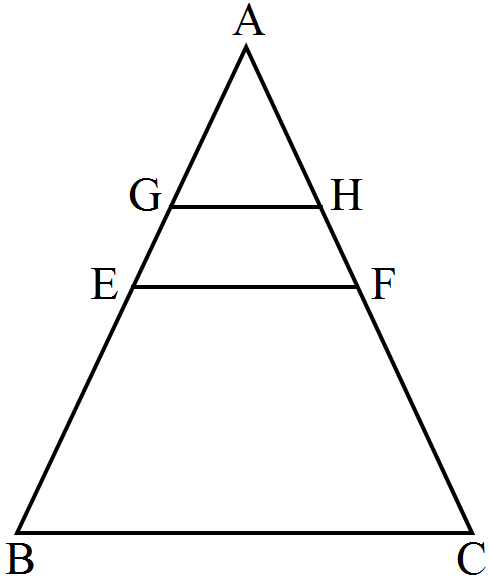
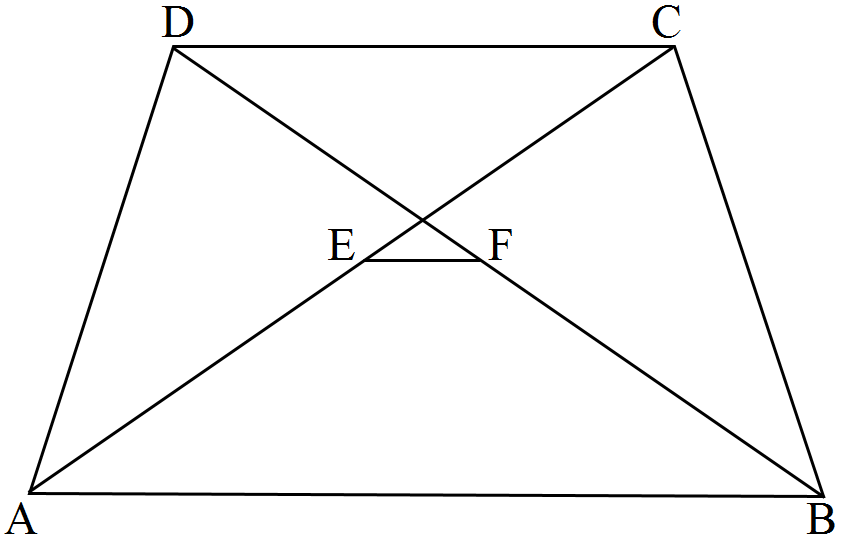
In $\triangle\text{ABC},$ E is the mid-point of median AD such that BE produced meets AC at F. If $\text{AC} = 10.5\text{cm},$ then AF = ?
  • A
    5cm
  • B
    3cm
  • C
    2.5cm
  • D
    3.5cm
View full question & answer
MCQ 111 Mark
Three angles of a quadrilateral are 75º, 90º and 75º. The fourth angle is:
  • A
    120º
  • B
    95º
  • C
    105º
  • D
    90º
Answer
  1. 120º
    Solution:
    We know that The sum of angles of quad = 360º
    4th angle = 360º - (75º + 90º + 75º)
    = 360º - 240º
    = 120º
View full question & answer
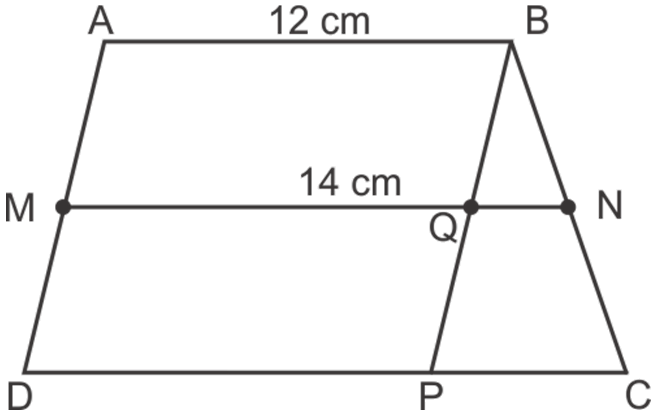
MCQ 131 Mark
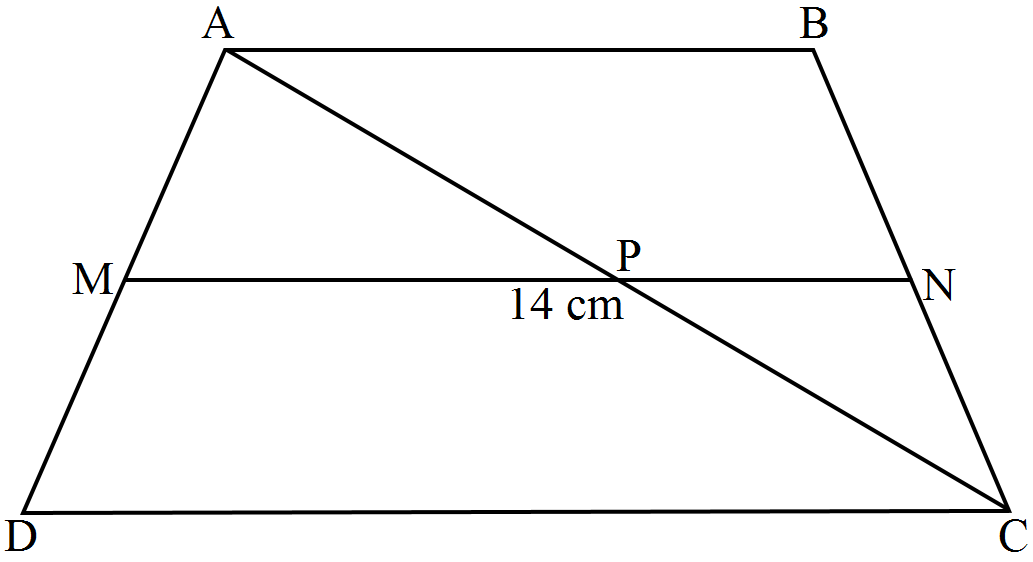
ABCD is a trpezium in which AB || DC. M and N are then mid-points of AD and BC respectively. If AB = 12cm, MN = 14cm, then CD =
  • A
    10cm.
  • B
    12cm.
  • C
    14cm.
  • D
    16cm.
View full question & answer
MCQ 141 Mark
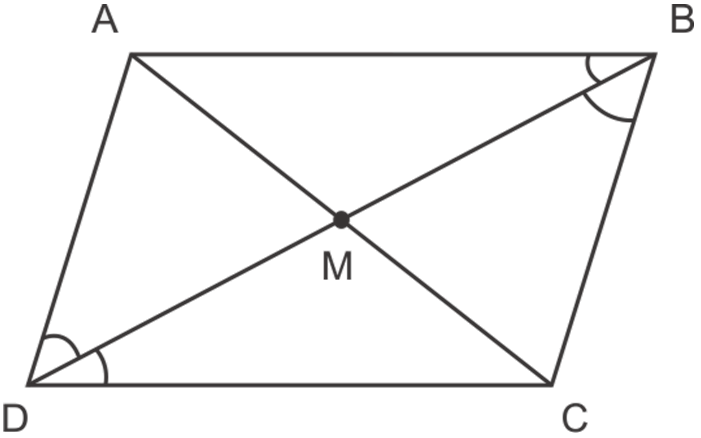
ABCD is a parallelogram, M is the mid-point of BD and BM bisects $\angle\text{B}.$ Then, $\angle\text{AMB}=$
  • A
    45°
  • B
    60°
  • C
    90°
  • D
    75°
View full question & answer
MCQ 151 Mark
  • A
    10º, 20º, 100º, 260º
  • B
    35º, 100º, 105º, 120º
  • C
    100º, 102º, 120º, 10º
  • D
    90º, 90º, 100º, 80º
Answer
  1. 35º, 100º, 105º, 120º
    Solution:
    given: $\angle\text{A}+ \angle\text{C}=140^\circ$
    and $\angle\text{A}:\angle\text{C} = 1:3$
    and $\angle\text{B}:\angle\text{D} = 5:6$
    $⇒ \angle\text{A}= \frac{1}{4} \times 140^\circ - 35^\circ$
    $⇒ \angle\text{C}= \frac{3}{4} \times 140^\circ - 105^\circ$
    Now according to angle sum property of quadrilateral
    $\angle\text{A} +\angle\text{B}+ \angle\text{C}+ \angle\text{D} = 360^\circ$
    $\Rightarrow 35^\circ+ \angle\text{B}+ 105^\circ +\angle\text{D} = 360^\circ$
    $\Rightarrow \angle\text{B}+ \angle\text{D} = 360^\circ - 140^\circ = 220^\circ$
    $\Rightarrow 5\text{x} + 6\text{x} = 220^\circ$
    $\Rightarrow\text{x}=20^\circ$
    So, $\angle\text{B} = 5 \times 20^\circ = 100^\circ$
    and $\angle\text{D} = 6 \times 20^\circ = 120^\circ$
View full question & answer
MCQ 161 Mark
In each of the questions one question is followed by two statements I and II. Choose the correct option.
Is quadrilateral ABCD a parallelogram?
  1. Diagonals AC and BD bisect each other.
  2. Diagonals AC and BD are equal.
  • A
    If the question cannot be answered by using both the statements together.
  • B
    If the question can be answered by one of the given statements alone and not by the other.
  • C
    If the question can be answered by both the statements together but not by any one of the two.
  • D
    If the question can be answered by either statement alone.
Answer
  1. If the question can be answered by one of the given statements alone and not by the other.
    Solution:
    Here, as we know that if the diagonals of a quadrilateral bisects each other, then it is a parallelogram.
    But as per II, if the diagonals of a quadrilateral are equal, then it is not necessarily a parallelogram which is not true. Thus, II does not give the answer.
    So the question can be answered by the one of the given statement alone and not by the other.
View full question & answer
MCQ 171 Mark
The angle between two altitudes of a Parallelogram through the vertex of an obtuse angle of the Parallelogram of 60º. Find the angles of the Parallelogram?
  • A
    200º, 100º, 30º, 30º
  • B
    110º, 50º, 105º, 105º
  • C
    150º, 150º, 30º, 30º
  • D
    120º, 60º, 120º, 60º
Answer
  1. 120º, 60º, 120º, 60º
    Solution:
    Let ABCD be a parallelogram and AP and CQ are the altitudes drawn from vertex A on sides DC and BC.
    In quadrilateral APCQ, sum of the all angles= 360º
    So, $60^\circ + 90^\circ + \angle\text{C} + 90^\circ = 360^\circ$
    $\angle\text{C} = 360^\circ - 240^\circ = 120^\circ$
    $\angle\text{C} + \angle\text{B} = 180^\circ$ (co-interior angles)
    $\angle\text{B} = 180^\circ - 120^\circ = 60^\circ$
    In parallelogram, opposite angles are equal.
    So, $\angle\text{A} = \angle\text{C} = 120^\circ$ and $\angle\text{B} = \angle\text{D} = 60^\circ$
View full question & answer
MCQ 191 Mark
Given Rectangle ABCD and P, Q, R and S are the mid-points of the sides AB, BC, CD and DA respectively. If length of a diagonal of Rectangle is 8cm, then the quadrilateral PQRS is a:
  • A
    Rhombus with each side 4cm.
  • B
    Rectangle with one side 4cm.
  • C
    Parallelogram with one side 4cm.
  • D
    Square with each side 4cm.
Answer
  1. Rhombus with each side 4cm.
    Solution:
    A quadrilateral formed by joining midpoints of the sides of the rectangle is a Rhombus.
    In Rhombus, all sides are equal.
    In triangle ABC, P and Q are midpoints of the sides AB and BC respectively. By midpoint theorem, PQ is parallel to AC and PQ is half of the AC.
    Let diagonal AC = 8cm. So, PQ = 4cm.
    Therefore, PQRS is a rhombus which all sides equal to 4cm.
View full question & answer
MCQ 201 Mark
Opposite angles of a Quadrilateral ABCD are equal. If AB = 4cm, find the length of CD.
  • A
    4cm
  • B
    2cm
  • C
    3cm
  • D
    5cm
Answer
  1. 4cm
    Solution:
    A quadrilateral with both pair of opposite angles equal is a parallelogram.
    In a parallelogram, opposite sides are equal.
    So, AB = CD = 4cm
View full question & answer
MCQ 211 Mark
  • A
    x = 38º and y = 85º
  • B
    x = 30º and y = 65º
  • C
    x = 32º and y = 95º
  • D
    x = 30º and y = 95º
Answer
  1. x = 30º and y = 95º
    Solution:
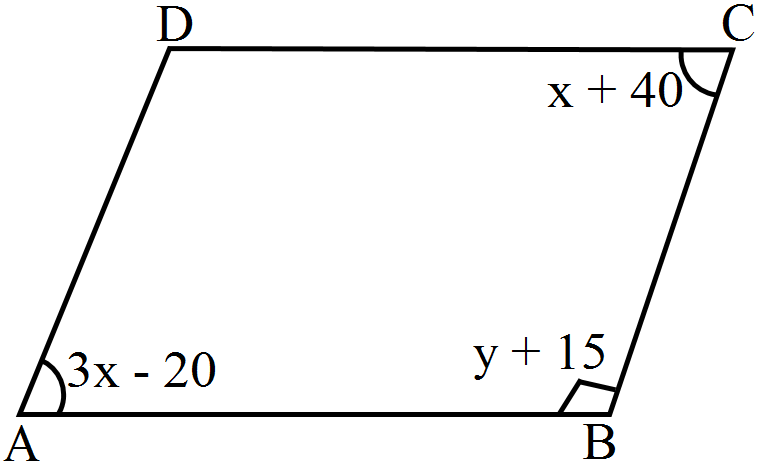
    Given, ABCD is a parallelogram.
    So,
    $\angle\text{A} = \angle\text{C}$ (Opposite angles of parallelogram are equal in size)
    ⇒ 3x − 20 = x + 40
    ⇒ 3x − x = 40 + 20
    ⇒ 2x = 60
    ⇒ x = 30°
    Thus, $\angle\text{A} = 3 × 30 − 20 = 90 − 20 = 70^\circ$
    Now, $\angle\text{A} + \angle\text{B} = 180^\circ$ (Sum of interior angles of parallelogram is 180º)
    $⇒ 70^\circ + \angle\text{B} = 180^\circ$
    $⇒ \angle\text{B} = 180^\circ − 70^\circ$
    $⇒\angle\text{B} = 110^\circ$
    $⇒ \text{y} + 15 = 110^\circ$
    $⇒ \text{y} = 95^\circ$
    Hence, x = 30° and y = 95°
View full question & answer
MCQ 221 Mark
In a rhombus ABCD, if $\angle\text{ACB}=40^\circ,$ then $\angle\text{ADB}=$
  • A
    70°
  • B
    45°
  • C
    50°
  • D
    60°  
View full question & answer
MCQ 231 Mark
Diagonals necessarily bisect opposite angles in a:
  • A
    Rectangle
  • B
    Isosceles trapezium
  • C
    Square
  • D
    Parallelogram
View full question & answer
MCQ 241 Mark
In Quadrilateral ABCD, $\angle\text{A} = 110^\circ, \ \angle\text{B} = 75^\circ$ and $\angle\text{C} = 35^\circ.$ Find $\angle\text{D}=\ ?$
  • A
    50º
  • B
    145º
  • C
    110º
  • D
    140º
Answer
  1. 140º
    Solution:
    $\angle\text{A} + \angle\text{B} + \angle\text{C} + \angle\text{D} = 360^\circ$ (angle sum property of quadrilateral).
    $110 + 75^\circ + 35^\circ + \angle\text{D} = 360^\circ$
    $\angle\text{D} = 360^\circ - 220^\circ = 140^\circ$
View full question & answer
MCQ 251 Mark
The angle between two altitudes of a Parallelogram through the vertex of an obtuse angle of the Parallelogram of 60º. Find the angles of the Parallelogram.
  • A
    110º, 50º, 105º, 105º
  • B
    150º, 150º, 30º, 30º
  • C
    120º, 60º, 120º, 60º
  • D
    200º, 100º, 30º, 30º
Answer
  1. 120º, 60º, 120º, 60º
    Solution:
    Let ABCD be a parallelogram and AP and CQ are the altitudes drawn from vertex A on sides DC and BC.
    In quadrilateral APCQ, sum of the all angles = 360º
    So, $60^\circ + 90^\circ + \angle\text{C} + 90^\circ = 360^\circ$
    $\angle\text{C} = 360^\circ - 240^\circ = 120^\circ$
    $\angle\text{C} + \angle\text{B} = 180^\circ$ (co-interior angles)
    $\angle\text{B} = 180^\circ - 120^\circ = 60^\circ$
    In parallelogram, opposite angles are equal.
    So, $\angle\text{A} = \angle\text{C} = 120^\circ$ and $\angle\text{B} = \angle\text{D} = 60^\circ$
View full question & answer
MCQ 261 Mark
ABCD is a Trapezium in which $\text{AB || DC}$ and $\angle\text{A}=\angle\text{B} = 45^\circ.$ Find $\angle\text{C}$ and $\angle\text{D}$ of the Trapezium.
  • A
    135º, 135º
  • B
    120º, 120º
  • C
    150º, 150º
  • D
    200º, 50º
Answer
  1. 135º, 135º
    Solution:
    AB is parallel to DC.
    $\angle\text{A} + \angle\text{D} = 180^\circ$ (co-interior angle)
    $\angle\text{D} = 180^\circ - 45^\circ = 135^\circ$
    Similarly by following same argument, $\angle\text{C} = 135^\circ.$
View full question & answer
MCQ 271 Mark
The diagonal AC and BD of quadrilateral ABCD are equal and are perpendicular bisector of each other then quadrilateral ABCD is a:
  • A
    Trapezium
  • B
    Square
  • C
    Rectangle
  • D
    Kite
Answer
  1. Square
    Solution:
    The triangles formed by the perpendicular bisectors are congruent to each other by SAS congruence. so the sides are equal hence it is a square.
View full question & answer
MCQ 281 Mark
Angles of a quadrilateral are in the ratio 3 : 4 : 4 : 7. Find all the angles of the quadrilateral.
  • A
    60º, 120º, 80º, 140º
  • B
    70º, 70º, 100º, 100º
  • C
    60º, 80º, 80º, 140º
  • D
    60º, 80º, 100º, 90º
Answer
  1. 60º, 80º, 80º, 140º
    Solution:
    Let ABCD be a quadrilateral with $\angle\text{A} = 3\text{x},\ \angle\text{B} = 4\text{x} ,\ \angle\text{C} = 4\text{x}$ and $\angle\text{D} = 7\text{x}$
    $\angle\text{A} + \angle\text{B} + \angle\text{C} + \angle\text{D} = 360^\circ$ (angle sum property)
    $3\text{x} + 4\text{x} + 4\text{x} + 7\text{x} = 360^\circ$
    $18\text{x} = 360^\circ$
    $\text{x} = 20^\circ$
    $\angle\text{A} = 3 (20^\circ) = 60^\circ$
    $\angle\text{B} = \angle\text{C} = 4 (20^\circ) = 80^\circ$
    $\angle\text{D} = 7 (20^\circ) = 140^\circ$
View full question & answer
MCQ 291 Mark
  • A
    x = 50º and y = 60º
  • B
    x = 120º and y = 120º
  • C
    x = 60º and y = 70º
  • D
    x = 55º and y = 35º
Answer
  1. x = 55º and y = 35º
    Solution:
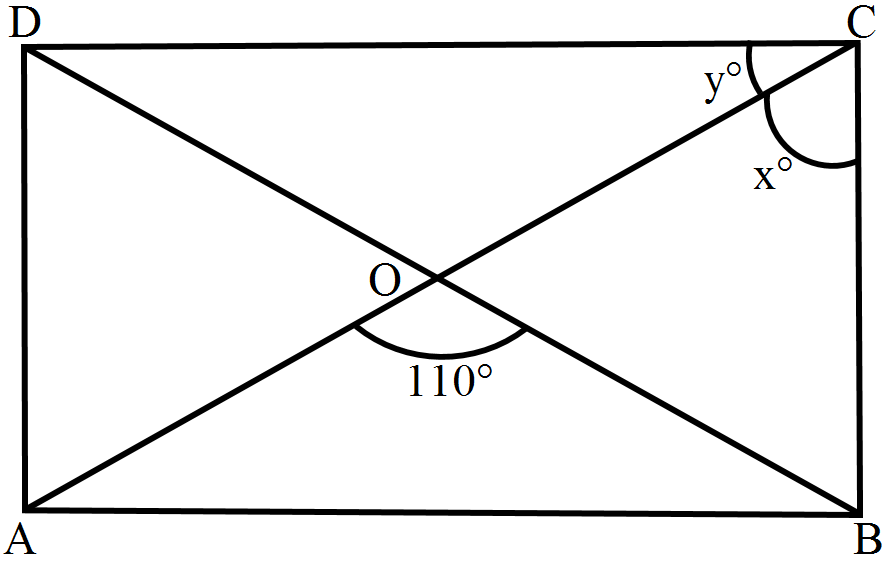
    Given $\angle\text{AOB}=110^\circ$
    $⇒\angle\text{DOC}=110^\circ$ vertically opposite angles
    $\triangle\text{DOC}$ we have:
    DO = OC
    Now, $\angle\text{ODC} = \angle\text{OCD} = \text{y}$
    now in $\triangle\text{ODC}$
    y + y + 110º = 180º (angle sum property of triangle)
    ⇒ 2y = 180º - 110º = 70º
    ⇒ y = 35º
    Also, x = 90º – y
    x = 90º – 35º = 55º
    Hence, x = 55º and y = 35º
View full question & answer
MCQ 301 Mark
  • A
    45º
  • B
    75º
  • C
    50º
  • D
    60º
Answer
  1. 45º
    Solution:
    It is given in the question that,
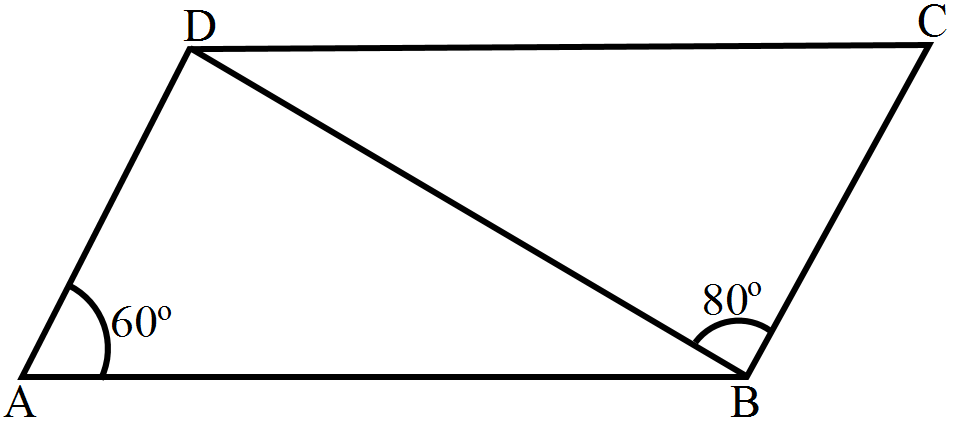
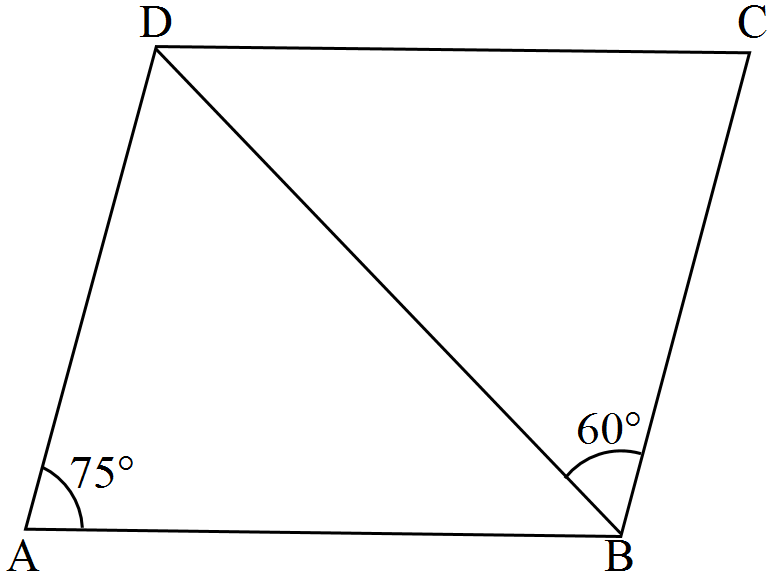
    In parallelogram ABCD: $\angle\text{BAD} = 75^\circ, \ \angle\text{CBD} = 60^\circ$
    Now, $\angle\text{DAB} = \angle\text{DCB} = 75^\circ$ (Opposite angles)
    Also, in triangle DBC we know that sum of angles of a triangle is 180º
    $\angle\text{DBC} + \angle\text{BDC} + \angle\text{DCB} = 180^\circ$
    $60^\circ + \angle\text{BDC} + 75^\circ= 180^\circ$
    $135^\circ + \angle\text{BDC} = 180^\circ$
    $\angle\text{BDC} = 180^\circ – 135^\circ$
    $\angle\text{BDC} = 45^\circ$
    Hence, 45º is correct.
View full question & answer
MCQ 311 Mark
If one angle of a parallelogram is 24º less than twice the smallest angle, then the measure of the largest angle of the parallelogram is:
  • A
    112º
  • B
    176º
  • C
    68º
  • D
    102º
View full question & answer
MCQ 331 Mark
A quadrilateral ABCD is a parallelogram if:
  • A
    $\angle\text{A} = 60^\circ, \ \angle\text{C} = 60^\circ,\ \angle\text{B} = 120^\circ$
  • B
    $\text{AB = CD}$
  • C
    $\text{AB = AD}$
  • D
    $\text{AB || BC}$
Answer
  1. $\angle\text{A} = 60^\circ, \ \angle\text{C} = 60^\circ,\ \angle\text{B} = 120^\circ$
    Solution:
    $\angle\text{A} = 60^\circ, \ \angle\text{C} = 60^\circ,\ \angle\text{B} = 120^\circ$
    Opposite angles are equal and sum of adjacent angles are supplementary.
View full question & answer
MCQ 341 Mark
In a quadrilateral ABCD, AO and BO are the bisectors of $\angle\text{A}$ and $\angle\text{B}$ respectively, $\angle\text{C} = 70^\circ$ and $\angle\text{D} = 30^\circ.$ Then, $\angle\text{AOB} =\ ?$
  • A
    50º
  • B
    40º
  • C
    100º
  • D
    80º
Answer
  1. 50º
    Solution:
    It is given in the question that, ABCD is a quadrilateral where AO and BO are the bisectors of $\angle\text{A}$ and $\angle\text{B}.$
    We know that, sum of all angles of a quadrilateral is equal to 360º
    $∴ \angle\text{A} + \angle\text{B} + \angle\text{C} + \angle\text{D} = 360^\circ$
    $\angle\text{A} + \angle\text{B} + 70^\circ + 30^\circ = 360^\circ$
    $\angle\text{A} + \angle\text{B} = 360^\circ - 100^\circ$
    $\angle\text{A} + \angle\text{B} = 260^\circ$
    $=\frac{1}{2}(\angle\text{A}+\angle\text{B})=\frac{1}{2}\times260^\circ$
    $=\frac{1}{2}(\angle\text{A}+\angle\text{B})=160^\circ$
    Now, in triangle AOB
    $=\frac{1}{2}(\angle\text{A}+\angle\text{B})+\angle\text{AOB}=160^\circ$
    $130^\circ + \angle\text{AOB} = 180^\circ$
    $\angle\text{AOB} = 180^\circ - 130^\circ$
    $\angle\text{AOB} = 50^\circ$
View full question & answer
MCQ 351 Mark
ABCD is a trapezium in which $\text{AB || DC}.$ M and N are the mid-points of AD and BC respectively. If AB = 12cm, MN = 14cm, then CD = ?
  • A
    16cm
  • B
    12cm
  • C
    10cm
  • D
    14cm
View full question & answer
MCQ 361 Mark
Write the correct answer in the following:
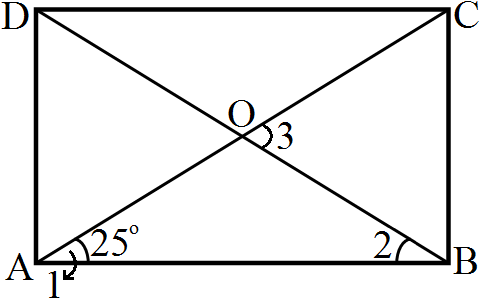
A diagonal of a rectangle is inclined to one side of the rectangle at 25º. The acute angle between the diagonals is:
  • A
    55º
  • B
    50º
  • C
    40º
  • D
    25º
View full question & answer
MCQ 371 Mark
In a Quadrilateral ABCD, $\angle\text{A} = 90^\circ$ and AB = BC = CD = DA, Then ABCD is a:
  • A
    Rectangle
  • B
    Triangle
  • C
    Parallelogram
  • D
    Square
Answer
  1. Square
    Solution:
    A quadrilateral with pair of opposite sides equal and having one right angle is called Rectangle and a rectangle with all sides equal is called Square. So, ABCD is a Square.
View full question & answer
MCQ 381 Mark
  • A
    x = 100º and y = 100º
  • B
    x = 60º and y = 120º
  • C
    x = 55º and y = 110º
  • D
    x = 50º and y = 100º
Answer
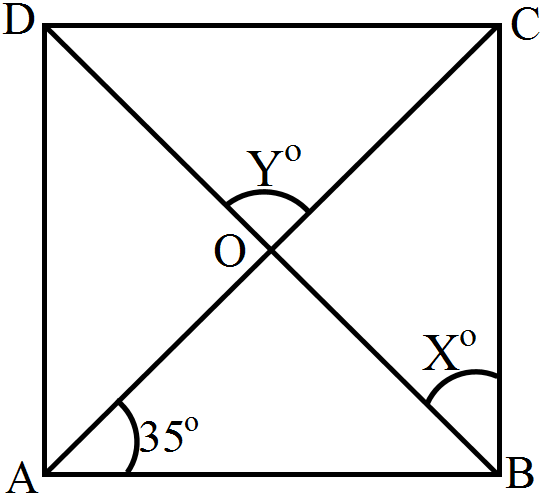
  1. x = 55º and y = 110º
    Solution:
    ABCD is a rectangle
    The diagonals of a rectangle are congruent and bisect each other. Therefore, in $\triangle\text{AOB},$
    we have:
    OA = OB
    $\angle\text{OAB} = \angle\text{OBA} = 35^\circ$
    $\text{x} = 90^\circ – 35^\circ = 55^\circ$ and $\angle\text{AOB} = 180^\circ – (35^\circ + 35^\circ) = 110^\circ$
    $\text{y} = \angle\text{AOB} = 110^\circ$ [Vertically opposite angles]
    Hence, x = 55° and y = 110°
View full question & answer
MCQ 391 Mark
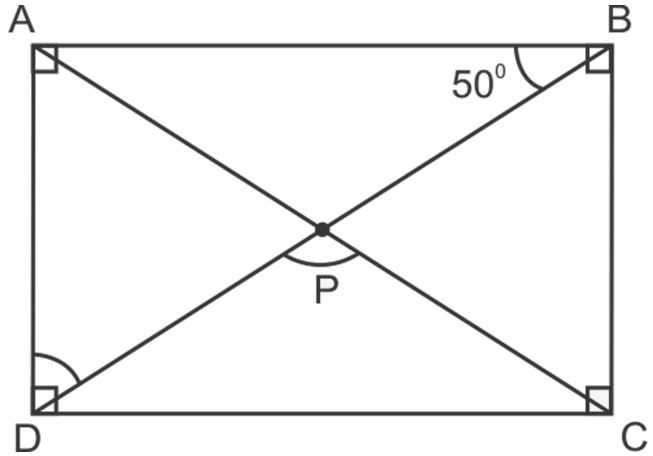
The diagonals AC and BD of a rectangle ABCD intersect each other at P. If $\angle\text{ABD}=50^\circ,$ then $\angle\text{DPC}=$
  • A
    70°
  • B
    90°
  • C
    80°
  • D
    100°
View full question & answer
MCQ 401 Mark
If APB and CQD are two parallel lines, then the bisectors of $\angle\text{APQ},\angle\text{BPQ},\angle\text{CQP}$and $\angle\text{PQD}$ enclose a:
  • A
    Square.
  • B
    Rhombus.
  • C
    Rectangle.
  • D
    Kite.
Answer
  1. Rectangle.
    Solution:
    The bisectors of $\angle\text{APQ},\angle\text{BPQ},\angle\text{CQP}$ and $\angle\text{PQD}$ enclose a rectengle.
View full question & answer
MCQ 411 Mark
If angles A, B, C and D of the quadrilateral ABCD, taken in order, are in the ratio 3 : 7 : 6 : 4, then ABCD is a:
  • A
    Kite
  • B
    Parallelogram
  • C
    Trapezium
  • D
    Rhombus
Answer
  1. Trapezium
    Solution:
    Let the angles be 3x, 7x, 6x, 4x
    then 3x + 7x + 6x + 4x = 360
    $\text{x}=\frac{360}{20}=18$
    So angles are,
    54º, 126º, 108º & 72º
    Hence it is a trapezium.
View full question & answer
MCQ 421 Mark
The figure formed by joining the midpoints of the sides of a quadrilateral ABCD, taken in order, is a square, only if:
  • A
    ABCD is a rhombus.
  • B
    Diagonals of ABCD are equal.
  • C
    Diagonals of ABCD are perpendicular.
  • D
    Diagonals of ABCD are equal and perpendicular.
Answer
  1. Diagonals of ABCD are equal and perpendicular.
    Solution:

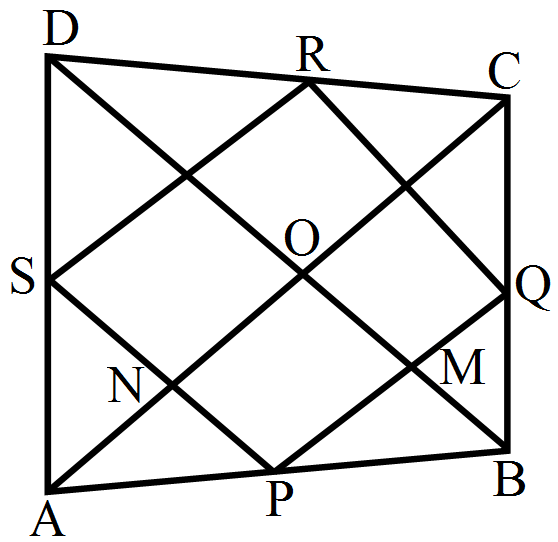
    In $\triangle\text{ABC},$ P and Q are the mid-points of sides AB and BC respectively.
    $\therefore\text{PQ || AC}$ and $\text{PQ}=\frac{1}{2}\text{AC ...(i)}$
    In $\triangle\text{BCD},$ Q and R are the mid-points of sides BC and CD respectively.
    $\therefore\text{QR || BD}$ and $\text{QR}=\frac{1}{2}\text{BD ...(ii)}$
    In $\triangle\text{ADC},$ S and R are the mid-points of sides AD and CD respectively.
    $\therefore\text{RS || AC}$ and $\text{RS}=\frac{1}{2}\text{AC ...(iii)}$
    In $\triangle\text{ABD},$ P and S are the mid-points of sides AB and AD respectively.
    $\therefore\text{SP || BD}$ and $\text{SP}=\frac{1}{2}\text{BD ...(iv)}$
    $\Rightarrow\text{PQ || RS}$ and $\text{QR || SP }$ [From (i), (ii), (iii) and (iv)]
    Thus, PQRS is a parallelogram.
    Now, $\text{AC = BD}$ (given)
    $\Rightarrow\frac{1}{2}\text{AC}=\frac{1}{2}\text{BD}$
    $\Rightarrow\text{PQ = QR = RS = SP}$ [From (i), (ii), (iii) and (iv)]
    Let the diagonals AC and BD intersect at O.
    Now,
    $\text{PS || BD}$
    $\Rightarrow\text{PN || MO}$
    Also, from (i), $\text{PQ || AC}$
    $\Rightarrow\text{PM || NO}$
    Thus, in quadrilateral PMON, $\text{PM || NO}$ and $\text{PN || MO}$
    $\Rightarrow\text{PMON}$ is a parallelogram.
    $\Rightarrow\angle\text{MPN}=\angle\text{MON}$ (opposite angles of a parallelogram are equal)
    $\Rightarrow\angle\text{MPN}=\angle\text{BOA}$ $(\text{Since }\angle\text{BOA}=\angle\text{MON})$
    $\Rightarrow\angle\text{MPN}=90^{\circ}$ $(\text{Since }\text{AC}\perp\text{BD},\angle\text{BOA}=90^{\circ})$
    $\Rightarrow\angle\text{QPS}=90^{\circ}$
    Thus, PQRS is a parallelogram such that PQ = QR = RS = SP and $\angle\text{QPS}=90^{\circ}.$
    Hence, PQRS is a square if diagonals of ABCD are equal and perpendicular.
View full question & answer
MCQ 431 Mark
Rhombus is a quadrilateral.
  • A
    In which diagonals are inclines at an angle of 60º.
  • B
    In which diagonals are equal.
  • C
    In which diagonals are inclines at an angle of 120.
  • D
    In which diagonals bisect opposite angles.
Answer
  1. In which diagonals bisect opposite angles.
    Solution:
    Let ABCD be a rhombus.
    Join BD which forms two triangles ABD and DCB. In $\triangle\text{ABD, AB = AD}.$
    So, $\angle\text{ADB} = \angle\text{ABD}$ (angles opposite to equal sides are equal) ...(i)
    But, $\angle\text{ABD} = \angle\text{BDC}$ and $\angle\text{ADB} = \angle\text{CBD}$ (alternate angles) ...(ii)
    So, from (i) and (ii)
    $\angle\text{ADB} = \angle\text{ABD}=\angle\text{BDC} = \angle\text{CBD}$
    $\therefore$ diagonal BD bisects $\angle\text{B}$ and $\angle\text{D}.$
View full question & answer
MCQ 441 Mark
  • A
    40°
  • B
    35°
  • C
    45°
  • D
    50°
Answer
  1. 40°
    Solution:
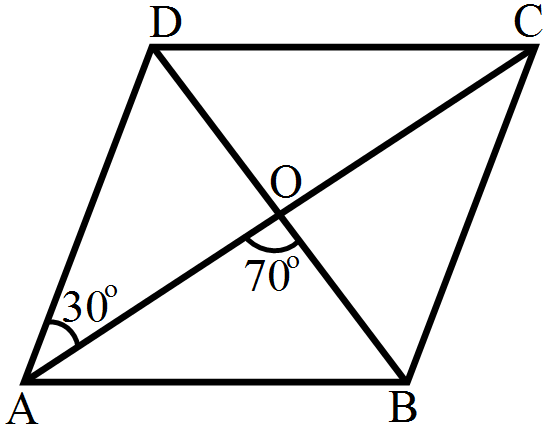
    $\text{AD || BC},$
    $\Rightarrow\angle\text{DAO}=\angle\text{BCO}=30^{\circ}$ ...(Alternate angles)
    $\Rightarrow\angle\text{BCO}=30^{\circ}$
    $\angle\text{AOB}+\angle\text{BOC}=180^{\circ}$ ...(Linear pair of angles)
    $\Rightarrow70+\angle\text{BOC}=180$
    $\Rightarrow\angle\text{BOC}=110^{\circ}$
    In $\triangle\text{CBO},$
    $\angle\text{BOC}+\angle\text{BCO}+\angle\text{OBC}=180^{\circ}$ ...(Angle sum Property)
    $\Rightarrow110+30+\angle\text{OBC}=180$
    $\Rightarrow\angle\text{OBC}=40^{\circ}$
    $\Rightarrow\angle\text{DBC}=40^{\circ}$ ...(D - O - B)
View full question & answer
MCQ 451 Mark
Which of the following quadrilateral is not a rhombus?
  • A
    All four sides sre equal.
  • B
    Diagonals bisect each other.
  • C
    Diagonals bisect opposite angles.
  • D
    One angle between the diagonals is 60°.
Answer
  1. One angle between the diagonals is 60°
    Solution:
    For a rhombus, the angle between the diagonals is 90° and not 60°.
View full question & answer
MCQ 461 Mark
  • A
    $\frac{1}{2}\text{AB}$
  • B
    $\frac{1}{2}(\text{AB} - \text{CD})$
  • C
    $\frac{1}{2}\text{CD}$
  • D
    $\frac{1}{2}(\text{AB + CD})$
Answer
  1. $\frac{1}{2}(\text{AB} - \text{CD})$
    Solution:
    Construction: Join CF and extent it to cut AB at point M
    Firstly, in triangle MFB and triangle DFC
    DF = FB (As F is the mid-point of DB)
    $\angle\text{DFC} = \angle\text{MFB}$ (Vertically opposite angle)
    $\angle\text{DFC} = \angle\text{FBM}$ (Alternate interior angle)
    $∴$ By ASA congruence rule
    $\triangle\text{MFB} ≅ \triangle\text{DFC}$
    Now, in triangle CAM
    E and F are the mid-points of AC and CM respectively.
    $\therefore\ \text{EF}=\frac{1}{2}(\text{AM})$
    $\text{EF}=\frac{1}{2}(\text{AB} - \text{MB})$
    $\text{EF}=\frac{1}{2}(\text{AB} - \text{CD})$
View full question & answer
MCQ 471 Mark
In quadrilateral ABCD, if $\angle\text{A} = 60^\circ$ and $\angle\text{B} : \angle\text{C} : \angle\text{D} = 2 : 3 : 7,$ then $\angle\text{D}$ is:
  • A
    175º
  • B
    180º
  • C
    25º
  • D
    50º
Answer
  1. 175º
    Solution:
    In quadrilateral, the sum of the all four angles equal to 360º. let $\angle\text{B} = 2\text{x},\ \angle\text{C} = 3\text{x}$ and $\angle\text{D} = 7\text{x}.$
    $\angle\text{A} + \angle\text{B} + \angle\text{C} +\angle\text{D} = 360^\circ$
    60 + 2x + 3x + 7x = 360
    12x = 300o
    x = 25º
    So, $\angle\text{D} = 7\text{x} = 7(25^\circ) = 175^\circ$
View full question & answer
MCQ 481 Mark
In quadrilateral ABCD, if $\angle\text{A}= 60^\circ$ and $\angle\text{B}: \angle\text{C}: \angle\text{D} = 2:3:7,$ then $\angle\text{D}$ is:
  • A
    175º
  • B
    25º
  • C
    180º
  • D
    50º
Answer
  1. 175º
    Solution:
    In quadrilateral, the sum of the all four angles equal to 360º.
    Let $\angle\text{B} = 2\text{x}, \ \angle\text{C} = 3\text{x}$ and $\angle\text{D} = 7\text{x}.$
    $\angle\text{A} + \angle\text{B} + \angle\text{C} + \angle\text{D} = 360^\circ$
    60 + 2x + 3x + 7x = 360
    12x = 300
    x = 25
    So, $\angle\text{D} = 7\text{x} = 7 (25) = 175^\circ$
View full question & answer
MCQ 501 Mark
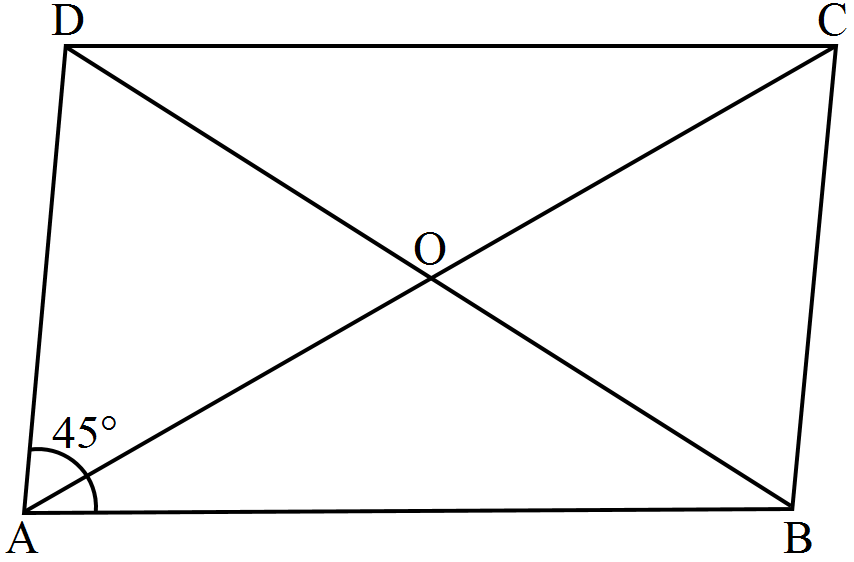
The Diagonals AC and BD of a Parallelogram ABCD intersect each other at point O. If $\angle\text{DAC}=32^\circ$ and $\angle\text{AOB}=70^\circ,$ then $\angle\text{DBC}$ is equal to:
  • A
    38º
  • B
    24º
  • C
    86º
  • D
    32º
Answer
  1. 38º
    Solution:
    $\angle\text{DAC} = \angle\text{ACB} = 32^\circ$ (alternate angles)
    $\angle\text{AOB} + \angle\text{COB} = 180^\circ$ (linear pair)
    $\angle\text{COB} = 180 - 70^\circ = 110^\circ$
    In triangle BOC,
    $\angle\text{BOC} + \angle\text{OCB} + \angle\text{CBO} = 180^\circ$ (angle sum property)
    $110^\circ + 32^\circ+ \angle\text{CBO} = 180^\circ$
    $\angle\text{CBO} = 180^\circ - 142^\circ = 38^\circ$
View full question & answer
M.C.Q - Maths STD 9 Questions - Vidyadip