Questions

2 Marks Questions

🎯

Test yourself on this topic

9 questions · timed · auto-graded

Question 12 Marks
Can the angles 110º, 80º, 70º and 95º be the angles of a quadrilateral? Why or why not?
Answer
  • No, we know that, sum of all angles of a quadrilateral is 360°.
  • Here, sum of the angles = 110° + 80° + 70° + 95° = 355° ≠ 360°.
  • So, these angles cannot be the angles of a quadrilateral.
View full question & answer
Question 22 Marks
In quadrilateral ABCD, $\angle\text{A}+\angle\text{D}=180^\circ$ What special name can be given to this quadrilateral?
Answer
In quadrilateral ABCD, $\angle\text{A}+\angle\text{D}=180^\circ$ i.e., the sum of two consecutive angles is 180o. So, pair of opposite side AB and CD are parallel.
Therefore, quadrilateral ABCD is trapezium.
Hence, special name which can be given to this quadrilateral ABCD is trapezium.
View full question & answer
Question 32 Marks
In $\Delta\text{ABC,}$ BC = 8cm and CA = 7cm. If D and E are respectively the mid-points of AB and BC, determine the length of DE.
Answer
In $\Delta\text{ABC,}$ BC = 8cm and CA = 7cm. If D and E are respectively the mid-points of AB and BC,
$\therefore\ \text{DE}=\frac{1}{2}\text{AC}=\frac{1}{2}\times7\text{cm}=3.5\text{cm}$ [Using the mid-point theorem]
View full question & answer
Question 42 Marks
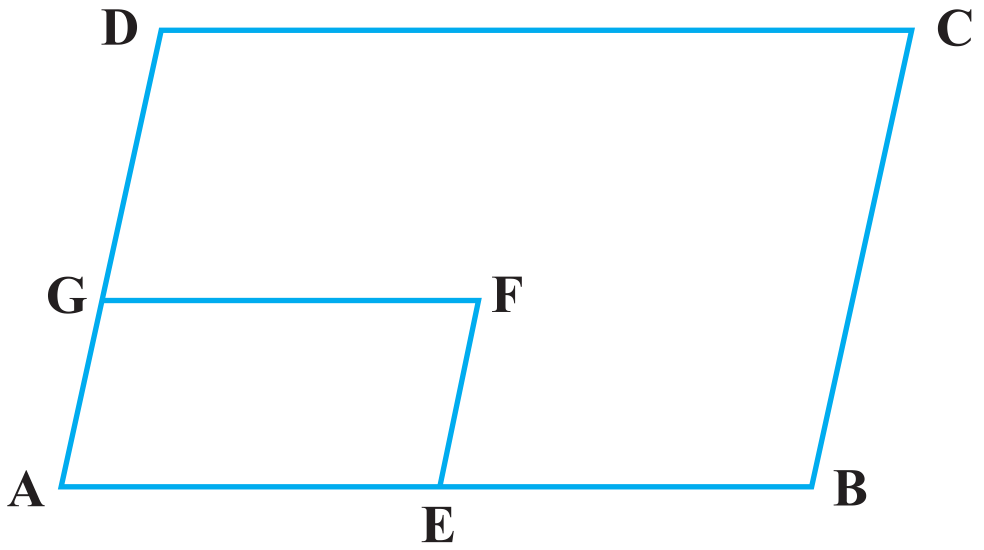
ABCD and AEFG are two parallelograms. If $\angle\text{C}=55^\circ,$ determine $\angle\text{F}.$

Answer
We have, ABCD and AEFG are two parallelograms and$\angle\text{C}=55^\circ.$ Since, ABCD is a parallelogram, then opposite angles of a parallelogram are equal.
$\angle\text{A}=\angle\text{C}=55^\circ\ ...(\text{i})$
Also, AEFG is a parallelogram.
$\therefore\ \angle\text{A}=\angle\text{F}=55^\circ$ [from eq.]
View full question & answer
Question 52 Marks
One angle of a quadrilateral is of 108º and the remaining three angles are equal. Find each of the three equal angles.
Answer
One angle of a quadrilateral is of 180° and let each of the three remaining equal angles be x0.
As the sum of the angles of a quadrilaterral is 360°.
$108^\circ+\text{x}+\text{x}+\text{x}=360^\circ$
$\Rightarrow\ 3\text{x}=360^\circ=108^\circ=252^\circ$
$\Rightarrow\ \text{x}=\frac{252^\circ}{3}=84^\circ$
Hence, each of the three angles be 84°.
View full question & answer
Question 62 Marks
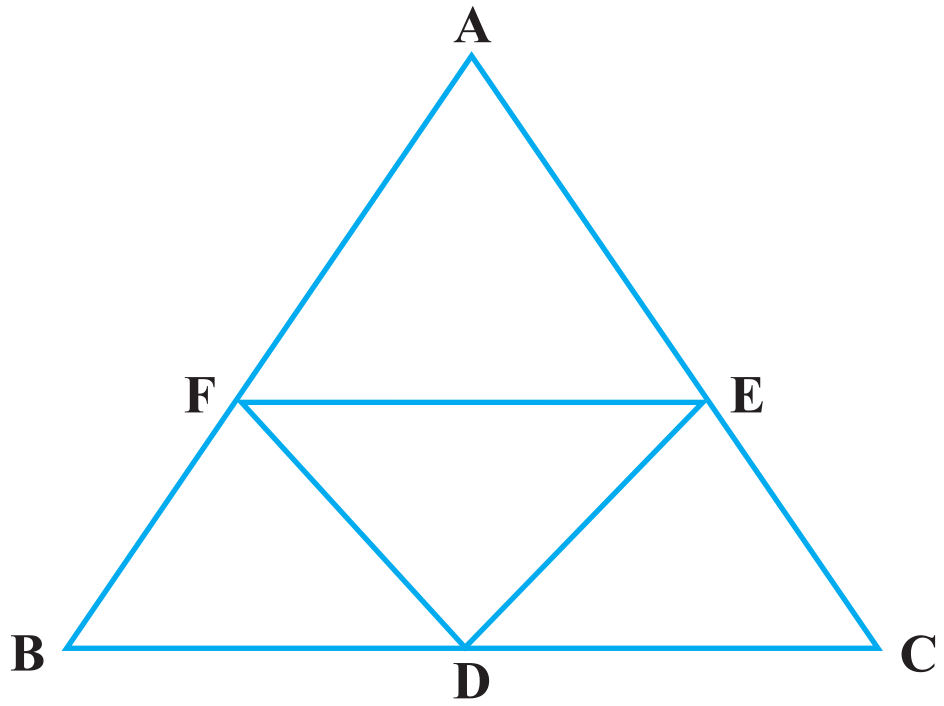
it is given that BDEF and FDCE are parallelograms. Can you say that BD = CD? Why or why not?

Answer
Yes, in the given figure, BDEF is a parallelogram..
$\therefore$ BD || EF and BD = EF …(i)
Also, FDCE is a parallelogram.
$\therefore$ CD||EF
and CD = EF …(ii)
From Eqs. (i) and (ii), BD = CD = EF
View full question & answer
Question 72 Marks
Diagonals of a quadrilateral ABCD bisect each other. If $\angle\text{A}=35^\circ$ determine $\angle\text{B}.$
Answer
As the diagonals of a qudrillateral ABCD bisect each other, so ABCD is a parallelogram.
New, ABCD is a parallelogram
$\therefore\ \angle\text{A}+\angle\text{B}=180^\circ$
[$\because$ abjacent angles of a parallelogram are supplementary]
$\therefore\ 35^\circ+\angle\text{B}=180^\circ$
$\Rightarrow\ \angle\text{B}=180^\circ-35^\circ=145^\circ$
View full question & answer
Question 82 Marks
Can all the angles of a quadrilateral be acute angles? Give reason for your answer.
Answer
No, all the angles of a quadrilateral cannot be acute angles. As, sum of the angles of a quadrilateral is 360°. So, maximum of three acute angles will be possible.
View full question & answer
Question 92 Marks
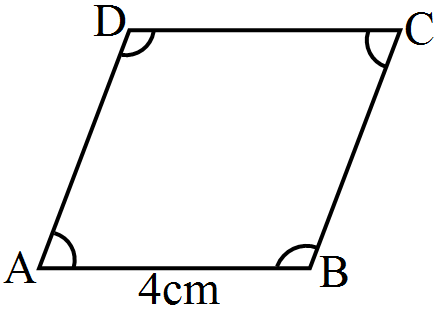
Opposite angles of a quadrilateral ABCD are equal. If AB = 4cm, determine CD.
Answer
Given, opposite angles of a quadrilateral are equal. So, ABCD is a parallelogram and we know that, in a parallelogram opposite sides are also equal.

$∴\text{CD}=\text{AB}=4\text{cm}$

View full question & answer
2 Marks Questions - Maths STD 9 Questions - Vidyadip