Questions

3 Marks Question

🎯

Test yourself on this topic

14 questions · timed · auto-graded

Question 13 Marks
Bulbs are packed in cartons each containing 40 bulbs. Seven hundred cartons were examined for defective bulbs and the results are given in the following table:
Number of defective bulbs
0
1
2
3
4
5
6
more than 6
Frequency
400
180
48 41 18 8 3 2
One carton was selected at random. What is the probability that it has:
  1. No defective bulb?
  2. Defective bulbs from 2 to 6?
  3. Defective bulbs less than 4?
Answer
Total number of cartons, n(S) = 700

  1. Number of cartons which has no defective bulb, n(E1) = 400

$\therefore$ Probability that no defective bulb $=\frac{\text{n}(\text{E}_1)}{\text{n(S)}}=\frac{400}{700}=\frac{4}{7}$

Hence, the probability that no defective bulb is $\frac{4}{7}$

  1. Number of catons which has defective bulbs from 2 to 6, n(E2)

= 48 + 41 + 18 + 8 + 3 = 118

probability that no defective bulbs from 2 to 6 $=\frac{\text{n}(\text{E}_2)}{\text{n(S)}}=\frac{118}{700}=\frac{59}{350}$

Hence, the probability that the defective bulbs from 2 to 6 is $\frac{59}{350}$

  1. Number of cartons which has defective bulbs less that 4

n(E3) = 400 + 180 + 48 + 41 = 669

$\therefore$ The probability that the defective bulbs less than 4 $=\frac{\text{n}(\text{E}_3)}{\text{n(S)}}=\frac{669}{700}$

Hence, the probability that the defective bulb less than 4 is $\frac{669}{700}$
View full question & answer
Question 23 Marks
A company selected 4000 households at random and surveyed them to find out a relationship between income level and the number of television sets in a home. The information so obtained is listed in the following table:
Monthly income (in Rs.) Number of Televisions/ household
  0 1 2 Above 2
<10000
10000-14999
15000-19999
20000-24999
25000 and above
20
10
0
0
0
80
240
380
520
1100
10
60
120
370
760
0
0
30
80
220
Find the probability:
  1. Of a household earning Rs. 10000 - Rs 14999 per year and having exactly one television.
  2. Of a household earning Rs. 25000 and more per year and owning 2 televisions.
  3. Of a household not having any television.
Answer
  1. So, required probability $=\frac{240}{4000}=\frac{60}{1000}=0.06$
  2. Number of households earning Rs. 25000 and more per year and owing 2 televisions = 460

 So, required probability $=\frac{760}{4000}=0.19$

  1. Number of households not having any televisions = 20 + 10 = 30

 So, required probability $=\frac{30}{4000}=\frac{3}{400}$

View full question & answer
Question 33 Marks
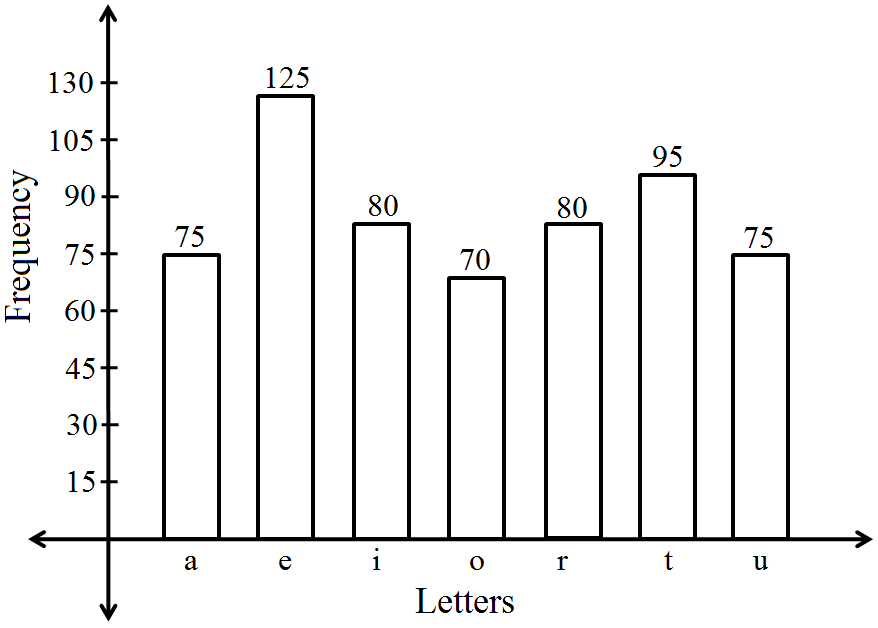
The following table gives the frequencies of most commonly used letters a, e, i, o, r, t, u from a page of a book:
Letter a e i o r t u
Frequency 75 125 80 70 80 95 75
Represent the information above by a bar graph.
Answer
We draw bar graph of this data in the following steps:
Step I We represent the letters (variable) on the horizontal axis choosing any scale, as the width of the bar is not important. But for clarity, we take equal widths for all bars and maintain equal gaps in between them. Let one letter be represented by one unit.
Step II We represent the letters on the vertical axis. Since, the maximum frequency is 125, we can choose the scale as 1 unit = 15 frequency.
Step III To represent our first letter i.e., a, we draw a rectangular bar with width 1 unit and height 5 units.
Step IV Similarly, other heads are represented by leaving a gap of ½ unit in between two consecutive bars.
The bar graph for given data is shown below:

View full question & answer
Question 43 Marks
Obtain the mean of the following distribution:
Frequency
Varible
4
8
14
11
3
4
6
8
10
12
Answer
We know that,
Mean of the data $(\bar{\text{x}})=\frac{\sum\limits^{5}_{\text{i}=1}\text{f}_\text{i}\text{x}_\text{i}}{\sum\limits^{5}_{\text{i}=1}\text{f}_\text{i}}$
$= \frac{\text{f}_1\text{x}_1+\text{f}_2\text{x}_2+\text{f}_3\text{x}_3+\text{f}_4\text{x}_4+\text{f}_5\text{x}_5}{\text{f}_1+\text{f}_2+\text{f}_3+\text{f}_4+\text{f}_5}$
$=\frac{4\times4+8\times6+14\times8+11\times10+3\times12}{4+8+14+11+3}$
$=\frac{16+48+112+110+36}{40}$
$=\frac{322}{40}=8.05$
Hence, the mean of the given data is 8.05
View full question & answer
Question 53 Marks
The scores (out of 100) obtained by 33 students in a mathematics test are as follows:
69, 48, 84, 58, 48, 73, 83, 48, 66, 58, 84000 66, 64, 71, 64, 66, 69, 66, 83, 66, 69, 71 81, 71, 73, 69, 66, 66, 64, 58, 64, 69, 69
Represent this data in the form of a frequency distribution.
Answer
Frequency distribution table.
Scores
Frequency
48
58
64
66
69
71
73
81
83
84
3
3
4
7
6
3
2
1
2
2
View full question & answer
Question 63 Marks
A class consists of 50 students out of which 30 are girls. The mean of marks scored by girls in a test is 73 (out of 100) and that of boys is 71. Determine the mean score of the whole class.
Answer
There are 50 students in a class. Out of these 50 students, 30 are girls.
So, number of boys in the class = 50 - 30 = 20
Mean markes of 30 girls = 73
Total markes of girls = 73
Mean marks of 20 boys = 71
Total marks of 20 boys = 71 × 20 = 1420
Hence, mean of the whole class $=\frac{2190+1420}{50}=\frac{3610}{50}=72.2$
View full question & answer
Question 73 Marks
Ten observations 6, 14, 15, 17, x + 1, 2x - 13, 30, 32, 34, 43 are written in an ascending order. The median of the data is 24. Find the value of x.
Answer
Ten observations 6, 14, 15, 17, x + 1, 2x - 13, 30, 32, 34, 43, are in an ascending order.
Here, n = 10(even)
$\therefore\text{ Median}=\text{average of}\Big(\frac{10}{2}\Big)^{\text{th}}\text{value and}\Big(\frac{10}{2}+1\Big)^{\text{th}}\text{value}\\=\text{average of 5}^{\text{th }}\text{item and }6^{\text{th}}\text{ item}$
$\text{Median}=\frac{\text{x}+1+2\text{x}-13}{2}=\frac{3\text{x}-12}{2}$
Now, $\frac{3\text{x}-12}{2}=24$
$3\text{x}=48+12=60$
$\therefore\ \text{x}=60\div3=20$
Hence, the value of x = 20
View full question & answer
Question 83 Marks
A football player scored the following number of goals in the 10 matches:
1, 3, 2, 5, 8, 6, 1, 4, 7, 9 Since the number of matches is 10 (an even number), therefore, the median.
$=\frac{5^{\text{th}}\text{observation}+6^{\text{th}}\text{observation}}{2}$
$=\frac{8+6}{2}=7$
Is it the correct answer and why?
Answer
No. It is not the correct answer, because the data have to be arranged in ascending or descending order before finding the median.
Arranging the data in ascending order 1,1,2, 3, 4, 5, 6, 7, 8, 9.
Here, number of observations is 10, which is even.
So, $\text{median}=\frac{\big(\frac{\text{n}}{2}\big)^{\text{th}}\text{observation}+\big(\frac{\text{n}}{2}+1\big)^{\text{th}}\text{observation}}{2}$
$=\frac{\big(\frac{\text{10}}{2}\big)^{\text{th}}\text{observation}+\big(\frac{\text{10}}{2}+1\big)^{\text{th}}\text{observation}}{2}$
$=\frac{5^{\text{th}}\text{observation}+6^{\text{th}}\text{observation}}{2}$
$=\frac{4+5}{2}=\frac{9}{2}=4.5$
View full question & answer
Question 93 Marks
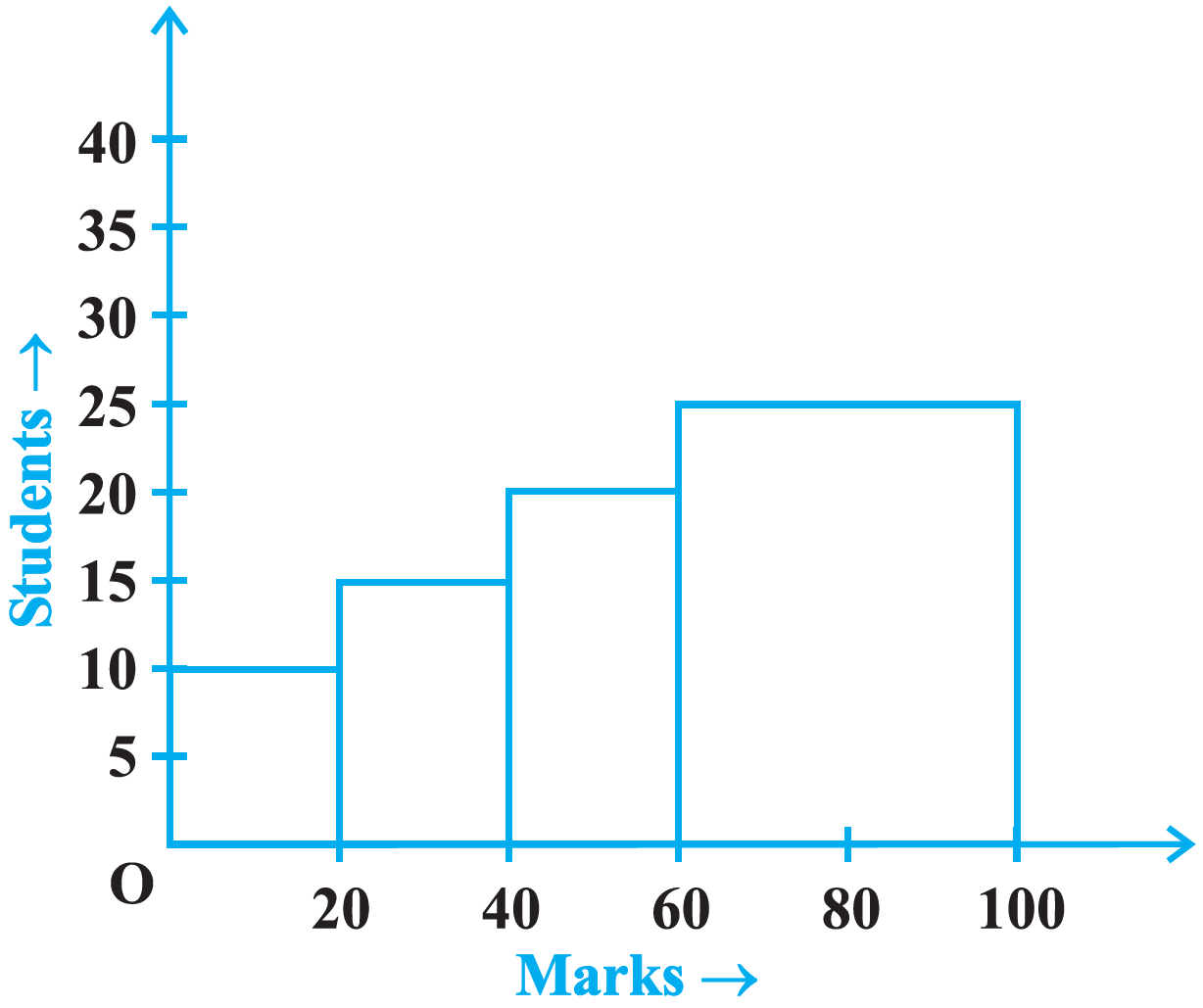
The frequency distribution:
Marks
0-20
20-40
40-60
60-100
Number of student
10
15
20
25
has been represented graphically as follows:

Do you think this representation is correct? Why?
Answer
This representation is not correct. The classes 0 - 20, 20 - 40, 40 - 60 and 60 - 100 are not of uniform width but of varying widths. Width 60 - 80 is given.
View full question & answer
Question 103 Marks
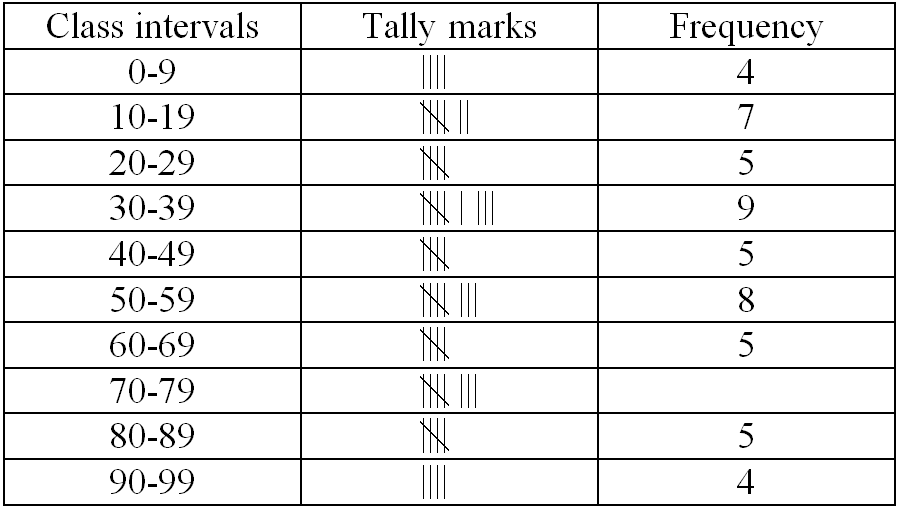
The following are the marks (out of 100) of 60 students in mathematics:
16, 13, 5, 80, 86, 7, 51, 48, 24, 56, 70, 19, 61, 17, 16, 36, 34, 42, 34, 35, 72, 55, 75, 31, 52, 28,72, 97, 74, 45, 62, 68, 86, 35, 85, 36, 81, 75, 55, 26, 95, 31, 7, 78, 92, 62, 52, 56, 15, 63,25, 36, 54, 44, 47, 27, 72, 17, 4, 30
Construct a grouped frequency distribution table with width 10 of each class starting from 0-9.
Answer
We have 0-9 as one of the class intervals and the class size is the same,

Therefore, the classes of equal size and 0-9, 10-19, ....., 90-99.

Frequency Distribution Table.

View full question & answer
Question 113 Marks
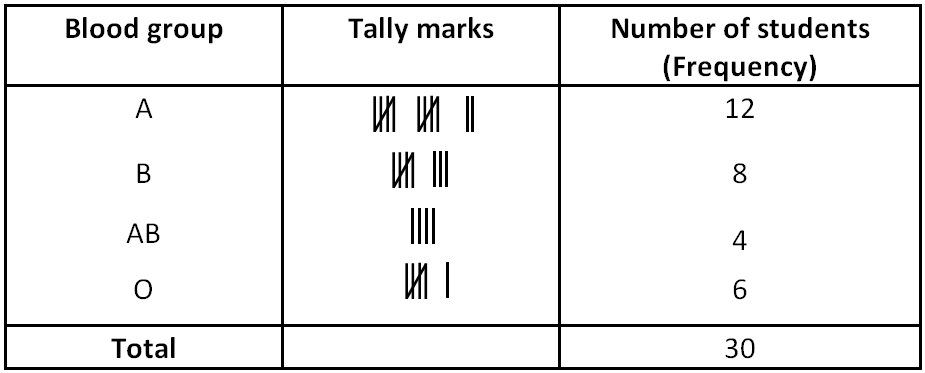
The blood groups of 30 students are recorded as follows:
A, B, O, A, AB, O, A, O, B, A, O, B, A, AB, B, A, AB, B, A, A, O, A, AB, B, A, O, B, A, B, A
Prepare a frequency distribution table for the data.
Answer
The number of students who have a certain type of blood group is called the frequency of those blood groups. A frequency distribution table for the given data is given below:

View full question & answer
Question 123 Marks
The value of $\pi$ upto 35 decimal places is given below:
3. 14159265358979323846264338327950288
Make a frequency distribution of the digits 0 to 9 after the decimal point.
Answer
The number of repeated digit is called the frequency of those digits. A frequency distribution table for the given data is given below:

View full question & answer
Question 133 Marks
If the mean of the following data is 20.2, find the value of p:
x
10
15
20
25
30
f
6
8
p
10
6
Answer
We know that,
Mean of the data $(\bar{\text{x}})=\frac{\sum\limits^{5}_{\text{i}=1}\text{f}_\text{i}\text{x}_\text{i}}{\sum\limits^{5}_{\text{i}=1}}=20.2$ [given]
$\Rightarrow\ \frac{\text{f}_1\text{x}_1+\text{f}_2\text{x}_2+\text{f}_3\text{x}_3+\text{f}_4\text{x}_4+\text{f}_5\text{x}_5}{\text{f}_1+\text{f}_2+\text{f}_3+\text{f}_4+\text{f}_5}$
$\Rightarrow\ \frac{(6)(10)+(8)(15)+(\text{p})(20)+(10)(25)+(6)(30)}{6+8+\text{p}+10+6}=20.2$
$\Rightarrow\ \frac{60+120+20\text{p}+250+180}{30+\text{p}}=20.2$
$\Rightarrow\ 20\text{p}+610=606+20.2\text{p}$
$\Rightarrow\ 610-606=0.2\text{p}$
$\Rightarrow\ \frac{2\text{p}}{10}=4$
$\therefore\ \text{p}=10\times2=20$
Hence, the value of p is 20
View full question & answer
Question 143 Marks
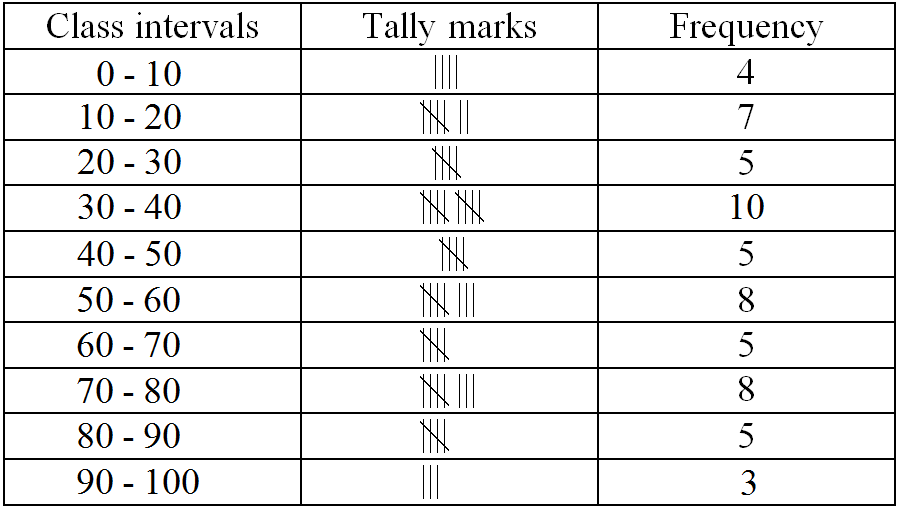
Construct a grouped frequency distribution table with width 10 of each class, in such a way that one of the classes is 10-20 (20 not included).
Answer
We arrange the given data into groups like 0-10, 10-20, 20-30 in which upper class limit is not included in that class. The class width in each case is 10.
The frequency distribution of the given data is given below:

View full question & answer
3 Marks Question - Maths STD 9 Questions - Vidyadip