Questions

1 Marks Question

🎯

Test yourself on this topic

10 questions · timed · auto-graded

Question 11 Mark
Prove that the sum of three altitudes of a triangle is less than the sum of its sides.
Answer
In any triangle, each altitude is shorter than the side on which it is drawn;so adding the three altitudes gives a total less than the sum of the three sides.
View full question & answer
Question 21 Mark
In two triangles ABC and DEF, it is given that $\angle A = \angle D, \angle B = \angle E$ and $\angle C = \angle F$. Arethe two triangles necessarily congruent?
Answer
No
View full question & answer
Question 41 Mark
In two congruent triangles ABC and DEF, if AB = DE and BC = EF . Name the pairs of equal angles.
Answer
$\angle A=\angle D, \angle B=\angle E, \angle C=\angle F$
View full question & answer
Question 51 Mark
In triangles ABC and CDE, if $AC = CE, BC = CD, \angle A = 60^{\circ}, \angle C = 30^{\circ}$ and $\angle D = 90^{\circ}$. Are two triangles congruent?
Answer
Yes
View full question & answer
Question 61 Mark
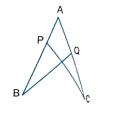
Image
In Fig. if AB = AC and angle B = angle C. Prove that BQ = CP
Answer
In the isosceles triangle $A B=A C$ and $\angle B=\angle C$,
$\triangle A B Q \cong \triangle A C P$ by SAS,
hence the corresponding sides are equal: $B Q=C P$
View full question & answer
Question 71 Mark
If ABC and DEF are two triangles such that $AC = 2.5 cm, BC = 5 cm, \angle C = 75^{\circ}$ $DE = 2.5 cm, DF = 5 cm$ and $\angle D = 75^{\circ}$. Are two triangles congruent?
Answer
Yes
View full question & answer
Question 91 Mark
CDE is an equilateral triangle formed on a side CD of a square ABCD. Show that $\triangle A D E \cong \triangle B C E$.
Answer
In square  ABCD,  AD=BC and in equilateral $\triangle C D E, C E=D E ;$ also $\angle A D E=\angle B C E=60^{\circ}$. So by SAS criterion,
$\triangle A D E \cong \triangle B C E$
View full question & answer
Question 101 Mark
ABC is an isosceles triangle in which AB = AC BE and CF are its two medians. Show that BE = CF
Answer
In the isosceles triangle $A B=A C$, the medians from B and C are corresponding parts of congruent triangles, so BE = CF.
View full question & answer
1 Marks Question - Maths STD 9 Questions - Vidyadip