Questions

3 Marks Question

🎯

Test yourself on this topic

7 questions · timed · auto-graded

Question 13 Marks
Angles opposite to equal sides of an isosceles triangle are equal.This result can be proved in many ways. One of the proofs is given here.
Answer
Image
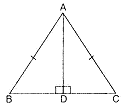
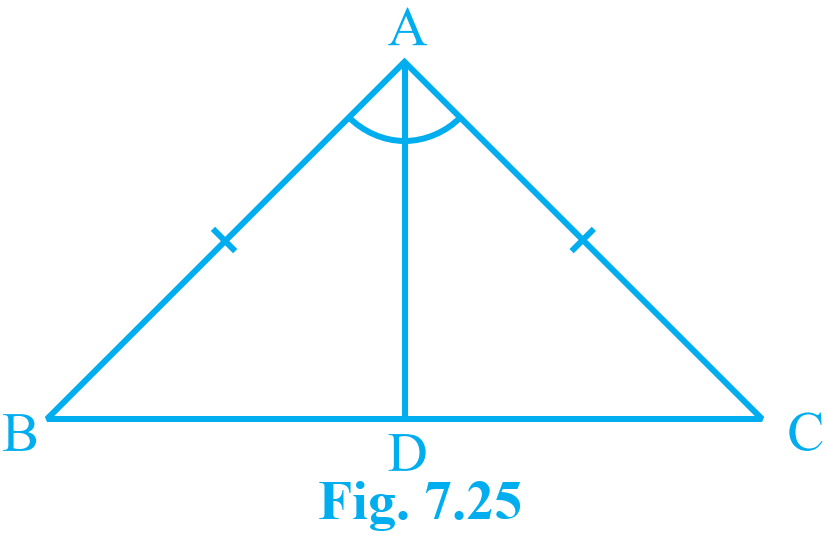
Proof: We are given an isosceles triangle $A B C$ in which $A B=A C$. We need to prove that $\angle \mathrm{B}=\angle \mathrm{C}$.
Let us draw the bisector of $\angle \mathrm{A}$ and let $\mathrm{D}$ be the point of intersection of this bisector of $\angle \mathrm{A}$ and $\mathrm{BC}$ (see Fig. 7.25).
In $\triangle \mathrm{BAD}$ and $\triangle \mathrm{CAD}$,
$
\begin{aligned}
\mathrm{AB} =\mathrm{AC} \quad (Given) \\
\angle \mathrm{BAD} =\angle \mathrm{CAD} \quad \text{(By construction)} \\
\mathrm{AD} =\mathrm{AD} \quad (Common) \\
So, \quad \triangle \mathrm{BAD} \cong \triangle \mathrm{CAD} \text{(By SAS rule)}
\end{aligned}
$
So, $\angle \mathrm{ABD}=\angle \mathrm{ACD}$, since they are corresponding angles of congruent triangles.
So, $\angle \mathrm{B}=\angle \mathrm{C}$
View full question & answer
Question 23 Marks
Answer
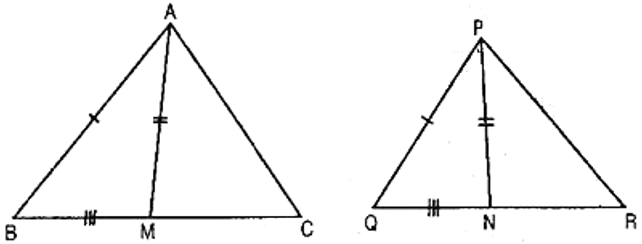
AM is the median of $\triangle$ABC.
$\therefore $ BM = MC = $\frac{1}{2}$ BC ...(i)
PN is the median of $\triangle$PQR.
$\therefore $ QN = NR = $\frac{1}{2}$ QR ...(ii)
Now BC = QR [Given] $\Rightarrow$ $\frac{1}{2} BC =\frac{1}{2} QR$
$\therefore $ BM = QN ...(iii)
  1. Now in $\triangle$ABM and $\triangle$PQN,
    AB = PQ[Given]
    AM = PN[Given]
    BM = QN[From eq.(iii)]
    $\therefore $ $\triangle$ABM $\cong$ $\triangle$PQN [By SSS congruency]
    $\Rightarrow$ $\angle$B = $\angle$Q [By C.P.C.T.] ...(iv)
  2. In $\triangle$ABC and $\triangle$PQR,
    AB = PQ [Given]
    $\angle$B = $\angle$Q [Prove above]
    $\therefore $ PR = QR [Given]
    ABC $\cong$ PQR [By SAS congruency]
View full question & answer
Question 33 Marks
AD is an altitude of an isosceles triangle ABC in which AB = AC. Show that

  1. AD bisects BC
  2. AD bisects $\angle$A.

Answer


Given : AD is an altitude of an isosceles triangle ABC in which AB = AC
To prove :

  1. AD bisects BC
  2. AD bisects $\angle$A

Proof :

  1. In right  $\triangle$ADB and right $\triangle$ADC,
    AB = AC . . . . [Given]
    Side AD = Side AD . . . . [Common]
    $\therefore$ $\triangle$ADB $\cong$ $\triangle$ADC . . . [RHS Rule]
    $\therefore$ BD = CD . . . [c.p.c.t.]
    $\therefore$ AD bisects BC.
  2. $\triangle$ADB $\cong$ $\triangle$ADC . . . [As proved above]
    $\therefore$ $\angle$BAD = $\angle$CDA . . . [c.p.c.t.]
    $\therefore$ AD bisects $\angle$A
View full question & answer
Question 43 Marks
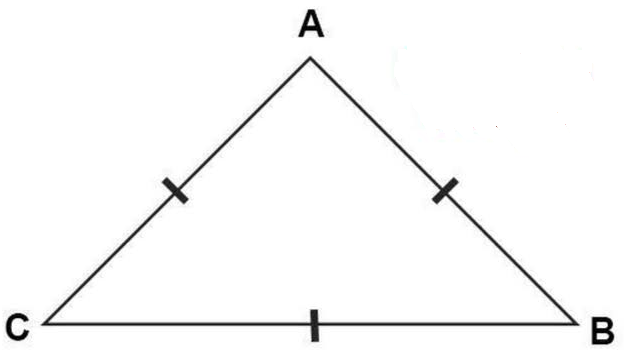
Show that the angles of an equilateral triangle are 60° each.
View full question & answer
Question 53 Marks
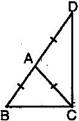
$\Delta$ ABC is an isosceles triangle in which AB = AC. Side BA is produced to D such that AD = AB(See figure). Show that $\angle$ BCD is a right angle.

Answer


From figure & according to the question, in $\Delta$ ABC,
AB = AC ..........(1)
$\Rightarrow$$\angle$ ACB = $\angle$ ABC ...(2) [Angles opposite to equal sides are equal]
Again given, AD = AB
But AB = AC  [ from (1) ]
$\therefore$ AD = AB = AC
$\Rightarrow$  AD = AC..... (3)
Now in $\Delta$ ADC, 
AD = AC [ from (3) ]
$\Rightarrow \angle A D C = \angle A C D$ …(4) [Angles opposite to equal sides are equal]
In $\Delta$ BCD,
$\angle A B C + \angle B C D + \angle C D A = 180 ^ { \circ }$[ Angle sum property ]
$\Rightarrow \angle A C B + \angle B C D + \angle C D A = 180 ^ { \circ }$[ Because $\angle$ ACB = $\angle$ ABC, from (2) ]
$\Rightarrow \angle A C B + \angle A C B + \angle A C D + \angle C D A = 180 ^ { \circ }$ [Because $\angle B C D = \angle A C B + \angle A C D$ ]
$\Rightarrow 2 \angle A C B + \angle A C D + \angle C D A = 180 ^ { \circ }$
$\Rightarrow 2 \angle A C B + \angle A C D + \angle A C D = 180 ^ { \circ }$ [ Because  $\angle$ ADC = $\angle$ ACD, see (4) ]]
$\Rightarrow 2 \angle A C B + 2 \angle A C D = 180 ^ { \circ }$
$\Rightarrow 2 ( \angle A C B + \angle A C D ) = 180 ^ { \circ }$ [ Taking out 2 common ]
$\Rightarrow 2 \angle B C D = 180 ^ { \circ }$ [ Because, $\angle A C D + \angle A C B = \angle B C D$ ]
$\Rightarrow$ $\angle B C D = 90 ^ { \circ }$
Hence $\angle$ BCD is a right angle.
View full question & answer
Question 63 Marks
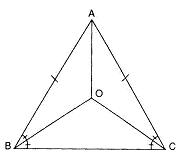
In an isosceles triangle ABC, with AB = AC, the bisectors of $\angle$B and $\angle$C intersect each other at O. Join A to O. Show that OB = OC and AO bisects $\angle$A.
Answer
Given: In $\triangle$ABC, AB = AC, the bisectors of $\angle$B and $\angle$C intersect each other at O.
Construction: Joint A to O

To prove: OB = OC and AO bisects A.
Proof : AB = AC . . . . [Given]
$\therefore$ $\angle$B = $\angle$C . . . [$\angle$s opposite to equal side of a $\triangle$]
$\therefore$ $\frac{1}{2}$$\angle$B =  $\frac{1}{2}$$\angle$C
$\therefore$ ∠OBC = ∠OCB . . . [As BO bisects $\angle$B and CO bisects $\angle$C]
$\therefore$ OB = OC . . . [Sides opposite to equal $\angle$s of a $\triangle$ ]
In $\triangle$OAB and $\triangle$OAC,
AB = AC . . . .[Given]
OB = OC . . . .[As proved above]
OA = OA . . . .[Common]
$\therefore$ $\triangle$OAB $\cong$$\triangle$OAC . . . [By SSS property]
$\therefore$ $\angle$OAB = $\angle$OAC . . . [c.p.c.t.]
$\therefore$ AO bisects $\angle$A
View full question & answer
Question 73 Marks
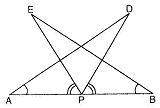
AB is a line segment and P is its mid-point. D and E are points on the same side of AB such that $\angle$BAD = $\angle$ABE and $\angle$EPA = $\angle$DPB.
Show that:
  1. $\triangle$DAP $\cong$ $\triangle$EBP
  2. AD = BE
Answer
Given: AB is a line segment and P is its mid-point. D and E are points on the same side of AB such that $\angle$BAD = $\angle$ABE and $\angle$EPA = $\angle$DPB.
To prove:

  1. DDAP $\cong$ DEBP
  2. AD = BE

Proof :(ii)
$\angle$EPA = $\angle$DPB ...[Given]
$\angle$EPA + $\angle$EPD = $\angle$EPD + $\angle$DPB ...[Adding $\angle$EPD to both sides]
∠APD = ∠BPE ...(1)
In DDAP and DEBP
$\angle$DAP = $\angle$EBP ...[Given]
AP = BP ...[As P is the mid-point of the line AB]
$\angle$APD = $\angle$BPE ...[From (1)]
$\therefore$ DDAP $\cong$ DEBP proved ...[ASA property] ...(2)
(i) As DDAP $\cong$ DEBP ...[From (2)]
$\therefore$ AD = BE ...[c.p.c.t.]

View full question & answer