Questions · Page 1 of 5

One word answer.

🎯

Test yourself on this topic

50 questions · timed · auto-graded

Question 11 Mark
Calculate the formula unit masses of ZnO, Na2O, K2CO3 , given atomic masses of Zn = 65u, Na = 23u, K = 39u, C = 12u, and O = 16u.
Answer
Formula unit mass of $ZnO =($ Atomic mass of $Zn )+($ Atomic mass of $O$ )
\[
=(65+16) u =81 u
\]
Formula unit mass of $Na _2 O =(2 \times 23)+16$
\[
=62 u
\]
Formula unit mass of $K _2 CO _3=(2 \times 39)+12+(3 \times 16)$
\[
=138 u
\]
View full question & answer
Question 21 Mark
How many atoms are present in a
PO4 3– ion?
Answer
In a PO43-ion, five atoms are present; one of phosphorus and four of oxygen.
View full question & answer
Question 31 Mark
How many atoms are present in a
H2S molecule.
Answer
In an H2S molecule, three atoms are present; two of hydrogen and one of sulphur.
View full question & answer
Question 41 Mark
What is meant by the term chemical formula?
Answer
The chemical formula of a compound means the symbolic representation of the composition of a compound. A chemical formula for a molecule is represented by the group of symbols of the elements that constitute the molecule, and the number of atoms of each element present in one molecule.
View full question & answer
Question 51 Mark
Write down the names of compounds represented by the following formulae:
CaCO3.
Answer
CaCO3 represents the compound calcium carbonate.
View full question & answer
Question 71 Mark
Write down the names of compounds represented by the following formulae:

K2 SO4

Answer
K2SO4→ Potassium sulphate.
View full question & answer
Question 81 Mark
Write down the names of compounds represented by the following formulae:
CaCl2
Answer
CaCl2→ Calcium chloride.
View full question & answer
Question 91 Mark
Write down the names of compounds represented by the following formulae:

Al2(SO4)3

Answer
Aluminum sulfate
View full question & answer
Question 141 Mark
Which postulate of Dalton’s atomic theory can explain the law of definite proportions?
Answer
The postulate which can explain the law of definite proportions is that the relative number and the kinds of atoms are constant in a given compound.
View full question & answer
Question 151 Mark
Calculate the molar mass of the following substances:
Nitric acid, HNO3.
Answer
Molar mass of nitric acid, HNO3 = 1 + 14 + 3 × 16 = 63g.
View full question & answer
Question 161 Mark
Calculate the molar mass of the following substances:
Hydrochloric acid, HCl.
Answer
Molar mass of Hydrochloric acid = Molar mass of H + Molar mass of Cl = 1 + 35.5 = 36.5 g.
View full question & answer
Question 171 Mark
Calculate the molar mass of the following substances:
Phosphorus molecule, P4 (atomic mass of phosphorus = 31).
Answer
Molar mass of phosphorus molecule, P4=4 → 31=124 g.
View full question & answer
Question 181 Mark
Calculate the molar mass of the following substances:
Sulphur molecule, S8.
Answer
Molar mass of sulphur molecule, S8 = 8 × 32 = 256g.
View full question & answer
Question 191 Mark
Calculate the molar mass of the following substances:
Ethyne, C2H2.
Answer
Molar mass of ethyne, C2H= 2 × 12 + 2 × 1 = 28g.
View full question & answer
Question 201 Mark
Give the names of the elements present in the following compounds.

Potassium sulphate.

Answer
Potassium sulphate is K2SO4. Elements present are potassium, sulphur and oxygen.
View full question & answer
Question 211 Mark
Give the names of the elements present in the following compounds.

Baking powder.

Answer
The elements present in baking powder are sodium, hydrogen, carbon, and oxygen.
View full question & answer
Question 221 Mark
Give the names of the elements present in the following compounds.

Hydrogen bromide.

Answer
Hydrogen bromide is HBr. Elements present are hydrogen and bromine.
View full question & answer
Question 231 Mark
Give the names of the elements present in the following compounds.
Quick lime.
Answer
Quick lime is CaO. Elements present are calcium and oxygen.
View full question & answer
Question 281 Mark
Write the chemical formulae of the following:
Magnesium chloride.
Answer
The chemical formula for Magnesium chloride is MgCl2.
View full question & answer
Question 291 Mark
The molecular formula of glucose is C6H12O6. Calculate its molecular mass. (Atomic masses: C = 12 u; H = 1 u; O = 16 u)
Answer
Molecular formula of glucose = C6H12O6
Molecular mass of glucose = (6 × C) + (12 × H) + (6 × O) = 72 + 12 + 96 = 180u
View full question & answer
Question 311 Mark
Give a brief description of the following:
Ionic compound.
Answer
Ionic compound: an ionic compound is a chemical compound composed of ions held together by electrostatic forces termed ionic bonding. The compound is neutral overall, but consists of positively charged ions called cations and negatively charged ions called anions.
View full question & answer
Question 321 Mark
Give the formulae of the compounds formed from the following set of element:
Boron and oxygen.
Answer
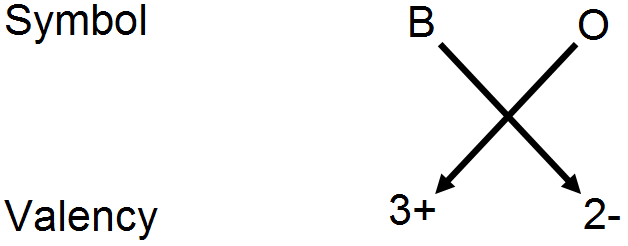
Boron and oxygen:
Boron oxide

Formula: B2O3
View full question & answer
Question 331 Mark
What is the SI prefix for the following multiples and submultiples of a unit?
10-9
Answer
10-9 → nano
View full question & answer
Question 341 Mark
What is meant by the valency of an element?
Answer
In chemistry, the valence or valency of an element is a measure of its combining power with other atoms when it forms chemical compounds or molecules. The concept of valence was developed in the second half of the 19th century and helped successfully explain the molecular structure of inorganic and organic compounds.
View full question & answer
Question 351 Mark
An element X has a valency of 4 whereas another element Y has a valency of 1. What will be the formula of the compound formed between X and Y?
Answer
As the valency of element X is 4 and that of Y is 1, so the resulting formula is XY4.
View full question & answer
Question 361 Mark
What is the mass of:
0.5 mole of water molecules?
Answer
1 mole of water molecules = 18gm.
0.5 mole of water molecules = 0.5 x 18 =9.0gm.
View full question & answer
Question 371 Mark
Define ‘formula mass’ of a compound.
Answer
The formula mass of a substance is defined as the sum of the atomic masses of constituent atoms in an ionic compound. This is generally used for ionic compounds which do not contain discrete molecules, but ions as their constituent units.
View full question & answer
Question 381 Mark
Calculate the molar mass of the following compound:
Ca(OH)2
Answer
The molar mass of calcium hydroxide i.e. Ca(OH)2 is 40g/mol + 2 × 16g/mol + 2 × 1 g/mol = 74g/mol.
View full question & answer
Question 391 Mark
How many atoms are present in one gram atomic mass of a substance?
Answer
One mole of atoms (6.002 × 1023 atoms)
View full question & answer
Question 401 Mark
Name the scientist who gave:
Law of conservation of mass.
Answer
Law of conservation of mass was proposed by Antoine Lavoisier.
View full question & answer
Question 411 Mark
An element X has a valency of 2. Write the simplest formula for:
oxide of the element.
Answer
Oxide of element: As valency of oxygen is -2 and that of element is +2 so, the resulting compound is XO.
View full question & answer
Question 431 Mark
Name the element used as a standard for atomic mass scale.
Answer
Carbon is used as a standard for atomic mass scale.
View full question & answer
Question 441 Mark
Calculate the number of molecules in 8g of O2.
Answer
Molar mass of oxygen = 32g.
So, 32g of oxygen = 1mole.
1g of oxygen = 1/32mole
8g of oxygen = 1/32 × 8
⇒ 1/4 moles
= 0.25 moles
no. of particles (molecules) = 0.25 × 6.02 × 1023
= 1.5 × 1023
= 1.5 × 10²³
View full question & answer
Question 451 Mark
Define the following terms.
Valency.
Answer
In chemistry, the valence or valency of an element is a measure of its combining power with other atoms when it forms chemical compounds or molecules.
View full question & answer
Question 481 Mark
Name the law of chemical combination:
Which was given by Proust.
Answer
The law of chemical combination proposed by Proust is well known as the law of constant proportions.
View full question & answer
Question 491 Mark
Define atomic mass unit. What is its symbol?
Answer
One atomic mass unit is defined as exactly one-twelfth the mass of an atom of carbon-12. Its symbol is 'u'.
View full question & answer
Question 501 Mark
Express the following in kilograms.
0.584g
Answer
$0.584\text{g}=\frac{1\times0.584}{10^{3}}\text{kg}=0.584\times10^{-3}\text{kg}=5.84\times10^{-4}\text{kg}$
View full question & answer
One word answer. - Science STD 9 Questions - Vidyadip