- AIt will float on the surface of water.
- BIt will float fully submerged in the liquid.
- ✓It will sink in the liquid.
- DIt will float partially submerged in the liquid.
Answer: C.
View full solution →486 questions across 8 question groups — pick any mix to generate a Science paper with step-by-step answer keys.
M.C.Q. [1 M]
172 Q→02Fill in the blank
13 Q→03true or false
11 Q→04One word answer.
77 Q→05Que-Ans (Each of 2 Mark )
142 Q→06Que-Ans (Each of 3 Mark )
51 Q→07Que-Ans (Each of 4 Mark )
15 Q→08Case study ( 4 Marks )
5 Q→One sample from each question group in this chapter. Select any group above to see the full set with answer keys.
Answer: C.
View full solution →Answer: A.
View full solution →Answer: D.
View full solution →Answer: C.
View full solution →Answer: A.
View full solution →Two objects of masses m1 and m having the same size are dropped simultaneously from heights h1 and h2 respectively. Find out the ratio of time they would take in reaching the ground. Will this ratio remain the same if
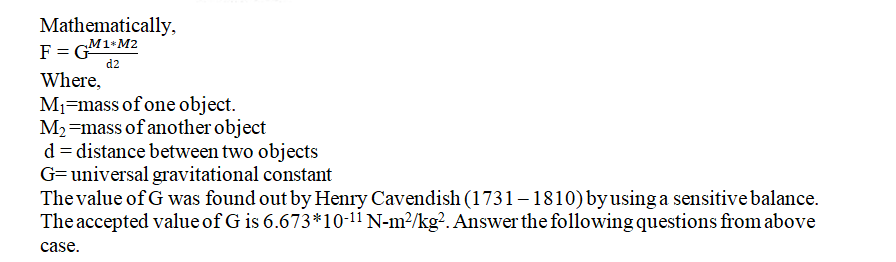
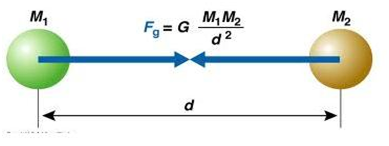
If the distance between two masses is increased by a factor of 5, by what factor would the mass of one of them have to be altered to maintain the same gravitational force? Would this be an increase or decrease in the mass?
Suppose a planet exists whose mass and radius both are half those of the earth. Calculate the acceleration due to gravity on the surface of this planet.


(i)Gravitational force does not depend on
(a) Masses of objects
(b) Separation between objects
(c) Charges on objects
(d) None of these
(ii) Force of gravitation varies with masses of object as
(a) Product of masses
(b) Sum of masses
(c) Difference of masses
(d) None of these
(iii) When mass of one body is doubled then force of gravitation will become
(a) Force will remain same
(b) Force will become double
(c) Force will become halved
(d) None of these
(iv)What is universal gravitational constant? What is its SI unit?
(v) Two objects of masses 10kg and 20kg separated by distance 10m. What is gravitational force between them?
Pressure=thrust/area. SI unit of pressure as N/m2or Pascal.
(i) SI unit of thrust is
(a) m/s
(b) m/s2
(c) Newton(N)
(d) None of these
(ii) We have two different areas A and B. where A>B. Then relation between pressure on A(PA) and pressure on B (PB) is
(a) PA>PB
(b) PB>PA
(c) PA=PA
(d) None of these
(iii)SI unit of pressure is
(a) N/m2
(b) Pascal.
(c) Both a and b
(d) None of these
(iv) The effects of forces of the same magnitude on different areas are different. True or false
(a) True
(b) False
(c) None of these
(v) Define pressure.
Density of a substance
Relative density =
Density of water
Since the relative density is a ratio of similar quantities, it has no unit. Answer the following.
(i) SI unit of density is
(a) kg/m
(b) kg /m2
(c) kg /m3
(d) None of these
(ii) SI unit of relative density is
(a) kg/s
(b) No unit
(c) kg /s3
(d) None of these
(iii) Relative density of water is
(a) 1000
(b) 1
(c) 10
(d) None of these
(iv)Define relative density.
(v) Comment of relative density value of substance which
(1) Sink in water
(2) float on water
(i)The up thrust of the body is equal to the
(a) Mass of liquid
(b) Weight of liquid
(c) Weight of liquid displaced by body
(d) None of these
(ii) If the density of the object is more than the density of the liquid in which it is immersed then
(a) It sinks in liquid
(b) It floats on liquid
(c) It comes out of liquid
(d) None of these
(iii) When anybody immersed in liquid it experience a force called as
(a) Gravitational force
(b) Buoyancy force
(c) Nuclear force
(d) None of these
(iv) State Archimedes’ principle.
(v) Why does cube of plastic released deep down under the water come up to surface of water?
W = m x g
Where, W= weight of object
m= mass of object
g= acceleration due to the gravitational force
As the weight of an object is the force with which it is attracted towards the earth, the SI unit of weight is the same as that of force, that is, Newton (N). The weight is a force acting vertically downwards; it has both magnitude and direction. We have learnt that the value of g is constant at a given place. Therefore at a given place, the weight of an object is directly proportional to the mass, say m, of the object, that is, W αm. It is due to this reason that at a given place, we can use the weight of an object as a measure of its mass. Answer the following questions.
(i) Unit of acceleration due to the gravity (g) is
(a) m/s
(b) m/s2
(c) Newton(N)
(d) None of these
(ii) Direction of weight of any object is
(a) Always towards centre of earth
(b) Always away from centre of earth
(c) Weight don’t have direction
(d) None of these
(iii) Which of the following has same unit
(a) Mass and weight
(b) Weight and force
(c) Velocity and acceleration
(d) None of these
(iv) Whether weight is scalar quantity or vector quantity? Justify your answer.
(v) Differentiate between mass and weight.
Pick question groups from the list above, set marks and difficulty, and export a branded PDF with step-by-step answer keys. First 3 chapters free — no signup.