A metal in which even iron can float is:
- Sodium.
- Magnesium.
- Mercury.
- Manganese.
194 questions across 7 question groups — pick any mix to generate a Science paper with step-by-step answer keys.
M.C.Q. [1 M]
23 Q→02Fill in the blank
13 Q→03true or false
7 Q→04One word answer.
62 Q→05Que-Ans (Each of 2 Mark )
59 Q→06Que-Ans (Each of 3 Mark )
20 Q→07Que-Ans (Each of 4 Mark )
10 Q→One sample from each question group in this chapter. Select any group above to see the full set with answer keys.
A metal in which even iron can float is:
Two objects of different masses falling freely near the surface of moon would:
Consider the following information in respect of four objects A, B, C and D:
| Object | Density (kg/m3) | Volume (m3) | Mass (kg) |
| A | - | 2 | 4000 |
| B | 8000 | 4 | - |
| C | 2000 | - | 1000 |
| D | - | 4 | 2000 |
Which object would float on water?
An object weighs 10N in air. When immersed fully in a liquid, it weighs only 8N. The weight of liquid displaced by the object will be:
The relative densities of four liquids P, Q, R and S are 1.26, 1.0, 0.84 and 13.6 respectively. An object is floated in all these liquids, one by one. In which liquid the object will float with its maximum volume submerged under the liquid?
What is the value of relative density of water?
Why does a block of wood held under water rise to the surface when released?
A mug full of water appears light as long as it is under water in the bucket than when it is outside water. Why?
An iron nail sinks in water but it floats in mercury. Why?
What is the density of water in SI units?
A coin and a piece of paper are dropped simultaneously from the same height. Which of the two will touch the ground first? What will happen if the coin and the piece of paper are dropped in vacuum? Give reasons for your answer.
Explain why, a wide steel belt is provided over the wheels of an army tank.
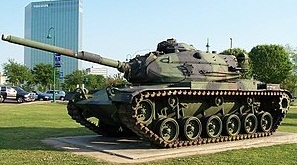
A wide steel belt is provided over the wheels of an army tank.
What is the density of a substance of mass 100g and volume 10cm3?
Why does a sharp knife cut objects more effectively than a blunt knife?
What is the difference between the density and relative density of a substance?
Explain why, when a person stands on a cushion, the depression is much more than when he lies down on it.
When is the pressure on the ground more-when a man is walking or when a man is standing? Explain.
If the relative density of a substance is 7.1, what will be its density in SI units?
If the distance between two masses is increased by a factor of 5, by what factor would the mass of one of them have to be altered to maintain the same gravitational force? Would this be an increase or decrease in the mass?
Universal law of gravitation states that every object exerts a gravitational force of attraction on every other object. If this is true, why don’t we notice such forces? Why don’t the two objects in a room move towards each other due to this force?
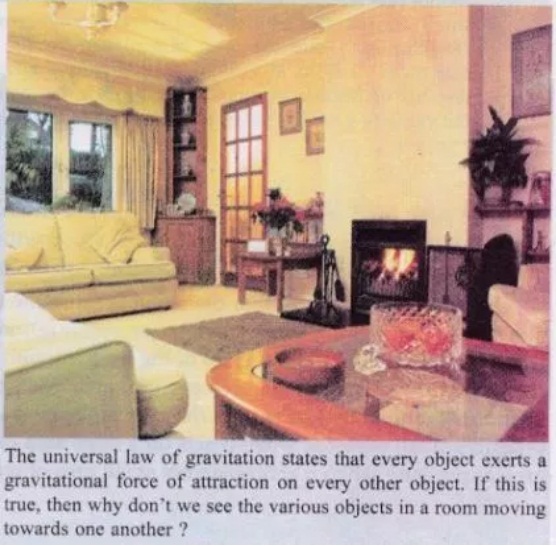
Suppose a planet exists whose mass and radius both are half those of the earth. Calculate the acceleration due to gravity on the surface of this planet.
Pick question groups from the list above, set marks and difficulty, and export a branded PDF with step-by-step answer keys. First 3 chapters free — no signup.