Question types

Matter in Our Surroundings question types

198 questions across 7 question groups — pick any mix to generate a Science paper with step-by-step answer keys.

198
Questions
7
Question groups
5
Question types
Sample Questions

Matter in Our Surroundings questions

One sample from each question group in this chapter. Select any group above to see the full set with answer keys.

Q 1M.C.Q. [1 M]1 Mark
Which of the following statement is incorrect?
  1. The particles of matter are very, very small.
  2. The particles of matter attract one another.
  3. The particles of some of the matter are moving constantly.
  4. The particles of all the matter have spaces between them.
View full solution
Q 2M.C.Q. [1 M]1 Mark
The conversion of a solid into vapours without passing through the liquid state is called:
  1. Vaporization.
  2. Fusion.
  3. Sublimation.
  4. Freezing.
View full solution
Q 4M.C.Q. [1 M]1 Mark
On converting 25°C, 38°C and 66°C to Kelvin scale, the correct sequence of temperatures will be:
  1. 298K, 311K and 339K
  2. 298K, 300K and 338K
  3. 273K, 278K and 543K
  4. 298K, 310K and 338K
View full solution
Q 5M.C.Q. [1 M]1 Mark
Which one of the following set of phenomena would increase on raising the temperature?
  1. Diffusion, evaporation, compression of gases.
  2. Evaporation, compression of gases, solubility.
  3. Evaporation, diffusion, expansion of gases.
  4. Evaporation, solubility, diffusion, compression of gases.
View full solution
At room temperature, the forces of attraction between the particles of solid substances are ____________ than those which exist in the gaseous state.
View full solution
  1. Compare the properties of solids, liquids and gases in tabular form.
  2. Give two reasons for saying that wood is a solid.

During class, the students resemble molecules in a solid (because they are very close to one another)

While going from one classroom to another the students resemble molecules in a liquid (because they are a little more father apart from one another)

View full solution
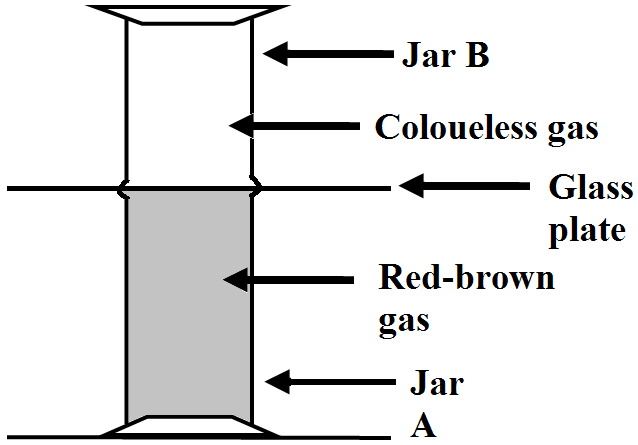
Look at the diagram on the right side. Jar A contains are d-brown gas whereas Jar B contains a colourless gas. The two gas jars are separated by a glass plate placed between them:

  1. What will happen when the glass plate between the two jars is pulled away?
  2. What name is given to the phenomenon which takes place?
  3. Name the brown gas which could be in jar A.
  4. Which is the colorless gas most likely to be present in jar B?
  5. Name one coloured solid and one colourless liquid which can show the same phenomenon.
View full solution
When extremely small particles X derived from the another of a flower were suspended in a liquid Y and observed through a microscope, it was found that the particles X were moving throughout the liquid Y in a very zig zag way. It was also observed that warmer the liquid Y, faster the particles X moved in its surface.
  1. What could particles X be?
  2. What do you think liquid Y is?
  3. What is the zig-zag movement of particles X?
  4. What is causing the zig-zag movement of particles X?
  5. Name the scientist who discovered this phenomenon.
  6. What does this experiment tell us about the nature of liquid Y?
View full solution
When a beam of sunlight enters a room through a window, we can see tiny particles X suspended in a gas (or rather a mixture of gases) Y which are moving rapidly in a very haphazard manner.
  1. What could particles X be?
  2. Name the gas (or mixture of gases) Y.
  3. What is the phenomenon exhibited by particles X known as?
  4. What is causing the movement of particles X?
  5. What conclusion does the existence of this phenomenon give us about the nature of matter?
View full solution

Generate a Matter in Our Surroundings paper free

Pick question groups from the list above, set marks and difficulty, and export a branded PDF with step-by-step answer keys. First 3 chapters free — no signup.

Download App