Question 14 Marks
The graph given alongside shows how the speed of a car changes with time:
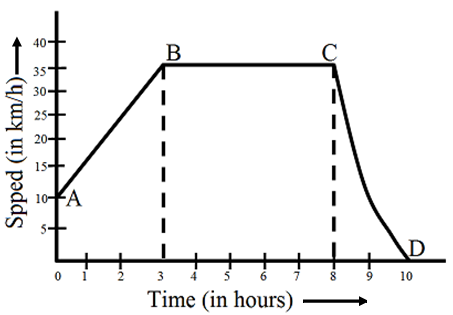
- What is the initial speed of the car?
- What is the maximum speed attained by the car?
- Which part of the graph shows zero acceleration
- Which part of the graph shows varying retardation?
- Find the distance travelled in first 8 hours.
Answer
View full question & answer→- Initial speed of the car is 10 km/h
- Maximum speed attained by the car is 35km/h
- BC represents zero acceleration.
- CD represents varying retardation.
- Distance travelled is given by the area enclosed within the curve. So,
Distance travelled = Area or trapezium + Area of rectangle
So distance travelled,
$= \Big(\frac{1}{2}\Big)(8+5)(25) + (8)(10)$
$= 242.5\text{km}$
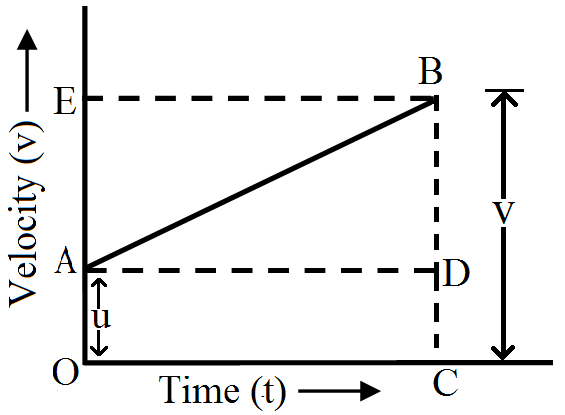
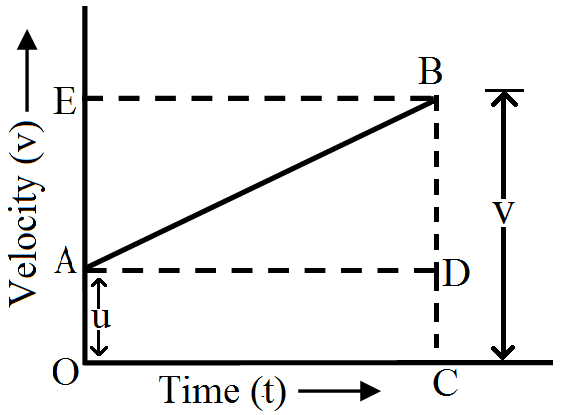
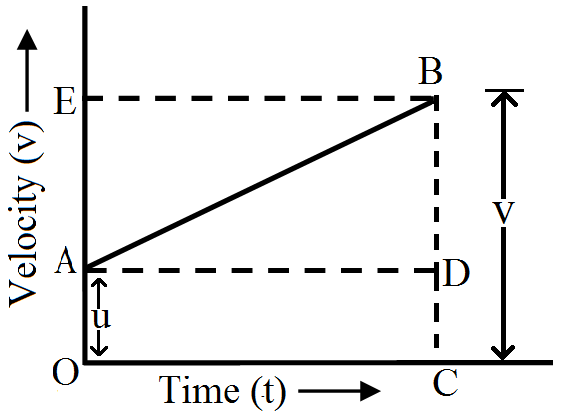 Suppose the body travels a distance s in time t. In the figure, the distance travelled by the body is given by the area of the space between the velocity-time graph AB and the time axis OC, which is equal to the area of the figure OABC. Thus: Distance travelled = Area of figure OABC = Area of rectangle OABC + area of triangle ABD Now, we will find out the area of rectangle OABC and area of triangle ABD.