Questions · Page 1 of 2

M.C.Q. [1 M]

🎯

Test yourself on this topic

50 questions · timed · auto-graded

MCQ 11 Mark
Pollution of water is caused by:
  • A
    Industrial effluents.
  • B
    Sewage.
  • C
    Farm runoff.
  • All of these.
Answer
Correct option: D.
All of these.
Waste from industries into water bodies pollutes the water bodies as majority of the waste is non$-$biodegradable. Sewage waste which is mostly from houses is also directed into water bodies. Runoff water from farms carries along with it chemicals of fertilizers and pesticides thus again polluting the water bodies.
View full question & answer
Question 21 Mark
What is nitrogen fixation? Describe this phenomenon in context with $N_2$ cycle.
Answer
The conversion of atmospheric nitrogen into ammonia $NH_3$ is known as nitrogen fixation. Bacteria that perform nitrogen fixation are either free living or they may form symbiotic associations with other organisms.
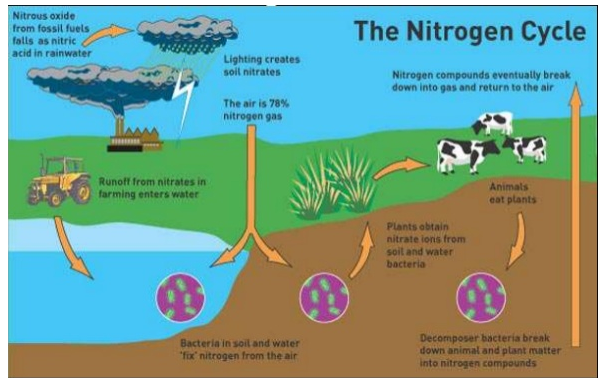
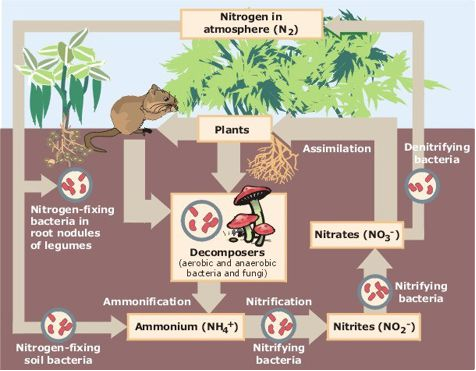
NITROGEN CYCLE: It is a process by which nitrogen is converted into various chemical forms and is made available to living organisms. There are various steps in a nitrogen cycle. Nitrogen fixation takes place by the action of microbes, inert nitrogen breaks down in the air and combines with oxygen to form nitrous oxide. Nitrifying bacterias in the soil take up this atmospheric nitrogen and make it available for plants. Plants get this nitrogen. Later when they decay, the nitrogen is returned back into the environment. In the soil there are some denitrifying bacterias too, they break down nitrate and release nitrogen into the atmosphere thus they end the nitrogen cycle.
View full question & answer
MCQ 31 Mark
Wind breaks are:
  • A
    Raising edges of fields.
  • B
    Growing grasses altemating with crops.
  • C
    Mud walls.
  • Rows of trees and shrubs.
Answer
Correct option: D.
Rows of trees and shrubs.
Wind breaks are rows of trees and shrubs on land to prevent erosion of soil by high speed wind.
View full question & answer
MCQ 41 Mark
Percentage of total water found as fresh water is:
  • A
    $46\%$
  • B
    $32\%$
  • C
    $16\%$
  • $2.5\%$
Answer
Correct option: D.
$2.5\%$
Only $2.5$ percent of total water is found as fresh water which occurs in lakes and rivers.
View full question & answer
MCQ 51 Mark
Rajasthan and Gujarat fall under:
  • A
    Semiarid zone.
  • Arid zone.
  • C
    Intermediate zone.
  • D
    Wet zone.
Answer
Correct option: B.
Arid zone.
Arid zone is characterized by areas of low rainfall and desert. Rajasthan and Gujarat fall in this zone.
View full question & answer
MCQ 61 Mark
Name the gas which plays major role in global warming:
  • A
    Carbon monoxide.
  • B
    Nitrous oxide.
  • Carbon dioxide.
  • D
    Sulphur dioxide.
Answer
Correct option: C.
Carbon dioxide.
Carbon dioxide traps the infrared rays and prevent heat from escaping the earth’s atmosphere. This causes the temperature of earth to rise which is known as global warming.
View full question & answer
MCQ 71 Mark
Cadmium pollution of water body produces a disease of humans called:
  • A
    Plumbasim.
  • B
    Black foot disease.
  • C
    Methaemoglobinaemia.
  • Itai$-$itai.
Answer
Correct option: D.
Itai$-$itai.
Cadmium poisoning in drinking water of Japan from a river basin resulted in itai$-$itai disease in people of Japan. The symptoms included kidney disorders, anemia, pain and bone fractures.
View full question & answer
Question 81 Mark
Set up an experiment to demonstrate the effect of low pressure and particulate nuclei over water vapours.
Answer
  1. Take an empty plastic bottle.
  2. Pour 5-10ml water into it and close the bottle tightly with a cap.
  3. Shake the bottle well and then place it in the sun for 10 minutes.
  4. Now, open the cap of the bottle and allow some smoke from the lighted incense stick to enter the bottle.
  5. Quickly close the bottle tightly with the cap.
  6. Press the bottle hard between your hands as much as possible.
  7. After few seconds release the bottle. Press the bottle again as hard as you can.
This simple experiment replicates, on a very small scale, the happenings when air with a very high content of water vapour goes from a region of high pressure to a region of low pressure. When bottle containing water is kept in the sun, the water evaporates and air inside the bottle gets saturated with water vapour. When the bottle is pressed between your hands, the pressure inside becomes high and air inside the bottle moves in a region of low pressure. It expands and cools. The smoke particles act as 'nuclei' on which water vapours condense in the form of tiny droplets. When you release the pressure, the air inside the bottle becomes foggy. When bottle is again pressed, the fog will disappear. It is so because due to high pressure condensed water vapours will fall down and collect as water at the bottom of the bottle. When the experiment is repeated without smoke inside the bottle, one will not observe foggy air inside the bottle as smoke particles are absent and nothing is available in air to act as ‘nucleus’ for water vapours to condense as tiny droplets.
View full question & answer
MCQ 91 Mark
Photochemical smog is formed by:
  • $NO_2$
  • B
    $SO_2$
  • C
    $CO_2$
  • D
    $CO$
Answer
Correct option: A.
$NO_2$
Photochemical smog is formed in atmosphere when ozidized volatile organic compounds react with nitrogen oxide.
View full question & answer
MCQ 101 Mark
Which of the following contribute to green house effect?
  • A
    Methane $\ce{(CH_4)}.$
  • B
    Carbon dioxide $\ce{(CO_2)}.$
  • C
    Chlorofluorocarbons $\ce{(CFCs)}.$
  • All of these.
Answer
Correct option: D.
All of these.
Methane, carbon dioxide and chlorofluorocarbons, all of them are greenhouse gases that trap the infrared rays and thus trap the heat, not allowing it to escape the earth’s surface, hence contributing to greenhouse effect.
View full question & answer
MCQ 111 Mark
Organisms such as lichens are very sensitive to the level of $.........$  in the atmosphere.
  • A
    Carbon dioxide.
  • Sulphur dioxide.
  • C
    Carbon monoxide.
  • D
    Methane.
Answer
Correct option: B.
Sulphur dioxide.
Lichens are sensitive to Sulphur dioxide because they have efficient absorption systems due to which they rapidly accumulate Sulphur from high levels of Sulphur dioxide in air.
View full question & answer
MCQ 121 Mark
Which one is inexhaustible resource?
  • A
    Fossil fuels.
  • B
    Minerals.
  • C
    Soil.
  • Solar radiation.
Answer
Correct option: D.
Solar radiation.
Solar energy is a renewable form of energy that cannot be exhausted ever. Radiations from sun are solar radiation so they are too inexhaustible and sustainable form of energy. Fossil fuels, minerals and soil are non$-$renewable sources. Once lost, they cannot be replenished.
View full question & answer
MCQ 131 Mark
The ultimate source of energy in an ecosystem is:
  • Sunlight.
  • B
    Glucose.
  • C
    Protein.
  • D
    Green plants.
Answer
Correct option: A.
Sunlight.
Green plants are producers in an ecosystem i.e. they produce food. The food obtained from plants is utilized by all the other components of an ecosystem. Hence, Green plants are ultimate source of energy.
View full question & answer
MCQ 141 Mark
Toxic chemical released by paper industry is:
  • A
    Cadmium.
  • Mercury.
  • C
    Lead.
  • D
    Nickel.
Answer
Correct option: B.
Mercury.
Paper industry uses fuels and during of fuels like coal releases mercury that is a toxic chemical.
View full question & answer
Question 151 Mark
Describe nitrogen cycle.
Answer
The continuous process by which nitrogen is exchanged between organisms and the environment is called nitrogen cycle. Nitrogen is an essential nutrient, needed to make amino acids and other important organic compounds, but most organisms cannot use free nitrogen, which is abundant as a gas in the atmosphere.
Nitrogen cycle involves the following steps:
  1. Nitrogen fixation: This process involves the conversion of atmospheric nitrogen into nitrates, which are soluble in water. This is done by various nitrogen fixing bacteria.
Example: Rhizobium, blue green algae and bacterium Azotobacter.
  1. Ammonification: It is the process of decomposing complex, dead organic matter into ammonia. This is done by microorganisms living in the soil.
  2. Nitrification: It is the process of conversion of ammonia into nitrites and then into nitrates. This is done by nitrifying bacteria.
Example: Nitrosomonas and Nitrobacter.
  1. Denitrification: It is the process of reducing nitrates present in the soil to release nitrogen back into the atmosphere.
Example: Pseudomonas.
The decomposers help in decomposing the dead bodies of plants and animals, and hence act as cleansing agents of environment. The decomposers also help in putting back the various elements of which the dead plants and animals were made, back into the soil, air and water for reuse by the producers like crop$-$plants, e.g. the decomposers like purifying bacteria and fungi decompose the dead plants and animal bodies into ammonia. This ammonia is converted into nitrates by nitrifying bacteria present in soil. These nitrates act as fertilizer in the soil and are again absorbed by the plants for their growth. Thus, the nitrates act as fertilizer in the biosphere so that the process of life may go on and on like an unending chain.
View full question & answer
MCQ 161 Mark
Biosphere occurs:
  • A
    In lithosphere.
  • B
    In lithosphere and hydrosphere.
  • At place of interaction of lithosphere, hydrosphere and atmosphere.
  • D
    In atmosphere and hydrosphere.
Answer
Correct option: C.
At place of interaction of lithosphere, hydrosphere and atmosphere.
Biosphere constitutes all the living beings and their relationships along with their interaction with lithosphere, hydrosphere and atmosphere.
View full question & answer
Question 171 Mark
Explain ozone layer, its depletion and effects of ozone depletion.
Answer
The ozone layer is a deep layer in the stratosphere, encircling the Earth, which has large amounts of ozone in it. This layer shields the entire Earth from much of the harmful ultraviolet radiation that comes from the sun. Ozone is a special form of oxygen, made up of three oxygen atoms rather than the usual two oxygen atoms.
It is formed when some type of radiation or electrical discharge separates the two atoms in an oxygen molecule $(O_2)$, which can then individually recombine with other oxygen molecules to form ozone $(O_3).$
Reduction in the concentration of ozone layer is called ozone depletion. Ozone depletion is caused by certain chemicals called ozone depleting substances. They include chlorofluoro carbons, methyl bromide, nitrogen oxides and chlorine.
Effects of ozone depletion: Depleting ozone layer allows more ultraviolet $\text{(UV)}$ radiations to pass through it, which reach the earth's surface. These $\text{UV}$ rays cause various harmful effects on human beings, animals, plants and environment such as:
  1. Skin cancer.
  2. Damage of eyes.
  3. Damage of immune system.
  4. Decreased crop yields.
View full question & answer
MCQ 181 Mark
Ozone hole was discovered in:
  • A
    $1992$
  • $1985$
  • C
    $1995$
  • D
    $1998$
Answer
Correct option: B.
$1985$
Ozone hole was discovered in $1985$ over Antarctic by Joe Farman, Brian Gardiner and Jonathan Shanklin.
View full question & answer
Question 191 Mark
What is weathering? Elucidate in the various types of weathering.
Answer
Break down of bigger rocks into smaller mineral particles is called weathering.
It is of three types:
  1. Physical weathering: Various climatic factors such as temperature, wind, rain water, ice, snow, glaciers and running water contribute to physical weathering. Water and high temperature cause corrosive humidity and bring about unequal expansion and contraction of rocks, facilitating their break down.
  2. Chemical weathering: It involves a variety of chemical processes, such as hydrolysis, hydration, oxidation and reduction. The breakdown of complex compounds by the carbonic acids present in water and acidic substances derived from the decomposition of organic matter in soil, are examples of chemical weathering.
  3. Biological weathering: Is done by living organisms such as lichens and bryophytes. They create small crevices which deepen to form cracks in the rocks. Cracks gradually widen and cause slow fragmentation and eventually pulverisation of rocks.
View full question & answer
MCQ 201 Mark
Air is:
  • A
    Exhaustible resource.
  • Inexhaustible resource.
  • C
    Perishable resource.
  • D
    Both $(b)$ and $(c).$
Answer
Correct option: B.
Inexhaustible resource.
Air is inexhaustible resource. It is present in an abundant amount and will not ever run out or deplete.
View full question & answer
MCQ 211 Mark
In a natural ecosystem, decomposers include:
  • Bacteria and fungi.
  • B
    Parasitic algae.
  • C
    Macroscopic animals.
  • D
    All the above.
Answer
Correct option: A.
Bacteria and fungi.
Bacteria and fungi are microorganisms that decompose the dead and decaying matter.
View full question & answer
MCQ 221 Mark
Who is popularly known as ‘water man’?
  • A
    Gajendra Singh.
  • Rajendra Singh.
  • C
    Louis Pasteur.
  • D
    Tansley.
Answer
Correct option: B.
Rajendra Singh.
Rajendra Singh is popularly known as water man of India. He is a water conservationist from Alwar, Rajasthan.
View full question & answer
MCQ 231 Mark
All the elements of life support system are:
  • A
    Inter$-$related.
  • B
    Inter$-$dependent.
  • C
    Interconnected.
  • All the above.
Answer
Correct option: D.
All the above.
All the elements of life support system are inter$-$related, inter$-$dependent, inter$-$connected. Food chain and food web are clear examples of this.
View full question & answer
MCQ 241 Mark
Greenhouse effect is caused by:
  • A
    Green plants.
  • Infrared rays.
  • C
    $UV-$rays.
  • D
    $X-$rays.
Answer
Correct option: B.
Infrared rays.
Greenhouse effect is caused by infrared rays. Gases like carbon dioxide absorb infrared rays, thereby increasing the temperature of earth and hence causing greenhouse effect.
View full question & answer
MCQ 251 Mark
To which height is ozonosphere present over the equator:
  • A
    $11–16\ km$
  • $23–25\ km$
  • C
    $16–20\ km$
  • D
    $10–12\ km$
Answer
Correct option: B.
$23–25\ km$
Ozone layer or ozonosphere occurs in the stratosphere. It is generally lowest at the equator and highest in polar regions. It is present to a height of $23-25\ kms$ over the equator.
View full question & answer
MCQ 261 Mark
Eutrophication results in reduction of:
  • A
    Dissolved hydrogen.
  • Dissolved oxygen.
  • C
    Mineral salts.
  • D
    Dissolved nitrate.
Answer
Correct option: B.
Dissolved oxygen.
Eutrophication leads to algal blooms in water bodies thus blocking the penetration of sunlight in the water bodies. Hence the plants do not get sufficient sunlight to carry out photosynthesis hence oxygen is not produced.
View full question & answer
MCQ 271 Mark
Ecosystem comprises both abiotic and biotic components. Biotic component of an ecosystem consists of:
  • A
    Producers.
  • B
    Consumers.
  • C
    Decomposers.
  • All of the above.
Answer
Correct option: D.
All of the above.
Biotic components refer to all the living components. Prodcers, consumers and decomposer, all are living components in an ecosystem.
View full question & answer
MCQ 281 Mark
Soil that is best suited for plant growth is:
  • A
    Clayey.
  • Loam.
  • C
    Sandy.
  • D
    Gravel.
Answer
Correct option: B.
Loam.
Loamy soil contains a small amount of organic material hence it is best suited for plant growth.
View full question & answer
MCQ 291 Mark
Green house effect is caused by:
  • A
    Green plants.
  • Infrared rays.
  • C
    $UV-$rays.
  • D
    $X-$rays.
Answer
Correct option: B.
Infrared rays.
Greenhouse gases trap infrared rays and stop them from escaping the earth’s surface thus causing global warming.
View full question & answer
MCQ 301 Mark
Name the gas which plays a major role in global warming:
  • A
    Carbon monoxide.
  • B
    Nitrous oxide.
  • Carbon dioxide.
  • D
    Sulphur dioxide.
Answer
Correct option: C.
Carbon dioxide.
Carbon dioxide traps infrared rays and prevent them from escaping the earth’s surface thereby increasing the temperature of earth and resulting in global warming.
View full question & answer
MCQ 311 Mark
Nif genes occur in:
  • Rhizobium.
  • B
    Streptococcus.
  • C
    Penicillium.
  • D
    Aspergillus.
Answer
Correct option: A.
Rhizobium.
Rhizobium is a gram $-$ve bacteria that fixes nitrogen. Nif gene occurs in Rhizobium.
View full question & answer
MCQ 321 Mark
$\text{SPM}$ includes:
  • A
    Flyash.
  • B
    Dust.
  • C
    Soot and smoke.
  • All the above.
Answer
Correct option: D.
All the above.
Suspended Particulate Matter $(\text{SPM})$ are finely divided matter particles that cause aur pollution. They may be dispersed into air by combustion or industrial processes. Dust, soot and smoke, flash are all Suspended Particulate Matter.
View full question & answer
MCQ 331 Mark
Nitromonas bacteria convert:
  • A
    Nitrite to nitrate.
  • B
    Ammonia into nitrate.
  • Ammonia into nitrite.
  • D
    Nitrite into ammonia.
Answer
Correct option: C.
Ammonia into nitrite.
Nitrosomonas are rod shaped bacteria that oxidize ammonia into nitrite. Nitrosomonas are useful in bioremediation.
View full question & answer
Question 341 Mark
Why water is necessary for living organisms? Explain.
Answer
Living organisms need water because it plays a vital role in the reactions taking place within organism’s cells and body. Water acts as a universal solvent, providing a medium for the chemical reactions to occur. Substances are also transported from one part of body to the other in the dissolved state. Therefore, it is necessary for the organisms to maintain a distinct level of water within their bodies in order to stay alive. Terrestrial life forms require fresh water because their bodies cannot tolerate or get rid of the high amounts of the dissolved salts in saline water. So, water sources need to be easily accessible to animals and plants to survive on land. Thus, availability of water decides not only the number of individuals of each species that are able to survive in a particular area, but it also decides the diversity of life there.
View full question & answer
MCQ 351 Mark
Minamata human disease is caused by pollution of water by:
  • A
    Cadmium.
  • B
    Lead.
  • Mercury.
  • D
    Arsenic.
Answer
Correct option: C.
Mercury.
Mercury contaminated water in Japan lead to the outspread of Minamata disease when people consumed this water polluted with high levels of mercury.
View full question & answer
MCQ 361 Mark
Solar radiation heat$-$up:
  • Land faster than the water bodies.
  • B
    Land slower than the water bodies.
  • C
    Equally both land and water bodies.
  • D
    Neither land nor water bodies.
Answer
Correct option: A.
Land faster than the water bodies.
Land absorbs more heat because they are darker, hence heat up faster than water bodies by absorbing solar radiations. Water bodies on the other hand reflect most of the solar radiation that fall on it thus not getting heated faster.
View full question & answer
MCQ 371 Mark
Green plants in an ecosystem are called:
  • Producers.
  • B
    Consumers.
  • C
    Decomposers.
  • D
    None of the above.
Answer
Correct option: A.
Producers.
Green plants are the producers as they produce their own food by photosynthesis.
View full question & answer
Question 381 Mark
Give various sources and harmful effects of soil pollution.
Answer
Soil pollution is caused by solid wastes and chemicals. The slag heaps from mines spoil the beauty of sites of mines. Pulp and paper mills, sugar mills, oil refineries, power plants, chemicals fertilizer manufacturing units, iron and steel plants, plastic and rubber producing complexes are some major contributions to soil pollution. Most industrial furnaces and thermal power stations produce fly ash, which is a grey, powdery residue of unburnt material, and causes pollution. This fly ash hampers the growth of crop plants and also decreases crops of orchards. Domestic waste also adds a large amount of solid wastes. Modern farming practices involve the use of large amounts of fertilizers and pesticides. Use of these substances over long period of time can destroy the soil structure by killing the soil microorganisms that recycle nutrients in the soil. It also kills the earthworms which are helpful in making the rich humus. Fertile soils can quickly become barren if sustainable practices are not followed.
View full question & answer
MCQ 391 Mark
Greenhouse is related to:
  • Global warming.
  • B
    Terrace gardening.
  • C
    Kitchen garden.
  • D
    Increase growth of algae.
Answer
Correct option: A.
Global warming.
Greenhouse is related to global warming. Greenhouse gases absorb infrared radiations and stop it from escaping the earth’s surface which results in increase in temperature of earth, thus causing global warming.
View full question & answer
MCQ 401 Mark
Pollution is not caused by:
  • A
    Thermal power plants.
  • B
    Automobiles.
  • C
    Radioactive power plants.
  • Hydroelectric power plants.
Answer
Correct option: D.
Hydroelectric power plants.
Water flowing through through dams spin the turbine plates to generate electricity. There is no air or water pollution caused by hydroelectric power plant.
View full question & answer
MCQ 411 Mark
In nitrogen cycle, which bacteria are responsible for nitrification:
  • A
    Clostridium.
  • B
    Rhizobium.
  • C
    Nitrosomonas.
  • Nitrosomonas and Nitrobacter.
Answer
Correct option: D.
Nitrosomonas and Nitrobacter.
Nitrosomonas and Nitrobacter are bacteria that carry out nitrification.
Nitrosomonas oxidize ammonia into nitrite. Nitrobacter break down nitrite into nitrate.
View full question & answer
MCQ 421 Mark
Sun causes weathering of rocks through:
  • A
    Mechanical force.
  • Physical phenomena.
  • C
    Chemical changes.
  • D
    Biological changes.
Answer
Correct option: B.
Physical phenomena.
Sun’s energy heats up rocks to a high temperature which causes them to expand. When temperature falls, these rock contract. This continuous expansion and contraction causes the rock layer to wear off. And hence results in weathering of rocks.
View full question & answer
MCQ 431 Mark
Soil is the component of:
  • A
    Atmosphere.
  • B
    Hydrosphere.
  • Lithosphere.
  • D
    None of the above.
Answer
Correct option: C.
Lithosphere.
Lithosphere is the upper part of the earth consisting f crust and solid part of mantle. It contains rocks, minerals and soil.
View full question & answer
MCQ 441 Mark
Causes of water pollution are:
  • A
    Inorganic.
  • B
    Organic.
  • C
    Biological.
  • All of these.
Answer
Correct option: D.
All of these.
Water pollution occurs from organic pollutants like detergents, insecticides. Inorganic water pollutants include heavy metals, fertilizers, chemical wastes from industries. Bacteria, viruses and fungi that contaminate water are biological causes.
View full question & answer
MCQ 451 Mark
Forest destruction results in:
  • A
    Loss of wild life.
  • B
    Floods and drought.
  • C
    Soil erosion.
  • All of these.
Answer
Correct option: D.
All of these.
Forest destruction results in all of the above mentioned effects.
  • Animals lose their habitat when forests are cut down
  • The soil losens when trees are cut down as roots of the trees no longer exist to hold the soil which hence results in floods and soile erosion by wind and water.
View full question & answer
MCQ 461 Mark
Major source of formation of soil is:
  • Rocks.
  • B
    Snow covered mountains.
  • C
    Rivers beds.
  • D
    Volcanoes.
Answer
Correct option: A.
Rocks.
Soil is a thin layer of sediments and fine particles covering the earth’s surface. It is mainly formed from weathering of rocks by various processes.
View full question & answer
Question 471 Mark
Give an account of various sources and harmful effects of water pollution.
Answer
Sources of water pollution:
  1. Sewage: Organic wastes are contributed as domestic and commercial sewage by food processing plants, dairy farms, piggeries, poultry farms, slaughter houses, breweries, tanneries, etc. Animal excreta is discharged into fields or dumped into pits reaches water bodies through run off and leaching, particularly during the rainy season.
  2. Industrial wastes: Effluents of mills and industries such as paper mills, petroleum refineries, etc., contain large quantities of harmful chemicals including acids, alkalis and heavy metals (e.g., mercury salts from paper industries) that are discharged into water bodies (rivers and lakes).
  3. Synthetic soaps and detergents: Water containing soaps and detergents is discharged from houses and certain factories.
  4. Fertilizers and pesticides: Fertilizers and pesticides are being used excessively in the fields to increase crop production. These are washed by rainwater into water bodies and pollute them.
  5. Petroleum oil: Drilling and shipping operations are common in the oceans. Leakage of petroleum oil during such operations or due to accidents results in water pollution.
  6. Solid particles: Rain erodes soil and carries silt to water. Tiny suspended particles of clay and dust also settle in water from air. These soil particles cause turbidity.
  7. Thermal pollution: Discharge of hot water from industries and thermal plants into water body changes the normal temperature of the water. The content of oxygen decreases. Reduced oxygen content kills aquatic animals and reduces the rate of decomposition of organic matter which, therefore, accumulates.
Harmful effects of Water pollution:
  1. Human diseases: Diseases such as typhoid, cholera, dysentery, jaundice and hepatitis are caused due to water pollution.
  2. Disturbance in ecological balance: All types of water pollutants affect the life forms living in the water. These pollutants can encourage the growth of some life forms and harm some other life forms hence affecting the balance between various organisms.
  3. Removal of desirable substances from water bodies: With increase in the amount of organic wastes in water, bacteria multiply rapidly and use up the available oxygen. Lack of oxygen kills the fish and other animals.
View full question & answer
Question 481 Mark
Briefly explain main layers of the atmosphere.
Answer
Atmosphere is divided into five distinct layers: Troposphere, stratosphere, mesosphere, thermosphere and exosphere.
  1. Troposphere is the lowest region of atmosphere which contains air and is subject of differential heating. It extends from the surface of the earth upto 8-20kms. Many important climatic events such as cloud formation, lightning, thundering etc all takes place in the troposphere.
  2. The Stratosphere extends from the top of the troposphere up to around 31 miles (50km) above the Earth's surface. In this region the temperature increases with height. Heat is produced due to the formation of ozone.
  3. The mesosphere extends from the top of the stratosphere to about 53 miles (85km) above the earth. The gases, including the oxygen molecules, continue to become thinner and thinner with height.
  4. Above the mesosphere the thermosphere extends up to near 375 miles (600km) above the earth. This layer is known as the upper atmosphere. As such, incoming high energy ultraviolet and x-ray radiation from the sun, absorbed by the molecules in this layer, causes a large temperature increase.
  5. Exosphere exists above the thermosphere.
View full question & answer
MCQ 501 Mark
Which of the following soil is transported by air?
  • A
    Alluvial.
  • Aeolian.
  • C
    Elluvial.
  • D
    Glacial.
Answer
Correct option: B.
Aeolian.
Aeolian soil are wind deposited sand and silt sized particles. They have no coarse fragments.
View full question & answer
M.C.Q. [1 M] - Science STD 9 Questions - Vidyadip