MCQ 511 Mark
Below the skin, the fat is in the form of ____________?
- ALipoproteins
- BAdipose tissue
- CMucous layer
- DLymphoid tissue
Answer
View full question & answer→- Adipose tissue
Explanation:
Dense connective tissue is of two types- tenonds and ligaments.
Explanation:
Conduction of water is a function of the xylem tissues and not of epidermis.
Explanation:
Dermatogen is also known as protoderm. It further divides to form the three dermal layers - epidermis, endodermis and hypodermis.These form the protective layers of the plant.
Explanation:
Longitudinal growth in stem takes place at the top. So, portion below the apical meristem will remain at a constant level even after growth.
Explanation:
Parenchyma which contains chlorophyll and takes part in photosynthesis, is called chlorenchyma.
Explanation:
The cell wall of meristematic cell is thin and made up of cellulose.
Explanation:
The grit of pear is formed of stone cells also known as sclereids.
Explanation:
Each stomata is surrounded by a pair of guard cells. Guard cells regulate the opening and closing of stomata.
Explanation:
Trabeculae refers to the projections from the cell wall that extends across the cavity of certain plants.
The endodermal cells elongate to form trabeculae and they help in connecting the two tissues.
Explanation:
Pholem is mainly responsible for the conduction or transport of organic food prepared by the plant.
Explanation:
Companion cells are present along the sieve tube are connected to them via plasmodesmata. These cells are metabolically active and sieve tube elements are dependent on these cells they do not lose nucleus at maturity. RBC vessels and sieve tube cells lose their nucleus at maturity.
Explanation:
Apical and intercalary meristems are permanent tissues
Parenchyma serves as a packing tissue in plants therefore they do not have intercellular spaces. Collenchymatous tissues are mechanical tissues in the plants and are characterised by deposition of cellulose at the corners of the cell, which leads to localised thickenings of the cell wall. Apical and intercalary meristem bring primary growth (increase in height) and secondary growth (increase in diameter) respectively and are classified under meristematic tissues. Meristematic tissue are dividing units of the plants and contain dense cytoplasm and large nucleus with few or no vacuoles at all.
Explanation:
The term tissue was given by Bichat.
Explanation:
Ligaments join one bone to another bone and hence ligament break can result in dislocation.
Explanation:
Collenchyma is generally absent in monocot stems and leaves.
Explanation:
Are groups of similar cells with the same functions and origin.
Organelles are small bodies within a cell with specific functions.
Organs are made of a group of tissues that function together.
Organ systems are made up of a group of organs that functions together.
Explanation:
Xylem consists of tracheids, vessels, xylem parenchyma and xylem fibres.
Explanation:
Generally, some group of cells have same function and structure and also are derived from same origin.These group of cells are called tissue.
Explanation:
Kidney is composed of different kinds of epithelial tissues.
Explanation:
Each neuron has a single long part, called th axon and many short, branched parts called dendrites.
Explanation:
The gymnosperms are characterised by the presence of tracheids as their major conducting tissue. These are elongated dead cells with hard lignified walls. They conduct water and do not have open ends like the vessels.
Explanation:
As epidermis is formed of cutin, suberin gives rise to cork cells which makes them impervious to gas and water. No other given option is formed from suberin.
Explanation:
Adipose tissue stores fat and since fat is a bad conductor it acts as an insulator and prevents loss of heat from the body. Therefore, a fatty person is less affected by cold.
Explanation:
Intercalary meriste is commonly present at the base of the leaves or internodes (on either side of the node). The intercalary meristem increses the internode length, hence the stem elongates.
Explanation:
Mast cells are found in areolar tissue, basophils are found in blood and osteocytes are found in bone.
Explanation:
Monocytes are largest blood cells. These are white blood cells.
Explanation:
Tendons are fibrous connective tissues and hence option 'c' is incorrect.
Explanation:
Matrix of cartilage is made up of chondrin.
Explanation:
Contractile proteins are found in the muscles. Contractile proteins of muscle are actin and myosin, the main components of the thin and thick filaments, respectively. The cytoplasm of cells is a colloidal network of contractile proteins. Actin filaments are the major components of this network.
Explanation:
Xylum parenchyma cells are living. The parenchyma stores food and helps in the sideway conduction of water.
Explanation:
Tendons and ligaments are dense connective tissue.
Explanation:
The nature of matrix differs according to their function for, e.g. Cartilage has calcium salts as it provides support to bones whereas muscles passes contractile proteins for their function of movement.
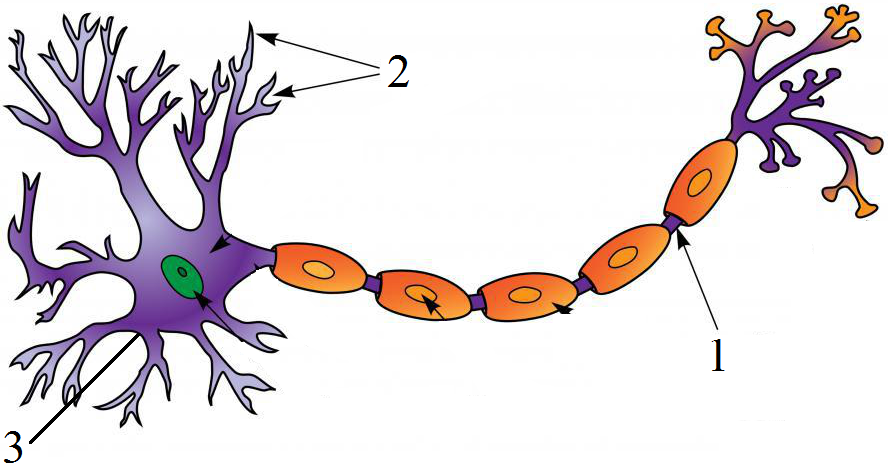
Explanation:
1 represents axon here through which impulse travels away from the cell body and toward the axon terminals.
Explanation:
Mast cells are scattered throughout the connective tissues of the body and they mediate inflammatory responses such as hypersensitivity and allergic reactions.
Mast cells secrete a number of different chemical mediators including heparin, histamine, serotonin, interleukins, proteoglycan (like heparin) and various enzymes in coarse granules found throughout the cytoplasm of cells.
Explanation:
Sieve tubes have the perforated walls instead of the companion cells. Companion cells remain associated with the sieve tubes.
Explanation:
The meristematic cells are full of cytoplasm and have a big nucleus.