Questions · Page 1 of 3

One word answer.

🎯

Test yourself on this topic

50 questions · timed · auto-graded

Question 11 Mark
Name the tissue responsible for movement in our body.
Answer
Themuscular tissue is responsible for movement in our body.
View full question & answer
Question 31 Mark
Name types of simple tissues.
Answer
The types of simple tissues are parenchyma, collenchyma, sclerenchyma and aerenchyma.
View full question & answer
Question 41 Mark
What is a tissue?
Answer
Tissue is a group of cells that are similar in structure and are organised together to perform a specific task.
View full question & answer
Question 51 Mark
What are the functions of the stomata?
Answer
The outermost layer of the cell is called epidermis and is very porous. These pores are called stomata. These stomata help in transpiration and exchange of gases.
View full question & answer
Question 61 Mark
Name the regions in which parenchyma tissue is present.
Answer
Leaves, fruits, and flowers are the regions where the parenchyma tissue is present.
View full question & answer
Question 81 Mark
Name the following.
Connective tissue with a fluid matrix.
Answer
Connective tissue with a fluid matrix → Blood.
View full question & answer
Question 101 Mark
Name the following.
Tissue that transports food in plants.
Answer
Tissue that transports food in plants → Phloem.
View full question & answer
Question 111 Mark
Name the following.
Tissue that connects muscle to bone in humans.
Answer
Tissue that connects muscle to bone in humans → Dense regular connective tissue (tendons).
View full question & answer
Question 121 Mark
Name the following.
Tissue that forms the inner lining of our mouth.
Answer
That forms the inner lining of our mouth → Epithelial tissue.
View full question & answer
Question 131 Mark
Define the term “tissue”.
Answer
Tissue is a group of cells that are similar in structure and are organized together to perform a specific task.
View full question & answer
Question 141 Mark
What are the functions of areolar tissue?
Answer
Functions of areolar tissue:
  1. It helps in supporting internal organs.
  2. It helps in repairing the tissues of the skin and muscles.
View full question & answer
Question 151 Mark
Which one is called pavement epithelium?
Answer
Squamous epithelium is also called pavement epithelium as it is made up of single thin layer of flattened cells.
View full question & answer
Question 161 Mark
What is s synapse? Explain.
Answer
Synapse is the junction between the terminal part of one axon and the dendrite of the adjacent neuron. Synapses helps in the transmission of impulses from one neuron to another.
View full question & answer
Question 171 Mark
What is common name of: (a) Xylem (b) Phloem?
Answer
  1. The common name of xylem is wood.
  2. The common name of phloem is bast.
View full question & answer
Question 191 Mark
Which tissue protects entire animal body?
Answer
Epithelial tissue is the simplest animal tissue which composed of one or more layer of cells. This tissue protects the entire animal body.
View full question & answer
Question 201 Mark
A person is carrying a heavy weight. He got tired and removed the weight to relax his muscles. Which tissues are involved in this case?
Answer
Muscular tissues are involved in this case.
View full question & answer
Question 211 Mark
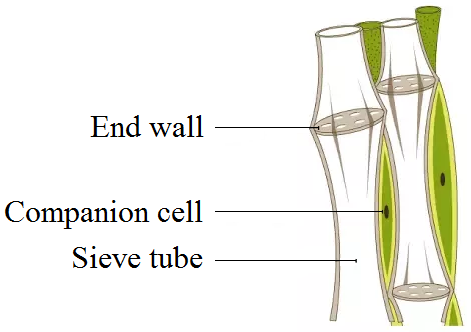
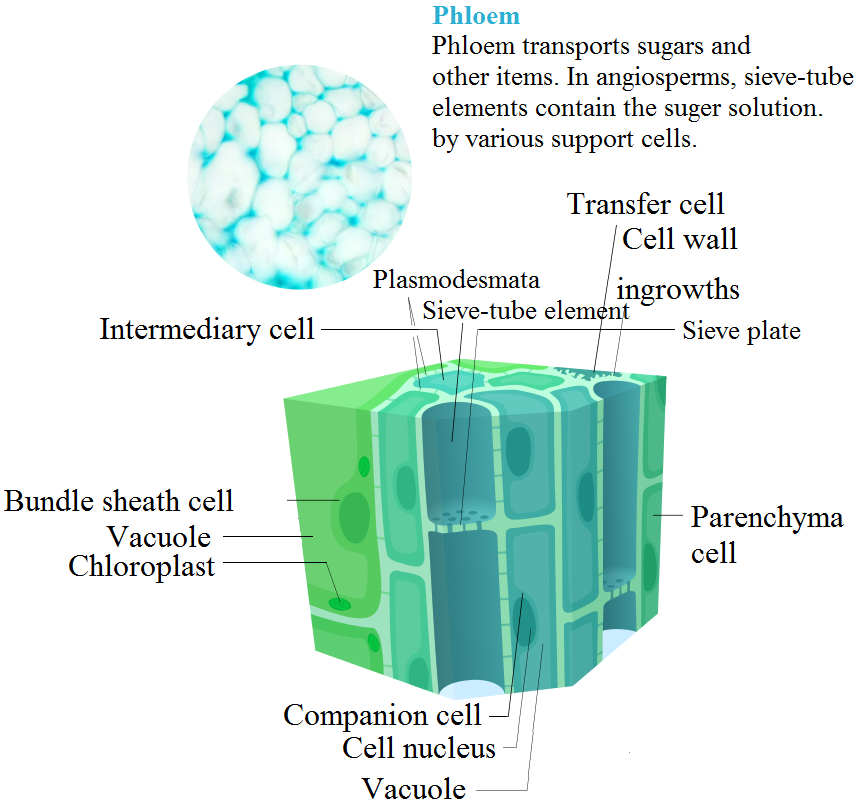
What is the function of companion cells?
Answer
  • Each of these functions (i.e., collection, transport, and release of photosynthate) is intimately related to the structure and activity of companion cells associated with the sieve elements.

  • companion cells in the veins of leaves function in the transfer of assimilates from photosynthetic tissues and bundle sheaths into the sieve tubes.

  • companion cells also play an important role in maintaining the viability and long-distance translocation system of the enucleate sieve tube members by providing them with proteins, including informational (signaling) molecules, and ribonuclear protein complexes as well as ATP.
  • Apoplastic loading, a process utilizing energy, is facilitated by carrier proteins called sucrose transporters which are located in the plasma membranes of companion cells and/or sieve tube members.
  • Companion cells that function as transfer cells are characterized by extensive wall in growths that vastly increase the surface area of the plasma membrane.
View full question & answer
Question 221 Mark
Name the following:
  1. Multinucleate muscle fiber.
  2. Spindle-shaped muscle fiber.
Answer
  1. Multinucleate muscle fibre: Striated muscle fibres which are present in limbs, tongue, hands.

  2. Spindle shaped Fibre: Unstriated muscle fibres which are present in iris of the eye, bronchi.

View full question & answer
Question 231 Mark
Multinucleate conditions is seen in:
  1. Only smooth nuscles cells.
  2. Only skeletal muscle cells.
  3. Both smooth and skeletal muscle cells.
  4. Neither smooth nor skeletal muscle cells.
Answer
  1. Only skeletal muscle cells.

Explanation:

The striated muscle cells are long, cylindrical, unbranched and multinucleate.

View full question & answer
Question 241 Mark
The correct order of the parts of nerve cells through which the nerve impulse is transmitted is:
  1. Nerve endings, dendrites, nerve endings.
  2. Cell body, acon, dendrites, nerve endings.
  3. Dendrites, nerve endings, cell body, acon.
  4. Dendrites, cell body, axon, nerve endings.
Answer
  1. Dendrites, cell body, axon, nerve endings.

Explanation:

Nerve impulse travel along the axons and dentrites. Nerve impulses enter a neuron along the dentrites and leave the neuron along the axon. Thus, the correct sequence through which nerve impulse is transmitted is: dendrites, cell body, axon, nerve endings.

View full question & answer
Question 251 Mark
A coverslip must always be places very gently while mounting in order to:
  1. Avoid the entry of air bubbles.
  2. Stop the stain from oozing out.
  3. Avoid crushing of the material.
  4. Stop the material from drying.
Answer
  1. Avoid the entry of air bubbles.

Explanation:

A coverslip must always be places very gently while mounting in order to avoid the entry of air bubbles.

View full question & answer
Question 261 Mark
Give one example of (i) apical meristem and (ii) lateral meristem.
Answer
  1. Apical meristem: Shoot apes.

  2. Lateral meristem: Cambium.

View full question & answer
Question 271 Mark
The features that best describe the cells of parenchyma cells are:
  1. Dead cells, thick walled, no inter cellular.
  2. Living cells, thin-walled, no intercellular spaces.
  3. Dead cells, thin-walled, large intercellular spaces.
  4. Living cells, thin-walled, large intercellular spaces.
Answer
  1. Living cells, thin-walled, large intercellular spaces.

Explanation:

Parenchyma cells are living and thin walled. They are oval, spherical or polygonal in shape. They have large, intercellular space between the cells.

View full question & answer
Question 281 Mark
Name the muscle which is commonly found in visceral organs.
Answer
Smooth muscle or unstriated muscle is commonly found in visceral organs.
View full question & answer
Question 291 Mark
In which type of plants arenchyma is found? Give example.
Answer
In aquatic plants, large air cavities are present in parenchyma to give buoyancy to the plants to help them float. Such a parenchyma type is called aerenchyma.
View full question & answer
Question 301 Mark
Which tissue is commonly known as “packaging tissue”?
Answer
Areolar tissue is commonly known as packaging tissue. It is basic type of connective tissue present all over in the body.
View full question & answer
Question 311 Mark
Which type of simple tissue of plants os used for making ropes?
Answer
Sclerenchyma is a type of simple permanent tissue which is used for making ropes.
View full question & answer
Question 321 Mark
Which tissue protects the entire body of human?
Answer
Connective tissues perform a variety of functions including support and protection. The following tissues are found in the human body, ordinary loose connective tissue, fat tissue, dense fibrous tissue, cartilage, bone, blood and lymph, which are all considered connective tissue.
View full question & answer
Question 331 Mark
What is the main function of vascular tissues in plants?
Answer
The main function of vascular tissues is to transport water and food in the plant. The Xylem is known to conduct water and Phloem conducts food in the form of sugars.
View full question & answer
Question 341 Mark
Which type of WBC is most abundant in lymph?
Answer
Lymphocytes are WBCs which are most abundant in lymph.
View full question & answer
Question 351 Mark
Name the cells that are dead and have no intercellular spaces.
Answer
Sclarenchyma.

Explanation:

Sclarenchyma is a long, dead cell with a deposite of lignin on their cell wall. They have no intercellular space. Sclarenchyma occur around the vascular tissue in stems, in the veins of leaves and in the covering of seeds and nuts. they provide strengths to plant.

View full question & answer
Question 361 Mark
Which chemical is deposited at the corner of cells in collenchymas?
Answer
Collenchyma tissue is irregularly thickened at the corners due to the depositon of pectin and cellulose.
View full question & answer
Question 371 Mark
Which structure protects the plant body against the invasion of parasites?
Answer
Epidermis having thick cuticle and dermal tissue to prevent the invasion of parasites and other harmful agents.
View full question & answer
Question 391 Mark
Where are the cardiac muscles present?
Answer
Cardiac muscle cells are located in the walls of the heart, appear striated, and are under involuntary control. Smooth muscle fibers are located in walls of hollow visceral organs, except the heart, appear spindle-shaped, and are also under involuntary control.
View full question & answer
Question 401 Mark
Name the type of cells, which form nervous tissue?
Answer
Although the nervous system is very complex, there are only two main types of cells in nerve tissue. The actual nerve cell is the neuron. It is the "conducting"cell that transmits impulses and the structural unit of the nervous system. The other type of cell is neuroglia, or glial, cell.
View full question & answer
Question 411 Mark
What is permanent tissue?
Answer
A permanent tissue is a group of cells which temporarily or permanently cease to divide have assumed a definite form and size.
View full question & answer
Question 421 Mark
What is stomata?
Answer
Stomata are tiny pores present on the leave’s surface which help in the exchange of gases and in transpiration.
View full question & answer
Question 431 Mark
Which type of simple tissue is used for making ropes?
Answer
Sclerenchyma is the simple tissue used for making ropes. It is the tissue that makes the plant hard and stiff as seen in the husk of the coconut. On the walls of sclerenchyma is lignin that provides tensile strength which is good for making ropes.
View full question & answer
Question 441 Mark
What contribute more to difference in organ system design of plants and animals?
Answer
Active movement of animals and sedentary habit of plants contribute more to difference in organ system of plants and animals.
View full question & answer
Question 451 Mark
Give one function of each of the following:
Cardiac muscle fibres.
Answer
Cardiac muscle fibres: It helps in rhythmic contraction and relaxation of heart throughout life.
View full question & answer
Question 461 Mark
Name the plant from which commercial cork is obtained.
Answer
Commercial cork is obtained from the cork oak tree.
View full question & answer
Question 481 Mark
Give one similarity between permanent and meristematic tissue.
Answer
They both are tissues of plants.
Both of them are composed of cells and have their own functions.
Some meristamatic and permanent tissues are homogeneous and consists of one cell only.
View full question & answer
Question 491 Mark
Give one example of protective tissue in plants.
Answer
Cork is the example of protective tissue in the plants.
View full question & answer
Question 501 Mark
Why are connective tissue named so?
Answer
Connective tissue is called as it connects different tissues through the protein substance present in it.
View full question & answer
One word answer. - Science STD 9 Questions - Vidyadip