- Electric motor.
- Alternator.
- Turbine.
- Electric heater.
- Alternator.
Explanation:
Alternator is the device that converts mechanical energy into energy, which runs in microwave oven.
22 questions · timed · auto-graded
Explanation:
Alternator is the device that converts mechanical energy into energy, which runs in microwave oven.
Explanation:
Electricity produced in a hydroelectric power station is similar to electricity produced in thermal power plants.
Explanation:
Total energy of a freely falling object remains conserved.
The work done on an object does not depend on the:
Explanation:
The work done on an object does not depend upon the initial velocity of the moving object.
In case of negative work, the angle between the force and displacement is:
Explanation:
Work done is negative when the direction of force is opposite to the direction of motion. So, the angle between force and displacement in the case of negative work.
A girl weighing 400N climbs a vertical ladder. If the value of g be 10ms2, the work done by her after climbing 2m will be:
Explanation:
Weight of the girl (W) = 400N
Vertical height (h) = 2m
Acceleration due to gravity (g) = 10m/s2
We can calculate the work done against gravity in moving a body of mass (m) by a height (h) as,
Work done in lifting a body = (Weight of body)(Vertical distance)
So,
W = (m)(g)(h)
So,
Work done in lifting a body
= (400)(2)J
= 800J
An iron sphere of mass 10kg has the same diameter as an aluminium sphere of mass 3.5kg. Both the spheres are dropped simultaneously from a tower. When they are 10 m above the ground, they have the same:
Explanation:
Momentum, potential energy and kinetic energy depend on the mass of the body. So, the answer is acceleration as it is independent of mass.
A car is accelerated on a levelled road and attains a speed of 4 times its initial speed. In this process, the kinetic energy of the car:
Explanation:
Kinetic energy of a body is directly proportional to the square of the velocity. So, the kinetic energy will become 16 times its initial value if the velocity is increased 4 times.
A car is accelerated on a levelled road and acquires a velocity 4 times of its initial velocity. During this process, the potential energy of the car:
Explanation:
Potential energy of an object depends only on its position above the ground and mass. So, the potential energy of a car traveling on a leveled road does not change.
The momentum of a bullet of mass 20g fired from a gun is 10kg m/s. The kinetic energy of this bullet in kJ will be:
Explanation:
Mass of the bullet, (m), = 0.02 gm
Momentum of the bullet, (P) = 10kg.m/s
The relation between momentum, mass and kinetic energy is as follows:
$\text{K.E.}=\frac{1}{2}\Big(\frac{\text{p}^2}{\text{m}}\Big)$
So,
$\text{K.E.}=\frac{1}{2}\Big(\frac{(10)^2}{0.02}\Big)\text{J}$
$=\frac{100}{0.04}\text{J}$
$=2500\text{J}$
$2.5\text{KJ}$
Each of the following statement describes a force acting. Which force is causing work to be done?
Explanation:
A girl is carrying a school bag of 3kg mass on her back and moves 200m on a levelled road. If the value of g be 10m/s2, the work done by the girl against the gravitational force will be:
Explanation:
The girl is moving with the bag on a levelled road. Her direction of motion is perpendicular to the direction of gravitational force. So, work done by the girl against gravity is zero.
Which of the following does not possess the ability to do work not because motion?
Explanation:
We will justify all statements one by one as:
Water stored in a dam possesses:
Explanation:
Water stored in a tank possesses gravitational potential energy because of its position above the ground.
Explanation:
Power, (P) = 100W
Time duration, (t) = 60s
Now, we can calculate the electrical energy consumed as,
Energy consumed = (Power)(Time)
So,
Energy consumed
= (100)(60)J
= 6000J
So, the energy consumed is 6000 J.
Explanation:
Mass of the load (m1) = 0.2kg
Height (h) = 3m
Acceleration due to gravity (g) = 10m/s2
Time taken (t) = 2s
We can calculate the work done against gravity as,
Work done by the car = (Weight of body)(Vertical distance)
= (0.2)(10)(3)J
= 6J
Now, we can calculate the power of the boy as,
$\text{Power}=\frac{\text{Work done}}{\text{Time}}$
So,
$\text{Power}=\frac{6}{2}\text{W}$
$=3\text{W}$
So, the power is 3W.
Explanation:
Kilowatt is the unit of power.

Explanation:
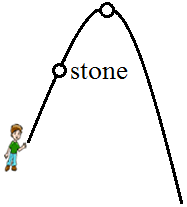
When a stone is thrown vertically upwards, the following conclusions can be done for point P:
Explanation:
Kilowatt-hour is the commercial unit of electricity.
Explanation:
A microphone converts sound energy into electrical energy in public address systems.
Explanation:
Frictional force is responsible for heating up of the tires of a moving vehicle. In such a situation, kinetic energy is converted into heat energy due to the frictional force.
Explanation:
During the free fall, potential energy is gradually converted into kinetic energy. At half of the maximum height, energy is equally distributed in the form of potential and kinetic energy.