Question types

Genetics question types

42 questions across 7 question groups — pick any mix to generate a Biology paper with step-by-step answer keys.

42
Questions
7
Question groups
5
Question types
Sample Questions

Genetics questions

One sample from each question group in this chapter. Select any group above to see the full set with answer keys.

Q 1MCQ1 Mark
Sarah and Tom are expecting their first child. Sarah's maternal uncle has hemophilia, a genetic disorder that affects blood clotting. Sarah is concerned about the risk of passing hemophilia to her child. Sarah's father is unaffected by hemophilia, but her mother is a carrier of the disorder. Tom has no family history of hemophilia but Sarah is also a carrier of disease. What is the likelihood that Sarah and Tom's child will have hemophilia?
  • A
    $0 \%$
  • B
    $25 \%$
  • $50 \%$
  • D
    $75 \%$

Answer: C.

View full solution
Q 2MCQ1 Mark
Assertion (A): In humans, the sex of the offspring is determined by the type of sex chromosome contributed by the father.
Reason (R): Females have two X chromosomes, while males have one X and one Y chromosome.
  • A
    A is True and R is False.
  • B
    A is False and R is True.
  • Both A and R are True.
  • D
    Both A and R are False.

Answer: C.

View full solution
Q 3MCQ1 Mark
Assertion (A): A carrier of a genetic disorder is always affected by the disorder.
Reason (R): Carriers are individuals who have one copy of a recessive allele for a genetic disorder but do not show symptoms of the disorder.
  • A
    A is True and R is False.
  • Both A and R are True.
  • C
    Both A and R are True.
  • D
    Both A and R are False.

Answer: B.

View full solution
Q 4MCQ1 Mark
Assertion (A): Mendel's law of segregation states that during the formation of gametes, the alleles segregate from each other so that each gamete carries only one allele for each gene.
Reason (R): This segregation of alleles occurs during anaphase I of meiosis.
  • A
    A is True and R is False.
  • B
    A is False and R is True.
  • Both A and R are True.
  • D
    Both A and R are False.

Answer: C.

View full solution
Q 5MCQ1 Mark
The disease 'colour blindness' is a
  • A
    Dominant X linked disease
  • Recessive X linked disease
  • C
    Dominant Y linked disease
  • D
    Recessive XY linked disease

Answer: B.

View full solution
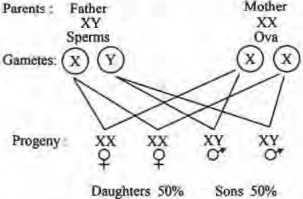
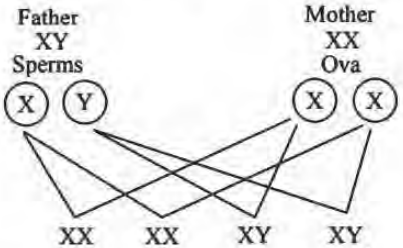
Given below is the diagram showing sex determination in humans. Read the information and fill in the blanks:

Image

Sex determination in humans is dependent on the combination of (i) __________ inherited from both parents. Females typically have two (ii) __________ chromosomes, while males have two different chromosomes. During fertilisation, the father's sperm can contribute either an (iii) __________ or __________ chromosome to the offspring.If the offspring receives an $X$ chromosome from the father's sperm, it will develop into a (iv) __________. The combination of sex chromosomes received during fertilisation ensures genetic
(v) __________ and the continuation of the species.
View full solution
Given below are two statements which are incorrect. Rewrite the correct statements:
(i) An unaffected carrier parent produce unaffected offspring only.
(ii) An affected father will always have affected sons.
View full solution
Column IColumn II
 (i) Offspring (a) Law of segregation
 (ii) Phenotype (b) External appearance
 (iii) Purity of gametes (c) Progeny produced due to                         reproduction
 (iv) Unit factor (d) Only one character
  (e) Gene
View full solution
(i) A pure tall plant (TT) is crossed with a pure dwarf plant (tt).
Draw Punnett squares to show (1) $F_1$ generation (2) $F_2$ generation.
(ii) Give the Phenotype of the $F_2$ generation.
(iii) Give the Phenotypic and Genotypic ratio of the $F_1$ and $F_2$ generation.
(iv) Name any one $X$-linked disease found in humans.
View full solution
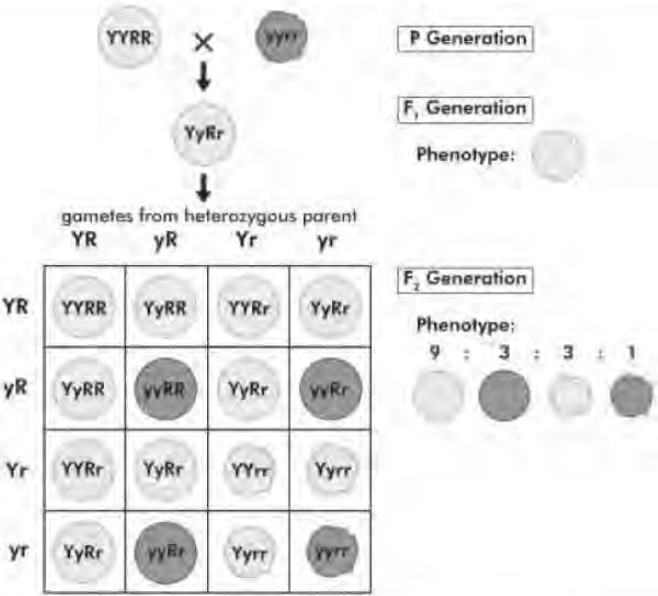
A homozygous tall plant (TT) bearing red coloured $(R R)$ flowers is crossed with a homozygous dwarf plant (tt) bearing white flowers (rr) :
(i) Give the genotype and phenotype of the $F_1$ generation.
(ii) Give the possible combinations of the gametes that can be obtained from the $F_1$ hybrid.
(iii) Give the dihybrid ratio and the phenotype of the offspring of $F_2$ generation when two plants of above $F_1$ generation are crossed.
View full solution

Generate a Genetics paper free

Pick question groups from the list above, set marks and difficulty, and export a branded PDF with step-by-step answer keys. First 3 chapters free — no signup.

Download App