Questions

[2 Mark Question Answer]

🎯

Test yourself on this topic

11 questions · timed · auto-graded

Question 12 Marks
Given below is a diagram depicting a defect of the human eye? Study the same and answer the question that follow:
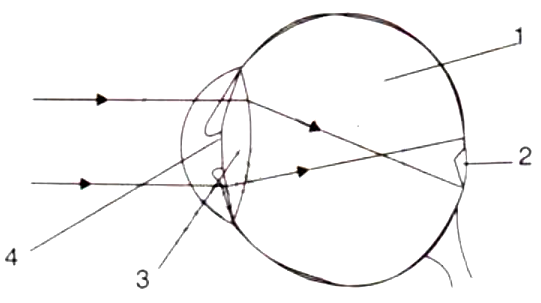
Name the parts labeled 1 to 4.
Answer
1 - vitreous humour,
2 - Fovea centralis (yellow spot),
3-lens,
4-pupil
View full question & answer
Question 22 Marks
With reference to the human ear, answer the question that follow:
Name the part of the ear associated with
(1) static balance
(2) hearing
(3) dynamic balance.
Answer
(1) Static balance - Utriculus and sacculus (inner ear)
(2) Hearing - Internal ear
(3) Dynamic balance - Semi-circular canals (inner ear)
View full question & answer
Question 32 Marks
What is meant by optical illusion? Give one example.
Answer
An optical illusion is the life-like continuous movement on the screen. Television is an example of optical illusion, where the scanning beam of a picture frame of the TV camera moves so rapidly on the viewing screen of the TV set that our eyes cannot keep pace with it.
View full question & answer
Question 42 Marks
Name an old age eye defect. What happens in it?
Answer
Presbyopia is an age-old eye defect. In this condition, the lens loses flexibility resulting in far-sightedness.
Cataract is also very common in old people, the cornea becomes opaque and the vision is cut down even to blindness.
View full question & answer
Question 52 Marks
Name an old age eye defect. Why is it caused?
Answer
Presbyopia is an age-old eye defect. In this condition, the lens loses flexibility resulting in far-sightedness.
Cataract is also very common in old people, the cornea becomes opaque and the vision is cut down even to blindness.
View full question & answer
Question 62 Marks
Differentiate between members of the following pair with reference to what is asked in bracket.
Semi-circular canal and cochlea (Senses perceived)
Answer
cochlea is responsible for hearing; it can perceive the senses of hearing.
Semicircular canals are responsible for perceiving the senses to maintain the body balance.
View full question & answer
Question 72 Marks
Differentiate between members of the following pair with reference to what is asked in bracket.
Rods and cones (sensitivity)
Answer
Rods are sensitive to dim light but do not respond to colour.
cones are sensitive to bright light and are responsible for colour vision.
View full question & answer
Question 82 Marks
Differentiate between members of the following pair with reference to what is asked in bracket.
Myopia and hyperopia (cause of the defect)
Answer
Myopia results when the eye ball is lengthened from front to back or the lens is too curved.
Hyperopia results from either too shortening of the eyeball from front to back or when the lens is too flat.
View full question & answer
Question 92 Marks
Name the three ear ossicles. How do they contribute in the mechanism of hearing?
Answer
The three ear ossicles are: Malleus (hammer), Incus (anvil), and Stapes (stirrup).
The last ear ossicle, stapes, vibrates and transmits the vibration to the oval window. The role of the other two ear ossicles is to magnify the vibration of stapes as a result of their lever like action.
View full question & answer
Question 102 Marks
You do not enjoy watching a movie from a very short distance from the screen in a cinema hall. Why?
Answer
Our eyes are designed to focus at a great variety of distances. To focus constantly at a short distance can make the lens focusing muscles fatigued. Therefore, we do not enjoy watching a movie from a very short distance from the screen in cinema hall.
View full question & answer
Question 112 Marks
By closing the eyes and gently pressing them by your palms, you may see some specks of brilliant light. How do you get this sensation while there is no light entering your eyes?
Answer
If we look at a bright object and then close our eyes, the sensation of light persists for a short period. This is known as persistence image or the after image. It lasts for one-tenth of a second. Therefore by closing the eyes and gently pressing them with your palms, you see some specs of brilliant light.
View full question & answer
[2 Mark Question Answer] - Biology STD 10 Questions - Vidyadip