Questions

[3 marks Question Answer]

🎯

Test yourself on this topic

6 questions · timed · auto-graded

Question 13 Marks
Which one or more of the expressions in column II are appropriate for the items listed in column I? write the correct matching pairs-
Column IColumn II
(i) The blind spot(a) colour of the eye
(ii) the yellow spot(b) shape of the lens
(iii) Ciliary muscle(c) protective covering of the brain
(iv) Iris(d) basic unit of brain
(v) Meninges(e) free of rod cells
(f) vitreous humour
(g) centre of the retina
(h) no sensory cells
Answer
Column IColumn II
(i) The blind spot(h) no sensory cells
(ii) the yellow spot(g) centre of the retina
(iii) Ciliary muscle(b) shape of the lens
(iv) Iris(d) basic unit of brain (e) free of rod cells
(v) Meninges(c) protective covering of the brain
View full question & answer
Question 23 Marks
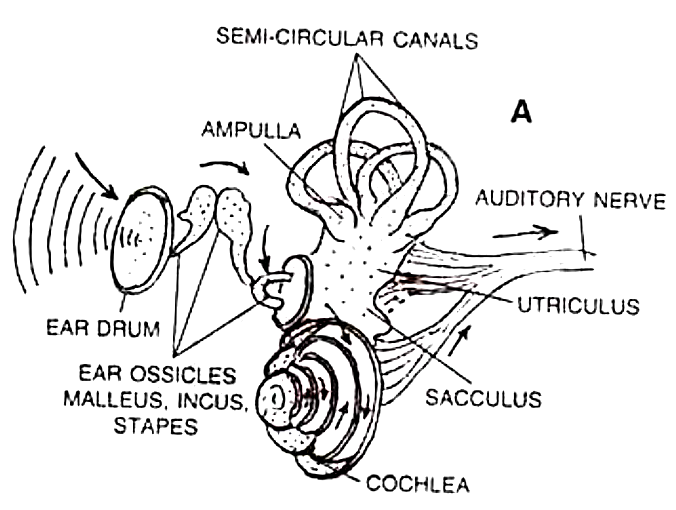
Draw a labelled diagram of the inner ear. Name the part of the inner ear that is responsible for static balance in human beings.
Answer

Utriculus and Sacculus are responsible for maintaining static balance in human beings.
View full question & answer
Question 33 Marks
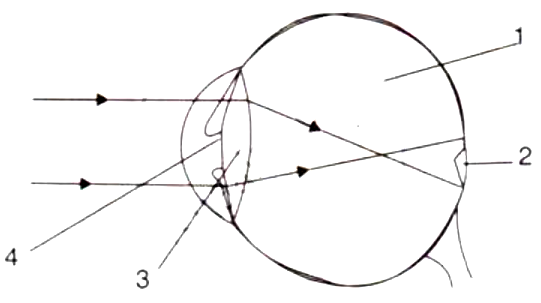
Given below is a diagram depicting a defect of the human eye? Study the same and answer the question that follow:

Draw a labeled diagram to show how the above mentioned defect is rectified using the lens named above.
View full question & answer
Question 43 Marks
Complete the following table by filling in the blank spaces.
StructureFunction
Yellow Spot
Transfers impulse from inner ear to brain
Helps to change the focal length of the eye lens
Spinal cord
Oval window
Dynamic equilibrium
Answer
StructureFunction
Yellow SpotRegion of the brightest vision
Auditory nerveTransfers impulse from inner ear to brain
Ciliary muscleHelps to change the focal length of the eye lens
Spinal cordConducts impulses
Oval windowSets fluid in cochlear canal into vibration
Semicircular canalsDynamic equilibrium
View full question & answer
Question 53 Marks
Explain the terms ‘adaptation’ and ‘accommodation’ with reference to the eye.
Answer
Adaptation is the ability to adjust vision in bright and dark areas. When we enter a dark room from bright light, the rhodopsin pigment broken down in bright light is regenerated. It dilates the pupil and allows more light to enter the eyes. This is called dark adaptation. On the other hand, if we enter bright area from a dark room, the rhodopsin pigment is bleached. This constricts the pupil and reduces the light entering the eyes. This is called 'light adaptation'
Accommodation is the process of focusing the eye at different distances. This is mainly brought about by a change in the curvature of the lens. When the ciliary muscles contract, the lens becomes thicker and we are able to focus a nearby object. On the other hand when the ciliary muscles relax, the lens remains stretched i.e. the normal condition and we are able to focus on distant object.
View full question & answer
Question 63 Marks
Sometimes you remember a vivid picture of a dream you saw. What is the role of your eyes in this experience?
Answer
The brain sees the vivid picture of the dream through the eyes. Our eyes have actually never seen the vivid picture. This is an example of optical illusion. The area of dream is controlled by the cerebrum of the central nervous system. So sometime we can remember the vivid picture seen in the dream.
View full question & answer
[3 marks Question Answer] - Biology STD 10 Questions - Vidyadip