Questions

[3 marks Question Answer]

🎯

Test yourself on this topic

21 questions · timed · auto-graded

Question 13 Marks
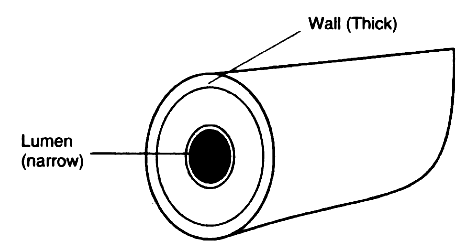
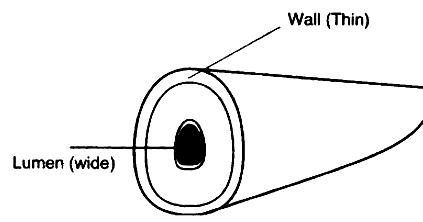
Draw well labeled diagrams of part Artery and Superior vena cava to show the structural.
Answer
(i) Artery

(ii) Superior vena cava
View full question & answer
Question 43 Marks
Describe the role of lymph
Answer
(i) Transport of nutrients and oxygen to the cells and tissues.
(ii) Removal of $CO_2$​​​​​​​ and nitrogenous wastes from the tissues and carry them to the blood.
(iii) It absorbs fatty acids and glycerol through lacteals.
(iv) It destroys harmful pathogens by its lymphocytes.
(v) It maintains body temperature.
(vi) It regulates protein level in the tissue fluid.
View full question & answer
Question 53 Marks
State any five functions of blood.
Answer
(i) It transports oxygen from the lungs to body tissues.
(ii) It transports carbon dioxide from the tissues to the lungs partly in combination with haemoglobin and partly as solution in blood plasma.
(iii) It transports digested food to different organs of the body which is utilized by cells.
(iv) It helps in keeping the temperature of the body uniform by distributing heat.
(v) It forms a clot wherever there is a cut in a blood vessel. The clot not only prevents further loss of blood but also prevents the entry of disease germs.
View full question & answer
Question 63 Marks
Complete the following table:
 
Components Origin Function Approx. No. $(mm^3)$ Life span
RBCs        
WBCs        
Platelets        
Answer
Components Origin Function Approx. No. $(mm^3)$ Life span
RBCs Bone marrow Carry $O_2$ to the different parts of the body 4.8 million-5.5 million 120 days
WBCs Bone marrow Develop immu­nity 7,000 Two weeks
Platelets Large bone marrow cells Initiate blood clotting 250,000 2-3 days
View full question & answer
Question 73 Marks
When are the sounds ‘LUBB’ and ‘DUB’ produced during heartbeat ?
Answer
The first sound ‘LUBB’ is produced when the atrioventricular valves get closed sharply at the start of ventricular systole. The second sound ‘DUB’ is produced at the beginning of ventricular diastole when the semilunar valves, at the roots of aorta and pulmonary artery get closed.
View full question & answer
Question 83 Marks
Differentiate between:
Open circulatory system and Closed circulatory system.
Answer
Open circulatory system Closed circulatory system
Blood may flow in vessels but also remains in direct contact with tissues. Blood flows in definite vessels known as arteries and veins.
Blood spaces or sinuses are present. Blood spaces or sinuses are absent
Haemocoel is present. Haemocoel is absent.
Found in insects, e.g., cockroach, housefly, etc. Found in annelids and higher vertebrates.
View full question & answer
Question 93 Marks
Differentiate between:
Arteries and Veins.
Answer
Arteries Veins
These carry blood from the heart to different organs of the body. These collect blood from different organs of the body.
These contain oxygenated blood (Pulmonary artery contains deoxygenated blood) These contain deoxygenated blood. (Pulmonary vein contains oxygenated blood).
Blood flows rapidly with jerks under
pressure.
Blood flows slowly at a constant slow speed.
The walls are thick and elastic. The walls are thin and non-elastic.
Valves are absent. Valves are present.
View full question & answer
Question 103 Marks
Differentiate between:
Blood and Lymph.
Answer
Blood Lymph
Blood contains plasma, RBCs, WBCs, and platelets. Lymph contains only the soluble parts of plasma.
It contains albumin, globulin, and fibrinogen. It does not contain these substances.
It is an opaque red coloured fluid of alkaline reaction. It is a colourless fluid resembling blood in other respects.
View full question & answer
Question 113 Marks
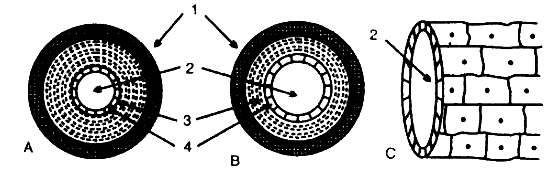
The figures given below are cross-sections of blood vessels.

(i) Identify the blood vessels A, B, and C.
(ii) Name the parts labeled 1-4.
(iii) Mention two structural differences between A and B.
(iv) Name the type of blood A that flows (a) through A, (b) through B.
(v) In which of the above vessels referred to in (iv) above does exchange of gases actually take place?
Answer
(i)
(A) Artery
(B) Vein
(C) Capillary.

(ii)
1. Connective tissue
2. Lumen.
3. Tunica media.
4. Tunica intima/Endothelium.
(iii) Two structural differences between arteries and veins are :
(a) Arteries are thick-walled and veins are thin walled.
(b) There are no valves in arteries while valves are present in veins.
(iv) (a) Oxygenated blood flows through A.
(b) Deoxygenated blood flows through B.
(v) The exchange of gases takes place in C capillaries.
View full question & answer
Question 123 Marks
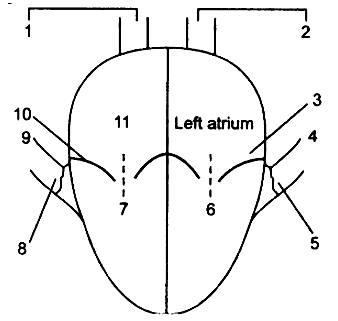
Given alongside is a highly diagrammatic sketch of the internal structure of the human heart:
(i) Name the parts numbered 1-11.
(ii) What is the main difference in the quality of blood contained in parts 6 and 7 ?
Answer
(i)
1. Anterior or superior vena cava
2. Pulmonary vein.
3. Mitral or bicuspid valve.
4. Dorsal aorta.
5. Semilurlar aortic valve.
6. Left ventricle.
7. Right ventricle
8. Pulmonary semilunar valve.
9. Pulmonary artery.
10. Tricuspid valve.
11. Right atrium.
(ii) Part 6 contains oxygenated blood whereas part 7 contains deoxygenated blood.
View full question & answer
Question 133 Marks
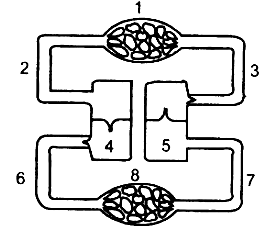
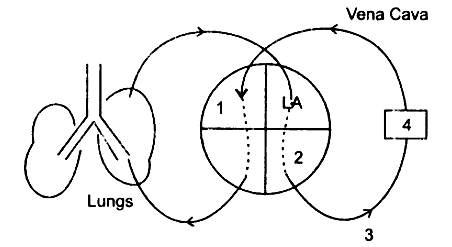
Given below is a schematic representation of the circulatory system in man. Study the same and answer the questions that follow:

(i) Label the parts 1 to 4 indicated in the diagram.
(ii) Give one difference between parts 1 and 2 based on:
(a) their structure
(b) the nature of blood flowing through them.
(iii) What is the specific name of the type of blood circulation that takes place between the heart and the lungs?
(iv) Name the valve found at the beginning of the part labeled 3.
Answer
(i)
1. Right auricle
2. Left ventricle
3. Aorta
4. Body organs
(ii)

Right Auricle Left Ventricle
The wall of the right auricle is thinner and smooth. The wall of the left ventricle is thicker and rough.
The deoxygenated blood flows. The oxygenated blood flows.

(iii) Pulmonary circulation.
(iv) Aortic semilunar valve
View full question & answer
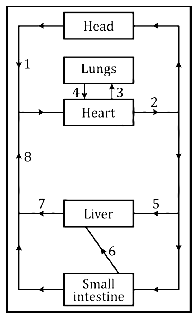
Question 143 Marks
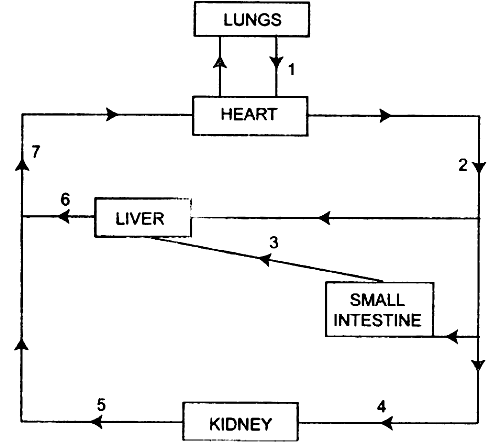
Given below is the simplified pathway of the circulatory system:

(i) Name the blood vessels marked 1 to 8.
(ii) Name the chamber of the heart which:
(a) Receives blood from ‘1’.
(b) Pumps blood into blood vessel ‘8’.
(iii) Mention two structural differences between blood vessels ‘7’ and ‘2’.
Answer
(i)
1. Pulmonary vein
2. Dorsal aorta,
3. Hepatic portal vein
4. Renal artery
5. Iliac vein
6. Hepatic vein
7. Inferior vena-cava
8. Pulmonary artery.
(ii) (a) Left auricle.
(b) Right ventricle.
(iii) (a) The inferior vena cava arises from iliac veins coming from the hind limbs, while the dorsal aorta arises from the left ventricle and continues behind as the abdominal aorta.
(b) The deoxygenated blood is collected by the inferior vena cava, while the branches of the dorsal aorta supply oxygenated blood to the body parts.
View full question & answer
Question 153 Marks
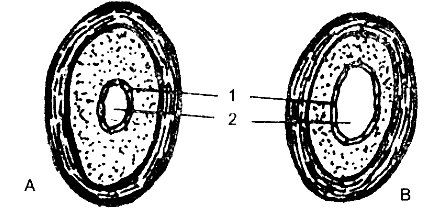
The diagrams given below show the cross-section of two kinds of blood vessels:

(i) Identify the blood vessels A and B. In each case give a reason to support your answer.
(ii) Name the parts numbered 1 and 2.
(iii) When are the sounds “LUBB” and “DUB” produced during a heartbeat?
(iv) Name the blood vessel that
(a) begins and ends in capillaries.
(b) supplies blood to the walls of the heart.
Answer
(i)
A—Artery
B—Vein, because in A lumen is narrow, in B lumen is wide.
(ii) 1 —> Endothelium, 2 —> Lumen.
(iii) Lubb is produced when the ventricles contract and atrioventricular valves get closed at the beginning of ventricular systole.
Dub is produced by the closure of semilunar valves at the beginning of ventricular diastole.
(iv) (a) Portal system
(b) Coronary arteries
View full question & answer
Question 163 Marks
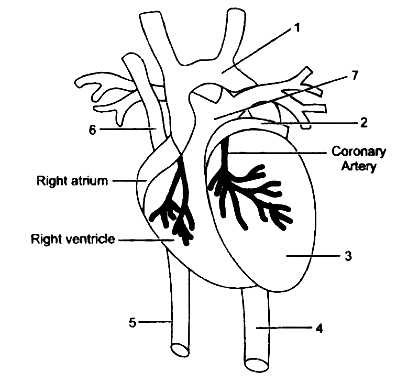
Given alongside is a diagram of the external features of the heart.
(i) Name the parts$ ‘1’$ to $‘7’.$
(ii) What happens if the coronary artery gets an internal clot?
(iii) Which type of blood does part$ ‘5’ $carry?
(iv) Mention one structural difference between part ‘5’ and$ ‘4’.$
Answer
(i)
1. Aorta
2. Left atrium
3. Left ventricle
4. Dorsal aorta
5. Inferior vena cava
6.Superior vena cava
7. Pulmonary artery.
(ii) If the coronary artery gets an internal clot, the corresponding part of the heart does not get its blood supply. This will result in loss of contraction or even death of the cardiac cells resulting in a heart attack or coronary arrest which may prove to be fatal.
(iii) Part $‘5’$ which is the inferior vena cava carries deoxygenated blood which is rich in $CO_2$ and metabolic wastes.
(iv) Part $‘5’$ is more muscular and the lumen is narrow while part ‘4’ is less muscular and the lumen is wider.
View full question & answer
Question 173 Marks
The figure below represents the internal structure of a mammalian heart and the associated blood vessels.

(i) (a) Name each of the structures labeled 1, 2, 3, 4, 5, 6, 7 and 8.
(b) State the function of each of the structures 5, 6, 7, and 8.
(ii) (a) State the function of the heart as an entire organ.
(b) Why are the walls of the left ventricle more muscular than the right?
Answer
(i) (a)
1. Right auricle,
2. Left ventricle,
3. Pulmonary artery,
4. Pulmonary vein,
5. Inferior vena cava,
6. Aorta,
7. Pulmonary semilunar valve,
8. Tricuspid valve.
(b)
5 — carry deoxygenated blood from the body parts to the right auricle of the heart.
6 — distributes blood all over the body.
7 — prevents the backflow of the blood into the ventricles.
8 — prevents the reverse flow of the blood from the right ventricle into the right auricle,
(ii) (a) The heart makes the blood to circulate all over the body.
(b) The walls of the left ventricle are more muscular because they have to pump blood to a larger distance than the right so that walls have to withstand high pressure.
View full question & answer
Question 183 Marks
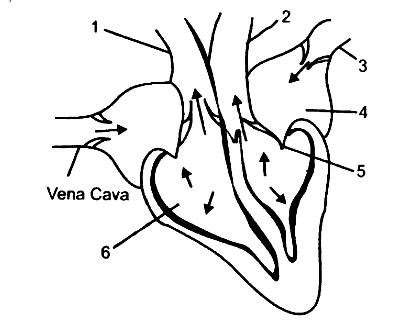
The diagram given below represents the human heart in one phase of its activity. Study the same and then answer the questions that follow:

(i) Name the phase.
(ii) Which parts of the heart are contracting in this phase ? Give a reason to support your answer.
(iii) Name the part numbered 1 to 6.
(iv) What type of blood flows through the parts marked ‘1’ and ‘2’?
(v) How many valves are closed in this phase?
Answer
(i) Ventricular systole.
(ii) Both ventricles are contracting in this phase, because both bicuspid and tricuspid valves are closed in order to prevent the back flow of blood into auricles and the semilunar valves are open.
(iii) 1. Pulmonary artery,
2. Aorta,
3. Pulmonary vein,
4. Left auricle,
5. Bicuspid valve (mitral valve),
6. Right ventricle.
(iv)
‘1’—carries deoxygenated blood.
‘2’—carries oxygenated blood.
(v) Two (Bicuspid and Tricuspid) valves.
View full question & answer
Question 193 Marks
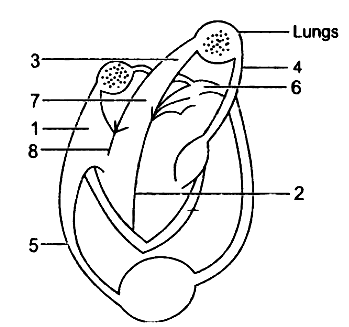
Given below is a simple diagram of the circulation of blood in a mammal showing the main blood vessels, the heart, lungs, and body tissues. The blood vessel labeled 6 contains deoxygenated blood and 2 the valve leading to it has three semi-lunar pockets.

(i) Name the blood vessels of organs marked by numbers 1 to 8.
(ii) What do you mean by the term ‘double circulation’ of blood in mammals?
(iii) What is diastole?
Answer
(i)
1. Veins from tissues.
2. Superior vena cava
3. Aorta
4. Right ventricle
5. Left ventricle
6. Pulmonary Artery
7. Pulmonary vein
8. Lungs.
(ii) The heart is said to have double circulation because the blood passes through the heart twice.
(a) It first leaves t.rough the right ventricle, goes to the lungs and then returns to the left auricle of the heart (pulmonary circulation).
(b) It leaves through the left ventricle, circulates through the body, and again returns to the right auricle of heart (systemic circulation).
(iii) Diastole is the phase of relaxation of the heart muscles during which the heart chambers fill with blood and the supply of blood to the cardiac muscle is improved.
View full question & answer
Question 203 Marks
The diagram below represents the simplified pathway of the circulation of blood. Study the same and answer the questions which follow:

(i) Name the blood vessels labelled 1 and 2.
(ii) State the function of blood vessels labelled 5 and 8.
(iii) What is the importance of the blood vessel labelled 6?
(iv) Which blood vessel will contain a high amount of glucose and amino acids after a meal?
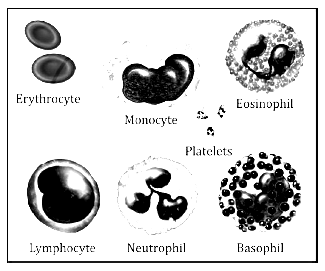
(v) Draw a diagram of the different blood cells as seen in a smear of human blood.
Answer
(i)
1- Superior vena cava
2 - Aorta
(ii) Function of blood vessel 5 (Hepatic artery) - It supplies oxygenated blood to the liver.
Function of blood vessel 8 (Inferior vena cava) - It carries deoxygenated blood from the posterior parts of the body to the heart.
(iii) Importance of blood vessel 6 (Hepatic portal vein) - It carries nutrient laden blood from the gastrointestinal tract to the liver.
(iv) Blood vessel 6, i.e. hepatic portal vein.
(v) Different blood cells seen in a smear of human blood:
View full question & answer
Question 213 Marks
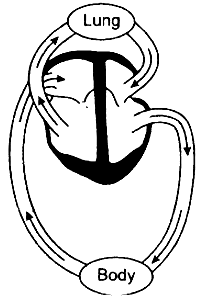
The diagram represents the ‘closed system’ or ‘double circulation’ of blood in mammals.

Justify the above statement.
State two structural and two functional differences between the arteries and veins.
State the changes in the composition of blood as it passes through the following organs:
$(a)$ Lungs $(b)$ Gut $(c)$ Liver $(d)$ Kidneys.
Answer
Double Circulation or closed system:
In human beings, the heart has double circulation as the blood passes through the heart twice.
$(1)$ It first leaves the heart $($right ventricle$)$ and goes to the lungs and then returns to the heart $($left auricle$).$
$(2)$ From the left auricle, it circulates through the entire body and again returns to the heart $($right auricle$)$.
See Answer to Question $11,$ differentiate between.
$(a)$ In the lungs, the blood releases carbon dioxide and picks up oxygen.
Hence before passing through the lungs, it contains more $CO_2$ while it contains more oxygen after it has passed through the lungs.
$(b)$ When blood passes through the gut, it absorbs digested food materials i.e., it contains more carbohydrates, proteins, fats, water, ions, and vitamins.
$(c)$ As the blood passes through the liver, it contains more urea another waste materials.
$(d)$ As the blood passes through kidneys, it contains less urea and other waste materials.
View full question & answer
[3 marks Question Answer] - Biology STD 10 Questions - Vidyadip