Questions

[2 Mark Question Answer]

🎯

Test yourself on this topic

30 questions · timed · auto-graded

Question 12 Marks
What do you understand by an inguinal hernia?
Answer
Inguinal Hernia: Sometimes due to pressure in the abdomen, the intestine bulges into the scrotum through the inguinal canal and causes the most common type of hernia.
View full question & answer
Question 22 Marks
Describe briefly the ways how a mammalian embryo is nourished
Answer
The mammalian embryo is nourished by the nutrients which diffuse through the placenta of the mother to pass through the umbilical cord to the embryo.
View full question & answer
Question 32 Marks
The circulatory system of the fetus and that of the mother are never connected directly. What are the advantages?
Answer
The separate circulatory system facilitates quick diffusion of nutrients, metabolic waste and respiratory gases between the foetus and the mother. Bacteria and other pathogens cannot pass from the mother to the foetus because they are filtered out by the placenta. Blood pressure changes in the maternal circulation also cannot affect the foetus which has delicate blood vessels.
View full question & answer
Question 42 Marks
Mention three functions of the placenta.
Answer
  1. It connects the fetus with the uterus of mother.
  2. It helps in the exchange of nutrients, gases and waste products between mother and the foetus.
  3. It acts as an endocrine gland and secretes chorionic gonadotropin hormone which maintains the pregnancy.
View full question & answer
Question 52 Marks
How is the fetus protected?
Answer
The human fetus is protected by the amnion layer having amniotic fluid and the yolk sac.
View full question & answer
Question 62 Marks
Give Reasons
The acrosome of sperm secretes an enzyme called hyaluronidase at the time of fertilization
Answer
This enzyme dissolved the membranous covering of the ovum to facilitate the entry of sperm into the ovum.
View full question & answer
Question 72 Marks
Give Reasons
Millions of sperms are produced at ejaculation yet one sperm actually fertilizes the ovum. Explain.
Answer
Only one ovum is released at a time in the human female during ovulation. Although millions of sperms are ejaculated only one sperm is enough to fertilize the single ovum. This arrangement is to control and maintain the growth rate of the human population. The ovum secretes a protective wall that prevents the entry of other sperms.
View full question & answer
Question 82 Marks
Give Reasons
The urethra is also called urinogenital duct.
Answer
Since the urethra carries both urine and semen.
View full question & answer
Question 92 Marks
Give Reasons
Most often only one embryo is formed at a time although there are two ovaries in women. Explain.
Answer
One ovum under the influence of hormones is released alternatively every month.
View full question & answer
Question 102 Marks
Explain the term Fetus
Answer
Fetus: The fertilized zygote gets implanted in the endometrial lining of the uterus and is called the fetus after undergoing cell division.
View full question & answer
Question 112 Marks
Explain the term Parturition or birth.
Answer
Parturition or birth: It is the expelling of the fetus from the body of the mother and it begins by the contraction of the uterine walls resulting in labour pains.
View full question & answer
Question 122 Marks
Explain the term Scrotum.
Answer
Scrotum: Each of the testes is present in a special sac, called scrotum which is located outside the abdominal cavity. In the scrotum, the testes are maintained at temperature for less than the body temperature.
View full question & answer
Question 132 Marks
Explain the term Cowper’s glands.
Answer
Cowper’s gland: It secretes a fluid which mixes with the sperms, offers chemical protection, and supports the swimming motion of the sperms. The mucous secretion of Cowper’s glands serves as lubricants and help to contrast the acidity of the semen.
View full question & answer
Question 142 Marks
Explain the term Androgens.
Answer
Androgens: These are the male sex hormones that have been produced by the interstitial cells of the testes. The androgens are essential for the maturation of sex organs, development of the sperm, and for promoting secondary sexual characters such as beard, mustache, the deepening of the voice, etc.
View full question & answer
Question 152 Marks
Explain the term Gametogenesis.
Answer
Gametogenesis: Formation of sperms in testes and ova in the ovary is called gametogenesis.
View full question & answer
Question 162 Marks
Explain the term Graffian follicle.
Answer
Graffian follicle: The ovum begins to develop in the ovary and as it matures, it migrates towards the surface of the ovary and becomes surrounded by a fluid-filled follicle called the Graffian follicle. Every 28 days, on average, the most highly developed Graffian follicle ruptures to release a single ovum.
View full question & answer
Question 172 Marks
Explain the Term Penis.
Answer
Penis: The Penis is a muscular and highly vascular copulatory organ composed of erectile tissue that serves to deposit the semen of the male into the vagina of the female during copulation or mating.
View full question & answer
Question 182 Marks
Explain the term Vasectomy.
Answer
Vasectomy: It is an operative procedure in males in which a small segment of the vas deferens is removed.
View full question & answer
Question 192 Marks
Explain the term Tubectomy.
Answer
Tubectomy: It is the operative procedure in females in which a small segment of the oviduct is removed.
View full question & answer
Question 202 Marks
Explain the term Secondary sexual characters.
Answer
Secondary sexual characters: They develop at the time of puberty due to hormonal activity. In a female, there is the development of breasts and change in body shape and size of hips. In a male, there is a development of a beard and mustache and deepening of the voice.
View full question & answer
Question 212 Marks
Explain the Term Vas deferens.
Answer
Vas deferens: The vas deferences also known as the sperm duct and receives the sperms from the epididymis. The vas deferens opens into the top of the urethra after receiving the secretions from the seminal vesicles, prostate gland, and Cowper’s gland.
View full question & answer
Question 222 Marks
Differentiate
Urinogenital system and Urinary system.
Answer
Urinogenital SystemUrinary System.
It is a combined system of excretory and reproductive functions.It is an excretory system.
View full question & answer
Question 232 Marks
Differentiate
Uterus and Urethra.
Answer
UterusUrethra
It is a sac that holds, nourishes, and protects the fetus.It is a tubular passage for the exit of sperms and urine in mammals.
View full question & answer
Question 242 Marks
Differentiate
Amnion and Chorion.
Answer
AmnionChorion
It is the innermost fetal membrane which secretes amniotic fluid.It is the outer membrane which forms placenta with endometrium and allantois. It does not secrete amniotic fluid.
View full question & answer
Question 252 Marks
Differentiate
Graffian follicle and Corpus luteum.
Answer
Graffian FollicleCorpus Luteum
It is a fully developed ovarian follicle containing ovum.It is a yellow mass formed after the release of an egg from the Graffian follicle which acts as an endocrine gland.
View full question & answer
Question 262 Marks
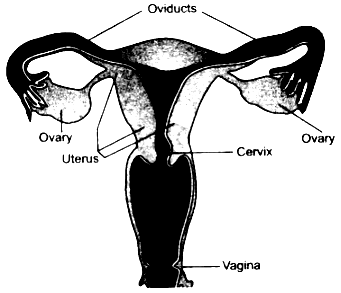
The adjoining figure represents the female reproductive organ of the humans

(i) How does the human embryo developing in the uterus obtain its nourishment?
(ii) Which structure protects and nourishes the developing embryo?
(iii) Define ovulation.
Answer
(i) The fetus gets its nourishment from the mother’s blood through the placenta.
(ii) Uterus.
(iii) The process by which the ova is released from the ovary.
View full question & answer
Question 272 Marks
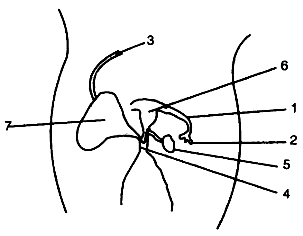
The below diagram represents the sectional view of the female reproductive organs of a mammal.
(i) Label the parts numbered 1 to 7.
(ii) What are the main functions of the parts labeled 2, 5, 6?
Answer
(i)
(1) Fallopian tube
(2) Fimbriated funnel
(3) Ureter
(4) Vagina
(5) Ovary
(6) Uterus
(7) Urinary bladder
(ii)
2 - Funnel. It collects ovum by us ciliary movement.
5-Ovary. It produces ovum.
6-Uterus. It lodges and nourishes ovum.
View full question & answer
Question 282 Marks
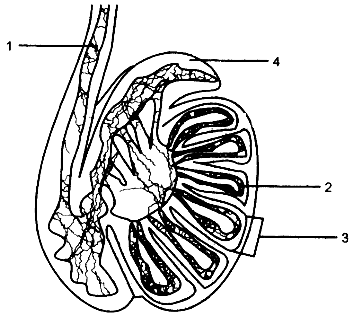
The diagram shown below is the lateral section of the testis of man. Study it carefully and answer the questions that follow:
(i) Label the part I to 4 of the diagram.
(ii) State the functions of the parts labeled 1 and 2.
Answer
(i)
(1) Sperm Duct
(2) Seminiferous Tubule
(3) Lobes of Testis
(4) Epididymis.

(ii) The function of Sperm Duct: It carries sperms from testis to urethra.
The function of Seminiferous tubule: Here sperms are produced.
View full question & answer
Question 292 Marks
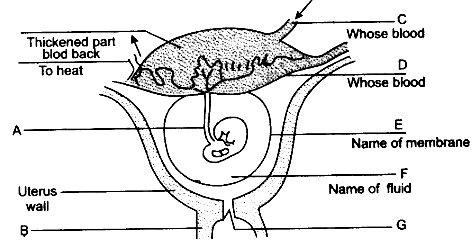
The diagram given below shows an embryo in the uterus of mammal. Label the parts indicated.
Answer
A – Umbilical cord
B-Cervix
C-Blood of mother flows into placenta
D-Blood of fetus flows into placenta E-Amnion
F-Amniotic fluid
G-Opening of the cervix
View full question & answer
Question 302 Marks
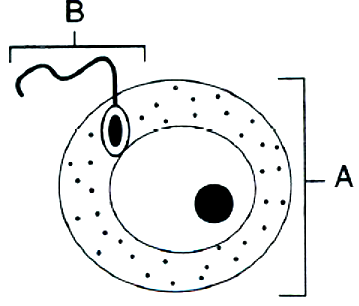
The diagram below represents two reproductive cells A and B. Study the same and then answer the question that follow:
Name an accessory gland found in the male reproductive system and state its secretion.
Answer
Accessory glands:
  • Seminal vesicle - Seminal fluid
  • Prostate gland - Alkaline secretion
  • Bulbo-urethral gland - Lubricant
View full question & answer
[2 Mark Question Answer] - Biology STD 10 Questions - Vidyadip